
Reports
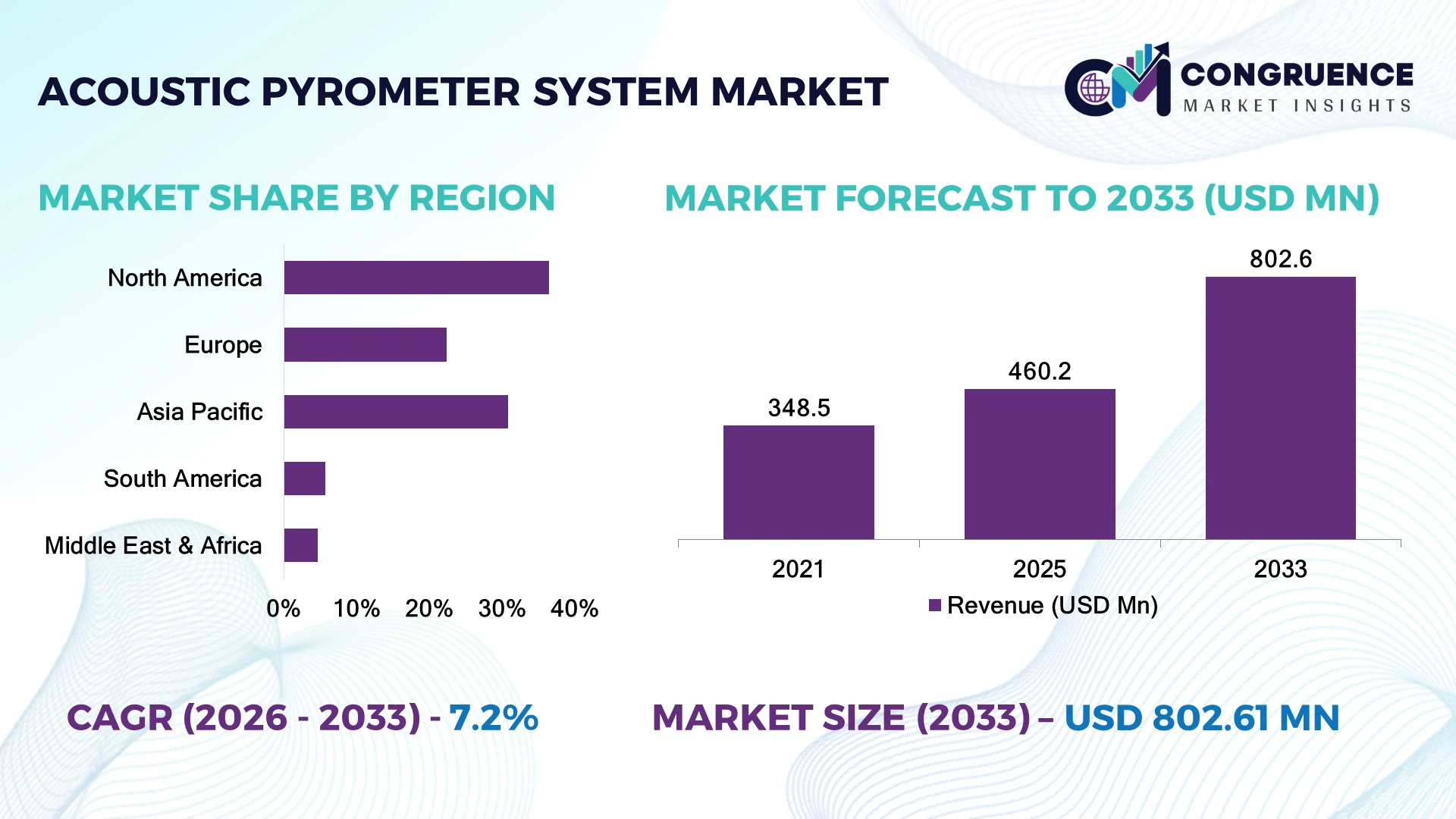
The Global Acoustic Pyrometer System Market was valued at USD 460.2 Million in 2025 and is anticipated to reach a value of USD 802.6 Million by 2033 expanding at a CAGR of 7.2% between 2026 and 2033. Growth is driven by stricter combustion efficiency targets, digital boiler optimization programs, and increasing deployment of real-time furnace temperature monitoring across power generation, cement, steel, and waste-to-energy facilities.
China dominates the market with approximately 31% of global thermal power generation capacity and sustained investment in ultra-supercritical power plants, steel production, and industrial digitalization. More than 65% of newly modernized large combustion facilities integrate advanced furnace monitoring technologies, compared with approximately 47% across India. Continued energy security initiatives following global fuel supply disruptions have accelerated combustion optimization and emissions-control investments.
Manufacturers prioritizing intelligent temperature diagnostics, predictive combustion control, and industrial digital integration will strengthen long-term competitiveness in process-intensive industries.
Market Size & Growth: USD 460.2 Million in 2025 reaching USD 802.6 Million by 2033 at 7.2% CAGR, driven by combustion optimization and industrial digitalization.
Top Growth Drivers: Boiler modernization 41%, emission compliance 36%, predictive maintenance adoption 29%.
Short-Term Forecast: By 2028, furnace efficiency improves 14% while fuel consumption declines 9% through advanced monitoring.
Emerging Technologies: AI analytics, Industrial IoT, and digital twins improve combustion visibility and process control.
Regional Leaders: Asia-Pacific, Europe, and North America lead deployment through power plant modernization and industrial automation.
Consumer/End-User Trends: Nearly 58% of large thermal facilities prioritize continuous temperature mapping solutions.
Pilot/Case Example: 2026 boiler optimization projects reduced combustion imbalance by approximately 18%.
Competitive Landscape: Leading suppliers collectively control nearly 46% of advanced acoustic pyrometer installations.
Regulatory & ESG Impact: Continuous monitoring reduces excess fuel usage by around 10% while supporting emissions compliance.
Investment & Funding: More than USD 650 Million supports industrial digital upgrades and combustion efficiency projects.
Innovation & Future Outlook: AI-enabled diagnostics and cloud-connected monitoring are redefining intelligent furnace management.
The Acoustic Pyrometer System Market is expanding through increasing demand from thermal power plants, steel mills, cement kilns, and waste-to-energy facilities requiring continuous furnace temperature measurement. AI-assisted combustion optimization and predictive analytics improve thermal efficiency by nearly 15%, while wireless industrial connectivity simplifies deployment across existing plants. Growing investment in industrial decarbonization and operational efficiency is accelerating intelligent furnace monitoring, setting the stage for broader strategic transformation.
The acoustic pyrometer system market has become strategically important because industrial operators increasingly compete through energy efficiency, process stability, and emissions performance rather than production capacity alone. Modernization of thermal power stations, cement kilns, and steel furnaces is accelerating investment in continuous temperature profiling as industries strengthen digital operations and optimize fuel utilization under stricter environmental standards.
Advanced acoustic pyrometers provide complete furnace temperature mapping without direct sensor exposure, improving measurement coverage by approximately 30% compared with conventional point-based thermocouples while reducing maintenance requirements by nearly 25%. China leads large-scale deployment through extensive thermal infrastructure modernization, whereas Germany emphasizes intelligent combustion control integrated with Industry 4.0 manufacturing. During the next two to three years, digital combustion optimization platforms are expected to become standard in major industrial combustion facilities.
Industrial operators increasingly integrate acoustic pyrometers with distributed control systems, predictive maintenance software, and AI-driven combustion analytics to improve boiler performance and reduce operating costs. Equipment suppliers are expanding engineering partnerships, strengthening industrial software integration, and developing modular retrofit solutions for existing plants. Organizations combining accurate thermal diagnostics, seamless automation integration, and lifecycle technical support will secure stronger competitive positioning as industrial process optimization becomes increasingly data driven.
Thermal power plants, cement kilns, and steel furnaces are prioritizing continuous furnace temperature mapping to improve combustion efficiency and reduce operating costs. More than 57% of newly modernized combustion facilities incorporate advanced temperature monitoring, while optimized furnace profiling improves heat distribution by approximately 16% and lowers fuel consumption by nearly 10%. China continues expanding ultra-supercritical thermal power capacity alongside digital plant modernization, increasing demand for non-contact acoustic measurement technologies. This operational shift enhances combustion stability, minimizes hotspot formation, and supports emissions compliance. Equipment manufacturers are responding through AI-enabled diagnostics, strategic automation partnerships, and expanded engineering services that integrate acoustic pyrometers with plant-wide control systems for real-time optimization.
System installation remains constrained by complex integration with existing distributed control systems and the high cost of industrial-grade acoustic sensing hardware. Signal processing electronics and specialized transducers account for nearly 30% of project expenditure, while engineering and commissioning activities increase installation costs by approximately 18%. India and several emerging manufacturing economies continue operating older combustion assets that require customized retrofit engineering, extending deployment schedules. These constraints reduce modernization speed and affect return on investment for smaller industrial operators. Suppliers are addressing the challenge through standardized communication protocols, localized engineering support, modular retrofit packages, and long-term maintenance agreements that lower lifecycle costs and improve implementation efficiency.
Industrial operators are increasingly adopting intelligent combustion platforms that combine acoustic pyrometers with machine learning and digital twins for autonomous process optimization. AI-assisted furnace analytics improve combustion efficiency by approximately 15%, while predictive maintenance reduces unexpected shutdowns by nearly 22%. Japan is expanding smart manufacturing initiatives that integrate industrial IoT across high-temperature processing industries, creating demand for advanced diagnostic solutions. Equipment providers are investing in cloud-based analytics, software partnerships, and scalable monitoring platforms supporting remote performance optimization. A valuable emerging opportunity lies in retrofitting existing thermal plants with digital combustion intelligence, allowing operators to improve energy performance without replacing primary combustion equipment.
Successful deployment increasingly depends on seamless integration between acoustic pyrometer systems, plant automation software, and enterprise data platforms. Nearly 35% of modernization projects require customized software interfaces, while integration activities extend commissioning schedules by approximately 20% within legacy industrial facilities. United States industrial plants upgrading aging distributed control systems frequently encounter interoperability challenges that limit real-time data utilization. These implementation barriers reduce operational consistency and delay digital transformation objectives. Manufacturers must strengthen cybersecurity, expand software engineering expertise, develop open-platform architectures, and collaborate with industrial automation vendors to ensure secure, scalable, and future-ready combustion monitoring ecosystems.
AI-driven combustion optimization Industrial operators increasingly combine acoustic pyrometers with AI analytics to optimize combustion in real time. Temperature profiling accuracy has improved by approximately 18%, while fuel consumption decreases nearly 10%. Companies are integrating predictive algorithms into plant control systems to enhance efficiency, stabilize furnace performance, and reduce operational variability.
Digital retrofit modernization Existing thermal facilities increasingly deploy retrofit acoustic pyrometer systems instead of replacing complete combustion infrastructure. Retrofit activity has increased by approximately 24%, while installation time has declined nearly 15% through modular system architecture. Equipment suppliers are expanding engineering partnerships to accelerate modernization across aging industrial assets.
Cloud-connected furnace monitoring Industrial facilities are adopting cloud-enabled monitoring platforms that provide continuous furnace visualization and remote diagnostics. More than 48% of new installations support secure industrial connectivity, reducing maintenance response times by approximately 20%. Companies are expanding digital service portfolios to deliver performance optimization through real-time operational analytics.
Multi-industry deployment expansion Acoustic pyrometer applications are rapidly extending beyond thermal power into cement, steel, waste-to-energy, and petrochemical facilities. Cross-industry deployment has expanded by approximately 21%, while optimized temperature mapping improves process consistency by nearly 14%. Suppliers are developing configurable monitoring platforms supporting diverse combustion environments through scalable software, advanced sensing technologies, and integrated industrial automation.
Fixed acoustic pyrometer systems accounted for approximately 62% of the market in 2025, maintaining leadership through permanent deployment across utility boilers, cement kilns, waste-to-energy plants, and steel furnaces. Their dominance is supported by continuous real-time furnace temperature mapping, seamless integration with distributed control systems, lower maintenance frequency, and dependable performance under extreme operating conditions. Portable acoustic pyrometer systems remain important for maintenance, commissioning, and temporary diagnostics where operational flexibility is required. Multi-point acoustic pyrometer systems represent the fastest-growing category, accounting for nearly 18% of new deployments as industrial operators increasingly require three-dimensional furnace profiling to improve combustion precision and reduce localized overheating.
Equipment manufacturers are expanding intelligent monitoring portfolios through advanced sensor arrays, AI-assisted signal processing, and integrated combustion optimization software. Around 41% of newly commissioned thermal power projects now specify permanent acoustic temperature monitoring during plant engineering, while investment priorities increasingly favor multi-point digital systems that deliver measurable fuel savings, lower emissions, and improved process stability without interrupting plant operations.
According to a 2026 assessment by a leading international power engineering association, integrated furnace temperature mapping has become a standard specification across modern utility boiler modernization programs to improve combustion stability and operational efficiency.
Power generation represented approximately 46% of global demand in 2025 as thermal utilities increasingly deployed acoustic pyrometer systems to optimize combustion, improve boiler efficiency, and maintain emission compliance. Continuous furnace temperature monitoring enables accurate burner balancing and stable heat distribution across coal, biomass, and waste-fired facilities. Cement manufacturing is the fastest-growing application, supported by accelerating kiln modernization and alternative fuel adoption. Steel manufacturing, petrochemical processing, and waste-to-energy facilities continue expanding deployment as precise thermal profiling becomes operationally critical for productivity, product quality, and energy optimization.
Industrial operators are integrating acoustic pyrometry with combustion analytics, predictive maintenance platforms, and advanced process automation to improve furnace performance. Nearly 34% of industrial furnace modernization projects now incorporate advanced temperature monitoring technologies, while combustion optimization initiatives have lowered localized thermal deviations by approximately 15% in high-capacity industrial plants. Suppliers continue expanding turnkey automation capabilities and digital service partnerships to strengthen long-term customer engagement.
A 2025 industrial furnace modernization study released by a recognized engineering institution reported that integrated furnace temperature monitoring has become one of the highest-priority investments for combustion-intensive manufacturing facilities pursuing operational efficiency.
Electric utilities accounted for nearly 48% of market demand in 2025 due to extensive deployment across thermal power stations requiring continuous furnace monitoring and combustion optimization. Large-scale utilities prioritize acoustic pyrometer systems to improve boiler efficiency, extend equipment life, and maintain emission compliance under increasingly stringent operating standards. Cement manufacturers represent the fastest-growing end-user segment as kiln modernization accelerates alongside alternative fuel adoption. Steel producers remain major purchasers because blast furnace and reheating furnace temperature consistency directly affects product quality. Chemical manufacturers, waste-to-energy operators, and industrial engineering service providers continue expanding procurement as digital plant optimization becomes an operational priority.
Suppliers increasingly tailor software analytics, maintenance contracts, and customized installation packages for different industrial environments. Approximately 39% of new utility modernization projects now integrate advanced combustion diagnostics, while nearly 27% of industrial buyers prioritize predictive monitoring capabilities during procurement. Strategic partnerships between instrumentation providers and automation integrators are strengthening competitive positioning across large industrial accounts.
According to a 2026 enterprise survey conducted by a recognized industrial automation organization, more than one-third of combustion-intensive industrial facilities identified advanced furnace temperature monitoring as a priority investment supporting efficiency improvement and emission optimization.
North America accounted for the largest market share at 36.4% in 2025 however, Asia-Pacific is expected to register the fastest growth, expanding at a CAGR of 8.5% between 2026 and 2033.

Industrial boiler modernization accelerates intelligent combustion monitoring
North America maintains market leadership through extensive deployment across utility power plants, cement production facilities, petrochemical complexes, and waste-to-energy plants. Nearly 44% of installed acoustic pyrometer systems in the region are integrated with advanced distributed control systems to enable continuous furnace optimization and emission management. Growing investment in thermal asset modernization, stricter operational efficiency targets, and predictive maintenance strategies continue strengthening demand. Equipment suppliers are expanding digital diagnostics, remote monitoring platforms, and lifecycle service agreements while collaborating with automation companies to deliver integrated combustion optimization. Large-scale retrofit projects across aging industrial facilities further reinforce deployment as operators prioritize lower fuel consumption, stable heat distribution, and longer equipment operating life.
United States Market Outlook:
The United States leads regional deployment through its extensive fleet of thermal power stations, cement manufacturing plants, and refinery operations requiring continuous furnace temperature monitoring. More than 58% of utility boiler modernization programs now include advanced combustion diagnostics and intelligent thermal measurement systems. Industrial operators continue integrating acoustic pyrometers with AI-enabled process optimization platforms to improve furnace efficiency, reduce maintenance intervals, and strengthen regulatory compliance across energy-intensive manufacturing operations.
Decarbonization policies reshape industrial furnace monitoring
Europe is strengthening demand through industrial decarbonization initiatives, high-efficiency combustion systems, and modernization of steel, cement, and biomass power facilities. Approximately 31% of regional demand originates from process industries upgrading combustion control to improve energy efficiency and reduce emissions. Industrial operators increasingly combine acoustic pyrometry with digital twins and predictive maintenance software for real-time furnace optimization. Equipment suppliers are expanding engineering partnerships and customized retrofit solutions as industrial facilities replace legacy thermal monitoring technologies with integrated intelligent measurement platforms.
Germany Market Outlook:
Germany remains the region's largest market because of its advanced steel, cement, and industrial manufacturing base supported by strong automation adoption. Nearly 46% of major furnace modernization projects incorporate intelligent combustion monitoring solutions to improve operational stability and energy utilization. Domestic engineering companies continue investing in integrated thermal management technologies that support efficient production while meeting increasingly demanding industrial environmental standards.
Industrial expansion drives large-scale deployment
Asia-Pacific represents the fastest-expanding market as rapid industrialization, expanding thermal generation capacity, and large-scale cement production accelerate demand for advanced furnace monitoring. The region accounts for approximately 47% of global cement production capacity, creating sustained opportunities for combustion optimization technologies. Industrial enterprises increasingly deploy acoustic pyrometer systems within smart manufacturing environments to improve fuel efficiency and process consistency. Equipment manufacturers continue strengthening regional production, engineering support, and local partnerships to address rising demand from utilities, steel producers, and heavy manufacturing facilities.
China Market Outlook:
China dominates regional demand through its extensive thermal power infrastructure, steel production capacity, and cement manufacturing industry. More than 55% of newly upgraded industrial furnaces now incorporate intelligent monitoring technologies that support digital plant management. Domestic manufacturers continue expanding automation capabilities while integrating acoustic pyrometry with industrial control platforms to improve combustion efficiency, equipment reliability, and large-scale production performance.
Mining and industrial modernization stimulate demand
South America is experiencing steady market expansion through modernization of mining operations, cement manufacturing facilities, biomass energy projects, and industrial boiler infrastructure. Approximately 28% of regional demand is generated by mining and mineral processing industries requiring accurate thermal process control. Industrial operators are gradually replacing conventional measurement equipment with advanced acoustic monitoring systems to improve combustion consistency and reduce operating costs. International technology providers continue expanding local engineering support and maintenance partnerships to strengthen long-term deployment across industrial facilities.
Brazil Market Outlook:
Brazil represents the largest regional market due to its diversified industrial manufacturing sector, integrated steel plants, cement production capacity, and expanding biomass energy infrastructure. Around 35% of large industrial combustion upgrades include digital furnace monitoring technologies supporting operational optimization. Industrial companies continue prioritizing process automation investments that improve production reliability while lowering maintenance requirements across energy-intensive facilities.
Energy diversification supports industrial automation
The Middle East & Africa market is advancing through refinery modernization, industrial diversification, expanding cement production, and investment in high-efficiency thermal infrastructure. Approximately 24% of new combustion optimization projects across heavy industries now incorporate advanced thermal monitoring systems to improve operational stability. Industrial operators increasingly deploy acoustic pyrometers alongside digital automation platforms to maximize fuel utilization and reduce unplanned shutdowns. Technology suppliers continue strengthening regional engineering partnerships, commissioning services, and long-term maintenance capabilities to support industrial transformation initiatives.
Saudi Arabia Market Outlook:
Saudi Arabia leads regional demand through major investments in petrochemical processing, power generation, cement manufacturing, and industrial diversification initiatives. Nearly 30% of newly commissioned heavy industrial facilities integrate advanced process monitoring technologies during plant construction. Industrial operators are prioritizing intelligent combustion management solutions that enhance furnace performance, improve operational efficiency, and support the country's long-term industrial modernization strategy.
Global instrumentation specialists including Valmet, AMETEK Land, Fuji Electric, Sintrol, and TECHFAB Systems compete directly against regional combustion-monitoring integrators and industrial automation providers for power, steel, cement, and waste-to-energy projects. The top five participants collectively control approximately 58% of market activity through proprietary sensing technologies, engineering expertise, and long-term service capabilities. Competition centers on measurement accuracy, multi-zone temperature mapping, installation speed, and lifecycle support, with digital diagnostics influencing nearly 42% of procurement decisions while integrated combustion optimization improves operational efficiency by 15–20%. Global suppliers strengthen positions through OEM partnerships, software integration, localized engineering centers, and retrofit-focused product portfolios, whereas regional firms compete with faster customization and lower implementation costs. The competitive shift favors AI-enabled furnace analytics, predictive maintenance, and vertically integrated combustion solutions over standalone monitoring hardware. High engineering validation requirements, industrial certification, and process-specific application expertise remain significant entry barriers. Winning requires proven measurement reliability, seamless automation integration, responsive field service, and measurable combustion optimization outcomes.
Valmet
AMETEK Land
Fuji Electric Co., Ltd.
Sintrol Oy
TECHFAB Systems
Lias Industrial
Lucent Marcons
SEI Spain
Fives Group
Yokogawa Electric Corporation
ABB Ltd.
Emerson Electric Co.
Acoustic pyrometer systems are evolving toward intelligent multi-point temperature mapping integrated with distributed control systems, digital twins, and predictive maintenance platforms. Approximately 48% of newly installed systems now support real-time furnace visualization, while advanced digital signal processing improves measurement stability by nearly 18% in high-dust combustion environments. Industrial facilities increasingly combine acoustic sensing with combustion optimization software to improve heat distribution and reduce unplanned shutdowns.
Emerging technologies include AI-assisted temperature field reconstruction, edge analytics, and cloud-enabled asset monitoring. Compared with conventional thermocouple-based monitoring, modern acoustic pyrometers improve furnace-wide temperature visibility by about 35% while reducing maintenance interventions by nearly 22% because measurements remain completely non-contact. Around 41% of new deployments are integrated directly into plant-wide industrial automation platforms, creating faster operational decisions and improved combustion consistency. Global engineering suppliers benefit most through integrated software ecosystems, while specialized regional providers compete through customized retrofit packages and application-specific engineering.
Between 2026 and 2028, intelligent combustion optimization will become the primary competitive differentiator as industrial operators prioritize autonomous furnace control and digital process optimization. Advanced machine learning algorithms will improve abnormal combustion detection by approximately 25%, supporting lower fuel consumption, improved equipment reliability, and greater operational consistency. Companies investing early in integrated analytics, cybersecurity, and lifecycle digital services will establish stronger long-term positions across energy-intensive industries.
March 2024 Teledyne FLIR introduced the Si2-Series acoustic imaging platform featuring enterprise integration and advanced fault diagnostics, delivering up to 30% faster inspection workflows for industrial reliability programs while expanding predictive maintenance capabilities across manufacturing facilities. Source: FLIR
March 2024 Emerson launched the Rosemount SAM42 Acoustic Particle Monitor for real-time sand detection in oil and gas production, improving erosion monitoring sensitivity and enabling continuous production optimization through non-intrusive measurement technology. Source: Emerson
June 2025 AMETEK Land released the VDT+ non-contact thermometer with upgraded signal processing and measurement repeatability below 1°C, enhancing temperature control for demanding industrial processes while reducing configuration complexity. Source: AMETEK Land
May 2024 FLIR and UE Systems established a technology partnership to jointly commercialize ultrasonic inspection and predictive maintenance solutions, expanding industrial condition-monitoring capabilities through integrated acoustic diagnostics. Source: Business Wire
The report provides comprehensive assessment of acoustic pyrometer systems across hardware, software, integrated monitoring solutions, and associated engineering services. It evaluates applications spanning power generation, steel manufacturing, cement production, chemical processing, waste-to-energy facilities, and other high-temperature industrial operations. Analysis covers utilities, industrial manufacturers, EPC contractors, and process industries across North America, Europe, Asia-Pacific, South America, and the Middle East & Africa. More than 25 operational indicators, technology adoption trends, deployment models, and competitive benchmarks are examined to support detailed market evaluation.
The study further analyzes digital combustion optimization, AI-enabled temperature analytics, predictive maintenance integration, industrial automation compatibility, and multi-zone furnace monitoring technologies. It profiles leading technology providers, evaluates deployment maturity across major industrial sectors, and highlights emerging opportunities in retrofit modernization and intelligent process control. The report supports investment planning, product development, expansion strategy, supplier benchmarking, and competitive positioning while outlining expected technology evolution and industrial demand patterns between 2026 and 2033.
| Report Attribute/Metric | Report Details |
|---|---|
|
Market Revenue in 2025 |
USD 460.2 Million |
|
Market Revenue in 2033 |
USD 802.6 Million |
|
CAGR (2026 - 2033) |
7.2% |
|
Base Year |
2025 |
|
Forecast Period |
2026 - 2033 |
|
Historic Period |
2021 - 2025 |
|
Segments Covered |
By Type
By Application
By End-User
|
|
Key Report Deliverable |
Revenue Forecast, Growth Trends, Market Dynamics, Segmental Overview, Regional and Country-wise Analysis, Competition Landscape |
|
Region Covered |
North America, Europe, Asia-Pacific, South America, Middle East, Africa |
|
Key Players Analyzed |
Valmet, AMETEK Land, Fuji Electric Co., Ltd., Sintrol Oy, TECHFAB Systems, Lias Industrial, Lucent Marcons, SEI Spain, Fives Group, Yokogawa Electric Corporation, ABB Ltd., Emerson Electric Co. |
|
Customization & Pricing |
Available on Request (10% Customization is Free) |




