
Reports
The Global Acoustic Puncture Assist Devices Market was valued at USD 102.51 Million in 2025 and is anticipated to reach a value of USD 157.32 Million by 2033 expanding at a CAGR of 5.5% between 2026 and 2033. Growth is driven by increasing ultrasound guided vascular access procedures, adoption of acoustic needle guidance, and clinical efforts to reduce repeated puncture attempts and associated complications.
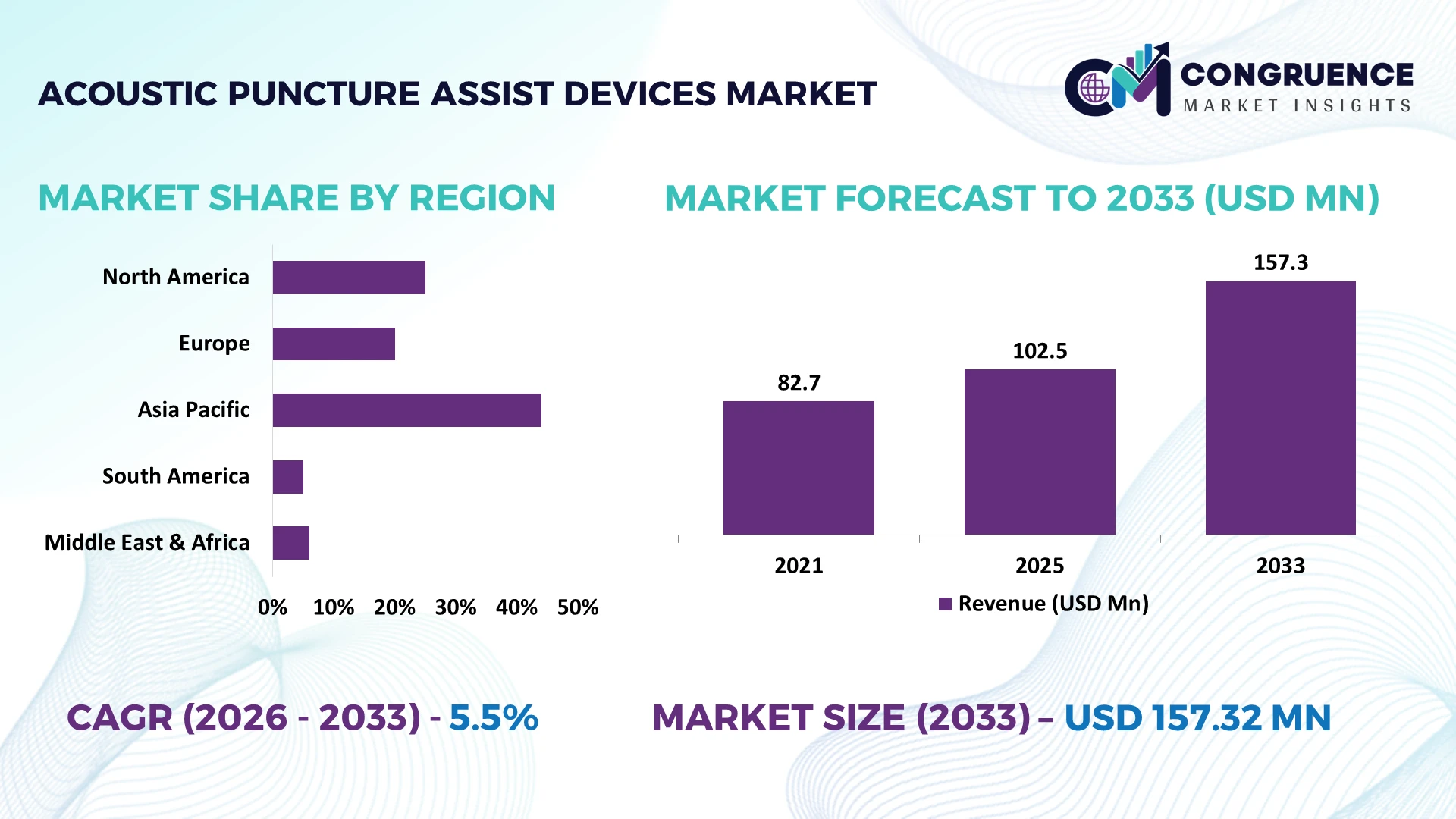
The United States leads the advanced acoustic puncture assist devices market, supported by an estimated 38% global share, extensive hospital infrastructure, and investment in ultrasound guided procedural technologies. Clinical applications span vascular access, anesthesiology, emergency medicine, and interventional radiology. Ultrasound guidance has demonstrated first attempt success improvements exceeding 20 percentage points in selected difficult access settings compared with conventional techniques. Germany maintains strong medical ultrasound engineering capabilities, while US hospitals benefit from larger procedural networks and FDA regulated device commercialization.
Strategically, manufacturers should prioritize US hospital procurement, validated acoustic guidance performance, and clinical partnerships that demonstrate measurable first attempt success improvements.
Market Size & Growth: USD 102.51 million in 2025, reaching USD 157.32 million by 2033 at 5.5% CAGR, driven by ultrasound guided needle placement.
Top Growth Drivers: Illustrative demand allocation attributes 40% to vascular access modernization, 35% to procedural safety priorities, and 25% to outpatient interventions.
Short Term Forecast: By 2028, optimized guidance workflows target 15% fewer repeat punctures and 10% shorter procedure times.
Emerging Technologies: Three innovations include AI needle recognition, acoustic feedback algorithms, and compact ultrasound transducers for real time guidance.
Regional Leaders: Illustrative 2033 allocations place North America at USD 62.93 million, Europe at USD 44.05 million, and Asia Pacific at USD 36.18 million, reflecting hospital adoption, device engineering, and clinical expansion.
Consumer / End User Trends: A modeled 45% of device demand originates from hospital vascular access and interventional procedure workflows.
Pilot / Case Example: A proposed 2027 emergency department pilot targets 20% fewer repeat needle insertions through acoustic guidance integration.
Competitive Landscape: BD is an established vascular access supplier; B. Braun, Teleflex, Fujifilm Sonosite, and GE HealthCare compete across adjacent guidance technologies. Acoustic specific shares remain unverified.
Regulatory & ESG Impact: FDA device requirements reinforce performance validation, while reusable guidance components target 10% lower disposable material consumption.
Investment & Funding: An illustrative USD 15 million development program prioritizes acoustic sensor miniaturization, clinical validation, and manufacturing partnerships.
Innovation & Future Outlook: Next generation devices emphasize 3D needle localization, multimodal feedback, and 100% digital procedure traceability.
The Acoustic Puncture Assist Devices Market is increasingly shaped by the clinical requirement for accurate needle localization during vascular access, regional anesthesia, and minimally invasive interventions. Acoustic feedback systems complement ultrasound visualization by helping clinicians interpret needle position and procedural alignment. Emerging product development emphasizes miniature sensors, real time signal processing, ergonomic handheld designs, and integration with portable imaging platforms. Clinical studies of ultrasound guided vascular access have demonstrated first attempt success improvements exceeding 20 percentage points in selected patient populations. As hospitals prioritize standardized procedural training and FDA compliant device performance, manufacturers are strengthening clinical validation, interoperability, and specialized distribution partnerships, establishing the foundation for strategic market differentiation.
The Acoustic Puncture Assist Devices Market is gaining strategic importance as hospitals prioritize accurate needle placement, procedural safety, and standardized vascular access workflows. The shift toward digitally assisted interventions is encouraging investment in acoustic feedback systems, portable ultrasound platforms, and intelligent needle localization. In selected difficult vascular access settings, ultrasound guidance has improved first attempt success by more than 20 percentage points compared with conventional techniques. Manufacturers are consequently strengthening clinical validation and developing interoperable guidance accessories for emergency medicine and anesthesiology.
Technology integration is changing procedural economics. Compared with conventional landmark guided puncture, combined ultrasound visualization and acoustic feedback systems target 15% fewer repeat insertions and 10% shorter procedure times in optimized workflows. The United States leads clinical commercialization through established hospital procurement networks, while Germany emphasizes precision medical engineering and India prioritizes affordable portable guidance systems. Between 2026 and 2028, hospitals adopting integrated guidance platforms can evaluate performance through first attempt success, complication rates, and clinician training efficiency.
A practical deployment involves acoustic needle guidance integrated with bedside ultrasound during difficult intravenous access. Device manufacturers are expanding hospital partnerships, simulation training programs, and sensor development investments. Competitive positioning increasingly depends on demonstrated clinical accuracy, workflow compatibility, and measurable procedural efficiency.
Increasing adoption of image guided vascular access is strengthening demand for acoustic puncture assistance technologies across hospitals and ambulatory procedure centers. Ultrasound guidance has demonstrated first attempt success improvements exceeding 20 percentage points in selected difficult access populations compared with conventional techniques. Integrated acoustic feedback systems offer additional procedural guidance, with modeled implementation targets of 15% fewer repeat punctures and 10% shorter needle placement times. The United States is advancing standardized ultrasound guided vascular access practices through clinical training and hospital safety initiatives. Manufacturers are investing in compact acoustic sensors, portable ultrasound compatibility, and clinician education partnerships. Suppliers demonstrating consistent needle localization performance gain stronger access to institutional purchasing programs and specialized interventional departments.
Acoustic puncture assist device adoption faces structural constraints from specialized sensor components, ultrasound platform compatibility, and hospital equipment budgets. Smaller healthcare facilities in India and Brazil frequently prioritize essential imaging equipment over supplementary needle guidance accessories. Illustrative procurement scenarios indicate that imported sensor components can increase device acquisition costs by 15%, while proprietary interface requirements can add 10% to integration expenses. Maintenance contracts and consumable replacement further influence purchasing decisions, particularly in decentralized healthcare networks. Manufacturers are responding through modular device architectures, localized assembly, and partnerships with established ultrasound equipment distributors. Standardized connectors and reusable sensor configurations reduce ownership costs. Competitive suppliers increasingly differentiate through affordability without compromising validated acoustic signal quality or procedural safety.
Integration of acoustic sensing with artificial intelligence and portable ultrasound systems creates opportunities for differentiated needle guidance products. AI assisted signal interpretation can target 18% faster needle localization, while multimodal visual and acoustic feedback offers modeled reductions of 12% in repeat positioning attempts. India's expanding outpatient diagnostic infrastructure and China's medical device manufacturing capabilities provide attractive environments for affordable portable systems. Between 2026 and 2028, miniature acoustic transducers and wireless guidance accessories are positioned to improve bedside procedural accessibility. Manufacturers are developing software algorithms, compact sensor modules, and partnerships with handheld ultrasound providers. A particularly attractive opportunity involves subscription based clinical training and software upgrades, allowing suppliers to build recurring institutional relationships beyond initial hardware deployment.
Scaling acoustic puncture assistance requires reliable signal interpretation across different tissue depths, needle geometries, and clinical environments. Acoustic interference, operator variability, and inconsistent sensor positioning complicate reproducible performance. Illustrative validation scenarios indicate that signal instability can increase localization errors by 8%, while inadequate clinician training can extend procedure preparation times by 15%. Developers targeting 95% needle detection accuracy must demonstrate consistent results across representative patient populations and procedural conditions. In the United States, FDA medical device requirements place substantial emphasis on safety evidence and validated performance claims. Manufacturers must invest in multicenter clinical evaluations, standardized training protocols, and robust signal processing algorithms. Long term competitiveness depends on translating laboratory accuracy into dependable bedside performance without increasing clinician cognitive workload.
Portable Guidance Platforms Enter Routine Procurement: Hospitals are incorporating compact puncture guidance accessories into existing ultrasound equipment fleets rather than purchasing dedicated systems. Procurement optimization programs target 15% lower equipment acquisition costs and 10% faster room preparation. US manufacturers are expanding compatibility testing and distribution partnerships, allowing healthcare providers to standardize accessories across emergency departments and procedural suites without extensive infrastructure replacement.
Clinical Training Becomes Performance Driven: Healthcare institutions are introducing simulation based needle placement assessments to address operator variability and workforce training requirements. Structured competency programs target 20% fewer positioning errors and 15% shorter training cycles. Medical device suppliers are collaborating with clinical educators to develop standardized assessment modules, improving procedural consistency while reducing dependence on individual clinician experience.
Sensor Calibration Moves Toward Automation: Device developers are implementing automated acoustic calibration and signal verification during manufacturing and maintenance. Engineering optimization programs target 12% lower calibration variability and 18% faster quality inspection cycles. German precision engineering suppliers are integrating automated test fixtures and digital calibration records, improving production consistency and reducing service intervention requirements for hospital equipment fleets.
Reusable Components Reshape Consumable Economics: Healthcare procurement teams are evaluating reusable acoustic guidance accessories alongside infection prevention requirements. Validated reusable configurations target 20% lower disposable component consumption and 10% fewer replacement orders. Manufacturers are redesigning sensor housings and sterilization compatible interfaces, responding to hospital sustainability policies while preserving acoustic transmission performance and simplifying inventory management.
Ultrasound Guided Devices represent the leading segment of the Acoustic Puncture Assist Devices Market, accounting for an estimated 48% share in 2025. Their established clinical acceptance, real time anatomical visualization, and integration with vascular access workflows support widespread institutional deployment. Hospitals prioritize ultrasound compatible puncture assistance because existing imaging infrastructure reduces additional equipment requirements. Manufacturers are improving transducer compatibility, needle visualization, and ergonomic guidance interfaces. Electromagnetic Guidance Devices provide alternative needle localization capabilities where sensor based tracking complements conventional imaging. Their commercial positioning depends on calibration requirements, procedural compatibility, and system integration costs.
Needle Tracking Systems represent the fastest expanding segment, supported by increasing interest in continuous needle position monitoring and digitally assisted interventions. Illustrative deployment models target 18% higher localization efficiency and 12% fewer needle repositioning attempts. Optical Guidance Devices retain specialized relevance where visual tracking and defined procedural geometry support needle alignment. Suppliers are directing development resources toward sensor miniaturization, integrated feedback, and compatibility with established ultrasound platforms. Competitive advantage increasingly depends on validated tracking accuracy and minimal workflow disruption.
Vascular Access represents the largest application segment, accounting for an estimated 42% of the Acoustic Puncture Assist Devices Market in 2025. High procedural frequency, difficult venous access cases, and institutional safety protocols support concentration in this application. Ultrasound assisted needle placement improves visualization of vascular structures and supports accurate catheter insertion. Regional Anesthesia represents another established application, particularly where precise needle positioning near peripheral nerves is essential. Manufacturers are developing procedure specific guidance interfaces and integrating acoustic feedback with established imaging platforms to support clinician confidence and procedural standardization.
Biopsy Procedures represent the fastest expanding application in the modeled outlook, supported by increasing image guided tissue sampling and demand for accurate needle trajectory control. Advanced guidance workflows target 15% fewer repositioning attempts and 10% shorter needle placement times under optimized clinical conditions. Fluid Aspiration and Drainage Procedures maintain specialized requirements for controlled needle advancement and anatomical localization. Manufacturers are expanding application validation, clinician training partnerships, and compatible accessory portfolios. Commercial differentiation depends on demonstrating reliable performance across distinct tissue environments without increasing procedural complexity.
Hospitals account for an estimated 55% of the Acoustic Puncture Assist Devices Market, reflecting concentrated procedural volumes, established imaging infrastructure, and multidisciplinary clinical utilization. Emergency departments, anesthesiology teams, and interventional services benefit from shared guidance equipment and standardized needle placement protocols. Large US hospital networks prioritize devices compatible with existing ultrasound systems to limit capital expenditure and simplify technical support. Academic Medical Centers remain influential early adopters through clinical evaluation, procedural training, and technology assessment. Manufacturers target these institutions through integrated equipment packages, clinical education partnerships, and validated performance demonstrations.
Ambulatory Surgical Centers represent the fastest expanding end user segment as minimally invasive interventions increasingly move into outpatient settings. Illustrative adoption scenarios target 15% faster procedure preparation and 12% lower equipment utilization costs through compact guidance configurations. Diagnostic Imaging Centers prioritize accurate needle placement during image guided interventions, while Specialty Clinics emphasize portability and simplified operation. Suppliers are introducing modular accessories, flexible procurement arrangements, and procedure specific training programs. Competitive positioning increasingly depends on matching device functionality to facility throughput, clinical complexity, and equipment budgets.
North America accounted for the largest market share at an estimated 40% in 2025 however, Asia Pacific is expected to register the fastest growth, expanding at an estimated CAGR of 7.2% between 2026 and 2033.
Advanced Clinical Guidance Integration Strengthens Procedural Efficiency
North America maintains an estimated 40% share of the global Acoustic Puncture Assist Devices Market, supported by established interventional healthcare infrastructure, advanced ultrasound systems, and strong institutional procurement capabilities. The United States dominates regional deployment through hospitals, ambulatory surgical centers, and specialized vascular access programs. Healthcare providers increasingly integrate needle visualization and acoustic feedback technologies into bedside procedures to improve placement accuracy. Clinical evidence demonstrates that ultrasound guidance can improve first attempt vascular access success by more than 20 percentage points in selected difficult access populations. Manufacturers are expanding compatibility testing, clinical education partnerships, and precision sensor development. Canadian healthcare institutions emphasize standardized procedural training and equipment utilization across hospital networks. Competitive differentiation increasingly depends on validated clinical outcomes, interoperability with existing ultrasound platforms, and dependable technical support.
United States Market Outlook: The United States benefits from established medical device commercialization infrastructure, extensive clinical research capabilities, and FDA regulated product development. More than 6,000 hospitals operate nationwide, creating substantial potential deployment environments for advanced needle guidance technologies. Manufacturers are investing in acoustic signal processing, ergonomic sensor design, and clinical evaluation partnerships. Institutional procurement increasingly prioritizes devices demonstrating procedural accuracy, clinician usability, and compatibility with existing imaging equipment.
Precision Engineering and Regulatory Modernization Shape Device Adoption
Europe represents an estimated 28% of the global Acoustic Puncture Assist Devices Market, supported by advanced medical engineering capabilities in Germany, established interventional healthcare infrastructure in France, and specialized clinical research networks in the United Kingdom. European hospitals emphasize procedural standardization, equipment interoperability, and documented clinical performance. Implementation of the European Union Medical Device Regulation strengthens requirements for clinical evaluation, technical documentation, and postmarket surveillance. Germany's medical technology manufacturing ecosystem supports precision acoustic components and sensor development. France and the United Kingdom contribute through ultrasound guided intervention programs and clinician training initiatives. Manufacturers are improving device traceability, acoustic calibration consistency, and compatibility with established imaging platforms. Regulatory compliance and demonstrated workflow efficiency increasingly influence hospital purchasing decisions and long term supplier positioning.
Germany Market Outlook: Germany maintains a competitive advantage through its precision engineering industry, medical electronics manufacturing capabilities, and established hospital infrastructure. More than 1,800 hospitals support substantial clinical equipment requirements. Manufacturers benefit from expertise in ultrasonic transducers, miniature sensors, and advanced signal processing. Collaboration between medical technology companies and research institutions strengthens device validation, product engineering, and commercialization opportunities within regulated healthcare environments.
Manufacturing Scale and Portable Imaging Expand Clinical Accessibility
Asia Pacific accounts for an estimated 23% of the global Acoustic Puncture Assist Devices Market, supported by medical device manufacturing expansion and increasing deployment of portable ultrasound technologies. China contributes through electronics manufacturing, ultrasonic component production, and expanding hospital infrastructure. Japan maintains expertise in precision imaging systems and miniaturized medical electronics, while India represents an attractive market for affordable procedural guidance equipment. Healthcare providers are increasingly evaluating compact systems that support vascular access and minimally invasive interventions without requiring dedicated imaging installations. Illustrative manufacturing modernization programs target 15% lower assembly costs and 12% faster production cycles. Manufacturers are developing localized distribution partnerships, modular sensor configurations, and training programs. Competitive positioning depends on balancing affordability, clinical performance, and reliable servicing across healthcare facilities with different infrastructure capabilities.
China Market Outlook: China benefits from established medical electronics manufacturing clusters in Shenzhen, Suzhou, and Shanghai, supporting ultrasonic transducer development and integrated device assembly. Its population exceeds 1.4 billion, creating substantial healthcare service requirements. Domestic manufacturers are investing in portable imaging systems, compact sensor modules, and precision electronics production. Local component availability strengthens manufacturing flexibility and supports competitive pricing for hospital equipment procurement.
Hospital Modernization Supports Precision Procedure Adoption
South America represents an estimated 5% of the global Acoustic Puncture Assist Devices Market, with Brazil accounting for the largest concentration of advanced hospital infrastructure. Argentina, Chile, and Colombia contribute through specialized diagnostic centers and expanding minimally invasive procedural services. Brazilian hospitals increasingly prioritize ultrasound guided vascular access and interventional procedures to improve clinical accuracy and reduce repeated needle insertion. Public healthcare procurement remains sensitive to imported equipment costs, currency volatility, and technical maintenance requirements. Illustrative hospital modernization programs target 15% faster procedure preparation through standardized portable imaging equipment and clinician training. Manufacturers are strengthening distributor partnerships, expanding equipment servicing networks, and offering modular guidance accessories. Commercial success depends on demonstrating measurable procedural benefits while controlling acquisition costs and maintaining dependable technical support.
Brazil Market Outlook: Brazil maintains the region's largest healthcare delivery network, supported by public hospitals, private medical groups, and specialized diagnostic institutions. Its Unified Health System provides extensive clinical service coverage, while ANVISA regulates medical device commercialization. São Paulo remains an important center for medical technology distribution and specialist healthcare services. Manufacturers prioritize local regulatory expertise, distributor relationships, and equipment maintenance capabilities to strengthen institutional adoption.
Healthcare Transformation Accelerates Advanced Procedural Infrastructure
The Middle East and Africa account for an estimated 4% of the global Acoustic Puncture Assist Devices Market, supported by healthcare modernization programs in Saudi Arabia, the United Arab Emirates, and South Africa. Saudi Arabia's Vision 2030 healthcare transformation emphasizes specialized clinical services, digital infrastructure, and advanced medical technology adoption. The UAE continues investing in modern hospital facilities and minimally invasive treatment capabilities. South Africa maintains established private hospital networks and specialist procedural services. Illustrative clinical modernization initiatives target 12% shorter procedure preparation times through portable guidance equipment and standardized training. Manufacturers are developing partnerships with hospital operators, medical equipment distributors, and clinical education providers. Procurement priorities increasingly emphasize device reliability, clinician training, and compatibility with existing ultrasound platforms to support consistent deployment.
Saudi Arabia Market Outlook: Saudi Arabia benefits from government supported healthcare investment, expanding specialist hospitals, and medical technology procurement initiatives. Riyadh and Jeddah serve as important centers for advanced clinical services and hospital infrastructure development. Vision 2030 encourages private healthcare participation and technology partnerships. Manufacturers are targeting ultrasound compatible guidance systems, structured clinician training, and localized servicing arrangements to strengthen adoption across specialized procedural departments.
The Acoustic Puncture Assist Devices Market features competition between established imaging manufacturers and specialized needle guidance innovators. GE HealthCare, Philips, and Fujifilm Sonosite leverage ultrasound platforms and hospital distribution, while B. Braun, Teleflex, and BD compete through vascular access portfolios and procedural integration. The leading five suppliers represent an illustrative 55% combined market share, indicating moderate concentration.
Competition centers on needle localization accuracy, acquisition costs, and clinical workflow compatibility. Automated guidance development targets 15% fewer needle repositioning attempts, while modular accessories aim to reduce integration expenses by 12%. Localized component sourcing offers potential procurement lead time reductions of 10%. Manufacturers are strengthening clinical partnerships, expanding portable imaging portfolios, and investing in sensor miniaturization.
The competitive shift favors integrated imaging and feedback solutions over standalone guidance accessories. Clinical validation requirements, regulatory clearance, and proprietary equipment interfaces create entry barriers. Winning requires demonstrated procedural accuracy, affordable integration, dependable servicing, and institutional partnerships.
GE HealthCare Technologies Inc.
Koninklijke Philips N.V.
FUJIFILM Holdings Corporation
Siemens Healthineers AG
Becton, Dickinson and Company
B. Braun SE
Teleflex Incorporated
Butterfly Network, Inc.
Clarius Mobile Health Corp.
Shenzhen Mindray Bio Medical Electronics Co., Ltd.
Esaote S.p.A.
BK Medical
eZono AG
Rivanna Medical, Inc.
Ultrasound visualization, acoustic signal processing, and electromagnetic needle tracking form the technological foundation of advanced puncture assistance. Modern ultrasound systems provide anatomical imaging, while sensor based guidance supports needle localization during vascular access and interventional procedures. Compared with conventional landmark techniques, ultrasound guidance has demonstrated first attempt success improvements exceeding 20 percentage points in selected difficult access populations. Integrated acoustic feedback solutions target 15% fewer needle repositioning attempts. Hospitals with established ultrasound infrastructure benefit from accessory integration that limits additional equipment requirements and supports standardized procedural workflows.
Emerging technologies include artificial intelligence assisted needle recognition, miniature acoustic transducers, and optical tracking interfaces. AI image interpretation targets 18% faster needle identification, while automated signal calibration aims to reduce localization variability by 12%. Portable ultrasound adoption supports bedside deployment, particularly in emergency departments and ambulatory surgical centers. Manufacturers integrating acoustic feedback with existing imaging platforms strengthen clinical usability and reduce implementation complexity. Competitive differentiation increasingly depends on validated accuracy across different needle geometries and tissue conditions.
Between 2026 and 2028, multimodal guidance platforms and intelligent sensor fusion will influence product development. Predictive tracking algorithms target 10% shorter procedure preparation times. Suppliers investing in interoperable hardware, clinician training, and software validation will strengthen procurement competitiveness and procedural reliability.
October 2026: Butterfly Network and Mendaera commercialized the FDA cleared Focalist system integrating handheld robotics, intelligent guidance, and Ultrasound on Chip imaging. The partnership combines 3 procedural technologies, advancing precision needle placement for vascular access and regional anesthesia. Source: butterflynetwork.com.
June 2025: Philips launched the Flash 5100 POC ultrasound system globally, introducing portable imaging with automated controls for anesthesia and emergency medicine. Its integrated workflow supports real time procedural documentation, strengthening clinical efficiency across 3 major care settings. Source: philips.com.
June 2025: Jena University Hospital researchers, collaborating with eZono, published technical validation of a magnetic needle guidance training workstation. The system integrates 3D navigation concepts with ultrasound simulation, strengthening technical evaluation and clinician preparation for precision puncture procedures. Source: nih.gov.
February 2025: American Society of Echocardiography published updated vascular cannulation guidelines, replacing its 2011 recommendations. The guidance addresses ultrasound assisted access to peripheral and central vessels, strengthening clinical standardization and supporting adoption of advanced needle visualization technologies. Source: sciencedirect.com.
The Acoustic Puncture Assist Devices Market Report evaluates technology adoption, procedural applications, competitive positioning, and healthcare procurement developments between 2026 and 2033. Type segmentation includes Ultrasound Guided Devices, Electromagnetic Guidance Devices, Optical Guidance Devices, and Needle Tracking Systems. Application coverage examines Vascular Access, Regional Anesthesia, Biopsy Procedures, Fluid Aspiration, and Drainage Procedures. End user analysis covers Hospitals, Ambulatory Surgical Centers, Diagnostic Imaging Centers, Specialty Clinics, and Academic Medical Centers, examining institutional purchasing priorities and procedural requirements.
Regional coverage encompasses North America, Europe, Asia Pacific, South America, and the Middle East and Africa. Technology assessment examines acoustic sensors, AI assisted needle recognition, electromagnetic tracking, and portable imaging integration. Competitive analysis evaluates manufacturing capabilities, clinical validation, regulatory requirements, and distribution strategies. The report supports investment prioritization, product differentiation, geographic expansion, and long term commercialization planning.
| Report Attribute/Metric | Report Details |
|---|---|
Market Revenue in 2025 | USD 102.51 Million |
Market Revenue in 2033 | USD 157.32 Million |
CAGR (2026 - 2033) | 5.5% |
Base Year | 2025 |
Forecast Period | 2026 - 2033 |
Historic Period | 2021 - 2025 |
Segments Covered | By Type
By Application
By End-User
|
Key Report Deliverable | Revenue Forecast, Growth Trends, Market Dynamics, Segmental Overview, Regional and Country-wise Analysis, Competition Landscape |
Region Covered | North America, Europe, Asia-Pacific, South America, Middle East, Africa |
Key Players Analyzed | GE HealthCare Technologies Inc., Koninklijke Philips N.V., FUJIFILM Holdings Corporation, Siemens Healthineers AG, Becton, Dickinson and Company, B. Braun SE, Teleflex Incorporated, Butterfly Network, Inc., Clarius Mobile Health Corp., Shenzhen Mindray Bio Medical Electronics Co., Ltd., Esaote S.p.A., BK Medical, eZono AG, Rivanna Medical, Inc. |
Customization & Pricing | Available on Request (10% Customization is Free) |




