
Reports
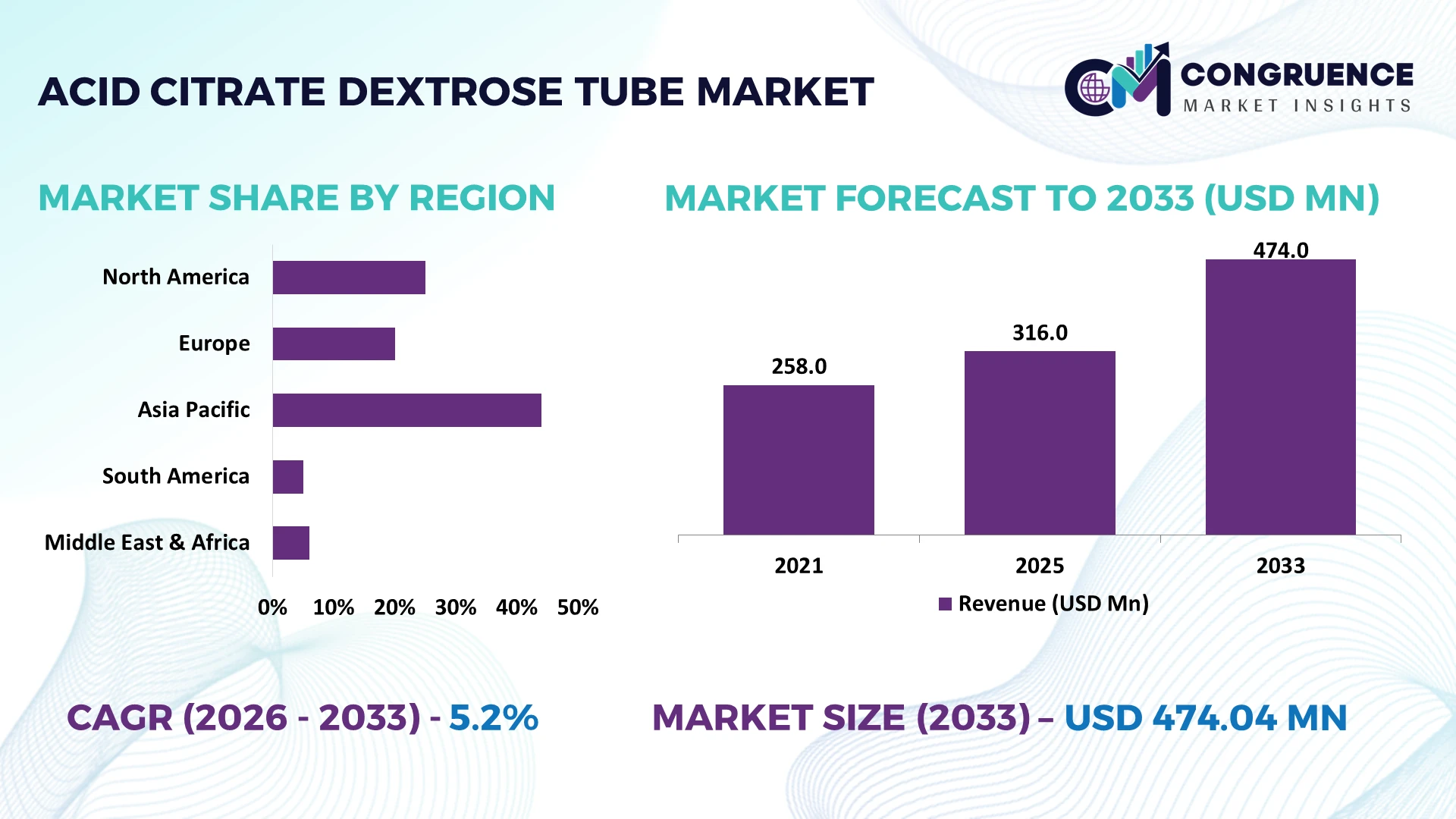
The Global Acid Citrate Dextrose Tube Market was valued at USD 316 Million in 2025 and is anticipated to reach a value of USD 474.037 Million by 2033 expanding at a CAGR of 5.2% between 2026 and 2033. Growth is driven by increasing hematopoietic stem cell transplantation, expanding HLA compatibility testing, and adoption of automated blood collection systems requiring reliable anticoagulant preservation.
The United States dominates the advanced acid citrate dextrose blood collection tube market through its established transplant infrastructure, diagnostic laboratories, and blood banking networks. The country recorded 48,935 organ transplants in 2024, compared with more than 16,000 annual organ transplants in India, demonstrating substantial differences in clinical infrastructure utilization. US laboratories increasingly integrate automated specimen identification, barcode traceability, and standardized ACD solution formulations. FDA oversight of blood collection devices strengthens supplier qualification, while domestic manufacturing investments support procurement resilience and specialized diagnostic applications.
Strategically, manufacturers should prioritize US transplant laboratories and automated specimen workflows, using the 48,935 transplant benchmark and 2033 market expansion to guide capacity planning.
Market Size & Growth: USD 316 million in 2025, reaching USD 474.037 million by 2033 at 5.2% CAGR, supported by transplant compatibility testing.
Top Growth Drivers: Modeled growth contributions include transplant diagnostics at 38%, blood banking modernization at 34%, and specialized molecular testing at 28%.
Short Term Forecast: By 2028, automated specimen handling targets 15% faster processing and 10% fewer identification errors in optimized laboratory workflows.
Emerging Technologies: Three innovations include AI specimen verification, automated tube labeling, and advanced PET tube materials improving collection consistency.
Regional Leaders: Illustrative 2033 allocations place North America at USD 189.615 million, Europe at USD 137.471 million, and Asia Pacific at USD 109.028 million, supported respectively by automation, traceability, and laboratory expansion.
Consumer / End User Trends: An estimated 45% of specialized ACD tube demand is associated with transplant diagnostics and blood banking workflows.
Pilot / Case Example: A proposed 2027 barcode verification pilot targets a 20% reduction in specimen identification errors across participating laboratories.
Competitive Landscape: BD is a prominent supplier; Greiner Bio One, Sarstedt, FL Medical, and Improve Medical compete in specialized collection products. Market shares remain unestablished.
Regulatory & ESG Impact: EU IVDR implementation strengthens traceability requirements, while a proposed 15% packaging reduction target supports laboratory sustainability procurement.
Investment & Funding: An illustrative USD 25 million manufacturing investment scenario prioritizes automated filling, sterile packaging, and regional supplier diversification.
Innovation & Future Outlook: Next generation ACD tubes emphasize 100% barcode traceability, standardized additive volumes, and integrated laboratory information systems.
The Acid Citrate Dextrose Tube Market is increasingly shaped by specialized blood collection requirements across transplant centers, immunogenetics laboratories, hematology facilities, and blood banks. ACD formulations preserve cellular integrity by limiting coagulation, supporting HLA typing, DNA analysis, and cellular testing workflows. Manufacturers are advancing PET collection tubes, precise additive dispensing, automated labeling, and specimen tracking technologies. A modeled 15% improvement in sample processing efficiency provides an operational target for automated laboratories. Against evolving EU diagnostic regulations and healthcare supply chain diversification, product consistency, regulatory compliance, and laboratory integration are becoming decisive strategic priorities for suppliers.
The Acid Citrate Dextrose Tube Market is becoming strategically important as transplant diagnostics, cellular therapies, and specialized blood collection demand greater specimen integrity and traceability. The United States performed 48,935 organ transplants in 2024, reinforcing the importance of reliable HLA typing and compatibility testing. Regulatory modernization, particularly the European Union's In Vitro Diagnostic Regulation, is strengthening documentation and supplier qualification requirements. Manufacturers are consequently prioritizing validated ACD formulations, consistent additive volumes, and automated production processes to protect laboratory contracts.
Technology adoption is reshaping operating economics. Compared with manual labeling, integrated barcode identification and automated specimen tracking can target 15% faster processing and 20% fewer identification errors, subject to workflow validation. US laboratories emphasize high throughput automation, while Indian diagnostic networks prioritize affordable collection systems and expanding testing accessibility. During 2026 to 2028, advanced laboratories are expected to increase investment in traceable consumables and integrated laboratory information systems.
A practical deployment involves integrating prefilled ACD tubes with automated accessioning, barcode verification, and electronic specimen records at transplant laboratories. Suppliers are expanding partnerships with diagnostic equipment manufacturers and strengthening localized distribution. Competitive advantage increasingly depends on validated specimen quality, digital compatibility, and dependable fulfillment rather than collection tube pricing alone.
Increasing transplant procedures and specialized immunogenetics testing are strengthening demand for acid citrate dextrose blood collection tubes. The United States completed 48,935 organ transplants in 2024, while India's expanding transplantation infrastructure supports additional specimen collection requirements. ACD solutions preserve cellular integrity for HLA typing, DNA extraction, and specialized hematological analysis. Automated barcode identification offers modeled reductions of 15% in processing time and 20% in specimen identification errors compared with manual workflows. FDA quality requirements reinforce demand for validated collection devices and consistent anticoagulant formulations. Manufacturers are responding through precision filling equipment, standardized tube configurations, and partnerships with transplant diagnostic laboratories. Reliable specimen performance increasingly determines institutional procurement eligibility and repeat purchasing.
Specialized ACD tube manufacturing faces cost pressure from medical grade polymers, chemical additives, sterile packaging, and validated production processes. Manufacturers sourcing PET resins and collection components internationally remain exposed to procurement fluctuations and shipping disruptions. Illustrative procurement stress scenarios involving 10% polymer price increases and 8% higher packaging expenses demonstrate potential margin pressure. Additional quality control and regulatory documentation can increase modeled production overhead by 12% for smaller suppliers. European IVDR requirements intensify technical documentation and conformity assessment obligations for applicable diagnostic products. Manufacturers are mitigating exposure through localized component sourcing, multiyear procurement contracts, and automated additive dispensing. Suppliers with integrated manufacturing capabilities retain stronger control over product consistency, inventory availability, and institutional pricing.
Integration of advanced ACD collection tubes with automated laboratory workflows creates opportunities beyond conventional consumable supply. India's expanding molecular diagnostics infrastructure and China's investments in clinical laboratory modernization provide attractive deployment environments. Smart labeling, automated additive dispensing, and laboratory information system connectivity can deliver modeled processing efficiency improvements of 18% and specimen handling cost reductions of 12%. Advanced PET tube designs also offer a potential 10% reduction in packaging material consumption through optimized product engineering. Between 2026 and 2028, manufacturers can strengthen competitive positioning through digital traceability partnerships, localized production, and specialized transplant testing portfolios. A particularly attractive opportunity involves supplying validated collection kits bundled with barcode identification and specimen transport solutions, improving laboratory procurement efficiency and supplier retention.
Scaling advanced ACD tube deployment requires consistent specimen preservation across automated analyzers, laboratory information systems, and decentralized collection networks. Compatibility differences between tube dimensions, closure designs, and robotic handling equipment create implementation complexity. Illustrative deployment scenarios indicate that integration defects can increase specimen rejection rates by 5%, while inadequate workforce training can extend processing time by 15%. Maintaining 99.5% barcode readability represents a practical performance target for digitally connected laboratories. India's fragmented diagnostic infrastructure adds operational complexity when collection centers use different equipment generations. Manufacturers must invest in interoperability testing, standardized device specifications, technician training, and digital quality monitoring. Long term competitiveness will depend on maintaining reproducible anticoagulant performance and reliable specimen identification across increasingly automated clinical laboratory networks.
Precision Anticoagulant Filling Gains Importance: Manufacturers are refining automated citrate and dextrose dispensing to improve additive consistency across specialized collection tubes. Production optimization programs target 10% lower filling variability and 12% fewer rejected batches. Automated gravimetric inspection enables continuous verification of fill volumes without relying exclusively on periodic sampling. Suppliers are upgrading filling machinery and process monitoring systems, strengthening product uniformity while reducing quality assurance workloads and manufacturing waste.
Laboratory Procurement Shifts Toward Standardization: Hospital purchasing groups increasingly consolidate specialized blood collection consumables into standardized procurement catalogs. Illustrative consolidation programs target 15% fewer stock keeping units and 8% lower inventory carrying costs. In the United States, hospital networks are aligning tube specifications across affiliated laboratories to simplify ordering and stock rotation. Manufacturers are responding with standardized packaging quantities, centralized distribution agreements, and broader institutional product catalogs, improving contract retention and inventory predictability.
Specimen Transport Stability Receives Greater Attention: Expanding centralized diagnostic networks are increasing scrutiny of sample transport conditions and preanalytical stability. Laboratory validation programs increasingly assess 24 hour specimen handling windows and temperature exposure under defined testing protocols. Optimized packaging and transport procedures target 10% fewer compromised specimens. Suppliers are collaborating with logistics providers and diagnostic networks to establish validated shipping configurations, reducing recollection expenses while supporting consistent testing quality across geographically dispersed collection facilities.
Sustainable Packaging Redesign Accelerates Adoption: Healthcare procurement teams are evaluating packaging efficiency as hospitals strengthen waste reduction policies. Manufacturers are testing secondary packaging redesigns targeting 15% lower material consumption and 10% higher carton utilization. European healthcare sustainability initiatives are encouraging suppliers to document packaging composition and transportation efficiency. Companies are adjusting carton dimensions, material selection, and shipment consolidation practices, lowering logistics burdens without changing validated tube contact materials or anticoagulant formulations.
ACD Solution A Tubes represent the leading formulation segment, with an estimated 42% share of the global Acid Citrate Dextrose Tube Market. Their established use in specialized cellular testing, blood collection, and immunogenetics workflows supports recurring institutional procurement. ACD Solution A contains a higher citrate concentration than ACD Solution B, making formulation selection dependent on validated laboratory protocols rather than interchangeability. Manufacturers prioritize additive precision, consistent fill volumes, and specimen compatibility to protect established laboratory relationships. ACD Solution B Tubes remain important for procedures requiring different anticoagulant formulations and collection ratios, supporting application specific purchasing decisions.
Vacuum Blood Collection Tubes represent the fastest expanding collection format, supported by standardized phlebotomy procedures and compatibility with closed collection systems. An illustrative adoption scenario places vacuum formats at approximately 65% of specialized tube procurement, with automated production improvements targeting 12% lower handling costs. Non Vacuum Blood Collection Tubes retain relevance in controlled specimen transfer and specialized collection procedures. Suppliers are directing investment toward precision vacuum control, closure integrity, and validated tube configurations, strengthening operational consistency and institutional purchasing efficiency.
Blood Component Separation accounts for an estimated 34% of the Acid Citrate Dextrose Tube Market, reflecting the importance of anticoagulated specimens in specialized blood processing and cellular laboratory workflows. Demand concentrates in facilities requiring controlled specimen collection, cellular integrity, and compatibility with downstream separation procedures. Blood Storage remains an established application, although storage duration depends on the validated collection system and intended clinical use. Blood Transfusion applications require strict compatibility with approved collection and processing protocols. Manufacturers prioritize standardized additive concentrations and packaging configurations to support institutional purchasing requirements and reproducible sample handling.
Platelet Collection represents the fastest expanding application in the modeled segment outlook, supported by specialized platelet processing and therapeutic collection procedures. Automated handling programs target 15% shorter processing cycles and 10% fewer manual handling interventions. Coagulation Testing maintains a narrower role because routine coagulation assays generally require sodium citrate tubes rather than ACD formulations. Suppliers are expanding application specific product validation and partnerships with blood processing equipment manufacturers. Competitive positioning increasingly depends on demonstrating specimen compatibility and procedural reliability rather than promoting universal tube interchangeability.
Hospitals represent the largest estimated end user segment, accounting for approximately 38% of the global Acid Citrate Dextrose Tube Market. Their purchasing concentration reflects integrated transplant services, specialized hematology departments, and clinical blood collection infrastructure. Large hospital networks benefit from centralized procurement, standardized consumable specifications, and established specimen management procedures. Blood Banks remain significant institutional buyers for specialized anticoagulated collection and component processing workflows. Manufacturers prioritize long term supply agreements, validated product configurations, and dependable distribution to maintain access to these procurement channels. Hospital purchasing consolidation can target approximately 10% lower inventory management costs through standardized ordering and coordinated replenishment.
Diagnostic Laboratories represent the fastest expanding end user category as specialized molecular testing and immunogenetics services become more accessible. Illustrative workflow modernization programs target 18% higher specimen processing productivity through automated accessioning and integrated tracking. Research Institutes maintain demand for cellular research and laboratory investigations, while Specialty Clinics require smaller volumes of application specific collection products. Suppliers are developing differentiated packaging, flexible order quantities, and technical support partnerships. Future competitive advantage will depend on matching collection formats to institutional workflows while maintaining reliable product availability.
North America accounted for the largest market share at an estimated 40% in 2025 however, Asia Pacific is expected to register the fastest growth, expanding at an estimated CAGR of 7.1% between 2026 and 2033.
Advanced Transplant Infrastructure Strengthens Specialized Collection Demand
North America maintains an estimated 40% share of the global Acid Citrate Dextrose Tube Market, supported by established transplant centers, clinical diagnostic laboratories, and specialized blood collection infrastructure. The United States and Canada demonstrate strong institutional procurement requirements for validated anticoagulant formulations and consistent specimen preservation. Automated laboratory accessioning and electronic sample identification support higher throughput across immunogenetics and hematology facilities. The United States recorded 48,935 organ transplants in 2024, highlighting the scale of its transplant ecosystem. FDA oversight encourages manufacturers to maintain documented quality systems and validated collection device specifications. Regional suppliers are prioritizing automated filling equipment, institutional distribution contracts, and specimen compatibility testing. These investments strengthen procurement reliability while supporting differentiated products for specialized cellular analysis and diagnostic applications.
United States Market Outlook: The United States benefits from extensive clinical laboratory networks, specialized transplantation programs, and established medical device manufacturing capabilities. More than 170 million red blood cell units are transfused globally each year, emphasizing the importance of dependable blood collection infrastructure. US manufacturers are emphasizing precise additive dispensing, validated tube closure systems, and automated packaging to meet institutional purchasing requirements and strengthen domestic supply resilience.
Regulatory Harmonization Reshapes Laboratory Consumable Procurement
Europe represents an estimated 29% of the global Acid Citrate Dextrose Tube Market, supported by established diagnostic infrastructure in Germany, France, the United Kingdom, and Italy. Implementation of the European Union In Vitro Diagnostic Regulation is increasing emphasis on technical documentation, product traceability, and conformity assessment for applicable diagnostic collection devices. Manufacturers are reviewing product classifications and strengthening regulatory documentation to preserve market access. European laboratory networks increasingly prioritize standardized specimen collection procedures and compatible consumables across multiple clinical facilities. Germany and France maintain substantial hospital laboratory infrastructure, supporting recurring demand for specialized anticoagulant collection products. Suppliers are investing in validated manufacturing processes, automated inspection, and packaging optimization. Regulatory readiness and consistent product specifications are becoming important competitive differentiators for manufacturers serving centralized healthcare procurement systems.
Germany Market Outlook: Germany maintains a strong position through its medical technology manufacturing base, hospital diagnostic infrastructure, and established laboratory equipment industry. The country has more than 1,800 hospitals, providing a substantial institutional healthcare network. German suppliers benefit from precision manufacturing capabilities and proximity to European diagnostic equipment producers, supporting specialized collection tube development, technical validation, and integrated laboratory procurement arrangements.
Manufacturing Localization Accelerates Diagnostic Infrastructure Expansion
Asia Pacific accounts for an estimated 23% of the global Acid Citrate Dextrose Tube Market, with China, India, Japan, and South Korea contributing to specialized diagnostic demand. China's established medical consumables manufacturing ecosystem supports domestic production and international distribution of blood collection products. India is expanding transplant services, molecular diagnostic laboratories, and private hospital networks, increasing requirements for standardized anticoagulant collection systems. Japan emphasizes high precision manufacturing and automated clinical laboratory operations. Regional manufacturers are improving production scalability through automated tube assembly, precision additive filling, and localized packaging operations. Illustrative manufacturing modernization programs target 15% higher production efficiency and 10% lower handling costs. Competitive advantages increasingly depend on balancing affordable procurement, validated specimen performance, and dependable distribution across diverse healthcare systems.
China Market Outlook: China benefits from extensive polymer processing capacity, medical consumables manufacturing clusters, and established export distribution networks. Its population exceeds 1.4 billion, creating substantial healthcare service requirements. Manufacturers in Jiangsu, Zhejiang, and Guangdong are positioned to integrate tube molding, additive dispensing, and packaging operations. Domestic production capabilities support shorter procurement cycles and competitive manufacturing economics for specialized blood collection consumables.
Hospital Modernization Supports Specialized Diagnostic Procurement
South America represents an estimated 5% of the global Acid Citrate Dextrose Tube Market, with Brazil accounting for the largest concentration of specialized clinical infrastructure. Argentina, Chile, and Colombia contribute through hospital laboratory modernization and expanding diagnostic service networks. Brazil's transplantation system creates institutional requirements for immunogenetics testing and standardized specimen collection. The Brazilian Association of Organ Transplantation reported more than 9,000 solid organ transplants during 2024, highlighting the operational importance of compatibility testing infrastructure. Regional procurement remains sensitive to imported consumable pricing, currency fluctuations, and distribution availability. Manufacturers are strengthening partnerships with medical distributors and hospital purchasing organizations to improve inventory continuity. Local packaging arrangements and consolidated procurement contracts offer opportunities to reduce supply disruptions while maintaining validated product quality.
Brazil Market Outlook: Brazil maintains the region's most developed transplantation infrastructure, supported by public healthcare institutions, specialized hospitals, and diagnostic laboratories. Its Unified Health System provides a nationwide framework for transplant services and clinical testing. ANVISA regulates medical devices and applicable diagnostic products, requiring suppliers to address registration and quality obligations. Domestic distribution partnerships remain essential for reaching geographically dispersed healthcare facilities.
Healthcare Infrastructure Investment Strengthens Laboratory Modernization
The Middle East and Africa account for an estimated 3% of the global Acid Citrate Dextrose Tube Market, supported by healthcare modernization initiatives in Saudi Arabia, the United Arab Emirates, and South Africa. Saudi Arabia's Vision 2030 healthcare transformation emphasizes service capacity, digital infrastructure, and specialized clinical capabilities. The UAE is investing in advanced hospital facilities and centralized diagnostic services, supporting demand for validated blood collection products. South Africa maintains established laboratory networks serving public and private healthcare institutions. Procurement strategies increasingly emphasize supplier reliability, standardized collection procedures, and temperature controlled distribution where required. Regional suppliers are expanding hospital partnerships and specialized diagnostic product portfolios. Investment priorities include laboratory workforce training, inventory management, and reliable consumable distribution to support consistent specimen handling across developing healthcare networks.
Saudi Arabia Market Outlook: Saudi Arabia benefits from government backed healthcare investment, expanding specialist hospital capacity, and national digital health initiatives. Vision 2030 targets substantial private sector participation in healthcare delivery, encouraging partnerships between hospital operators, diagnostic laboratories, and medical technology suppliers. Riyadh and Jeddah remain important centers for specialized clinical services, creating opportunities for validated ACD tube procurement and laboratory workflow integration.
The Acid Citrate Dextrose Tube Market features competition between established collection system manufacturers and specialized diagnostic consumable suppliers. BD, Greiner Bio One, and Sarstedt compete through automated collection compatibility, manufacturing consistency, and institutional contracts, while FL Medical and Improve Medical emphasize customization and competitive procurement pricing. The leading five suppliers collectively represent an estimated 55% market share, indicating moderate concentration within specialized collection products.
Competitive differentiation increasingly centers on additive precision, closure integrity, and distribution reliability. Automated filling investments target 12% lower production costs, while advanced inspection systems aim to reduce batch rejection by 10%. Localized sourcing strategies can shorten procurement lead times by an estimated 15%. Manufacturers are expanding distributor partnerships, strengthening quality validation, and integrating specimen identification technologies.
Regulatory documentation, formulation consistency, and laboratory qualification remain significant entry barriers. Winning requires validated product performance, competitive manufacturing economics, and dependable institutional supply agreements across specialized diagnostic networks worldwide.
Becton, Dickinson and Company (BD)
Greiner Bio One International GmbH
Sarstedt AG & Co. KG
FL Medical S.r.l.
Improve Medical Instruments Co., Ltd.
KIMA S.r.l.
Zhejiang Gongdong Medical Technology Co., Ltd.
Sekisui Diagnostics, LLC
Cardinal Health, Inc.
Medline Industries, LP
AdvaCare Pharma
CML Biotech Pvt. Ltd.
Automated additive dispensing, precision tube molding, and optical inspection are transforming ACD tube manufacturing. Gravimetric filling systems target 12% lower additive variability, while automated inspection can reduce defective batch release risks by 10% under validated production conditions. Compared with conventional manual dispensing, integrated filling equipment offers modeled 18% higher production efficiency. Established manufacturers benefit from standardized processing and tighter quality control, particularly when supplying transplant laboratories requiring consistent anticoagulant concentrations and specimen preservation characteristics.
Emerging technologies include machine vision inspection, advanced PET formulations, and digital specimen identification. Barcode verification systems target 20% fewer identification errors, while optimized polymer engineering supports 8% lower material consumption without compromising validated tube performance. Automated laboratory accessioning is gaining relevance in hospital diagnostic networks, with modernization programs targeting 15% faster specimen registration. Suppliers integrating collection devices with laboratory information systems gain stronger institutional procurement positioning through improved traceability and reduced manual handling.
Between 2026 and 2028, digitally connected collection systems and predictive manufacturing analytics will influence competitive differentiation. Automated equipment monitoring targets 10% lower unplanned downtime, supporting consistent production availability. Manufacturers investing in interoperable identification, validated additive dispensing, and intelligent quality monitoring strengthen laboratory compatibility, operational resilience, and long term supply relationships.
September 2024: Kriya Medical Technologies introduced its ICHOR Medical Molding System in Chennai, India, with annual capacity of 250 million blood collection tubes. The automated platform strengthens domestic manufacturing and export readiness. Source: biospectrumindia.com.
April 2025: IVEN Pharmatech Engineering unveiled its Mini Vacuum Blood Collection Tube Production Line at CMEF, delivering 10,000 to 15,000 tubes hourly. Compact automated equipment improves manufacturing accessibility and supports localized production capacity. Source: iven-pharma.com.
October 2025: BD implemented revised electronic instructions for three Vacutainer sodium citrate tube configurations, strengthening documentation and analytical performance transparency. This development concerns coagulation tubes rather than ACD formulations, but illustrates evolving collection device compliance. Source: bd.com.
April 2026: Husky Technologies partnered with SEM Biotech to establish automated blood collection tube manufacturing in Türkiye, providing annual capacity of 500 million units. The collaboration strengthens medical consumables localization and European export capabilities. Source: packagingmea.com.
The Acid Citrate Dextrose Tube Market Report examines industry developments, competitive positioning, manufacturing technologies, and procurement patterns between 2026 and 2033. Segmentation covers ACD Solution A Tubes, ACD Solution B Tubes, Vacuum Blood Collection Tubes, and Non Vacuum Blood Collection Tubes. Application analysis evaluates Blood Component Separation, Blood Storage, Blood Transfusion, Platelet Collection, and Coagulation Testing. End user coverage includes Hospitals, Diagnostic Laboratories, Blood Banks, Research Institutes, and Specialty Clinics, highlighting differences in purchasing concentration and operational requirements.
Regional analysis encompasses North America, Europe, Asia Pacific, South America, and the Middle East and Africa, examining manufacturing capabilities, healthcare infrastructure, and regulatory developments. Technology coverage addresses automated additive dispensing, precision molding, barcode identification, and laboratory integration. Competitive assessment supports investment planning, supplier selection, manufacturing expansion, and differentiated product strategies.
| Report Attribute/Metric | Report Details |
|---|---|
Market Revenue in 2025 | USD 316 Million |
Market Revenue in 2033 | USD 474.037 Million |
CAGR (2026 - 2033) | 5.2% |
Base Year | 2025 |
Forecast Period | 2026 - 2033 |
Historic Period | 2021 - 2025 |
Segments Covered | By Type
By Application
By End-User
|
Key Report Deliverable | Revenue Forecast, Growth Trends, Market Dynamics, Segmental Overview, Regional and Country-wise Analysis, Competition Landscape |
Region Covered | North America, Europe, Asia-Pacific, South America, Middle East, Africa |
Key Players Analyzed | Becton, Dickinson and Company (BD), Greiner Bio One International GmbH, Sarstedt AG & Co. KG, FL Medical S.r.l., Improve Medical Instruments Co., Ltd., KIMA S.r.l., Zhejiang Gongdong Medical Technology Co., Ltd., Sekisui Diagnostics, LLC, Cardinal Health, Inc., Medline Industries, LP, AdvaCare Pharma, CML Biotech Pvt. Ltd. |
Customization & Pricing | Available on Request (10% Customization is Free) |




