
Reports
The Global Acetate Salt Market was valued at USD 1,157.2 Million in 2025 and is anticipated to reach a value of USD 1,334.7 Million by 2033 expanding at a CAGR of 1.8% between 2026 and 2033. Growth is driven by expanding pharmaceutical-grade buffers, food-preservation applications, specialty chemical formulations, and higher-purity acetate salts for industrial processing and healthcare.
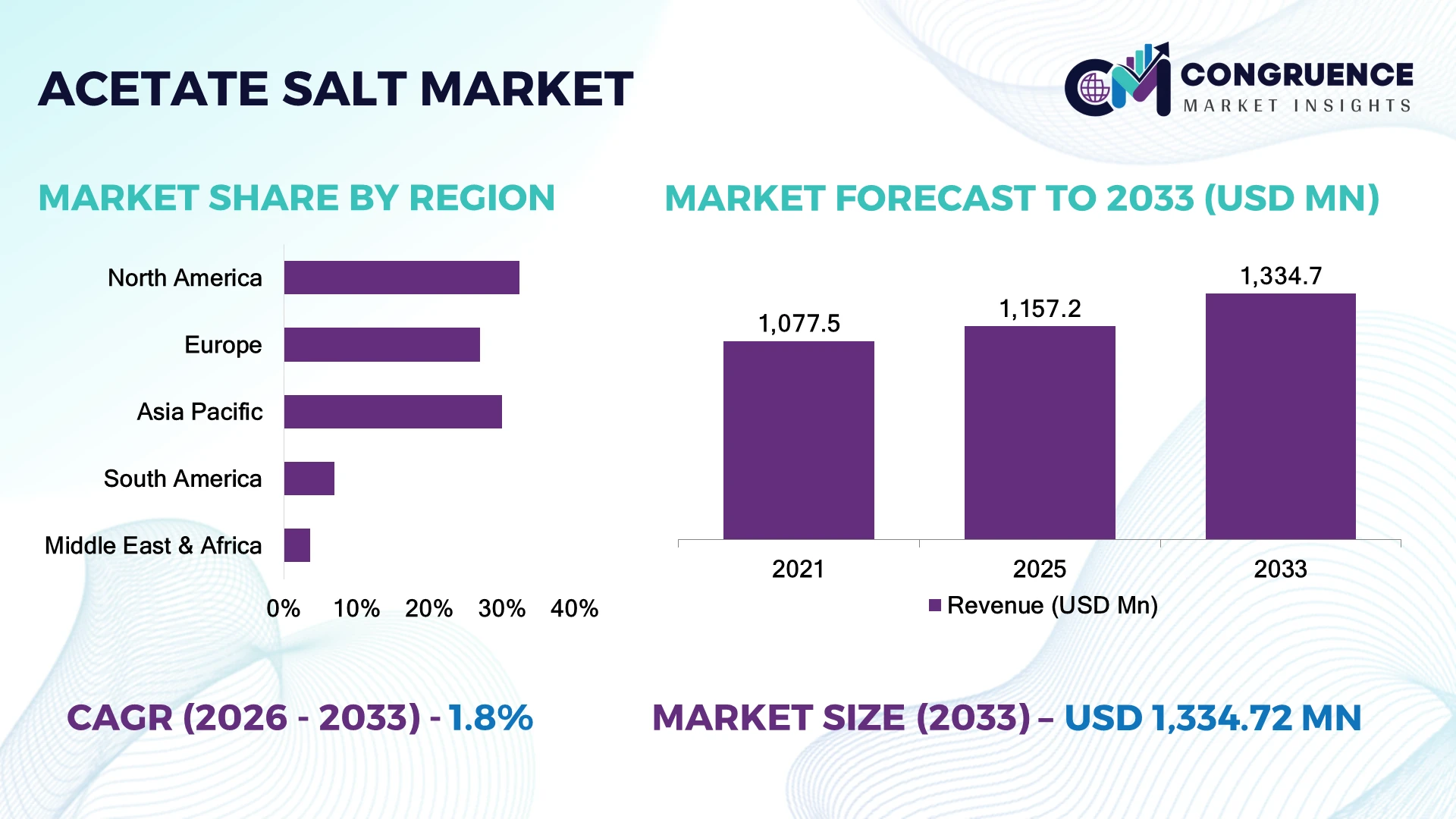
China represents approximately 34% of global acetate salt production capacity, supported by pharmaceutical intermediates, food processing, chemicals, and industrial formulations, while the United States contributes about 18%. Advanced crystallization and drying systems reduce processing losses by 8–12%. Red Sea shipping disruptions in 2024–2026 have encouraged regional inventory strategies and shorter sourcing routes.
Strategically, suppliers should prioritize high-purity grades, localized production, application-specific formulations, and resilient feedstock procurement to defend margins and secure regulated end-use customers.
Market Size & Growth: USD 1,157.2 million in 2025 to USD 1,334.7 million by 2033, with pharmaceutical and high-purity applications supporting 1.8% CAGR.
Top Growth Drivers: Pharmaceuticals 32%; food preservation 24%; industrial chemicals 18%.
Short-Term Forecast: By 2028, automated crystallization can improve production efficiency 8–12% and reduce material losses.
Emerging Technologies: Continuous crystallization, automated drying, high-purity filtration, and digital batch monitoring are reshaping acetate production.
Regional Leaders: North America USD 427 million; Asia-Pacific USD 387 million; Europe USD 334 million, with regional purification capacity expanding.
Consumer/End-User Trends: Pharmaceutical and healthcare users represent approximately 32% of premium-grade acetate consumption, favoring tighter purity specifications.
Pilot/Case Example: 2026 automated batch-control deployments target 10% lower off-specification production through tighter crystallization and drying control.
Competitive Landscape: Niacet leads with approximately 12% share, competing with Jost Chemical, Jungbunzlauer, Spectrum Chemical, and Dr. Paul Lohmann.
Regulatory & ESG Impact: Higher-purity production and optimized drying reduce process waste by approximately 8–12% while supporting pharmaceutical compliance.
Investment & Funding: Approximately USD 180 million is being directed toward capacity modernization, purification upgrades, partnerships, and regional specialty-chemical expansion.
Innovation & Future Outlook: High-purity, application-specific acetate salts and localized supply networks will outperform commodity-oriented models as procurement shifts toward reliability and specification control.
Acetate Salt Market demand centers on pharmaceutical buffers, food preservation, dialysis solutions, textile processing, chemical synthesis, and industrial formulations. High-purity sodium, potassium, calcium, and zinc acetates are gaining preference, with pharmaceutical applications representing about 32% of premium-grade demand. Supply-chain restructuring following Red Sea disruptions is strengthening regional inventories and encouraging localized production.
The Acetate Salt Market is becoming strategically relevant as pharmaceutical, food, healthcare, and specialty-chemical manufacturers place greater emphasis on purity consistency and supply assurance. Procurement is shifting toward qualified regional suppliers as geopolitical freight disruptions expose vulnerabilities in long-distance chemical sourcing. High-purity acetate grades increasingly command greater strategic value than undifferentiated commodity products.
Technology is reinforcing this transition. Automated crystallization and digital batch controls can improve process efficiency by 8–12% versus conventional batch operations, while tighter drying controls reduce off-specification output. Asia-Pacific retains the largest manufacturing scale, particularly China, whereas North American and European producers compete more heavily through pharmaceutical-grade quality, regulatory qualification, and specialty formulations.
During 2026–2028, companies will prioritize purification, automation, localized warehousing, and application-specific product development. A practical deployment involves pharmaceutical manufacturers using tightly controlled acetate buffers to stabilize formulations, requiring consistent impurity profiles and batch documentation. Producers are therefore directing capital toward automated processing and regional inventory hubs while strengthening partnerships with pharmaceutical and food manufacturers. Competitive advantage will increasingly depend on specification reliability, efficient production, supply resilience, and the ability to convert acetate chemistry into higher-value application solutions.
Pharmaceutical and healthcare applications are increasing demand for tightly specified acetate salts, with premium-grade consumption estimated at 32% of the market and pharmaceutical formulations requiring purity levels commonly above 99%. Automated crystallization and controlled drying can improve recovery efficiency by 8–12%, reducing batch variability. U.S. pharmaceutical manufacturers are tightening supplier qualification as formulation stability requirements increase. Chinese producers are responding with purification upgrades and higher-specification production lines, while international suppliers are expanding application-specific portfolios. The key shift is value migration from commodity acetate volumes toward validated grades where impurity control and documentation directly influence customer retention. Companies investing in purification and automated quality control gain pricing resilience and stronger access to regulated pharmaceutical procurement channels.
Acetate salt producers remain exposed to acetic-acid, energy, packaging, and freight volatility, with raw materials and utilities together representing roughly 55–65% of manufacturing costs. International logistics disruptions can increase delivered costs by 10–15%, particularly for suppliers dependent on Asian exports. European buyers face additional pressure from elevated energy-intensive processing costs, while U.S. distributors increasingly favor domestic or nearshore inventory. Companies are mitigating exposure through multi-year feedstock contracts, regional warehousing, dual sourcing, and localized finishing operations. The non-obvious pressure point is inventory economics: maintaining additional safety stock protects pharmaceutical customers from interruptions but ties working capital to relatively low-value commodity grades. Producers with integrated procurement and regional distribution can therefore protect margins more effectively than export-dependent suppliers.
Higher-value acetate applications create opportunities beyond conventional food and industrial uses. Pharmaceutical-grade and analytical-grade products can command substantially tighter specifications, while automated purification can improve recovery by 8–12% and reduce off-specification batches by approximately 10%. India is strengthening pharmaceutical manufacturing capacity, creating opportunities for localized acetate supply and qualification partnerships. Emerging demand for battery-material processing and specialty chemical synthesis also expands addressable applications. Companies are investing in high-purity crystallization, smaller-batch production, and application laboratories rather than relying solely on bulk capacity. The strategic opportunity lies in converting relatively modest-volume specialty grades into higher-margin contracts through technical qualification, customized particle characteristics, and dependable documentation. Suppliers that combine regional production with formulation support can capture customers that commodity producers struggle to retain.
Acetate salts face increasing specification complexity as pharmaceutical, food, analytical, and industrial customers impose different impurity, moisture, particle-size, and packaging requirements. Specialty production can require 10–20% more quality-control interventions than commodity batches, while customized grades increase SKU complexity by approximately 15%. European chemical compliance and pharmaceutical qualification requirements further extend validation workflows. Companies must prevent cross-contamination while maintaining economically viable batch sizes, particularly where specialty orders are fragmented. Digital batch records, automated sampling, dedicated production zones, and laboratory partnerships are becoming essential responses. A critical execution issue is balancing flexibility with plant utilization: excessive changeovers can erode throughput even when premium-grade pricing is attractive. Producers that standardize modular purification and packaging platforms will manage customization without sacrificing manufacturing efficiency.
Purity Controls Move Upstream: Pharmaceutical buyers are increasingly specifying impurity profiles before production rather than relying solely on final-product testing. Automated process monitoring can reduce batch deviations by 10–15%, while inline moisture measurement improves drying consistency by 8–12%. U.S. suppliers are integrating quality-control checkpoints earlier in production to shorten release cycles and strengthen qualification performance.
Regional Inventory Models Strengthen: Red Sea shipping disruption and volatile freight availability are encouraging distributors to hold 10–20% higher safety inventories for critical acetate grades. European and Middle Eastern buyers increasingly favor regional stocking points, while manufacturers are establishing shorter replenishment routes. The operational shift improves delivery reliability but increases working-capital requirements, accelerating demand for inventory optimization systems.
Customized Packaging Gains Ground: Pharmaceutical and laboratory customers are shifting toward smaller, specification-controlled packaging, with customized formats representing an estimated 15–20% of specialty-grade shipments. Moisture-barrier containers and tamper-evident packaging reduce handling exposure by approximately 10%. Producers are expanding packaging flexibility and contract-manufacturing partnerships, allowing them to serve regulated customers without dedicating entire production lines to low-volume grades.
Digital Documentation Becomes Differentiator: Electronic batch records and automated certificate generation are expanding across regulated acetate supply chains, reducing documentation preparation time by 20–30%. Digital traceability also cuts manual data-entry errors by approximately 15%. European and North American suppliers are prioritizing integrated quality platforms, making documentation speed and audit readiness increasingly important competitive differentiators alongside product purity.
Sodium acetate is estimated to account for approximately 52% of the Acetate Salt Market, supported by scalable production, broad food-preservation use, pharmaceutical buffering, and industrial applications. Potassium acetate follows at about 21%, benefiting from specialty chemical processing and deicing formulations, while calcium acetate contributes roughly 14% and remains relevant in pharmaceutical and nutritional applications. Other acetate salts collectively represent about 13%. Sodium acetate retains a cost advantage because mature manufacturing infrastructure supports large-volume crystallization and standardized grades, while pharmaceutical-grade variants increasingly require tighter impurity controls.
Potassium and calcium acetate are gaining strategic attention as buyers diversify beyond commodity grades. Specialty formulations can command 8–12% higher pricing than standard industrial grades where purity and functional performance are critical. Producers are therefore expanding high-purity lines, flexible packaging, and application-specific formulations rather than adding undifferentiated capacity. This shift favors suppliers with integrated purification and quality-control systems.
The U.S. FDA currently recognizes sodium acetate for antimicrobial, flavoring, and pH-control functions in food applications, reinforcing its established multi-use positioning.
Food processing represents approximately 36% of acetate salt consumption, making it the leading application due to sodium acetate's established use in preservation, pH control, and flavor-related functions. Pharmaceutical applications account for nearly 32%, supported by buffering and formulation requirements, while industrial chemicals represent about 20%. Other applications contribute approximately 12%. Food remains the mature volume base, but pharmaceutical-grade demand is strengthening faster as manufacturers require tighter specifications and traceability.
Pharmaceutical applications increasingly prioritize high-purity grades, with specialty demand estimated to expand 8–10% annually in selected formulations. Food processors, meanwhile, are integrating acetate salts into larger automated preservation and quality-control workflows, improving batch consistency by approximately 5–8%. Industrial users remain price-sensitive but increasingly favor dependable regional supply. Producers are responding with application-specific grades, localized inventory, and technical partnerships with formulators and food manufacturers.
India’s Ministry of Food Processing Industries reported that the food-processing sector grew at an average 6.55% annually during the nine years through 2023–24, reinforcing the expansion of processing infrastructure relevant to food-grade acetate consumption.
Food and beverage manufacturers account for approximately 36% of acetate salt demand, reflecting high-volume use in preservation and pH management. Pharmaceutical manufacturers represent about 32%, while chemical and industrial producers contribute approximately 20%; laboratories and other specialized users comprise the remaining 12%. Food manufacturers prioritize consistent bulk supply and cost control, whereas pharmaceutical buyers emphasize validated purity, documentation, and batch-to-batch consistency.
Pharmaceutical demand is the fastest-shifting end-user segment, with premium-grade procurement increasing approximately 8–10% as formulation standards become more stringent. Chemical manufacturers continue favoring standardized industrial grades, but specialty processors increasingly require customized particle size and moisture specifications. Suppliers are responding through dedicated quality systems, smaller specialty batches, technical support, and regional warehousing. The competitive opportunity is therefore shifting from volume-only contracts toward differentiated supply agreements that combine product consistency with formulation support and reliable replenishment.
India’s food-processing policy framework targets ₹6,057 crore of additional investment through its production-linked incentive program, strengthening processing capacity and procurement opportunities for food-grade functional ingredients.
North America accounted for the largest market share at 32.4% in 2025 however, Asia-Pacific is expected to register the fastest growth, expanding at a CAGR of 2.6% between 2026 and 2033.
Pharmaceutical-grade production strengthens regional value capture
North America represents approximately 32.4% of global acetate salt demand, supported by pharmaceutical manufacturing, food processing, laboratory chemicals, and industrial formulations. The United States accounts for the majority of regional consumption, with pharmaceutical applications representing roughly 35% of premium-grade demand. Manufacturers are emphasizing high-purity sodium and potassium acetate, automated crystallization, and domestic inventory buffers. The region's strategic advantage is qualification infrastructure: suppliers serving regulated pharmaceutical customers increasingly use tighter batch documentation and automated quality controls. U.S. reshoring and supply-chain resilience initiatives are also encouraging domestic sourcing of specialty chemical inputs, while advanced purification can reduce off-specification output by approximately 10–15%. Producers are consequently prioritizing specialty grades and long-term supply agreements over undifferentiated commodity expansion.
United States Market Outlook: The United States remains the region's strongest acetate salt market because of its extensive pharmaceutical, food, healthcare, and specialty-chemical manufacturing base. Pharmaceutical manufacturing investment is increasing the requirement for validated excipients and processing chemicals, while domestic suppliers benefit from shorter replenishment cycles. High-purity acetate grades increasingly support formulation, buffering, and laboratory applications where consistent impurity profiles are commercially critical.
Regulatory discipline accelerates specialty-grade positioning
Europe contributes approximately 27% of global acetate salt demand, with Germany, France, Italy, and the United Kingdom forming important pharmaceutical and chemical consumption centers. High energy costs and tighter environmental requirements are pushing producers toward energy-efficient crystallization, lower-waste drying, and higher-value specialty grades. Germany's pharmaceutical industry invested EUR 10.7 billion in R&D in 2024, strengthening demand for qualified high-purity chemical inputs. At the same time, Europe's chemical sector remains under cost pressure, making process efficiency increasingly decisive. Producers are responding through plant modernization, specialty-grade portfolios, and closer customer qualification programs rather than broad commodity capacity additions. The regional market increasingly rewards suppliers capable of meeting pharmaceutical documentation and sustainability requirements while controlling energy-intensive processing costs.
Germany Market Outlook: Germany offers the strongest combination of pharmaceutical manufacturing, chemical-processing expertise, and technical workforce capability in Europe. Its pharmaceutical sector employs approximately 133,000 people and operates more than 650 companies, supporting consistent demand for high-specification acetate salts. The country's advanced industrial infrastructure enables suppliers to integrate automated quality control and specialty chemical production closer to pharmaceutical customers.
China-led manufacturing scale reshapes supply economics
Asia-Pacific represents approximately 30% of global acetate salt demand while maintaining the strongest production scale. China accounts for an estimated 34% of global acetate salt manufacturing capacity, supported by food processing, pharmaceuticals, chemical intermediates, and export-oriented specialty production. Chinese chemical producers are expanding downstream integration and higher-purity processing, while India is strengthening pharmaceutical and food-processing capacity. A major Chinese petrochemical expansion approved in 2025 includes 320,000 tonnes per year of high-performance specialty chemicals, reinforcing the region's broader specialty-chemical infrastructure. Companies are increasingly combining bulk production with purification and application-specific grades, improving supply flexibility and reducing dependence on imported specialty inputs.
China Market Outlook: China remains the most strategically significant country because of its manufacturing scale, integrated chemical supply chains, and competitive production economics. Large petrochemical complexes provide feedstock and processing advantages that support acetate salt manufacturing and downstream conversion. Producers are increasingly investing in specialty chemical capacity, enabling higher-purity grades to serve pharmaceutical, food, and industrial customers while maintaining export competitiveness.
Food-processing modernization expands functional-ingredient demand
South America accounts for approximately 7% of global acetate salt demand, with Brazil representing the principal consumption and production center. Food processing is the region's most important demand channel because acetate salts support preservation and pH control across processed foods. Brazil's food-processing industry generated approximately USD 248 billion in 2025 and processed 62% of agricultural production, creating a substantial downstream base for functional ingredients. The sector also received R$116 billion in investments between 2023 and 2025, strengthening factory modernization and innovation capacity. Producers are responding by improving local distribution, food-grade specifications, and supply reliability. The main strategic constraint remains logistics efficiency across geographically dispersed industrial customers.
Brazil Market Outlook: Brazil dominates South American acetate salt demand because of its large food-processing, agricultural, pharmaceutical, and chemical manufacturing base. Food processing sales increased 8.02% in 2025, supporting continued demand for preservation and formulation ingredients. Local suppliers can gain advantage through domestic warehousing, food-grade certification, and partnerships with large processors seeking dependable ingredient replenishment.
Healthcare localization creates new specialty demand
Middle East & Africa contributes approximately 5% of global acetate salt demand, with Saudi Arabia emerging as the region's most strategically important market. Pharmaceutical localization, healthcare infrastructure investment, food manufacturing, and specialty chemical imports are reshaping procurement requirements. Saudi Arabia's pharmaceutical market reached approximately USD 16.7 billion in 2025, while domestic production represented about 28% of market value and 42% of units produced. The government is also accelerating local manufacturing and supply-chain resilience. Acetate suppliers are therefore targeting pharmaceutical-grade products, local distribution partnerships, and shorter replenishment routes. The market remains import-dependent for several specialty chemical inputs, making reliable regional inventory an important competitive differentiator.
Saudi Arabia Market Outlook: Saudi Arabia combines pharmaceutical localization with substantial healthcare investment, creating a stronger platform for specialty acetate demand. In 2026, a new automated pharmaceutical factory began operations with initial capacity of 250 million units annually and planned expansion beyond 450 million units. Such manufacturing localization strengthens demand for qualified chemical inputs and encourages suppliers to establish regional partnerships and inventory positions.
Niacet, Kerry, Jost Chemical, Dr. Paul Lohmann, and Jungbunzlauer compete across food-grade, pharmaceutical-grade, nutritional, and specialty acetate salts, with global ingredient leaders confronting regional cost-focused manufacturers. The top five players are estimated to control about 35% combined share, leaving substantial room for regional suppliers. Competition centers on purity, price, formulation support, and supply reliability: high-purity grades above 99% target regulated applications, while customized particle formats can command 8–12% premiums. Kerry differentiates through integrated acetate-based preservation systems; Jost emphasizes high-purity mineral salts; Lohmann focuses on pharmaceutical and biopharma specifications; Jungbunzlauer is strengthening North American manufacturing through local production. The competitive shift is moving from commodity salt supply toward application-specific grades, documented quality, and regional availability. Entry barriers include qualification requirements, cGMP capabilities, analytical infrastructure, and established food and pharmaceutical contracts. Winners will combine scalable manufacturing, validated purity, regional inventory, technical formulation support, and resilient feedstock access to outperform established suppliers globally.
Kerry Group plc
Jungbunzlauer Suisse AG
Jost Chemical Co.
Dr. Paul Lohmann GmbH & Co. KGaA
Merck KGaA
Thermo Fisher Scientific Inc.
Avantor, Inc.
Spectrum Chemical Manufacturing Corp.
Anmol Chemicals Group
Shandong Kunda Biotechnology Co., Ltd.
Foodchem International Corporation
Karn Chem Corporation
Acetate salt manufacturing is shifting from conventional batch crystallization toward automated crystallization, controlled drying, inline spectroscopy, and digital records. Automated process control can improve recovery efficiency by 8–12%, while inline moisture monitoring reduces batch deviations by 5–10%. Adoption is strongest in pharmaceutical-grade production, where documented purity and repeatability influence supplier qualification. These systems also reduce operator intervention and improve release consistency.
Emerging purification platforms combine membrane filtration, efficient crystallizers, and particle-engineering. Compared with conventional batch processing, optimized crystallization can shorten cycle times by 10–15% and reduce off-specification material by approximately 8–10%. Jost Chemical and Dr. Paul Lohmann benefit from this shift because high-purity mineral-salt portfolios require tight analytical control, customized particle formats, and pharmaceutical documentation. Digital traceability links manufacturing data with quality systems and customer certificates.
During 2026–2028, producers will integrate automated quality control, predictive maintenance, energy-efficient drying, and flexible packaging into specialty acetate lines. Adoption across regulated facilities is expected to move from selective deployment to broader plant integration. The strongest competitive advantage will favor suppliers that combine process automation with application expertise, enabling faster qualification, lower waste, and consistent specifications. Companies acting now can reduce production variability, strengthen pharmaceutical and food contracts, and improve responsiveness to supply-chain disruptions.
November 2025 Jungbunzlauer acquired the Thomson, Illinois production site, establishing its first U.S. manufacturing facility. The move localizes ingredient production, shortens customer lead times, and supports North American capacity expansion for specialty acetate-related ingredient portfolios for customers nationwide. Source: jungbunzlauer.com
June 2025 Jost Chemical secured ISO/IEC 17025:2017 accreditation for its St. Louis laboratory. The certification strengthens analytical credibility for high-purity mineral salts, including sodium acetate, improving pharmaceutical qualification, testing consistency, and customer confidence across regulated pharmaceutical applications globally. Source: jostchemical.com
July 2025 Shandong Kunda Biotechnology expanded sodium acetate production capacity by 30% to address Asia-Pacific demand. The increase strengthens regional supply availability, supports export competitiveness, and intensifies pressure on established suppliers to improve cost efficiency and delivery reliability.
May 2026 Dr. Paul Lohmann recorded shipments totaling about 204,083 kilograms of calcium acetate from Germany to the United States. The volume demonstrates active transatlantic pharmaceutical-grade supply and reinforces the importance of dependable logistics for regulated acetate procurement. Source: seair.co.in
The Acetate Salt Market Report covers sodium, potassium, calcium, ammonium, zinc, magnesium, and other specialty acetate salts across food preservation, pharmaceuticals, healthcare, animal nutrition, laboratory chemicals, textiles, chemical processing, and industrial formulations. End-user analysis includes food manufacturers, pharmaceutical companies, chemical processors, laboratories, healthcare organizations, and specialty ingredient formulators. Regional coverage spans North America, Europe, Asia-Pacific, South America, and Middle East & Africa, with country-level assessment of manufacturing capacity, supply chains, regulatory requirements, and procurement structures.
The report evaluates high-purity grades, customized particle formats, automated crystallization, digital batch monitoring, advanced purification, and flexible packaging. Competitive analysis covers 12 major market participants, highlighting capacity expansion, localization, qualification capabilities, partnerships, and specialty-grade positioning. Strategic findings support investment planning, geographic expansion, supplier selection, portfolio development, competitive benchmarking, and technology prioritization while assessing market direction and emerging application opportunities through 2033.
| Report Attribute/Metric | Report Details |
|---|---|
|
Market Revenue in 2025 |
USD 1,157.2 Million |
|
Market Revenue in 2033 |
USD 1,334.7 Million |
|
CAGR (2026 - 2033) |
1.8% |
|
Base Year |
2025 |
|
Forecast Period |
2026 - 2033 |
|
Historic Period |
2021 - 2025 |
|
Segments Covered |
By Type
By Application
By End-User
|
|
Key Report Deliverable |
Revenue Forecast, Growth Trends, Market Dynamics, Segmental Overview, Regional and Country-wise Analysis, Competition Landscape |
|
Region Covered |
North America, Europe, Asia-Pacific, South America, Middle East, Africa |
|
Key Players Analyzed |
Kerry Group plc, Jungbunzlauer Suisse AG, Jost Chemical Co., Dr. Paul Lohmann GmbH & Co. KGaA, Merck KGaA, Thermo Fisher Scientific Inc., Avantor, Inc., Spectrum Chemical Manufacturing Corp., Anmol Chemicals Group, Shandong Kunda Biotechnology Co., Ltd., Foodchem International Corporation, Karn Chem Corporation |
|
Customization & Pricing |
Available on Request (10% Customization is Free) |




