
Reports
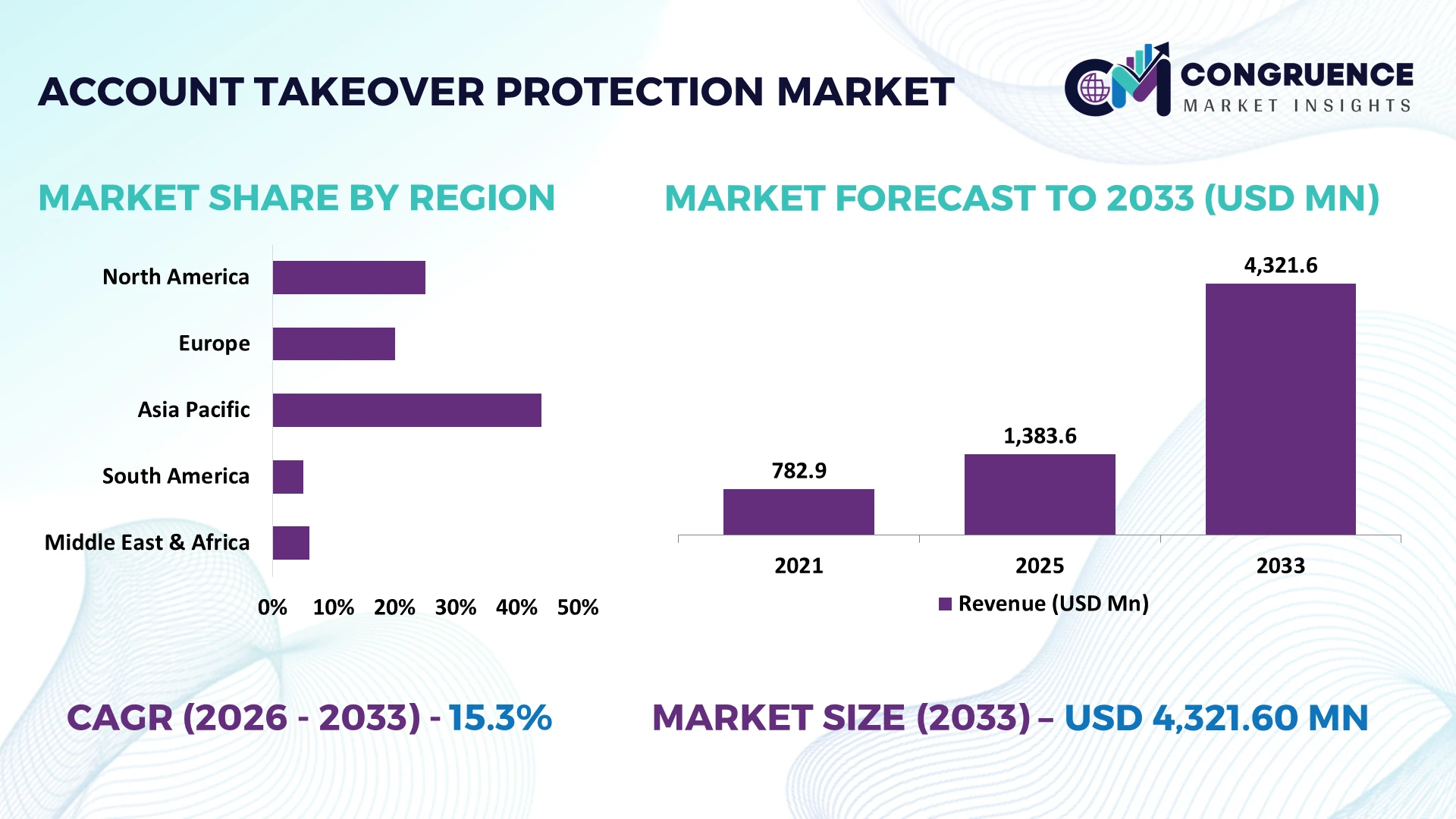
The Global Account Takeover Protection Market was valued at USD 1383.6 Million in 2025 and is anticipated to reach a value of USD 4321.6 Million by 2033 expanding at a CAGR of 15.3% between 2026 and 2033. Growth is driven by credential stuffing, AI-enabled phishing, automated bot attacks, and enterprise adoption of behavioral biometrics, risk-based authentication, and real-time identity threat detection.
The United States leads the global account takeover protection landscape, supported by advanced cybersecurity infrastructure, digital banking adoption, and concentrated identity security investment. Microsoft's identity infrastructure processes more than 600 million identity attacks daily, illustrating the scale of automated authentication threats. American financial institutions, e-commerce platforms, and cloud service providers increasingly deploy passkeys, device intelligence, and behavioral analytics. Compared with India, where UPI transactions exceed 20 billion monthly, the United States has a more established enterprise market for integrated fraud prevention and adaptive authentication.
Strategically, vendors combining real-time behavioral intelligence, automated bot mitigation, and frictionless authentication are positioned to secure high-value enterprise contracts.
Market Size & Growth: USD 1,383.6 million in 2025, reaching USD 4,321.6 million by 2033 at 15.3% CAGR, driven by automated account fraud prevention.
Top Growth Drivers: 80% of breaches involve compromised identities; phishing accounts for approximately 16% of initial access; automated credential attacks intensify authentication exposure.
Short-Term Forecast: By 2028, passkey-based authentication targets higher login success, with existing implementations demonstrating 93% success versus 63% for traditional methods.
Emerging Technologies: Three technologies reshape protection: behavioral biometrics, AI-driven anomaly detection, and device-bound passkey authentication.
Regional Leaders: North America leads enterprise fraud prevention, Europe strengthens PSD2 authentication controls, and Asia-Pacific expands digital payment protection across three major deployment environments.
Consumer/End-User Trends: Passkey authentication achieves approximately 93% login success, strengthening adoption across banking, e-commerce, and consumer identity platforms.
Pilot/Case Example: In 2025, passkey deployment research demonstrated a 30-percentage-point improvement in authentication success compared with traditional login methods.
Competitive Landscape: Microsoft, Okta, Ping Identity, TransUnion, and LexisNexis Risk Solutions compete through identity analytics, adaptive authentication, and transaction risk scoring.
Regulatory & ESG Impact: Europe's PSD2 framework requires strong customer authentication using two independent factors for applicable electronic payments.
Investment & Funding: Enterprise investment concentrates on three priorities: account fraud analytics, automated bot defense, and phishing-resistant authentication infrastructure.
Innovation & Future Outlook: By 2033, continuous authentication, real-time identity risk scoring, and cross-channel fraud intelligence will strengthen account protection platforms.
The Account Takeover Protection Market is evolving as financial institutions, online retailers, telecommunications operators, and digital service providers confront increasingly automated credential attacks. Attackers combine stolen passwords, residential proxy networks, and AI-generated phishing to bypass conventional login defenses. Passkey implementations have demonstrated approximately 93% authentication success, highlighting the operational advantages of phishing-resistant credentials. Emerging protection platforms integrate behavioral biometrics, device fingerprinting, bot detection, and transaction monitoring to identify suspicious account activity beyond initial authentication. Regulatory pressure surrounding payment security and customer data protection further reinforces demand for adaptive fraud controls, establishing the foundation for evaluating strategic investment priorities.
Account takeover protection is becoming a strategic investment priority as compromised customer identities threaten digital banking, e-commerce transactions, and enterprise account security. Credential stuffing, session hijacking, and AI-assisted impersonation increasingly expose weaknesses in password-based authentication. Microsoft's security infrastructure observes more than 600 million identity attacks daily, demonstrating the operational scale of automated threats. Europe's strong customer authentication requirements are also shifting investment toward phishing-resistant credentials, adaptive verification, and continuous account monitoring.
Modern authentication platforms combine passkeys, device intelligence, and behavioral risk scoring to identify suspicious activity without requiring repeated customer challenges. Passkey authentication has demonstrated 93% login success compared with 63% for traditional authentication, a 30-percentage-point improvement. American financial institutions emphasize integrated fraud analytics, while Indian payment providers prioritize high-volume transaction protection. A digital bank can combine device fingerprinting with transaction monitoring to detect unfamiliar access patterns and trigger additional verification before sensitive account changes.
Between 2026 and 2028, investment priorities will increasingly favor continuous session protection, automated fraud investigation, and cross-channel identity intelligence. Vendors are strengthening partnerships with payment processors, identity platforms, and cloud security providers. Competitive advantage will depend on reducing fraudulent account access while maintaining conversion performance and minimizing unnecessary authentication friction.
Increasing automated credential attacks are accelerating enterprise investment in account takeover protection. Verizon's 2025 breach investigations identified credential abuse in approximately 22% of initial access cases, while phishing accounted for 16%. Third-party involvement reached 30% of investigated breaches, highlighting exposure across interconnected digital services. In the United States, financial institutions and online retailers face persistent credential stuffing, password spraying, and malicious login automation. The transition toward phishing-resistant authentication is reshaping security procurement around device intelligence and real-time behavioral analytics. Microsoft, Okta, and specialized fraud prevention vendors are expanding risk-based authentication, bot mitigation, and compromised credential detection. Providers combining identity telemetry with transaction risk assessment gain stronger enterprise positioning by protecting accounts beyond initial login.
Complex identity infrastructure and authentication friction constrain account takeover protection deployment, particularly among enterprises operating legacy customer authentication systems. Traditional authentication methods demonstrate approximately 63% login success compared with 93% for passkeys, revealing substantial usability differences between authentication approaches. Organizations must integrate fraud scoring, customer identity platforms, payment gateways, and device intelligence without disrupting legitimate access. India's large digital payments ecosystem adds pressure to maintain low-latency authentication across high-volume transactions. Fragmented customer identity records and inconsistent application interfaces increase implementation costs and complicate centralized fraud monitoring. Providers are introducing modular APIs, adaptive authentication thresholds, and phased migration services. Enterprise procurement increasingly favors solutions that reduce false challenges while preserving conversion rates and operational continuity.
Continuous authentication creates opportunities to detect account compromise after successful login, addressing attacks involving stolen sessions and trusted devices. Passkey implementations have achieved approximately 93% authentication success, while traditional methods recorded 63%, demonstrating the usability advantage of phishing-resistant access. Device intelligence and behavioral biometrics extend protection through interaction patterns, session anomalies, and transaction context. Brazil's expanding instant payment ecosystem creates opportunities for real-time account risk assessment across digital banking applications. Technology vendors are developing behavioral models, cross-channel identity intelligence, and automated fraud decision engines through partnerships with financial institutions and payment networks. The strongest opportunity lies in connecting authentication risk with subsequent account activity, preventing unauthorized transfers without introducing unnecessary verification for legitimate customers.
Maintaining detection accuracy against adaptive fraud techniques presents a significant execution challenge. Credential abuse accounted for approximately 22% of initial breach access in 2025, while phishing represented 16%, demonstrating the diversity of identity compromise methods. Third-party involvement in breaches reached 30%, complicating account risk assessment across interconnected platforms. In Singapore, digital financial services providers must distinguish legitimate customer behavior from automated attacks involving residential proxies, device emulation, and AI-assisted social engineering. Excessively aggressive fraud controls increase false positives, customer abandonment, and investigation workloads. Vendors must invest in continuously updated behavioral models, explainable risk scoring, and coordinated fraud intelligence. Sustainable competitive performance depends on detecting sophisticated account compromise without degrading authentication reliability or customer experience.
Bot Management Extends Beyond Login Pages: Enterprises are monitoring automated activity across registration, password recovery, and account profile changes. Credential abuse accounted for approximately 22% of initial breach access in 2025, while phishing represented 16%. Security providers are expanding API-level bot detection, request fingerprinting, and automated traffic classification, helping digital platforms identify coordinated account attacks before authentication attempts escalate.
Account Recovery Security Receives Greater Scrutiny: Financial institutions are strengthening identity verification during password resets and device replacement. The FIDO Alliance reported 93% authentication success for passkeys versus 63% for traditional methods, but recovery workflows still require separate protection. Vendors are integrating device history, account tenure, and recovery risk scoring to prevent attackers from exploiting weaker fallback authentication processes.
Fraud Operations Adopt Unified Investigation Workflows: Security teams are consolidating authentication events, customer support interactions, and suspicious account modifications within centralized investigation platforms. Third-party involvement reached 30% of investigated breaches in 2025. Providers are introducing shared case management, automated evidence collection, and coordinated escalation procedures, reducing investigation fragmentation and improving response consistency across banking and digital commerce operations.
Telecommunications Identity Signals Strengthen Fraud Screening: Digital service providers are incorporating SIM-swap indicators, mobile number verification, and device connectivity intelligence into account protection workflows. Europe's PSD2 framework requires two independent authentication factors for applicable electronic payments. Telecommunications operators and fraud prevention vendors are expanding identity signal partnerships, improving detection of unauthorized device changes and reducing dependence on vulnerable SMS-based verification.
Multi-Factor Authentication represents the leading type within the Account Takeover Protection Market, supported by extensive enterprise deployment, established identity infrastructure, and regulatory authentication requirements. Financial institutions, government agencies, and digital platforms use additional verification factors to restrict unauthorized account access. Microsoft's identity security research has demonstrated that properly implemented multi-factor authentication can block more than 99% of automated account compromise attempts. Behavioral Analytics strengthens protection through interaction monitoring, typing patterns, and anomalous session activity. Vendors are expanding phishing-resistant authentication, adaptive verification, and centralized identity orchestration to reduce reliance on vulnerable password-based controls.
Risk-Based Authentication represents a rapidly expanding type as enterprises increasingly evaluate login context before determining verification requirements. Device Intelligence complements this approach through device fingerprinting, connection attributes, and historical account associations. Passkey authentication has demonstrated approximately 93% login success compared with 63% for traditional methods, reinforcing demand for low-friction identity verification. Security providers are integrating contextual risk engines with authentication platforms, allowing high-risk sessions to receive additional scrutiny while legitimate customers experience fewer interruptions. Investment priorities increasingly favor coordinated identity intelligence rather than isolated verification controls.
Online Banking represents a leading application within the Account Takeover Protection Market because compromised banking credentials can expose payment accounts, sensitive customer information, and financial transaction privileges. Banks deploy multi-factor authentication, behavioral analytics, and device intelligence to identify unauthorized access attempts and suspicious account modifications. Credential abuse accounted for approximately 22% of initial breach access in 2025, emphasizing the importance of monitoring authentication risk. E-Commerce platforms also represent substantial demand centers, particularly where stored payment credentials and loyalty accounts create opportunities for automated account fraud. Security vendors are expanding identity verification integrations, fraud scoring interfaces, and automated account monitoring to protect customer access without increasing checkout friction.
Digital Payments represents a rapidly expanding application as instant transfer networks and mobile financial platforms increase transaction frequency. India's UPI ecosystem processed more than 20 billion transactions during a single month in 2025, demonstrating the operational scale requiring account protection. Social Media Accounts remain important because compromised profiles enable impersonation, fraudulent messaging, and further credential attacks. Providers are developing transaction-aware risk assessment, device reputation models, and automated session controls. Competitive advantage increasingly depends on connecting login intelligence with sensitive account activity.
Banking and Financial Services represent the leading end-user category within the Account Takeover Protection Market, supported by extensive digital account infrastructure, high-value financial transactions, and strict customer authentication requirements. Banks deploy adaptive authentication, device intelligence, and behavioral monitoring to detect compromised customer identities and unauthorized transaction attempts. Europe's PSD2 framework requires strong customer authentication using two independent factors for applicable electronic payments, reinforcing structured identity protection. Retail and E-Commerce organizations maintain substantial demand through customer account security, payment credential protection, and loyalty fraud prevention. Vendors are expanding financial fraud analytics, authentication orchestration, and retail identity security partnerships to address different transaction risk profiles.
Telecommunications is emerging as an important expansion segment because mobile account compromise, SIM-swap fraud, and unauthorized service changes can undermine downstream authentication systems. Healthcare organizations require secure patient portal access, while Government agencies protect citizen identity platforms and digital public services. Passkey implementations have demonstrated 93% authentication success, supporting broader adoption of phishing-resistant access methods. Security providers are developing sector-specific fraud models, mobile identity intelligence, and flexible deployment architectures. Future competitive positioning depends on reducing account compromise while maintaining reliable customer access.
North America accounted for the largest market share at an estimated 39% in 2025 however, Asia-Pacific is expected to register the fastest growth, expanding at a CAGR of an estimated 18.2% between 2026 and 2033.
Advanced Identity Intelligence Strengthens Enterprise Fraud Prevention
North America maintains a leading position in account takeover protection through extensive digital banking infrastructure, sophisticated identity security platforms, and concentrated cybersecurity investment. The United States represents the principal deployment market, while Canada contributes through financial services modernization and consumer identity protection. Enterprises increasingly integrate behavioral biometrics, device intelligence, and automated bot detection into customer authentication systems. Credential abuse accounted for approximately 22% of initial breach access in 2025, reinforcing the operational importance of compromised credential monitoring. Financial institutions and e-commerce platforms are expanding real-time fraud scoring to identify suspicious logins and unauthorized account changes. Technology providers including Microsoft, Okta, and TransUnion are strengthening identity verification partnerships and adaptive authentication capabilities. Regional competition increasingly emphasizes detection accuracy, reduced authentication friction, and integrated protection throughout the customer account lifecycle.
United States Market Outlook: The United States benefits from established financial technology infrastructure, extensive cloud services, and advanced cybersecurity research. Microsoft's identity security systems observe more than 600 million identity attacks daily, demonstrating the scale of automated authentication threats. American banks, retailers, and digital platforms are expanding phishing-resistant passkeys, session monitoring, and account recovery protection. Federal cybersecurity modernization initiatives further strengthen enterprise adoption of identity-aware access controls.
Payment Authentication Regulation Reshapes Fraud Prevention Strategies
Europe's account takeover protection market is strongly influenced by digital payment regulation, customer data protection requirements, and expanding electronic commerce infrastructure. Germany, the United Kingdom, France, and the Netherlands represent important deployment centers, supported by established banking networks and digital identity services. The revised Payment Services Directive requires strong customer authentication using at least two independent factors for applicable electronic payments, strengthening adoption of adaptive verification and transaction monitoring. Financial institutions increasingly integrate device recognition, behavioral analytics, and authentication orchestration to detect suspicious account access. The European Digital Identity Wallet framework is also encouraging investment in interoperable identity verification infrastructure. Security providers are developing privacy-conscious fraud analytics and strengthening partnerships with payment processors. Competitive differentiation increasingly depends on maintaining regulatory compliance while minimizing unnecessary authentication challenges.
United Kingdom Market Outlook: The United Kingdom's established digital banking ecosystem and extensive financial technology sector support account takeover protection deployment. UK Finance reported approximately 3.13 million confirmed unauthorized fraud cases during 2024, highlighting substantial financial crime exposure. British banks and payment providers are strengthening device-based authentication, behavioral monitoring, and customer account recovery controls. Financial institutions increasingly coordinate fraud intelligence with payment networks and identity verification providers.
Digital Payment Scale Accelerates Automated Account Defense
Asia-Pacific is emerging as a major expansion environment for account takeover protection, supported by mobile payment adoption, digital commerce growth, and extensive telecommunications infrastructure. India, China, Japan, Australia, and Singapore represent strategically important deployment markets with distinct authentication requirements. India benefits from high-volume instant payment infrastructure, while China maintains extensive digital wallet and e-commerce ecosystems. Japan emphasizes secure consumer authentication and financial transaction integrity, while Singapore prioritizes digital banking protection and coordinated anti-scam initiatives. Enterprises are deploying device intelligence, behavioral risk scoring, and automated login monitoring to protect customer accounts across mobile applications. Technology providers are expanding partnerships with payment platforms, telecommunications operators, and regional financial institutions. Competitive advantage increasingly depends on processing high authentication volumes with low latency and accurately distinguishing legitimate activity from automated attacks.
India Market Outlook: India's Unified Payments Interface processed more than 20 billion transactions during a single month in 2025, demonstrating the scale of digital payment infrastructure. Banks, payment aggregators, and financial technology companies increasingly require device binding, transaction-aware authentication, and automated fraud monitoring. The Reserve Bank of India's digital payment security requirements reinforce structured authentication controls. Domestic cybersecurity providers are developing localized fraud intelligence and mobile-first account protection platforms.
Instant Payment Adoption Intensifies Account Security Requirements
South America's account takeover protection market is increasingly shaped by digital banking penetration, mobile commerce expansion, and growing exposure to financial identity fraud. Brazil represents the largest operational center, while Colombia, Chile, and Argentina contribute through financial technology adoption and digital payment modernization. Instant payment networks are increasing the frequency of customer authentication events and creating greater demand for real-time account monitoring. Financial institutions are integrating device fingerprinting, behavioral analytics, and automated transaction risk scoring to identify unauthorized access. Security vendors are strengthening regional banking partnerships and introducing cloud-delivered fraud prevention services for smaller financial institutions. Deployment constraints include fragmented identity infrastructure, inconsistent customer verification practices, and limited specialist cybersecurity resources. Providers offering localized fraud models and simplified integration are strengthening their competitive positioning.
Brazil Market Outlook: Brazil's Pix instant payment system has transformed consumer payment behavior and increased the importance of protecting mobile banking accounts. The Central Bank of Brazil has strengthened security requirements for payment participants, including fraud prevention and transaction monitoring measures. Brazilian banks and financial technology providers are expanding biometric authentication, device reputation analysis, and account activity monitoring to identify suspicious transfers and unauthorized credential use.
Digital Banking Modernization Strengthens Identity Fraud Controls
The Middle East & Africa account takeover protection market is developing through financial services modernization, government digital identity programs, and expanding mobile banking infrastructure. Saudi Arabia and the United Arab Emirates represent major cybersecurity investment centers, while South Africa contributes through established banking and telecommunications networks. Government digital transformation programs are increasing the use of authenticated online services, strengthening requirements for secure customer identities and continuous account monitoring. Financial institutions are deploying adaptive authentication, device intelligence, and automated fraud detection to protect digital banking applications. The UAE's digital identity infrastructure supports secure authentication across public and private services. Security providers are expanding regional partnerships with banks, telecommunications operators, and identity verification platforms. Market competition increasingly emphasizes localized fraud intelligence, regulatory alignment, and reliable mobile authentication.
Saudi Arabia Market Outlook: Saudi Arabia's Vision 2030 financial sector development initiatives are accelerating digital banking adoption and secure electronic transactions. The Saudi Central Bank's cybersecurity framework strengthens financial institution requirements for identity protection and security governance. Domestic banks are expanding biometric authentication, device-based verification, and automated account risk assessment. Technology providers are developing partnerships with financial institutions to improve fraud monitoring across mobile banking and digital payment environments.
Microsoft, Okta, and Ping Identity compete in enterprise authentication, while TransUnion, LexisNexis Risk Solutions, and BioCatch emphasize transaction intelligence and behavioral fraud detection. The market combines established identity platforms with specialist account protection providers. A verified combined top-five market share is unavailable because vendors report overlapping identity, fraud, and cybersecurity businesses. Competitive differentiation centers on authentication accuracy, integration speed, and customer friction. Passkey authentication demonstrates 93% login success versus 63% for traditional methods, representing a 30-percentage-point advantage. Vendors are expanding behavioral analytics, acquiring fraud intelligence capabilities, and integrating device reputation signals through banking partnerships. Competition is shifting from login verification toward continuous account monitoring and automated fraud intervention. Proprietary behavioral datasets, financial institution integrations, and model accuracy create substantial entry barriers. Winning providers must combine phishing-resistant authentication, reliable risk scoring, and low-friction customer experiences while demonstrating measurable fraud reduction across banking, commerce, and digital services.
Microsoft Corporation
Okta, Inc.
Ping Identity
TransUnion
LexisNexis Risk Solutions
BioCatch
Forter
SEON Technologies
Arkose Labs
HUMAN Security
Feedzai
Featurespace
Group-IB
Account takeover protection platforms increasingly combine multi-factor authentication, device fingerprinting, behavioral biometrics, and automated bot mitigation. Risk engines evaluate login velocity, device history, IP reputation, and account behavior before approving access. Modern phishing-resistant authentication improves user experience while limiting credential replay attacks. Passkey implementations have demonstrated 93% authentication success compared with 63% for traditional methods, a 30-percentage-point improvement. Financial institutions integrating adaptive verification with transaction monitoring gain stronger fraud detection without applying identical challenges to every customer.
Emerging technologies include continuous session analytics, graph-based identity intelligence, and machine learning models trained on coordinated attack patterns. Behavioral systems analyze navigation sequences, typing cadence, and transaction anomalies to distinguish legitimate customers from account intruders. Microsoft's identity research indicates properly implemented multi-factor authentication prevents more than 99% of automated account compromise attempts. Security providers are combining authentication telemetry with fraud investigation workflows, allowing analysts to prioritize suspicious activity and reduce manual case assessment.
Between 2026 and 2028, protection platforms will increasingly incorporate AI-assisted attack detection, real-time account recovery screening, and telecommunications identity signals. Device-bound credentials strengthen resistance to phishing, while automated session controls address stolen authentication tokens. Vendors offering unified fraud intelligence and configurable risk policies gain competitive advantages. Deployment priorities will emphasize detection precision, authentication reliability, and seamless integration across customer-facing applications.
August 2026: Visa announced an agreement to acquire BioCatch for USD 2.4 billion, combining payment security with behavioral intelligence. The transaction strengthens Visa's capabilities for detecting account takeovers, scams, and fraudulent activity before payment authorization across connected financial institutions. Source: visa.gcs-web.com.
January 2026: BioCatch reported adding 90 customers during 2025, including Wells Fargo, while expanding financial institution partnerships. Its behavioral intelligence platform supports earlier detection of account compromise, strengthening fraud prevention capabilities across community banks, credit unions, and enterprises. Source: biocatch.com.
October 2025: FIDO Alliance launched its Passkey Index, reporting 93% authentication success versus 63% for traditional methods. The findings demonstrated stronger login reliability and supported accelerated deployment of phishing-resistant credentials across major consumer platforms and digital services. Source: fidoalliance.org.
November 2024: Arkose Labs introduced Device ID, integrating device identification, session risk signals, and anti-spoofing technology. Research accompanying the announcement found over 70% of enterprises considered identity attacks a leading concern, reinforcing demand for proactive account defense. Source: securityinfowatch.com.
The Account Takeover Protection Market Report evaluates industry developments from 2026 to 2033 across four solution types: Behavioral Analytics, Multi-Factor Authentication, Device Intelligence, and Risk-Based Authentication. Application coverage includes Online Banking, E-Commerce, Digital Payments, and Social Media Accounts. End-user analysis examines Banking and Financial Services, Retail and E-Commerce, Telecommunications, Healthcare, and Government. Technology assessment covers phishing-resistant authentication, session monitoring, automated bot detection, and identity risk orchestration.
Geographical coverage includes North America, Europe, Asia-Pacific, South America, and the Middle East & Africa, with country-level assessment of digital infrastructure, regulatory requirements, and fraud prevention deployment. Competitive analysis examines 13 influential providers, their technology capabilities, partnerships, and market positioning. The report supports investment prioritization, geographic expansion, solution differentiation, and enterprise security procurement decisions through 2033.
| Report Attribute/Metric | Report Details |
|---|---|
Market Revenue in 2025 | USD 1383.6 Million |
Market Revenue in 2033 | USD 4321.6 Million |
CAGR (2026 - 2033) | 15.3% |
Base Year | 2025 |
Forecast Period | 2026 - 2033 |
Historic Period | 2021 - 2025 |
Segments Covered | By Type
By Application
By End-User
|
Key Report Deliverable | Revenue Forecast, Growth Trends, Market Dynamics, Segmental Overview, Regional and Country-wise Analysis, Competition Landscape |
Region Covered | North America, Europe, Asia-Pacific, South America, Middle East, Africa |
Key Players Analyzed | Microsoft Corporation, Okta, Inc., Ping Identity, TransUnion, LexisNexis Risk Solutions, BioCatch, Forter, SEON Technologies, Arkose Labs, HUMAN Security, Feedzai, Featurespace, Group-IB |
Customization & Pricing | Available on Request (10% Customization is Free) |




