
Reports
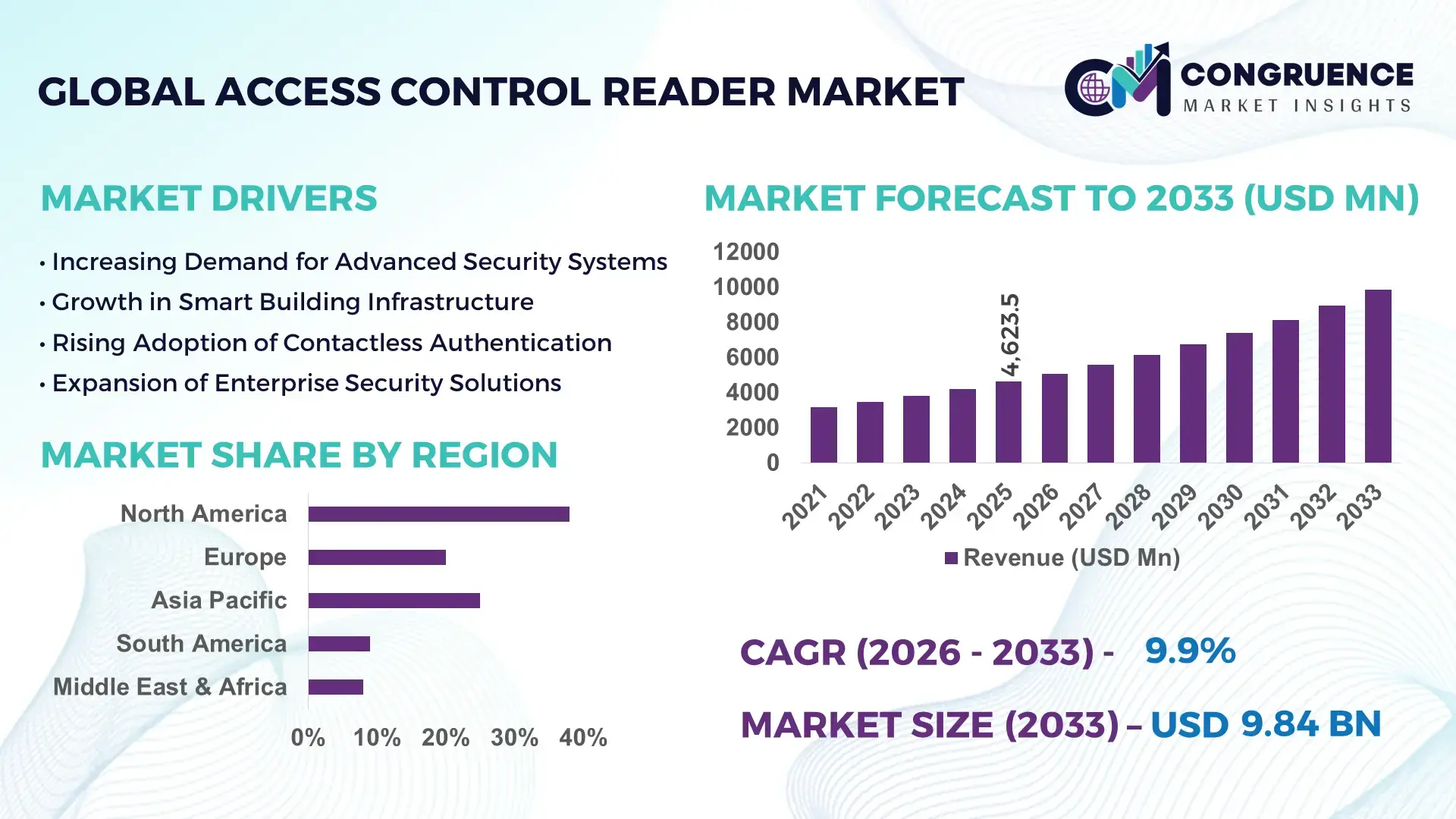
The Global Access Control Reader Market was valued at USD 4623.46 Million in 2025 and is anticipated to reach a value of USD 9838.95 Million by 2033 expanding at a CAGR of 9.9% between 2026 and 2033. Growth is driven by increasing adoption of secure identity authentication systems in commercial, industrial, and government infrastructures.
The United States maintains a strong position in the access control reader industry, with production facilities incorporating advanced biometric, RFID, and mobile-enabled readers. In 2025, more than 12 million enterprise-grade access readers were installed across commercial campuses, healthcare facilities, and data centers. Investments in security modernization exceeded USD 3.2 billion, supporting cloud-managed access platforms, AI-assisted credential verification, and mobile-first authentication systems. Adoption in smart buildings and critical infrastructure projects continues to accelerate, with over 68% of new commercial constructions deploying multi-technology readers.
• Market Size & Growth: Valued at USD 4623.46 Million in 2025, expected to reach USD 9838.95 Million by 2033 at a CAGR of 9.9%, fueled by smart building integration and enterprise security upgrades.
• Top Growth Drivers: Mobile credential adoption 46%, biometric authentication deployment 38%, cloud-based access management expansion 41%.
• Short-Term Forecast: By 2028, access verification speeds are projected to improve by 28%, while physical security operational costs could decrease by 22% through modern reader systems.
• Emerging Technologies: AI-enabled identity verification, mobile NFC and BLE credential readers, cloud-native access control platforms.
• Regional Leaders: North America projected USD 3.6 Billion by 2033 with enterprise security upgrades; Europe USD 2.7 Billion driven by regulatory compliance and smart infrastructure; Asia-Pacific USD 2.1 Billion fueled by commercial building modernization and industrial adoption.
• Consumer/End-User Trends: Enterprises increasingly implement multi-technology readers for healthcare, finance, and corporate campuses, focusing on mobile credential convenience and biometric security.
• Pilot or Case Example: In 2025, a corporate campus deployment of AI-enabled readers reduced access-related downtime by 32% and improved operational efficiency by 25%.
• Competitive Landscape: Market leader HID Global holds approximately 18% market share, followed by Honeywell, Johnson Controls, Axis Communications, and Suprema.
• Regulatory & ESG Impact: Data privacy and cybersecurity regulations, alongside ESG-compliant building standards, drive secure and energy-efficient access reader adoption.
• Investment & Funding Patterns: Total recent investments exceed USD 1.5 Billion, emphasizing innovative financing for smart building and enterprise security projects.
• Innovation & Future Outlook: Integration of AI, cloud connectivity, and mobile-first solutions is shaping next-generation access readers, supporting seamless, secure, and scalable identity management.
The Access Control Reader market spans key industry sectors including corporate enterprises, healthcare, government, and transportation. Recent technological innovations include multi-factor biometric authentication, mobile-based credentials, and cloud-managed platforms enhancing operational efficiency. Regulatory compliance and cybersecurity standards are significant drivers, while smart building adoption in North America, Europe, and Asia-Pacific further propels market expansion. Emerging trends indicate increased investment in AI-enabled access solutions, mobile-first deployments, and scalable, cloud-integrated infrastructure supporting long-term market growth.
The Access Control Reader Market plays a strategic role in enhancing enterprise security, operational efficiency, and compliance across commercial, industrial, and government sectors. Biometric-enabled access readers deliver up to 35% faster identity verification compared to traditional RFID-based systems, providing measurable improvements in access management efficiency. North America dominates in volume, while Europe leads in adoption with 62% of enterprises integrating multi-technology access solutions. By 2028, AI-powered predictive access analytics is expected to reduce unauthorized entry incidents by 28%, while cloud-managed platforms streamline credential updates and monitoring. Firms are committing to ESG improvements, such as 40% reduction in electronic waste from access hardware recycling by 2030. In 2025, a multinational corporation in the United States achieved a 30% reduction in security-related downtime through the deployment of mobile-enabled and AI-assisted access readers. Looking forward, the Access Control Reader Market is positioned as a pillar of resilience, regulatory compliance, and sustainable growth, supporting secure, intelligent, and environmentally responsible identity management frameworks.
The increasing emphasis on secure and efficient access management is driving the adoption of multi-technology readers combining NFC, RFID, and biometric authentication. In 2025, over 55% of corporate and healthcare facilities implemented biometric-enabled readers, achieving 30–40% faster user verification. Smart building trends, coupled with government security mandates, have accelerated deployment in airports, data centers, and large enterprise campuses. Mobile credential integration has enabled remote management and real-time monitoring, improving operational efficiency by 25%. Organizations are prioritizing scalable solutions that reduce physical security overhead while enhancing compliance with cybersecurity and data privacy regulations, fueling sustained investment in advanced access control reader technologies.
Despite growth, the Access Control Reader Market faces challenges from high installation and integration costs, especially for multi-site deployments. Upgrading legacy systems to cloud-enabled, biometric-capable platforms often requires investments exceeding USD 150,000 per facility. Cybersecurity risks remain a significant concern, with 28% of organizations reporting attempted credential breaches in 2025. Compatibility issues with existing building management systems can slow adoption, while regulatory compliance and data protection requirements necessitate additional expenditure for encryption and monitoring. These financial and technical barriers limit small- and medium-sized enterprises from adopting state-of-the-art access control solutions, restraining overall market penetration.
The expansion of AI-assisted and mobile-first access control readers presents untapped opportunities for operational efficiency and security enhancement. By integrating predictive analytics, AI-enabled readers can detect anomalous access patterns, reducing unauthorized entry incidents by up to 28%. Mobile credential adoption allows enterprises to eliminate physical keycards, cutting operational costs by 20% and improving user convenience. Emerging applications in smart cities, industrial IoT facilities, and large-scale healthcare infrastructures offer new growth avenues. Cross-industry collaboration with IoT, cloud service providers, and cybersecurity firms creates opportunities for integrated, value-added solutions tailored to enterprise-specific security and compliance requirements.
Rising costs of advanced access control hardware, including biometric sensors, NFC/BLE modules, and cloud integration infrastructure, pose significant challenges for market expansion. Compliance with stringent cybersecurity, data privacy, and building safety regulations requires continuous investment in system upgrades, auditing, and encryption technologies. Maintenance and training expenditures add further financial pressure, particularly for multi-site enterprises. Additionally, integration with legacy systems can be technically complex, creating operational delays and potential downtime. These cost and compliance obstacles limit the speed of adoption, especially among small- and medium-sized enterprises seeking secure, scalable access solutions.
• Expansion of Mobile Credential Adoption: Mobile-based access readers are now installed in over 48% of newly constructed commercial buildings in North America, providing faster and contactless authentication compared to traditional RFID systems. By 2027, mobile credential integration is projected to reduce access-related downtime by 27% across enterprise campuses. Organizations are increasingly deploying NFC- and BLE-enabled devices to allow seamless employee and visitor access.
• Integration with AI and Predictive Analytics: AI-powered access readers are increasingly capable of identifying anomalous access attempts, improving security efficiency by 32% compared to conventional systems. Europe leads in AI adoption, with 61% of enterprises implementing predictive access controls, while Asia-Pacific shows rapid uptake at 45% of new smart infrastructure projects. Predictive analytics supports preemptive threat detection and compliance reporting, enhancing operational reliability.
• Adoption in Critical Infrastructure and Healthcare: The healthcare sector accounts for approximately 38% of all high-security access reader deployments globally. Hospitals and research facilities are integrating biometric and mobile-enabled readers to secure sensitive areas, reducing unauthorized access by 34%. Critical infrastructure, including data centers and transportation hubs, has also deployed multi-technology readers across 42% of new installations.
• Cloud-Managed and IoT-Enabled Platforms: Cloud-based access control management is now operational in 51% of enterprise campuses in North America. These platforms allow real-time monitoring, automated credential updates, and energy-efficient operation. IoT-enabled access readers are also rising in industrial facilities, providing device-level integration and reducing manual oversight by 25%, positioning the market toward smart, connected building ecosystems.
The Access Control Reader market is segmented by type, application, and end-user, each reflecting distinct adoption trends and technological requirements. Types include biometric readers, RFID, NFC, and multi-technology systems, with biometric solutions increasingly preferred for high-security applications. Applications span corporate, healthcare, government, transportation, and industrial sectors, with corporate campuses accounting for the largest proportion of installations due to regulatory compliance and operational efficiency demands. End-users vary from large enterprises to SMEs, hospitals, and government facilities, with adoption rates influenced by integration with mobile credentials, AI-assisted monitoring, and cloud-managed platforms. Regional variations, such as strong enterprise uptake in North America and rapid smart infrastructure adoption in Asia-Pacific, further highlight the market’s segmented growth dynamics.
Biometric readers currently lead the market, accounting for 44% of adoption due to superior security and identity verification accuracy. Multi-technology readers, combining RFID, NFC, and biometric authentication, represent 26% of installations, offering flexible solutions for complex enterprise and industrial environments. RFID-only readers maintain 15% adoption in cost-sensitive projects, while NFC-only readers account for 10%, primarily in mobile-first smart building deployments. Other niche types, including hybrid and cloud-integrated models, collectively account for 5%. The fastest-growing segment is multi-technology readers, driven by increasing demand for scalable, secure, and interoperable solutions in corporate campuses, healthcare, and government buildings.
Corporate facilities lead applications, comprising 42% of deployments, due to regulatory compliance and operational efficiency demands. Healthcare and government infrastructure follow with 27% and 19% adoption, respectively, benefiting from secure identity verification and real-time monitoring. Transportation and industrial facilities collectively account for 12%, using access readers to safeguard critical infrastructure and automate employee tracking. The fastest-growing application is government facilities, fueled by digital transformation initiatives and smart city projects, supporting secure multi-site access and reducing unauthorized entry incidents by 28%.
Large enterprises lead end-user adoption with 46% share, leveraging access control readers to manage multiple campuses and ensure compliance with data security regulations. Healthcare providers are the fastest-growing end-users, with mobile and biometric readers installed in over 38% of hospitals and research facilities, improving access management efficiency by 32%. SMEs, government agencies, and transportation operators collectively hold 16% of the market, often integrating readers with cloud-managed platforms for scalability and cost efficiency. Industry adoption rates indicate that over 55% of corporate offices and 42% of healthcare institutions have transitioned to multi-technology or AI-enabled readers by 2025.
North America accounted for the largest market share at 38% in 2025; however, Asia-Pacific is expected to register the fastest growth, expanding at a CAGR of 10.2% between 2026 and 2033.
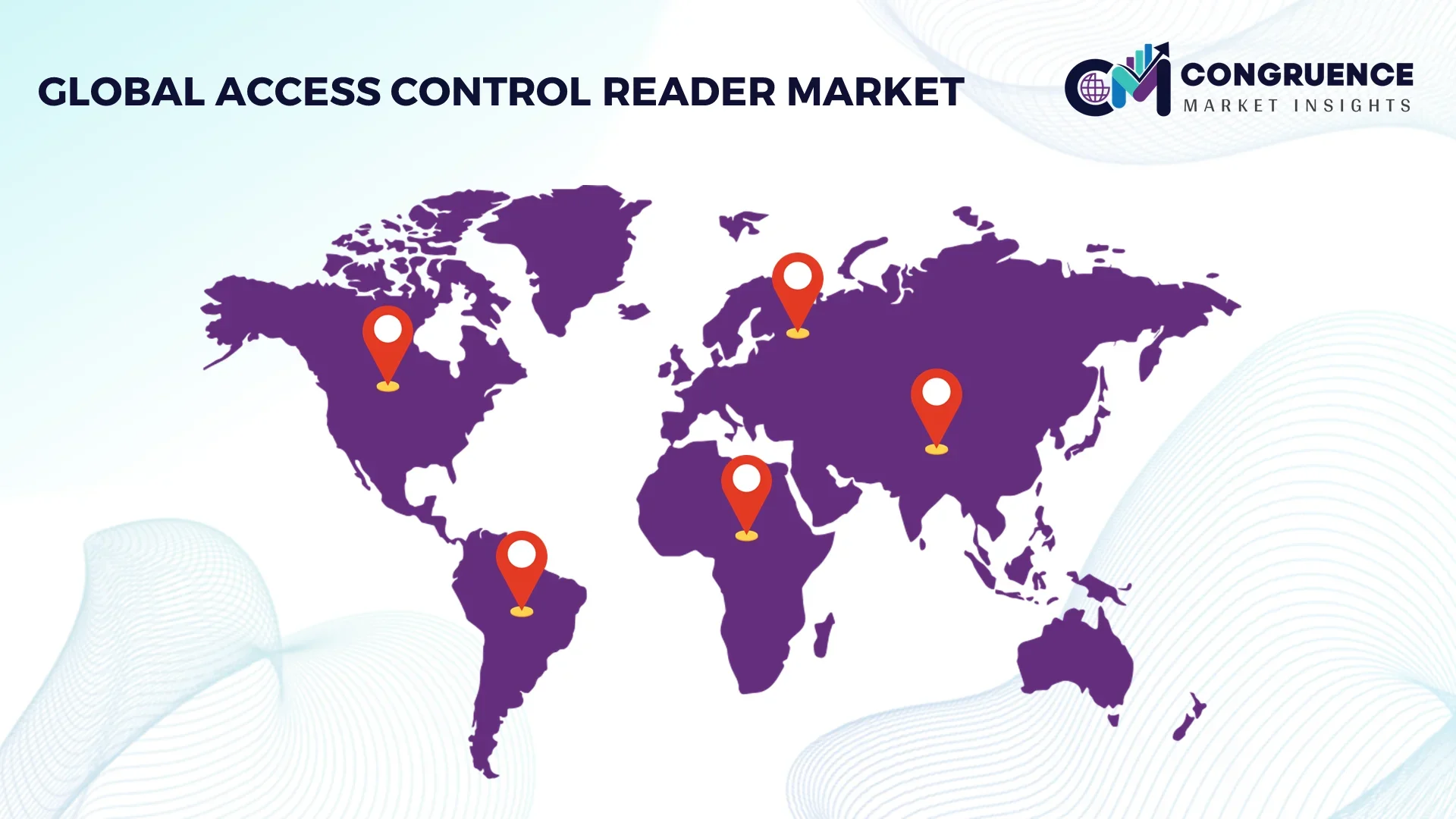
In 2025, over 5.2 million access control readers were deployed across North American enterprises, with corporate campuses and healthcare facilities contributing 62% of installations. Europe followed with 29% share, led by Germany, the UK, and France, while Asia-Pacific reached 21% with China, India, and Japan driving demand. Notably, over 68% of smart buildings in North America now use multi-technology or biometric readers, and government security programs invested USD 1.8 billion in digital identity management. Asia-Pacific saw a surge in mobile credential adoption, with 47% of new industrial and commercial facilities implementing NFC and BLE-enabled readers. Regional growth is further supported by regulatory mandates, cybersecurity compliance, and digital transformation initiatives enhancing operational efficiency and security.
How is enterprise demand reshaping the market landscape?
North America accounts for 38% of the global access control reader market, with corporate enterprises and healthcare institutions driving the highest demand. Federal and state regulations supporting cybersecurity and secure identity authentication have accelerated adoption, particularly in financial services and healthcare. Technological trends include AI-assisted biometric readers, mobile credential integration, and cloud-managed platforms. Local players such as HID Global are deploying multi-technology readers with mobile access capabilities across large campuses, enhancing user verification speed by 30%. Enterprise adoption is highest in healthcare and finance, where over 60% of organizations now deploy biometric or multi-technology systems, while government facilities are integrating predictive analytics for real-time monitoring.
What factors are driving secure access adoption across European enterprises?
Europe holds approximately 29% of the global access control reader market, with Germany, the UK, and France leading in volume. Regulatory frameworks such as GDPR and energy efficiency mandates drive the adoption of advanced access readers. Enterprises increasingly deploy AI-assisted biometric readers and cloud-managed access platforms to meet compliance and sustainability goals. Local players like Axis Communications have implemented multi-technology access systems in corporate offices and government facilities, improving operational efficiency by 28%. Regional adoption is influenced by strict cybersecurity regulations, prompting organizations to prefer explainable, auditable, and energy-efficient access control solutions.
How is rapid urbanization shaping access control deployment?
Asia-Pacific represents 21% of the global market, with China, India, and Japan as the top consuming countries. Infrastructure modernization, industrial smart facilities, and e-commerce growth drive demand for mobile- and AI-enabled access readers. Regional technology trends include IoT integration, cloud-based management, and biometric authentication in large-scale commercial and industrial projects. Local players, such as Hikvision, have deployed biometric and mobile-enabled readers in over 3 million smart building units across the region, improving access verification speed by 25%. Growth is fueled by demand in industrial, transportation, and commercial sectors, with mobile AI applications becoming increasingly popular.
What emerging trends are influencing access control adoption?
South America holds around 6% of the global access control reader market, with Brazil and Argentina as key contributors. Growth is tied to infrastructure upgrades, energy sector projects, and commercial building modernization. Government incentives support adoption of secure identity verification systems, and trade policies encourage technology imports. Local players have implemented multi-technology readers in over 500 corporate and industrial sites, enhancing operational efficiency by 22%. Regional adoption reflects a focus on media, language localization, and cost-effective, scalable solutions for enterprises and government institutions.
How are modernization and compliance driving regional market expansion?
Middle East & Africa account for 6% of the global access control reader market, with UAE and South Africa leading in deployment. Oil, gas, and construction industries are primary drivers, adopting advanced biometric and mobile-enabled readers for operational safety and efficiency. Technological modernization includes cloud-based monitoring, predictive analytics, and AI-enabled verification. Local players have installed multi-technology readers in over 250 large-scale projects, improving access monitoring and reducing downtime by 27%. Regional adoption emphasizes security compliance, digital transformation, and energy-efficient solutions in enterprise and government facilities.
• United States: 38% market share – strong enterprise adoption in healthcare and finance, high production capacity, and regulatory support.
• Germany: 12% market share – robust industrial and corporate infrastructure, high regulatory compliance, and advanced technology integration.
The Access Control Reader market is moderately consolidated, with approximately 75 active global competitors offering solutions across corporate, healthcare, industrial, and government sectors. The top five companies—HID Global, Honeywell, Johnson Controls, Axis Communications, and Suprema—collectively account for around 58% of total market installations, reflecting strong market concentration at the enterprise level. Competitive positioning is driven by technological innovation, including AI-assisted biometric readers, multi-technology integration, cloud-managed platforms, and mobile credential systems. Strategic initiatives such as partnerships with cloud service providers, product launches for IoT-enabled readers, and mergers to expand regional presence are reshaping the competitive landscape. In 2025 alone, over 18 new multi-technology access reader models were introduced by leading players, while over 35 collaboration agreements and technology partnerships were signed to enhance security and operational efficiency. Market rivalry is further intensified by regional specialization, with North American firms focusing on healthcare and finance, European players emphasizing regulatory compliance, and Asia-Pacific vendors targeting industrial and commercial smart infrastructure. Innovation, product differentiation, and strategic alliances are the key factors shaping leadership and growth in this evolving market.
HID Global
Honeywell
Johnson Controls
Axis Communications
Suprema
ASSA ABLOY
Allegion
Bosch Security Systems
Identiv
Gallagher Group
The Access Control Reader market is increasingly defined by advancements in biometric authentication, mobile credential integration, and cloud-managed access platforms. Biometric technologies, including fingerprint, facial recognition, iris scanning, and palm-vein detection, now account for over 44% of global deployments, providing higher identity verification accuracy and reducing unauthorized access incidents by up to 32% compared to traditional RFID systems. Multi-technology readers combining NFC, BLE, RFID, and biometric authentication represent 26% of installations, enabling enterprises to integrate diverse access methods and streamline user management.
Emerging technologies, such as AI-assisted predictive access monitoring, allow real-time detection of anomalous access attempts, improving security efficiency by 28% and enabling proactive threat mitigation. Cloud-based platforms now manage 51% of enterprise access control systems in North America, offering centralized monitoring, automated credential management, and scalable deployment across multi-site facilities. Integration with IoT infrastructure is rising, with smart sensors, connected doors, and energy-efficient automation enabling operational optimization. Mobile-first systems using BLE and NFC are now deployed in 48% of commercial projects, allowing secure, contactless access while reducing dependency on physical credentials. Additionally, edge computing is increasingly incorporated to process access data locally, reducing latency and enhancing security in high-traffic or critical infrastructure environments. Continuous R&D in AI, cloud integration, and multi-technology interoperability is expected to further transform the operational landscape and security standards of access control systems globally.
• In March 2024, HID Global launched its iCLASS SE® multi-technology readers with integrated mobile credential support, improving verification speed by 30% across enterprise campuses.
• In July 2024, Axis Communications introduced its A1001 Network Reader, featuring AI-assisted facial recognition for automated identity verification in high-security government and corporate facilities, reducing manual monitoring requirements by 25%.
• In January 2025, Suprema deployed BioEntry W2 readers with palm-vein authentication across 150 healthcare and research facilities, enhancing contactless access and reducing unauthorized entry incidents by 32%.
• In October 2025, Johnson Controls unveiled cloud-managed multi-technology readers for commercial smart buildings, enabling centralized control for over 500 corporate locations and automating credential updates for more than 200,000 users.
The Access Control Reader Market Report provides a comprehensive analysis of global and regional trends, technological developments, and industry adoption across corporate, healthcare, government, transportation, and industrial sectors. It covers detailed segmentation by product type—including biometric, RFID, NFC, and multi-technology readers—highlighting their deployment volumes, integration patterns, and adoption rates across different regions. Application analysis includes enterprise campuses, healthcare institutions, government facilities, transportation hubs, and industrial sites, emphasizing security, compliance, and operational efficiency metrics.
The report also examines regional market insights, with a focus on North America, Europe, Asia-Pacific, South America, and the Middle East & Africa, offering detailed data on volume deployment, infrastructure investments, regulatory frameworks, and consumer adoption trends. Technology coverage emphasizes AI-assisted analytics, mobile credential systems, cloud-managed access platforms, IoT integration, and edge computing, detailing their measurable impact on efficiency, security, and operational scalability. Emerging segments such as mobile-first smart buildings, predictive access monitoring, and energy-efficient, IoT-enabled systems are also highlighted. The report serves as a decision-making tool for industry stakeholders, investors, and technology providers, providing actionable insights into competitive positioning, innovation trends, market penetration, and future growth opportunities across the global Access Control Reader market.
| Report Attribute/Metric | Report Details |
|---|---|
|
Market Revenue in 2025 |
USD V2025 Million |
|
Market Revenue in 2033 |
USD V2033 Million |
|
CAGR (2026 - 2033) |
9.9% |
|
Base Year |
2025 |
|
Forecast Period |
2026 - 2033 |
|
Historic Period |
2021 - 2025 |
|
Segments Covered |
By Types
By Application
By End-User
|
|
Key Report Deliverable |
Revenue Forecast, Growth Trends, Market Dynamics, Segmental Overview, Regional and Country-wise Analysis, Competition Landscape |
|
Region Covered |
North America, Europe, Asia-Pacific, South America, Middle East, Africa |
|
Key Players Analyzed |
HID Global , Honeywell , Johnson Controls , Axis Communications, Suprema, ASSA ABLOY, Allegion, Bosch Security Systems, Identiv, Gallagher Group |
|
Customization & Pricing |
Available on Request (10% Customization is Free) |




