
Reports
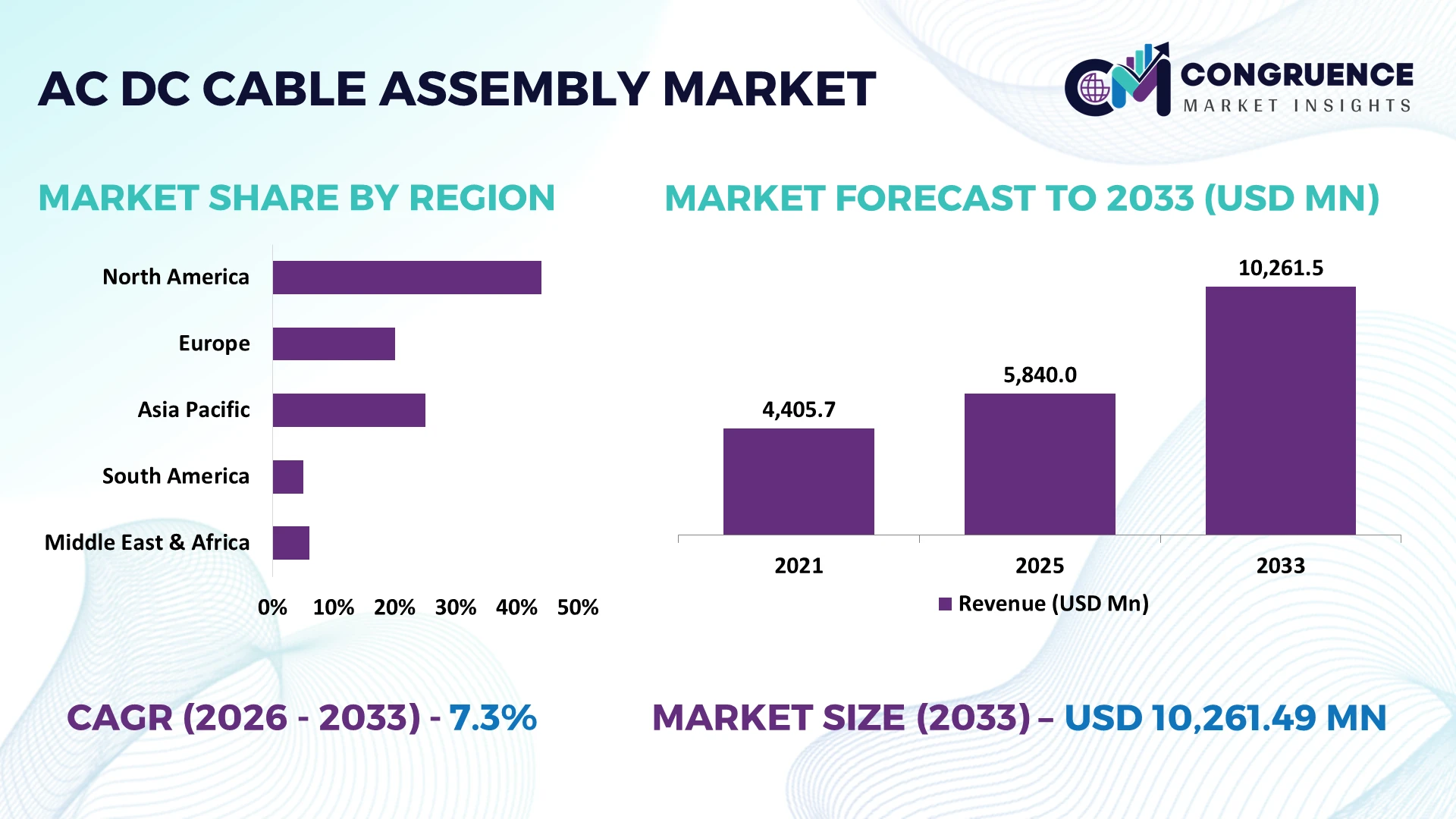
The Global AC-DC Cable Assembly Market was valued at USD 5840 Million in 2025 and is anticipated to reach a value of USD 10261.49 Million by 2033 expanding at a CAGR of 7.3% between 2026 and 2033. Growth is driven by EV charging infrastructure, data-center power expansion, industrial automation, renewable-energy equipment, and higher-density power connections requiring certified, thermally stable cable assemblies.
China remains the dominant manufacturing country, supported by an electronics sector contributing roughly 10% of national industrial output and an EV market exceeding 11 million annual new-energy vehicle sales. Cable demand spans power supplies, charging equipment, telecom hardware, appliances, factory automation, and renewable systems. Compared with the U.S., China combines deeper connector-component localization with larger electronics manufacturing clusters. Meanwhile, U.S.-China trade tensions and supply-chain diversification are directing additional cable-assembly capacity toward Vietnam, India, and Mexico, reducing single-country sourcing exposure.
Strategically, buyers should secure multi-country production, automated assembly capability, and certified high-current designs as electrification increases cable-performance requirements.
Market Size & Growth: USD 5,840 million in 2025 reaches USD 10,261.49 million by 2033 at 7.3% CAGR, supported by electrification, charging infrastructure, and data-center power density.
Top Growth Drivers: EV sales expanded 25%, data-center electricity demand approaches 945 TWh by 2030, and renewable capacity additions increased about 15% in 2024.
Short-Term Forecast: By 2028, automated cutting, stripping, crimping, and inspection can improve cable-assembly throughput by 20–30%, strengthening high-volume production economics.
Emerging Technologies: 3 major shifts—automated crimp inspection, high-temperature insulation, and high-current connector engineering—are improving assembly consistency, thermal management, and power density.
Regional Leaders: Asia-Pacific, North America, and Europe remain core markets; applying indicative shares of 45%, 27%, and 22% implies approximately USD 4.62 billion, USD 2.77 billion, and USD 2.26 billion by 2033.
End-User Trends: Global EV sales exceeded 17 million units in 2024, increasing requirements for charging, power-conversion, battery-support, and auxiliary cable assemblies.
Pilot/Case Example: In 2025, automated cable processing lines demonstrated production configurations exceeding 5,000 processing cycles per hour, reducing manual handling across standardized harness operations.
Competitive Landscape: TE Connectivity holds a significant global interconnect position, while Amphenol, Molex, Aptiv, and Yazaki compete through high-current engineering, customization, manufacturing scale, and qualification capability.
Regulatory & ESG Impact: EU rules target at least 42.5% renewable energy by 2030, accelerating grid, storage, charging, and power-conversion installations requiring durable electrical interconnections.
Investment & Funding: Global clean-energy investment is moving beyond USD 2 trillion annually, increasing equipment orders across renewable generation, grids, storage, electrification, and associated cable infrastructure.
Innovation & Future Outlook: 800V vehicle architectures can halve current at equivalent power versus 400V systems, shifting cable design toward higher-voltage insulation, optimized conductor sizing, and advanced connector safety.
The AC-DC Cable Assembly Market is increasingly shaped by EV charging systems, data centers, industrial automation, renewable-energy converters, consumer electronics, and power-distribution equipment. Global EV sales exceeded 17 million units in 2024, intensifying requirements for high-current, thermally stable interconnections. Manufacturers are advancing automated crimping, machine-vision inspection, high-temperature insulation, compact connectors, and application-specific assemblies to improve reliability and production consistency. Supply-chain diversification away from concentrated Chinese sourcing is simultaneously expanding manufacturing footprints in India, Vietnam, and Mexico, making qualification capability, regional production flexibility, and electrical-performance engineering central to the market’s strategic direction.
AC-DC cable assemblies are becoming strategically important as electrification shifts power connectivity from standardized wiring toward higher-current, thermally controlled, application-specific systems. Global EV sales exceeded 17 million units in 2024, while data-center electricity consumption is projected to approach 945 TWh by 2030. Supply-chain restructuring is simultaneously moving assembly capacity beyond China toward India, Vietnam, and Mexico, giving OEMs greater sourcing resilience and shorter delivery routes.
Automated cutting, stripping, crimping, and vision inspection can raise production throughput by 20–30% versus labor-intensive assembly while improving termination consistency. China retains advantages in electronics-component scale, whereas Mexico benefits from proximity to U.S. automotive and industrial customers. Through 2028, 800V vehicle platforms, higher-density computing infrastructure, and automated factories will increase requirements for high-voltage insulation, compact connectors, and traceable assemblies.
A practical EV charging installation combines AC input assemblies with DC power connections engineered for continuous high-current operation. Manufacturers are expanding automated production, regionalizing sourcing, and partnering with connector and equipment specialists. Competitive advantage will increasingly depend on certified engineering, automation, supply-chain redundancy, and rapid customization rather than low-cost cable fabrication alone.
Electrification is increasing cable content across vehicles, charging systems, renewable installations, data centers, and automated machinery. Global electric-car sales exceeded 17 million units in 2024, rising more than 25%, while EVs represented over 20% of worldwide new-car sales. Renewable capacity additions also increased by roughly 15% during 2024, expanding inverter, converter, storage, and grid-connection requirements. China’s large EV and electronics manufacturing base creates particularly dense demand for high-current assemblies, while 800V vehicle architectures are changing insulation and connector specifications. Manufacturers are responding with high-voltage product platforms, automated termination lines, temperature-resistant materials, and partnerships with charging-equipment suppliers. The strategic advantage increasingly lies in engineering assemblies around power density and thermal performance rather than supplying standardized cable lengths.
Material intensity remains a structural constraint because copper conductors, polymers, connectors, and terminals represent substantial assembly input costs. Copper prices have experienced swings exceeding 20% across recent annual trading periods, while copper accounts for approximately 60% of global electricity-related conductor demand. China processes more than 40% of refined copper globally, creating additional concentration exposure for international electrical-component supply chains. Freight disruption through the Red Sea has also lengthened selected Asia-Europe shipping routes, complicating inventory planning for connectors and cable materials. Producers face margin pressure when contracts cannot immediately pass through metal-price movements. Companies are countering this through indexed pricing, longer-term copper procurement, dual sourcing, regional inventories, and selective aluminum-conductor engineering. Procurement discipline therefore has direct influence on profitability, not simply manufacturing efficiency.
Higher-voltage power architectures create opportunities for technically differentiated assemblies rather than commodity wiring. Moving an EV platform from 400V to 800V can reduce current by approximately 50% at equivalent power, supporting smaller conductors, lower resistive losses, and faster charging architectures. Electric cars already exceed 20% of global new-car sales, while clean-energy additions continue expanding electrical conversion infrastructure. China leads 800V vehicle commercialization, but premium platforms in Germany, South Korea, and the United States are broadening adoption. Cable manufacturers are investing in advanced insulation, shielding, liquid-cooled charging connections, automated electrical testing, and high-voltage connector partnerships. A non-obvious opportunity lies in engineering optimization: reduced conductor cross-section can offset higher insulation and connector sophistication, allowing suppliers to capture more design value without proportionally increasing material content.
Scaling advanced assemblies requires consistent crimp geometry, insulation integrity, connector mating, thermal performance, and electrical safety across millions of terminations. EV platforms increasingly use 400–800V electrical architectures, while fast-charging systems can operate at power levels above 350 kW, sharply increasing consequences from contact resistance or assembly defects. Automotive programs can also require validation across temperature ranges approaching -40°C to 125°C, creating substantially tougher qualification conditions than conventional consumer cabling. Mexico and India are expanding manufacturing footprints, but transferring production requires synchronized tooling, process control, skilled technicians, and supplier qualification. Manufacturers must invest in automated crimp-force monitoring, machine-vision inspection, high-voltage testing, digital traceability, and workforce training. Long-term competitiveness therefore depends on replicating certified process capability across plants, not simply adding assembly capacity.
Automation Moves Into Quality Control: Cable processors are integrating crimp-force monitoring, machine vision, and automated electrical testing alongside cutting and stripping equipment. Modern processing lines can exceed 5,000 cycles per hour, while automated workflows can improve throughput by 20–30%. Manufacturers in China and Mexico are linking inspection data directly to production records, reducing manual sampling and accelerating fault isolation. Labor-cost pressure is pushing suppliers toward digitally traceable production rather than simply faster machinery.
Nearshoring Reshapes Assembly Footprints: U.S. manufacturers are shifting selected cable-assembly sourcing toward Mexico as geopolitical and logistics exposure alters procurement strategies. Mexico-U.S. goods trade exceeds USD 800 billion annually, while Red Sea diversions have added roughly 3,500 nautical miles to some Asia-Europe routes. Suppliers are expanding regional termination, molding, and final-testing operations, shortening replenishment cycles and reducing dependence on single-country Asian supply chains.
Data Centers Demand Denser Connections: Global data-center electricity consumption is moving toward approximately 945 TWh by 2030, while AI-optimized facilities increasingly deploy rack architectures above 100 kW. Higher power density is changing cable requirements around conductor sizing, thermal management, connector retention, and compact routing. Assembly manufacturers are developing pre-terminated, modular power connections and improving thermal validation, allowing operators to install high-density infrastructure faster while limiting connection-related downtime.
Circular Materials Enter Cable Design: Sustainability requirements are pushing manufacturers toward recyclable polymers, halogen-free insulation, and higher recycled-metal content. The EU targets at least 42.5% renewable energy by 2030, while cable producers increasingly pursue 100% recyclable packaging and lower-carbon copper procurement. Suppliers are redesigning material specifications and consolidating qualified compounds, creating a non-obvious procurement advantage: fewer insulation formulations can simplify certification, inventory management, and recycling simultaneously.
Multi-Core Assemblies account for an estimated 36% market share, supported by their ability to consolidate multiple power or control conductors within one routed assembly. Their space efficiency and simplified installation make them particularly relevant to industrial machinery, appliances, telecommunications hardware, and integrated power systems. Single-Core Assemblies remain important where high-current capacity, thermal separation, or straightforward replacement is prioritized. Unshielded Assemblies retain cost advantages in electrically stable environments, supporting standardized, high-volume applications.
Shielded Assemblies represent the fastest-growing type as higher switching frequencies, compact electronics, industrial automation, and data-center equipment increase electromagnetic-interference requirements. Shielding can deliver attenuation above 80–90 dB in appropriately engineered configurations, making signal and power integrity increasingly valuable. Molded Assemblies are also gaining strategic importance because overmolding improves strain relief, ingress protection, and connector durability. Manufacturers are therefore expanding automated multi-core processing, shielding capability, and injection-molding operations while prioritizing application-specific engineering over commodity cable production.
Power Distribution holds an estimated 29% share, reflecting extensive use of AC-DC assemblies across power supplies, conversion equipment, electrical cabinets, charging infrastructure, and distributed power architectures. Industrial Equipment remains a mature application because robotics, drives, machine controls, and automated production lines require durable pre-terminated connections. Consumer Electronics maintains substantial unit volumes but emphasizes compact construction and aggressive cost control, while Telecommunications increasingly requires high-density power connectivity for network equipment.
Data Centers represent the fastest-growing application as AI computing raises rack-level power requirements and increases connection density. Global data-center electricity consumption is projected to approach 945 TWh by 2030, while emerging AI racks can exceed 100 kW compared with roughly 10–20 kW in conventional installations. Automotive Systems are simultaneously adopting increasingly specialized assemblies around onboard electronics and power conversion. Manufacturers are responding with modular power cabling, higher-temperature insulation, factory-tested terminations, compact connectors, and automated production. Demand is therefore shifting toward assemblies that reduce installation time while sustaining higher continuous electrical loads.
Electronics Manufacturers lead end-user demand with an estimated 31% share because power assemblies are embedded across computing equipment, power supplies, displays, networking hardware, control systems, and consumer devices. Their purchasing scale favors standardized connector platforms, automated assembly, and supplier consolidation. Appliance Manufacturers remain significant volume buyers, while Industrial Equipment Manufacturers prioritize ruggedness, customization, service life, and dependable termination performance over minimum unit cost. Telecommunications Companies increasingly specify compact, high-density assemblies for network and edge infrastructure.
Data Center Operators represent the fastest-growing buyer group as AI infrastructure increases rack density and accelerates electrical-system redesign. Data-center electricity use is heading toward approximately 945 TWh by 2030, while AI-oriented racks can exceed 100 kW, creating demand for modular and thermally robust power connections. Automotive Manufacturers provide another technically demanding customer base through electrified auxiliary and power-conversion systems. Cable suppliers are responding with customized engineering, long-term OEM qualification, regional production, automated inspection, and integrated connector partnerships.
Asia-Pacific accounted for the largest market share at approximately 45% in 2025 however, Asia-Pacific is expected to register the fastest growth, expanding at a CAGR of approximately 8.2% between 2026 and 2033.
Nearshoring and High-Power Infrastructure Reshape Procurement
North America accounts for approximately 27% of global AC-DC cable assembly demand, supported by data-center construction, industrial automation, telecommunications infrastructure, automotive electronics, and power-distribution modernization. U.S. AI infrastructure is raising rack-level electrical density, with advanced computing installations moving beyond 100 kW per rack compared with roughly 10–20 kW in conventional facilities. This transition increases requirements for factory-terminated, thermally validated, high-current assemblies. Mexico is simultaneously gaining manufacturing relevance as OEMs shorten supply chains and reduce exposure to trans-Pacific logistics. USMCA-based production networks support regional sourcing of connectors, wiring systems, and finished assemblies. Suppliers are investing in automated termination, molding, electrical testing, and Mexico-based capacity while U.S. customers increasingly prioritize traceability and shorter replenishment cycles over lowest-cost offshore sourcing.
United States Market Outlook: The United States combines large data-center capacity with advanced industrial automation, semiconductor investment, and extensive telecommunications infrastructure. Data-center electricity consumption is expected to rise sharply through 2030 as accelerated computing expands. This creates sustained requirements for high-density power distribution, modular connections, certified assemblies, and temperature-resistant insulation, encouraging suppliers to integrate engineering support with domestic or nearshore production.
Electrification and Compliance Elevate Cable Specifications
Europe represents approximately 22% of global demand, with Germany, France, Italy, and Central European manufacturing hubs supporting automotive, machinery, renewable-energy, appliance, and industrial-electronics applications. Electrification is raising specification requirements as EV platforms, charging systems, inverters, automation equipment, and distributed energy assets require higher-voltage and thermally robust connections. The EU’s renewable-energy framework targets at least 42.5% renewable energy by 2030, reinforcing investment across grids, storage, conversion equipment, and charging infrastructure. At the same time, RoHS, REACH, and circular-economy requirements influence conductor, insulation, and connector material selection. Suppliers are investing in halogen-free compounds, automated quality inspection, recyclable materials, and localized engineering. Competition increasingly favors manufacturers able to combine regulatory documentation with application-specific electrical and mechanical performance.
Germany Market Outlook: Germany remains Europe’s most strategically important market because its automotive, machinery, automation, and electrical-equipment industries create concentrated demand for technically qualified assemblies. Electric vehicles represented roughly one-fifth of new German passenger-car registrations in 2024. Suppliers serving German OEMs increasingly require automated crimp validation, documented traceability, robust shielding, and production processes capable of meeting demanding automotive and industrial qualification cycles.
Manufacturing Scale Reinforces Supply-Chain Leadership
Asia-Pacific commands approximately 45% of global AC-DC cable assembly demand, anchored by China’s electronics manufacturing ecosystem and complemented by Japan, South Korea, India, Vietnam, and Taiwan. China combines large-scale production of consumer electronics, telecommunications hardware, EVs, appliances, renewable-energy equipment, connectors, and power electronics, creating vertically integrated demand for cable assemblies. Chinese electric-car sales exceeded 11 million units in 2024, intensifying requirements for auxiliary power, charging, conversion, and electrical-system connections. Vietnam and India are simultaneously gaining assembly capacity as electronics companies diversify manufacturing footprints. Suppliers are expanding automated cutting, stripping, crimping, molding, and testing operations while building secondary production locations. The region’s advantage increasingly combines component availability, manufacturing scale, engineering capability, and faster supplier-to-OEM qualification rather than labor economics alone.
China Market Outlook: China remains the critical production and consumption hub because electronics, EV, battery, renewable-energy, appliance, and telecommunications supply chains operate at exceptional scale. New-energy vehicles exceeded 40% of domestic new-car sales during 2024. Dense connector, copper-processing, plastics, and contract-manufacturing ecosystems allow cable suppliers to shorten component lead times while supporting rapid design iterations for high-volume OEM programs.
Industrial Electrification Concentrates Demand in Brazil
South America accounts for approximately 3% of global AC-DC cable assembly demand, with Brazil providing the largest industrial base and Argentina, Chile, and Colombia contributing through telecommunications, renewable energy, mining, appliances, and automation. Brazil’s manufacturing ecosystem supports automotive components, electrical machinery, consumer equipment, and data infrastructure, creating demand for both standardized and application-specific assemblies. Renewable electricity already represents more than 80% of Brazilian power generation, supporting continued investment in conversion, grid, storage, and control equipment. However, imported connectors, specialized polymers, and electronics components expose assemblers to currency movements and longer procurement cycles. Manufacturers are responding through localized termination and molding, regional inventories, supplier diversification, and standardized connector platforms. This structure favors companies capable of combining imported technology with cost-efficient local value addition.
Brazil Market Outlook: Brazil offers the region’s strongest operational platform through its automotive clusters, appliance production, renewable-energy infrastructure, and expanding data-center footprint. São Paulo and neighboring industrial states concentrate electronics and component manufacturing. High renewable-electricity penetration also supports electrification investments, while local assembly enables suppliers to reduce finished-product import exposure and customize cables for Brazilian industrial standards and operating environments.
Infrastructure Modernization Expands Power Connectivity
Middle East & Africa represents approximately 3% of global AC-DC cable assembly demand, with activity concentrated in the UAE, Saudi Arabia, South Africa, and selected North African industrial centers. Gulf economies are expanding data centers, renewable-energy projects, telecommunications networks, automated logistics, and advanced manufacturing, increasing requirements for certified power assemblies and pre-terminated electrical systems. Saudi Arabia targets 50% of its electricity generation capacity from renewable sources by 2030, creating additional demand across conversion, control, storage, and grid infrastructure. UAE data-center expansion is simultaneously raising requirements for high-density electrical distribution. Suppliers are partnering with electrical contractors, equipment OEMs, and regional distributors while maintaining strategic inventories to offset long import lead times. Localization initiatives are gradually shifting selected termination, panel-building, and assembly operations closer to major infrastructure projects.
United Arab Emirates Market Outlook: The UAE provides a concentrated market for data centers, telecommunications, aviation, automated logistics, renewable energy, and commercial infrastructure. Large-scale solar installations and hyperscale computing investment are increasing demand for reliable power conversion and distribution connections. Dubai and Abu Dhabi also provide established logistics infrastructure, allowing cable suppliers to serve Gulf projects through regional warehousing, customization, and rapid-response distribution.
TE Connectivity, Amphenol, Molex, Yazaki, and Sumitomo Electric compete with specialized regional assemblers across automotive, industrial, data-center, telecommunications, and electronics applications. The top five suppliers hold an estimated 35–40% combined share, leaving substantial business with contract manufacturers and application-specific specialists. Global leaders compete through connector technology, qualification capability, automation, and vertically integrated supply chains, while regional suppliers emphasize customization, price, and lead-time flexibility. Automated processing can raise throughput 20–30%, while optimized high-voltage designs can reduce conductor current by 50% when systems move from 400V to 800V at equivalent power. Suppliers are expanding Mexico, India, and Southeast Asian capacity, forming OEM partnerships, and integrating molding, shielding, testing, and connector production. Competition is shifting from low-cost assembly toward engineered power connectivity and supply resilience. Qualification cycles, tooling investment, certified processes, and customer-specific designs create entry barriers. Winning requires scalable automation, engineering depth, regional capacity, traceability, and rapid customization.
TE Connectivity
Amphenol Corporation
Molex
Yazaki Corporation
Sumitomo Electric Industries
Aptiv
Hirose Electric
Japan Aviation Electronics Industry
Phoenix Contact
Belden
BizLink Holding
Volex
Samtec
Rosenberger
Current AC-DC cable assembly technology centers on automated cutting, stripping, crimping, overmolding, electrical testing, and machine-vision inspection. Automated processing can raise throughput 20–30% versus labor-intensive lines while crimp-force monitoring detects termination deviations during production. High-voltage assemblies now operate across 300–800 V and up to 1,000 A, reflecting deployment in electric mobility, industrial power systems, and dense computing infrastructure. Manufacturers integrating traceability with inspection gain lower rework exposure and faster qualification for demanding OEM programs.
Emerging systems combine shielded multi-core cables, high-temperature polymers, compact high-current connectors, and digital manufacturing cells. Moving from conventional manual harness production to robot-guided assembly can automate component handling through final testing, improving repeatability while reducing direct labor requirements. 360-degree EMC shielding strengthens interference control, while conductor-processing capability spanning 2.5–120 mm² supports wider power ranges. Suppliers with connector, cable, molding, and testing capabilities benefit through faster customization and greater design ownership.
Between 2026 and 2028, disruptive adoption will center on fully automated harness cells, digital twins, AI-assisted inspection, and modular high-voltage connections. Integration of process data with serial-level traceability will shorten fault isolation and strengthen compliance. Companies investing now can defend margins, regionalize production, accelerate customer qualification, and compete on engineered reliability rather than assembly cost alone.
April 2024 Yazaki secured THB1.675 billion in co-financing for its Thai subsidiary to renovate aluminum-wire manufacturing equipment. The investment directly strengthens local power-network supply capability and improves Japanese industrial supply-chain resilience as Thailand expands transmission and distribution infrastructure. Source: jbic.go.jp
November 2025 Volex opened its expanded San Luis Potosí manufacturing hub, tripling production space from 5,000 to 15,000 square meters. The expansion increases custom wiring-harness and cable-assembly capacity while strengthening nearshore support for consumer-electrical and industrial HVAC customers. Source: volex.com
August 2025 Amphenol agreed to acquire Trexon for approximately USD 1 billion, adding high-reliability interconnect and cable-assembly capabilities. The transaction strengthens Amphenol’s defense portfolio as military connectivity requirements intensify and expands its position globally in mission-critical engineered assemblies. Source: reuters.com
March 2026 TE Connectivity launched 56G MezzaWave connectors and cable assemblies supporting 56 Gbps PAM4, 80–560 pins, and 7–10 mm stack heights. The platform improves high-density connectivity for data centers, edge AI, industrial automation, robotics, aerospace, and defense. Source: te.com
The AC-DC Cable Assembly Market Report evaluates Single-Core, Multi-Core, Shielded, Unshielded, and Molded Assemblies across Power Distribution, Industrial Equipment, Consumer Electronics, Automotive Systems, Telecommunications, and Data Centers. End-user coverage spans electronics manufacturers, automotive manufacturers, industrial equipment manufacturers, telecommunications companies, data-center operators, and appliance manufacturers. Analysis examines conductor architecture, shielding, insulation, connector integration, automated processing, overmolding, electrical testing, and digital traceability.
Regional assessment covers North America, Europe, Asia-Pacific, South America, and Middle East & Africa, with Asia-Pacific representing approximately 45% of 2025 demand. The report tracks high-current connectivity, automated harness production, nearshoring, high-density data-center power, and application-specific qualification. Competitive analysis evaluates 14 influential manufacturers and their positioning across technology, capacity, localization, and customization. The 2026–2033 framework supports capital allocation, supplier selection, geographic expansion, partnership planning, product development, and long-term competitive positioning.
| Report Attribute/Metric | Report Details |
|---|---|
Market Revenue in 2025 | USD 5840 Million |
Market Revenue in 2033 | USD 10261.49 Million |
CAGR (2026 - 2033) | 7.3% |
Base Year | 2025 |
Forecast Period | 2026 - 2033 |
Historic Period | 2021 - 2025 |
Segments Covered | By Type
By Application
By End-User
|
Key Report Deliverable | Revenue Forecast, Growth Trends, Market Dynamics, Segmental Overview, Regional and Country-wise Analysis, Competition Landscape |
Region Covered | North America, Europe, Asia-Pacific, South America, Middle East, Africa |
Key Players Analyzed | TE Connectivity, Amphenol Corporation, Molex, Yazaki Corporation, Sumitomo Electric Industries, Aptiv, Hirose Electric, Japan Aviation Electronics Industry, Phoenix Contact, Belden, BizLink Holding, Volex, Samtec, Rosenberger |
Customization & Pricing | Available on Request (10% Customization is Free) |




