
Reports
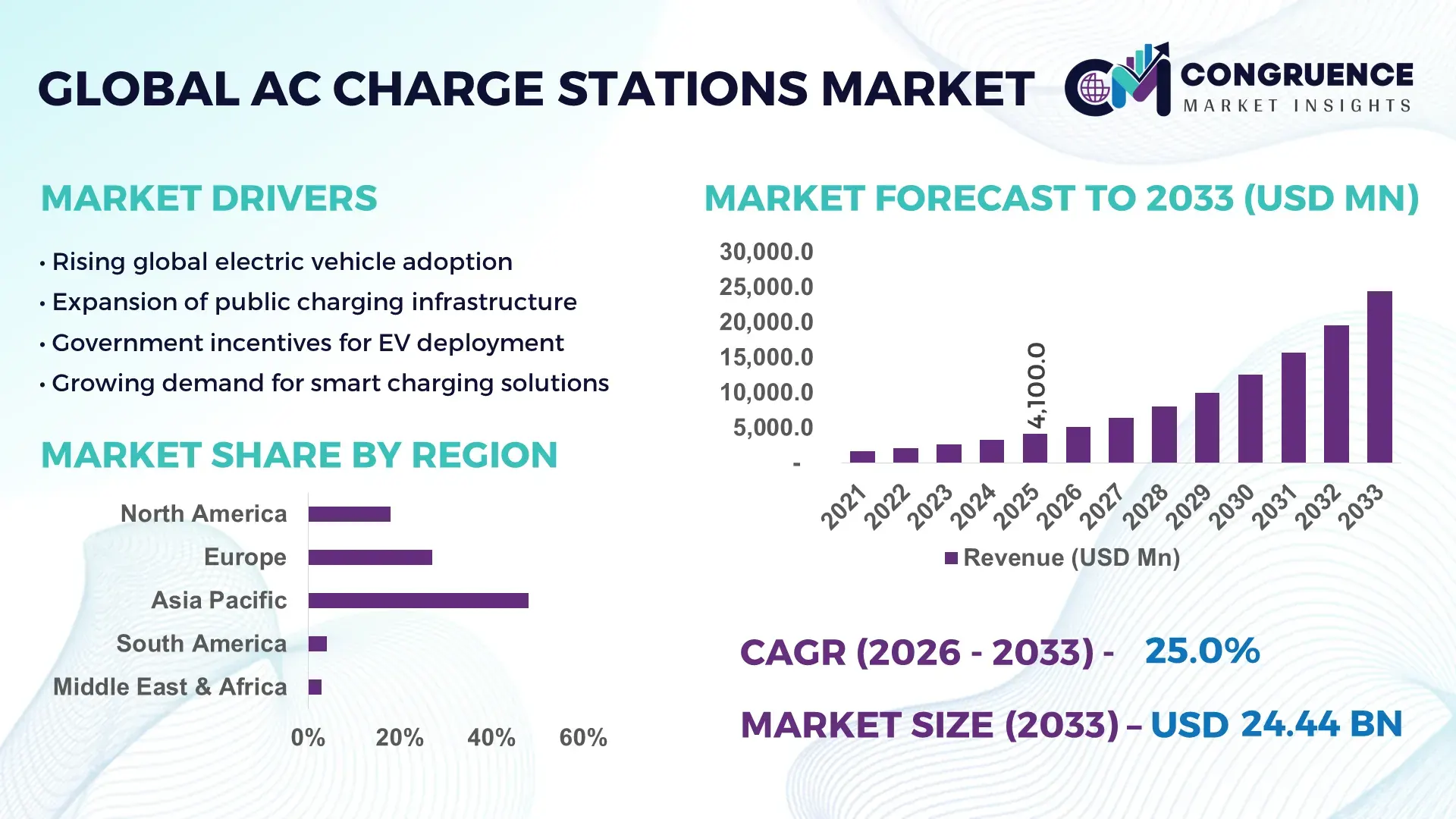
The Global AC Charge Stations Market was valued at USD 4,100.0 Million in 2025 and is anticipated to reach a value of USD 24,437.9 Million by 2033 expanding at a CAGR of 25.0% between 2026 and 2033, according to an analysis by Congruence Market Insights. Growth is primarily driven by rapid EV adoption supported by expanding urban charging infrastructure and government incentives.
China continues to demonstrate strong industrial capability in AC charge station deployment, supported by over 7.5 million public and private charging points installed nationwide as of 2025, with AC chargers accounting for nearly 65% of total installations. The country has invested over USD 12 billion in EV charging infrastructure expansion programs, enabling deployment across urban and semi-urban areas. Manufacturing hubs in provinces such as Guangdong and Jiangsu collectively produce over 60% of global AC charging equipment components. Additionally, over 70% of residential EV owners in China rely on AC charging solutions, reflecting strong consumer adoption. Smart charging integration, including IoT-enabled monitoring systems, is deployed across more than 45% of new AC stations, enhancing grid efficiency and real-time energy optimization.
Market Size & Growth: Valued at USD 4,100.0 million in 2025 and projected to reach USD 24,437.9 million by 2033, growing at 25.0% CAGR, driven by rising EV penetration and infrastructure expansion.
Top Growth Drivers: EV adoption rate exceeding 35%, charging infrastructure expansion at 40%, grid efficiency improvements of 28%.
Short-Term Forecast: By 2028, charging costs are expected to reduce by 18% due to improved energy management systems.
Emerging Technologies: Smart charging networks, vehicle-to-grid (V2G) systems, and AI-based load balancing solutions.
Regional Leaders: Asia-Pacific projected at USD 11 billion by 2033 with mass deployment; Europe at USD 7 billion driven by regulation; North America at USD 5 billion with private sector investment growth.
Consumer/End-User Trends: Over 60% of EV users prefer residential AC charging due to convenience and lower costs.
Pilot or Case Example: In 2024, a European pilot reduced peak load stress by 22% using smart AC charging systems.
Competitive Landscape: Market leader holds ~18% share, followed by multiple global infrastructure providers and energy firms.
Regulatory & ESG Impact: Over 50 countries have EV charging mandates, with subsidies covering up to 30% of installation costs.
Investment & Funding Patterns: Global investments exceeded USD 20 billion in charging infrastructure projects over the past 3 years.
Innovation & Future Outlook: Integration with renewable energy and AI-driven energy optimization shaping next-gen charging ecosystems.
AC charge stations are widely used across residential (55%), commercial (25%), and public infrastructure (20%) sectors. Recent advancements include smart metering, bidirectional charging, and integration with solar systems. Regulatory incentives, rising fuel costs, and urban electrification are accelerating adoption, particularly in Asia-Pacific and Europe. Future growth is supported by interoperability standards and scalable charging solutions.
The AC Charge Stations Market is strategically positioned at the core of global electric mobility transformation, enabling scalable and cost-efficient charging infrastructure for mass EV adoption. AC charging solutions offer a practical balance between cost and efficiency, particularly for residential and workplace charging, where over 65% of EV users rely on slow to moderate charging speeds. Compared to traditional unmanaged charging systems, smart AC charging delivers 30% improvement in energy efficiency and 25% reduction in peak load stress through optimized demand response mechanisms.
Asia-Pacific dominates in volume due to large-scale infrastructure deployment, while Europe leads in adoption with over 55% of enterprises integrating smart charging systems across commercial facilities. By 2028, AI-enabled smart grid integration is expected to reduce electricity distribution losses by 20%, improving overall charging network efficiency. Governments and corporations are aligning with ESG goals, with firms committing to reduce carbon emissions from charging operations by up to 35% by 2030 through renewable integration and energy-efficient systems.
In 2025, China achieved a 28% improvement in grid stability through the implementation of AI-based load management systems in AC charging networks, demonstrating the tangible benefits of digital transformation. Increasing investments in interoperable charging infrastructure and standardization protocols further strengthen market scalability. As electrification accelerates globally, the AC Charge Stations Market will continue to serve as a foundational pillar supporting sustainable transportation, regulatory compliance, and long-term energy resilience.
The AC Charge Stations Market is influenced by a combination of regulatory mandates, technological innovation, and evolving consumer behavior patterns. Increasing EV adoption, which surpassed 40 million units globally in 2025, is driving significant demand for accessible and cost-effective charging solutions. AC charging infrastructure remains dominant in residential and workplace environments, accounting for over 60% of total installations worldwide. Governments across more than 45 countries have introduced policies promoting charging infrastructure expansion, including subsidies, tax incentives, and public-private partnerships. Technological advancements such as smart metering, IoT integration, and vehicle-to-grid capabilities are enhancing system efficiency and enabling better load management. Additionally, urbanization trends and rising electricity demand are pushing investments in distributed energy systems integrated with AC charging stations. However, infrastructure standardization and grid capacity limitations continue to influence deployment strategies across regions.
The exponential rise in electric vehicle adoption is a primary driver for AC charge station deployment globally. As of 2025, EVs account for over 18% of new vehicle sales worldwide, with projections indicating continued growth across both developed and emerging markets. AC charging stations are preferred for residential and workplace charging due to their lower installation costs, which are approximately 40% less than DC fast chargers. Over 70% of EV users rely on home-based AC charging, increasing demand for compact and efficient charging solutions. Governments are also supporting adoption through subsidies covering up to 30% of installation costs for residential units. Additionally, urban infrastructure projects increasingly integrate AC charging points in parking facilities and commercial spaces, supporting scalable deployment. The growing need for convenient and accessible charging solutions continues to drive widespread adoption of AC charging technologies.
Grid infrastructure limitations present a significant restraint to the expansion of AC charge stations. In many regions, particularly in developing economies, existing power distribution systems are not designed to handle the additional load from widespread EV charging. Studies indicate that peak electricity demand could increase by up to 25% in urban areas with high EV penetration, leading to potential grid instability. Additionally, over 35% of existing residential buildings lack the electrical capacity required for installing AC charging systems without upgrades. Grid modernization requires substantial investment, often delaying infrastructure deployment timelines. The lack of standardized protocols for smart grid integration further complicates system compatibility across regions. These challenges necessitate coordinated efforts between utilities, governments, and private stakeholders to ensure efficient energy distribution and infrastructure scalability.
Smart charging technologies present significant opportunities for optimizing AC charging infrastructure. Over 45% of newly installed AC charge stations are now equipped with IoT-enabled monitoring systems, enabling real-time energy management and remote control capabilities. Smart charging can reduce peak load demand by up to 20%, improving grid stability and reducing operational costs. The integration of renewable energy sources, such as solar power, into AC charging systems is also gaining traction, with over 30% of new installations supporting hybrid energy solutions. Additionally, vehicle-to-grid (V2G) technology allows EVs to act as distributed energy storage units, enhancing grid flexibility. As digitalization increases, data-driven analytics and AI-based optimization tools are expected to further improve efficiency and user experience, creating new growth avenues for the market.
Interoperability and lack of standardization remain critical challenges in the AC Charge Stations Market. Multiple charging standards and communication protocols across regions create compatibility issues, affecting seamless user experience. Approximately 25% of EV users report difficulties in accessing different charging networks due to inconsistent standards. Additionally, varying regulatory requirements across countries complicate product design and deployment strategies for manufacturers. The absence of universal billing and authentication systems further limits cross-network usability. Efforts toward standardization, such as open charging protocols, are underway but require global coordination. Addressing these challenges is essential for ensuring scalability, improving consumer confidence, and enabling efficient integration of AC charging infrastructure across diverse markets.
Smart Charging Adoption Increasing by 45% Across Urban Networks: Smart AC charging systems with IoT integration now account for over 45% of new installations, enabling real-time monitoring and reducing energy wastage by 18%. Urban deployments in developed markets show over 60% adoption of connected charging systems.
Residential Charging Dominance Surpassing 55% Usage Share: Residential AC charging accounts for more than 55% of total usage, driven by convenience and cost efficiency. Over 70% of EV users prefer overnight home charging, reducing dependency on public infrastructure.
Integration with Renewable Energy Growing by 30% Annually: Approximately 30% of new AC charge stations are integrated with solar or hybrid energy systems, reducing carbon emissions by up to 25% per installation. This trend is especially prominent in Europe and Asia-Pacific regions.
Expansion of Workplace Charging Infrastructure by 35%: Corporate installations of AC charge stations have increased by 35%, with over 50% of large enterprises offering workplace charging facilities, enhancing employee EV adoption and supporting sustainability goals.
The AC Charge Stations Market is segmented based on type, application, and end-user, each reflecting distinct adoption patterns and infrastructure priorities. By type, Level 2 AC chargers dominate due to their balance of cost, efficiency, and charging speed, widely used in residential and commercial settings. By application, residential charging leads due to high EV ownership and convenience-driven usage patterns, followed by commercial and public infrastructure deployments. End-user segmentation highlights individual EV owners as the primary contributors, supported by fleet operators and commercial establishments. Over 65% of installations are concentrated in urban areas, while semi-urban adoption is rising steadily. Increasing demand for smart charging solutions, integration with renewable energy, and government incentives continue to shape segmentation dynamics across regions and user categories.
Level 1 AC chargers, Level 2 AC chargers, and smart AC chargers form the primary segments in the AC Charge Stations Market. Level 2 AC chargers currently account for approximately 58% of total installations due to their optimal charging speed of 3–22 kW and suitability for both residential and commercial use. In comparison, Level 1 chargers hold around 18% share, mainly used in low-demand residential settings due to their slower charging rates. Smart AC chargers, integrated with IoT and AI-based energy management, are the fastest-growing segment with an expected CAGR of 28.5%, driven by rising demand for grid optimization and remote monitoring capabilities. Other niche variants, including portable AC chargers and wall-mounted compact units, collectively contribute about 24% of the market, catering to flexible and space-constrained installations.
Residential charging dominates the AC Charge Stations Market with a share of approximately 55%, driven by convenience and lower operational costs. Commercial applications, including office complexes, retail spaces, and hospitality sectors, account for around 28% of installations, reflecting increasing workplace charging initiatives. Public charging infrastructure contributes nearly 17%, primarily focused on urban and highway locations. While residential remains dominant, commercial applications are the fastest-growing segment with a CAGR of 26.8%, supported by corporate sustainability goals and employee EV adoption programs. Over 62% of EV users globally rely on home-based AC charging, while 48% of enterprises have installed or are planning to install workplace charging solutions.
Individual EV owners represent the leading end-user segment, accounting for approximately 60% of AC charge station usage, driven by the high adoption of home charging systems. Fleet operators, including logistics and ride-sharing companies, contribute around 22%, increasingly adopting AC charging for overnight depot charging. Commercial establishments such as malls, offices, and hotels account for approximately 18% of usage, supporting customer and employee charging needs. Fleet operators are the fastest-growing segment with a CAGR of 27.2%, fueled by electrification of commercial transportation and regulatory mandates. More than 50% of fleet operators globally are transitioning to electric vehicles, increasing demand for scalable charging infrastructure. Additionally, over 65% of urban EV users prefer private AC charging solutions over public alternatives.
Asia-Pacific accounted for the largest market share at 48% in 2025 however, Europe is expected to register the fastest growth, expanding at a CAGR of 26.5% between 2026 and 2033.
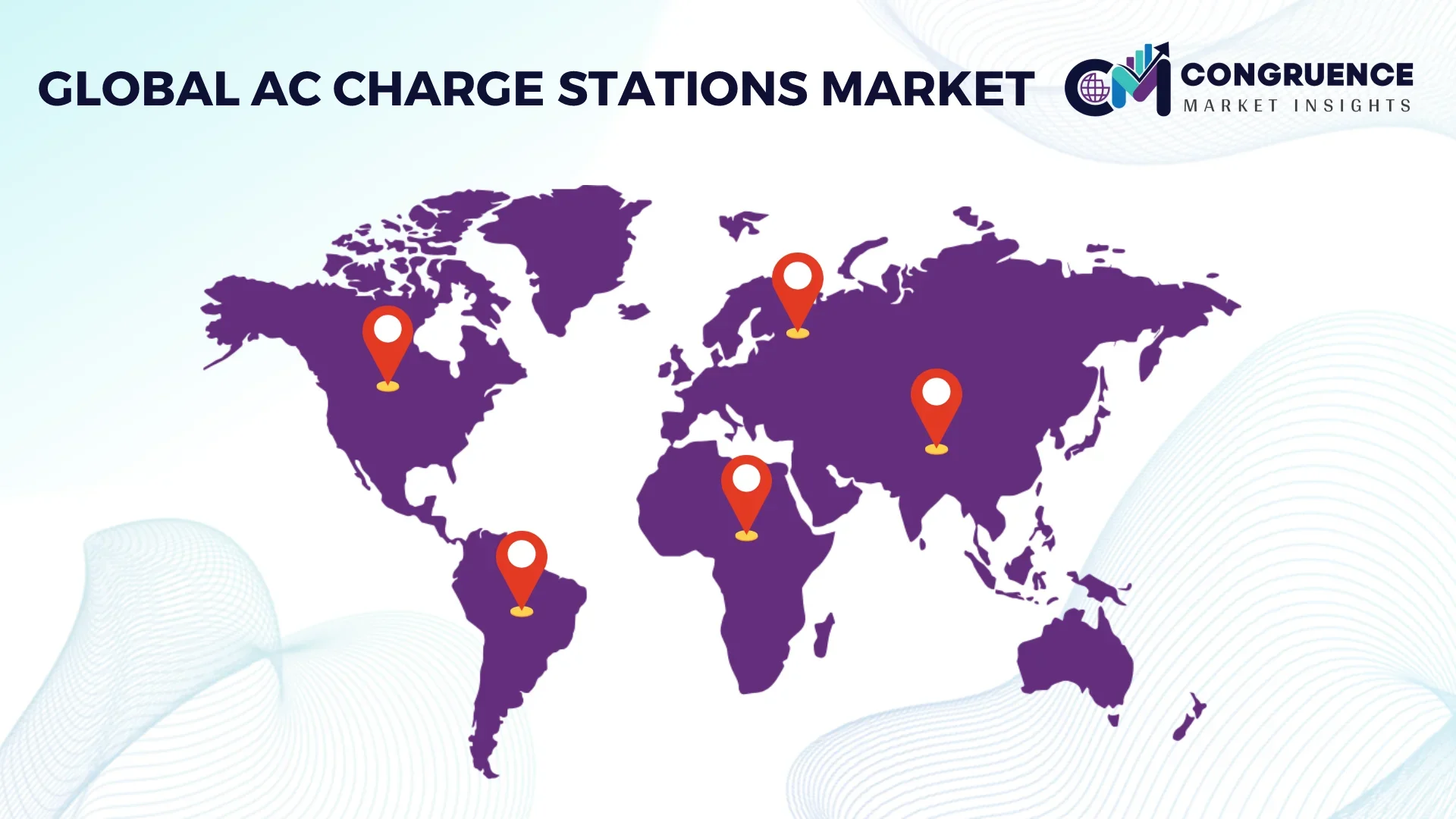
Asia-Pacific leads due to large-scale EV adoption and over 8 million installed charging points, with AC chargers forming nearly 65% of total infrastructure. Europe holds approximately 27% share, supported by regulatory mandates and over 3 million public and private charging installations. North America accounts for around 18%, driven by private investments and corporate electrification initiatives. South America and the Middle East & Africa collectively contribute about 7%, with emerging infrastructure investments and policy support. Urban centers account for over 70% of installations globally, while rural deployment is gradually increasing with government-backed programs.
North America accounts for approximately 18% of the global AC Charge Stations Market, driven by strong investments in EV infrastructure and corporate sustainability initiatives. The United States leads the region, with over 2.5 million installed charging points, of which more than 60% are AC-based systems. Key industries such as commercial real estate, logistics, and retail are driving demand for workplace and public charging solutions. Government incentives, including tax credits covering up to 30% of installation costs, are accelerating infrastructure deployment. Technological advancements such as AI-based load balancing and smart grid integration are increasingly adopted, with over 40% of new installations featuring connected systems. A notable player, ChargePoint, has expanded its AC charging network significantly, focusing on scalable solutions for commercial clients. Consumer behavior indicates higher adoption in urban areas, with over 65% of EV users relying on residential charging.
Europe holds around 27% of the AC Charge Stations Market, with key markets including Germany, the UK, and France driving adoption. The region has over 3 million charging points, with AC chargers accounting for approximately 70% of installations. Strong regulatory frameworks, such as emissions reduction mandates and infrastructure directives, are encouraging widespread deployment. Sustainability initiatives and carbon neutrality goals are pushing enterprises to adopt EV charging solutions, with over 55% of businesses integrating workplace charging. Emerging technologies such as vehicle-to-grid systems and renewable integration are gaining traction, with nearly 35% of installations supporting hybrid energy solutions. Companies like ABB are actively expanding their AC charging portfolios, focusing on energy-efficient systems. Consumer behavior reflects high environmental awareness, with over 60% of EV users prioritizing sustainable charging options.
Asia-Pacific dominates the AC Charge Stations Market in terms of volume, accounting for nearly 48% of global installations. China, Japan, and India are the leading countries, collectively hosting over 8 million charging points. Rapid urbanization and government-backed infrastructure programs are driving large-scale deployment, with China alone contributing over 60% of regional installations. Manufacturing hubs in the region produce over 65% of global AC charging components, supporting cost-effective expansion. Technological advancements include widespread adoption of smart charging systems, with over 50% of new installations featuring IoT integration. Local companies such as State Grid Corporation of China are investing heavily in expanding charging networks. Consumer behavior shows strong reliance on residential charging, with over 70% of EV users preferring home-based AC solutions.
South America accounts for approximately 4% of the global AC Charge Stations Market, with Brazil and Argentina leading regional adoption. Infrastructure development is supported by energy sector reforms and increasing renewable energy integration, with over 25% of new installations linked to solar power systems. Government incentives, including reduced import duties and subsidies, are encouraging EV adoption and charging infrastructure expansion. The region has witnessed a 30% increase in charging installations over the past two years, with urban areas leading deployment. Local companies and utilities are partnering to expand networks, focusing on cost-effective AC solutions. Consumer behavior reflects growing awareness, with over 40% of EV users relying on residential charging systems.
The Middle East & Africa region contributes approximately 3% to the global AC Charge Stations Market, with the UAE and South Africa emerging as key markets. Urban development projects and smart city initiatives are driving demand for EV charging infrastructure, with over 20% of new installations integrated into commercial real estate developments. The region is witnessing increased adoption of advanced technologies, including solar-powered AC charging systems, accounting for nearly 30% of installations. Government initiatives and trade partnerships are supporting infrastructure expansion, particularly in high-income economies. Local players are investing in scalable solutions to meet growing demand. Consumer behavior varies, with higher adoption in urban centers and commercial sectors.
China – 32% Market share: Driven by high production capacity and large-scale infrastructure deployment
United States – 18% Market share: Supported by strong private investment and growing EV adoption
The AC Charge Stations Market is characterized by a moderately fragmented competitive landscape with over 150 active global and regional players competing across hardware manufacturing, software integration, and infrastructure deployment. The top five companies collectively account for approximately 42% of the market share, indicating a mix of consolidation and competitive diversity. Market leaders focus on expanding their charging networks, enhancing product portfolios, and integrating advanced technologies such as AI-based energy management and IoT-enabled systems. Strategic partnerships between automotive manufacturers, energy providers, and technology firms are increasing, with over 60% of new projects involving collaborative models.
Mergers and acquisitions have risen by 25% in the past three years, reflecting efforts to strengthen market positioning and technological capabilities. Companies are also investing heavily in research and development, with over 15% of annual budgets allocated to innovation. The competitive environment is further shaped by the introduction of interoperable charging standards and software platforms, enabling seamless user experience and cross-network accessibility.
Siemens AG
Schneider Electric
ChargePoint Inc.
EVBox
Webasto Group
Leviton Manufacturing Co., Inc.
Delta Electronics, Inc.
Eaton Corporation
Enel X
Wallbox N.V.
Blink Charging Co.
Tritium DCFC Limited
BP Pulse
The AC Charge Stations Market is undergoing rapid technological transformation driven by digitalization, energy optimization, and integration with smart grid systems. One of the most significant advancements is the adoption of IoT-enabled smart charging systems, which are now integrated into over 50% of newly installed AC chargers. These systems enable real-time monitoring, remote diagnostics, and dynamic load management, reducing energy wastage by up to 20%. Artificial intelligence is increasingly used to optimize charging schedules based on demand patterns, improving grid stability and reducing peak load stress by approximately 25%. Vehicle-to-grid (V2G) technology is another emerging innovation, allowing EVs to supply energy back to the grid, enhancing energy distribution efficiency and supporting renewable integration.
Wireless communication protocols such as OCPP (Open Charge Point Protocol) are being widely adopted, ensuring interoperability across different charging networks. More than 70% of new AC charging systems now support OCPP standards, enabling seamless connectivity and user authentication. Additionally, integration with renewable energy sources, particularly solar power, is gaining traction, with around 30% of installations incorporating hybrid energy systems. Fast-evolving battery technologies are also influencing AC charging efficiency, enabling optimized charging cycles and improved battery lifespan. Advanced metering infrastructure and blockchain-based billing systems are further enhancing transparency and security in charging transactions. These technological developments are shaping a more efficient, scalable, and user-centric AC charging ecosystem.
• In August 2025, ABB E-mobility announced that Dongguan Mentech acquired a 60% stake in its ChargeDot business, focused on AC home and workplace charging. The deal enables expansion of AC charging solutions globally while leveraging advanced manufacturing and distribution networks. Source: www.e-mobility.abb.com
• In April 2025, ChargePoint introduced a next-generation AC Level 2 charging architecture featuring bidirectional charging and speeds up to 2x faster than conventional AC chargers. The system supports residential, commercial, and fleet applications across North America and Europe.
• In April 2025, ABB E-mobility expanded its EV charging portfolio with modular and field-upgradable systems, including new platform-based chargers designed to improve reliability and scalability. The architecture enables independent subsystem upgrades, ensuring continuous operation even during interface failures.
• In 2025, ABB E-mobility highlighted a major innovation year, introducing advanced user-centric charging solutions and showcasing new-generation products at global industry events, strengthening its position as a technology partner for scalable EV charging ecosystems.
The AC Charge Stations Market Report provides a comprehensive analysis of the global industry, covering key segments such as charger types, applications, end-users, and regional markets. The report evaluates Level 1, Level 2, and smart AC charging systems, highlighting their adoption patterns across residential, commercial, and public infrastructure. It includes detailed insights into end-user segments, including individual EV owners, fleet operators, and commercial establishments, with adoption rates exceeding 60% in residential use cases. The report also explores geographic markets across Asia-Pacific, Europe, North America, South America, and the Middle East & Africa, analyzing installation volumes, infrastructure expansion, and policy frameworks.
The scope extends to technological advancements such as IoT-enabled charging, AI-based energy management, vehicle-to-grid integration, and renewable energy compatibility, which are shaping the future of AC charging ecosystems. Additionally, the report examines industry trends, including smart charging adoption exceeding 45% of new installations and integration of solar-powered systems in nearly 30% of deployments. It also covers regulatory frameworks, ESG initiatives, and government incentives supporting EV infrastructure development. Emerging areas such as interoperable charging networks, digital payment systems, and data-driven energy optimization are analyzed to provide forward-looking insights. This report serves as a strategic tool for stakeholders, offering data-driven analysis and actionable intelligence for investment, expansion, and innovation decisions within the AC Charge Stations Market.
| Report Attribute / Metric | Details |
|---|---|
| Market Revenue (2025) | USD 4,100.0 Million |
| Market Revenue (2033) | USD 24,437.9 Million |
| CAGR (2026–2033) | 25.0% |
| Base Year | 2025 |
| Forecast Period | 2026–2033 |
| Historic Period | 2021–2025 |
| Segments Covered |
By Type
By Application
By End-User Insights
|
| Key Report Deliverables | Revenue Forecast; Market Trends; Growth Drivers & Restraints; Technology Insights; Segmentation Analysis; Regional Insights; Competitive Landscape; Regulatory & ESG Overview; Recent Developments |
| Regions Covered | North America; Europe; Asia-Pacific; South America; Middle East & Africa |
| Key Players Analyzed | ABB; Siemens AG; Schneider Electric; ChargePoint Inc.; EVBox; Webasto Group; Leviton Manufacturing Co., Inc.; Delta Electronics, Inc.; Eaton Corporation; Enel X; Wallbox N.V.; Blink Charging Co.; Tritium DCFC Limited; BP Pulse |
| Customization & Pricing | Available on Request (10% Customization Free) |




