
Reports
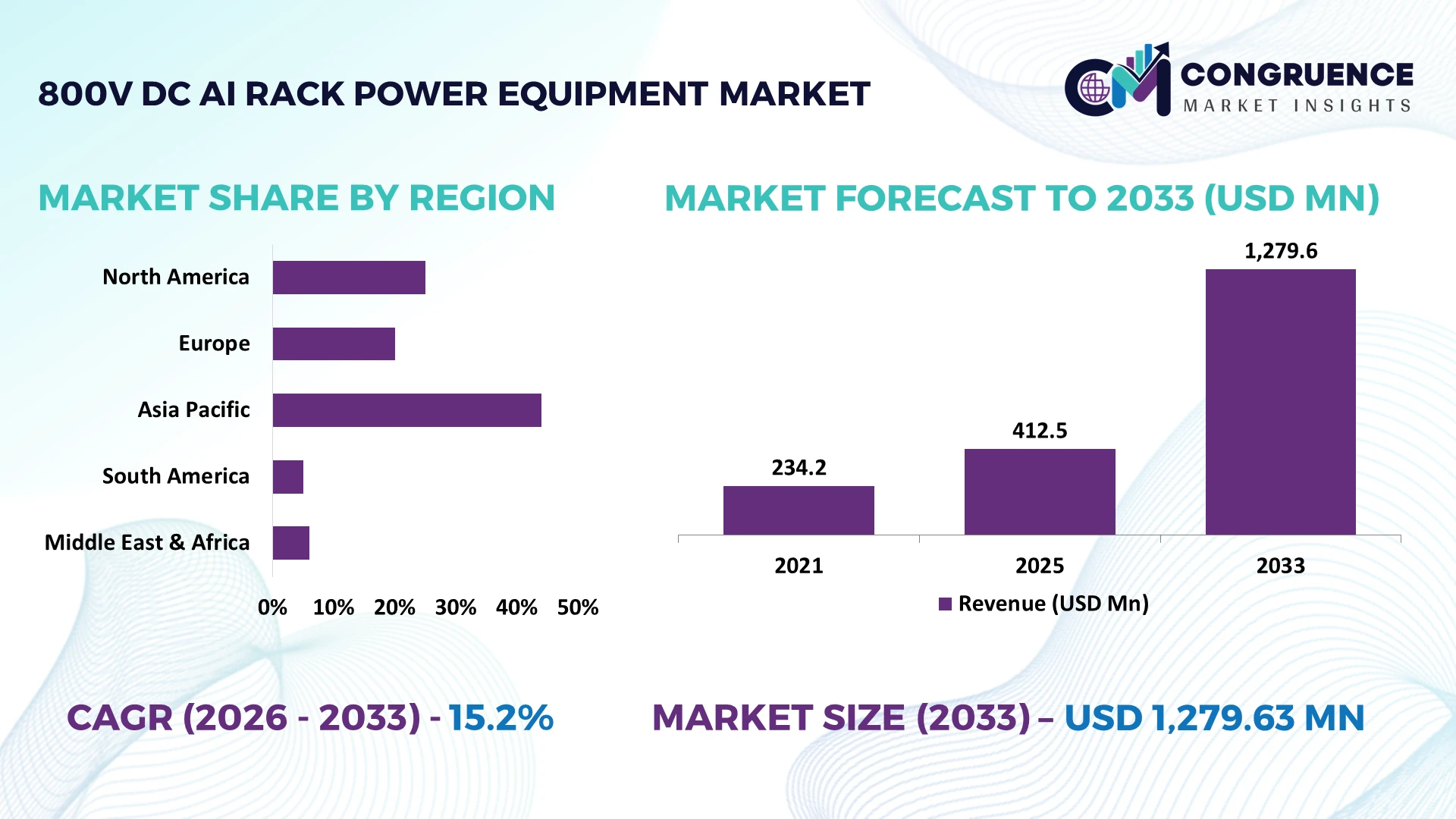
The Global 800V DC AI Rack Power Equipment Market was valued at USD 412.54 Million in 2025 and is anticipated to reach a value of USD 1279.63 Million by 2033 expanding at a CAGR of 15.2% between 2026 and 2033. Growth is driven by AI rack power densities exceeding 100 kW, the transition toward 800V DC distribution, reduced conductor losses, and the development of silicon carbide power conversion systems for hyperscale data centers.
The United States leads the emerging 800V DC AI rack power equipment ecosystem through hyperscale infrastructure investment, semiconductor innovation, and advanced power architecture development. The country accounted for approximately 45% of global data center electricity consumption in 2024, compared with China's approximately 25%. NVIDIA's 800V DC architecture targets AI infrastructure supporting rack power requirements approaching 1 MW. Microsoft, Google, and Amazon are expanding AI computing infrastructure, while domestic semiconductor developers advance silicon carbide power conversion and intelligent rack distribution technologies.
Strategically, suppliers should prioritize United States hyperscale deployments and 800V DC conversion platforms, where moving from 48V to 800V reduces equivalent power delivery current by approximately 94%.
Market Size & Growth: USD 412.54 million in 2025, reaching USD 1,279.63 million by 2033 at 15.2% CAGR, supported by high density AI computing.
Top Growth Drivers: Indicative demand contributions include AI rack density expansion at 45%, electrical distribution efficiency at 30%, and advanced semiconductor adoption at 25%.
Short Term Forecast: By 2028, advanced rack power architectures target approximately 10% lower distribution losses through higher voltage conversion and optimized electrical infrastructure.
Emerging Technologies: Three innovations include silicon carbide converters, gallium nitride power modules, and AI enabled power management for 800V DC distribution.
Regional Leaders: Indicative 2033 allocations place North America at USD 563.04 million, Asia Pacific at USD 396.69 million, and Europe at USD 230.33 million, reflecting hyperscale investment.
Consumer / End User Trends: AI infrastructure developers increasingly evaluate rack configurations exceeding 100 kW, creating demand for higher voltage power delivery systems.
Pilot / Case Example: In 2025, NVIDIA introduced its 800V DC power architecture roadmap, targeting AI racks approaching 1 MW and substantially lower distribution current.
Competitive Landscape: NVIDIA influences architecture development, while Delta Electronics, Vertiv, Schneider Electric, Eaton, and ABB compete in power equipment integration.
Regulatory & ESG Impact: At equal power, increasing distribution voltage from 48V to 800V reduces current approximately 94%, supporting lower resistive losses.
Investment & Funding: Major hyperscalers announced combined capital expenditure plans exceeding USD 300 billion for 2025, accelerating advanced data center power infrastructure development.
Innovation & Future Outlook: Next generation 800V DC systems target megawatt scale racks, modular conversion equipment, and intelligent electrical protection for AI factories.
The 800V DC AI Rack Power Equipment Market is emerging as a specialized segment of advanced data center electrical infrastructure, integrating high voltage distribution, intelligent power conversion, and rack level energy management. Hyperscale cloud operators, AI accelerator manufacturers, and data center engineering companies represent primary demand centers. Moving from conventional 48V distribution to 800V reduces equivalent current by approximately 94%, enabling smaller conductors and improved distribution efficiency when appropriately engineered. NVIDIA's AI infrastructure roadmap and expanding hyperscale computing investment are accelerating supplier development of silicon carbide converters, modular power shelves, and high voltage protection systems, establishing the foundation for strategic technology positioning.
The transition toward 800V DC distribution is reshaping AI data center infrastructure investment as accelerator clusters demand increasingly concentrated electrical capacity. NVIDIA's roadmap for rack power approaching 1 MW is accelerating development of high voltage converters, protection devices, and intelligent distribution equipment. This shift requires closer coordination between semiconductor manufacturers, electrical equipment suppliers, and hyperscale operators. United States developers lead architecture definition, while Taiwan contributes advanced power electronics manufacturing and China maintains substantial electrical component production capacity.
At equivalent power, 800V distribution carries 94% less current than conventional 48V systems. With identical conductor resistance, calculated resistive losses fall approximately 99.6%, although actual savings depend on conductor sizing and conversion architecture. Between 2026 and 2028, equipment development will emphasize silicon carbide conversion, modular power shelves, and coordinated electrical protection. Suppliers are prioritizing conversion efficiency above 97% and qualification for increasingly dense accelerator configurations.
A practical deployment involves distributing 800V DC to an AI rack and converting it locally to lower operating voltages. Vertiv, Delta Electronics, and Schneider Electric are aligning engineering capabilities with emerging architectures. Competitive advantage will depend on certified safety performance, reliable conversion efficiency, and integration with next generation computing platforms.
AI accelerator concentration is driving electrical infrastructure redesign as rack power requirements move beyond conventional server configurations. NVIDIA's roadmap targets AI racks approaching 1 MW, creating demand for higher voltage distribution and advanced power conversion. Increasing distribution voltage from 48V to 800V reduces current approximately 94% at equivalent power, while calculated conductor losses decline 99.6% when resistance remains unchanged. United States hyperscale operators are expanding accelerator infrastructure and evaluating new electrical architectures to manage power density. Vertiv, Delta Electronics, and Schneider Electric are developing compatible conversion equipment, protection systems, and modular distribution platforms. Suppliers offering integrated electrical architectures gain procurement advantages because conventional low voltage distribution becomes increasingly difficult to scale economically.
Existing data center electrical infrastructure is primarily designed around established AC distribution and lower voltage rack power systems, limiting immediate compatibility with 800V DC architectures. Transitioning from 48V to 800V increases nominal distribution voltage approximately 1,567%, requiring different insulation coordination, switching devices, connectors, and protection equipment. Converter efficiency of 97% still produces approximately 30 kW of conversion heat for every 1 MW of electrical input. United States equipment manufacturers face specialized semiconductor supply requirements and extended qualification procedures for emerging architectures. These factors increase engineering expenditure and delay standardized procurement. Suppliers are responding through modular conversion designs, component qualification partnerships, and coordinated development with hyperscale operators to reduce integration uncertainty.
Advanced semiconductor technologies create opportunities for compact, efficient 800V DC conversion systems supporting megawatt scale AI infrastructure. Silicon carbide devices enable high voltage switching with improved thermal characteristics, supporting converter designs targeting efficiencies above 98%. At 1 MW electrical input, improving conversion efficiency from 96% to 98% reduces conversion losses by 50%, from 40 kW to 20 kW. Taiwan's power electronics manufacturing ecosystem provides opportunities for integrated semiconductor packaging, converter production, and intelligent distribution equipment. Suppliers are investing in modular conversion platforms, digital power monitoring, and partnerships with accelerator manufacturers. Equipment providers combining semiconductor expertise with rack level power management can capture higher value system integration opportunities.
Reliable 800V DC deployment requires coordinated fault detection, electrical isolation, and thermal management across densely integrated AI computing infrastructure. A 1 MW rack operating at 800V draws approximately 1,250 amperes before conversion losses, creating demanding requirements for busbars, connectors, and protection devices. DC fault interruption presents engineering challenges because direct current lacks the natural current zero crossings available in alternating current systems. Maintaining converter efficiency above 98% still leaves approximately 20 kW of heat per 1 MW input, requiring effective thermal management. Taiwan's power equipment manufacturers must coordinate semiconductor reliability, protection controls, and equipment qualification. Suppliers need advanced fault isolation, redundant conversion architectures, and standardized interfaces to maintain operational continuity and support industrial scale deployment.
Modular Power Shelves Gain Procurement Priority: Hyperscale operators are shifting toward replaceable power modules that simplify maintenance across dense AI installations. Designs targeting 97% to 98% conversion efficiency reduce thermal overhead, while N+1 redundancy maintains operation after a module failure. Taiwanese power equipment manufacturers are expanding modular product platforms, enabling faster replacement and standardized maintenance across multiple rack configurations.
Rack Busbar Engineering Becomes More Specialized: Electrical equipment suppliers are redesigning copper distribution assemblies for concentrated rack loads. At 800V, a 500 kW rack requires approximately 625 amperes, while a 1 MW configuration requires 1,250 amperes. Manufacturers are strengthening insulation, connection monitoring, and thermal testing. This shifts procurement attention from conductor price toward connection reliability and long term maintenance requirements.
Factory Validation Replaces Extensive Field Adjustment: United States AI infrastructure developers are requesting integrated electrical testing before equipment shipment. Suppliers are combining rectifiers, distribution units, and monitoring controls into validated assemblies, with acceptance programs targeting 100% functional testing and simulated fault conditions. Standardized testing improves installation predictability, while equipment manufacturers expand factory integration capabilities to reduce commissioning complexity.
Electrical Telemetry Moves Into Capacity Planning: Power equipment suppliers are integrating branch level current monitoring, temperature sensing, and event recording into rack distribution platforms. Monitoring designs with 1 second sampling intervals and 100% monitored branch coverage provide detailed load visibility. Hyperscale operators use these measurements to identify phase imbalance, connector heating, and unused capacity, improving operational decisions without increasing installed electrical infrastructure.
AC DC Rectifiers represent the leading equipment category, with an indicative 30% market share, reflecting their essential role in converting facility electrical supply into regulated DC distribution. Hyperscale operators require high capacity rectification platforms with reliable voltage regulation, modular redundancy, and integrated protection. Power Shelves support scalable equipment installation and maintenance, while Power Distribution Units manage controlled delivery across rack electrical branches. Busbar Systems provide high current distribution with mechanically stable electrical connections. DC DC Converters perform localized voltage conversion for downstream computing equipment. Rectifiers remain commercially important because upstream conversion reliability determines the availability of the entire rack power architecture.
DC DC Converters represent the fastest expanding category as 800V distribution requires efficient conversion near accelerator hardware. Equipment manufacturers are developing compact power stages with conversion efficiency targets above 98%, supporting reduced thermal loads and higher equipment density. At 800V, equivalent power delivery current is approximately 94% lower than at 48V, allowing greater flexibility in distribution design. Delta Electronics, Vertiv, and other power equipment suppliers are expanding modular converter development and integrated electrical control capabilities. Procurement priorities increasingly emphasize conversion efficiency, fault isolation, and compatibility with evolving rack architectures.
AI Training Racks represent the leading application, accounting for an indicative 36% market share, supported by concentrated accelerator deployments and demanding electrical requirements. Large model training infrastructure uses tightly connected GPU systems that require stable power delivery and coordinated thermal management. GPU Server Clusters represent another significant application, particularly where multiple computing nodes operate within integrated infrastructure. Hyperscale Data Centers provide the broader facility environment for advanced rack power deployment, while High-Performance Computing installations emphasize reliability and sustained computational workloads. AI Inference Racks are becoming increasingly important as commercial AI applications move into continuous production environments.
AI Inference Racks represent the fastest expanding application as enterprises deploy AI services requiring sustained, high availability computing capacity. Training infrastructure prioritizes peak computational performance, while inference installations emphasize operating efficiency, workload variability, and predictable service delivery. NVIDIA's roadmap for AI racks approaching 1 MW reinforces the need for advanced distribution systems across dense computing configurations. Equipment suppliers are adapting rectifiers, converters, and intelligent distribution units for different power profiles. Modular power architectures support deployment flexibility, while integrated monitoring enables operators to optimize capacity utilization and identify electrical anomalies before service interruptions.
Cloud Service Providers represent the leading end user category, with an indicative 42% market share, supported by large scale accelerator infrastructure investment and centralized equipment procurement. Microsoft, Amazon, and Google operate extensive computing platforms requiring coordinated electrical infrastructure and standardized equipment qualification. Hyperscale Data Centers represent another major buyer group, emphasizing high capacity power distribution, reliability, and infrastructure expansion. Colocation Providers serve customers requiring dedicated computing capacity, while Enterprise Data Centers maintain specialized deployments for private AI workloads. Cloud operators benefit from procurement scale, allowing equipment standardization across multiple facilities and closer collaboration with electrical equipment manufacturers.
Colocation Providers represent the fastest expanding end user category as demand for specialized AI hosting infrastructure increases. These operators are adapting electrical distribution systems for customers requiring concentrated rack capacity and dedicated power availability. Cloud Service Providers emphasize vertically coordinated infrastructure design, while colocation operators prioritize flexible power allocation and customer specific configurations. Enterprise Data Centers generally favor phased modernization and compatibility with existing electrical infrastructure. Equipment suppliers are developing modular rectifiers, configurable distribution units, and intelligent monitoring platforms. Commercial differentiation increasingly depends on installation flexibility, electrical reliability, and equipment compatibility with diverse accelerator configurations.
North America accounted for the largest market share at an estimated 44% in 2025 however, Asia Pacific is expected to register the fastest growth, expanding at an estimated CAGR of 17.8% between 2026 and 2033.
Hyperscale AI Infrastructure Drives High Voltage Power Architecture Modernization
North America holds an estimated 44% market share, supported by hyperscale computing investment, advanced semiconductor development, and early adoption of high density AI infrastructure. The United States leads architecture development through NVIDIA, Microsoft, Amazon, and Google, which influence electrical equipment specifications and deployment requirements. NVIDIA's 800V DC infrastructure roadmap targets rack power approaching 1 MW, accelerating demand for advanced rectifiers, modular power shelves, and intelligent distribution equipment. Vertiv, Eaton, and Schneider Electric are strengthening power conversion and electrical protection capabilities. Canada's data center development activity supports additional infrastructure opportunities, particularly where reliable electricity supply and cooling capacity are available. Equipment procurement increasingly emphasizes electrical safety, factory qualification, and compatibility with emerging accelerator platforms. Suppliers providing integrated power distribution solutions gain advantages over vendors offering independently qualified components.
United States Market Outlook: The United States maintains leadership through semiconductor innovation, hyperscale cloud infrastructure, and advanced electrical equipment engineering. NVIDIA's 800V DC roadmap establishes a technology direction for next generation AI computing facilities. At 800V, a 1 MW rack requires approximately 1,250 amperes, making electrical protection and thermal engineering essential. Domestic equipment suppliers are strengthening modular conversion development, testing capabilities, and partnerships with accelerator manufacturers to support scalable installations.
Energy Efficiency Requirements Accelerate Advanced Electrical Infrastructure Development
Europe represents an estimated 18% market share, supported by advanced power engineering capabilities, data center modernization, and increasing emphasis on electricity efficiency. Germany leads regional industrial equipment development through established electrical engineering and automation expertise. France and the Netherlands maintain important data center infrastructure clusters, while Ireland hosts substantial hyperscale computing operations. European Union energy efficiency requirements are increasing attention toward electrical losses, monitoring, and infrastructure transparency. The revised Energy Efficiency Directive strengthens reporting obligations for qualifying data centers, encouraging improved measurement of facility energy performance. ABB, Schneider Electric, and Siemens are developing advanced power distribution, monitoring, and protection capabilities. European equipment procurement prioritizes electrical reliability, standardized safety compliance, and integration with existing infrastructure. Higher voltage DC architectures create opportunities for specialized conversion equipment, particularly in facilities preparing for concentrated accelerator deployments.
Germany Market Outlook: Germany benefits from established industrial electrical engineering, semiconductor development, and advanced manufacturing capabilities. Siemens and other equipment manufacturers support innovation in electrical distribution, industrial monitoring, and power protection. Germany's energy efficiency regulatory framework encourages detailed assessment of data center electricity consumption. Equipment developers are strengthening high voltage component qualification, automated testing, and thermal monitoring capabilities to support emerging AI computing infrastructure requirements.
Power Electronics Manufacturing Strengthens Regional Supply Chain Leadership
Asia Pacific accounts for an estimated 31% market share, supported by concentrated electronics manufacturing, advanced semiconductor production, and expanding AI infrastructure investment. Taiwan leads specialized power conversion manufacturing through established electronics supply chains and suppliers including Delta Electronics. China contributes extensive electrical component manufacturing and domestic AI data center development, while Japan and South Korea maintain capabilities in power semiconductors and precision electronics. The region benefits from established production ecosystems supporting converters, transformers, connectors, and electrical monitoring systems. NVIDIA's 800V DC architecture transition creates opportunities for suppliers developing high efficiency power conversion and modular rack equipment. Taiwan's manufacturing ecosystem supports rapid product engineering and close coordination with computing hardware developers. Regional competition increasingly emphasizes component availability, manufacturing flexibility, and qualification speed for emerging AI power architectures.
Taiwan Market Outlook: Taiwan maintains a strategic position through advanced electronics manufacturing, semiconductor packaging, and power conversion engineering. Delta Electronics supplies power management technologies for data center infrastructure and advanced computing applications. The transition toward 800V DC distribution creates opportunities for modular converter development and integrated power shelves. Taiwanese suppliers benefit from proximity to server manufacturers and semiconductor technology partners, strengthening product development coordination and equipment qualification capabilities.
Data Center Modernization Creates Selective High Density Power Opportunities
South America represents an estimated 4% market share, with infrastructure opportunities concentrated in Brazil, Chile, and Colombia. Brazil leads regional data center development through cloud computing expansion, enterprise digital infrastructure, and established electrical equipment distribution networks. Chile contributes through data center investment and access to renewable electricity resources. Advanced 800V DC rack power adoption remains at an early stage because existing facilities predominantly use conventional electrical distribution architectures. Higher density AI installations require specialized power conversion, protection equipment, and technical engineering capabilities that remain dependent on international suppliers. Regional equipment procurement emphasizes infrastructure reliability, modular installation, and compatibility with established facility power systems. International electrical equipment manufacturers are strengthening local partnerships and technical support capabilities to address complex deployment requirements.
Brazil Market Outlook: Brazil benefits from substantial cloud infrastructure investment, established telecommunications networks, and growing enterprise AI adoption. São Paulo remains the country's principal data center concentration, supporting demand for electrical distribution modernization. The country's electricity system includes a significant renewable generation contribution, strengthening interest in efficient computing infrastructure. Equipment suppliers are expanding local engineering support and evaluating modular conversion technologies for future high density AI installations.
Sovereign AI Investment Accelerates Advanced Data Center Infrastructure
The Middle East and Africa represent an estimated 3% market share, supported by sovereign AI infrastructure initiatives, digital economy investment, and expanding hyperscale computing capacity. The United Arab Emirates and Saudi Arabia lead regional development through government supported technology programs and partnerships with international computing providers. The UAE's Stargate AI infrastructure initiative includes plans for a 1 GW AI computing cluster, creating substantial requirements for electrical distribution and facility power engineering. Saudi Arabia's industrial diversification strategy supports additional advanced computing infrastructure development. South Africa contributes through established data center operations and enterprise computing requirements. Equipment suppliers are evaluating high voltage conversion, intelligent monitoring, and modular power distribution opportunities. Regional implementation priorities include electrical reliability, cooling integration, and technical workforce development for high density AI facilities.
United Arab Emirates Market Outlook: The United Arab Emirates is strengthening its position through sovereign AI investment, advanced digital infrastructure, and partnerships with international technology companies. Abu Dhabi's planned AI computing developments establish opportunities for advanced electrical equipment suppliers. High density accelerator infrastructure requires coordinated power conversion, electrical protection, and cooling integration. Equipment manufacturers are strengthening regional partnerships and engineering capabilities to support large computing installations and specialized electrical infrastructure requirements.
Vertiv, Delta Electronics, Schneider Electric, Eaton, and ABB compete for emerging 800V DC AI rack infrastructure contracts through power conversion, distribution, and protection technologies. Their combined share is provisionally estimated at 55%, although dedicated 800V equipment shipments remain insufficiently disclosed for definitive concentration measurement. Vertiv and Schneider Electric emphasize integrated infrastructure, while Delta competes through power electronics manufacturing and converter engineering. Eaton and ABB differentiate through electrical protection and distribution expertise. Moving from 48V to 800V reduces equivalent current approximately 94%, increasing the importance of compatible switching equipment and insulation systems. Converter efficiencies approaching 98% establish demanding performance benchmarks, while modular architectures target shorter replacement times. Suppliers are strengthening accelerator manufacturer partnerships, qualification laboratories, and integrated product development. Competition is shifting toward complete electrical architectures rather than individual components. Certification complexity, DC fault interruption, and interoperability remain entry barriers. Winning requires verified reliability, efficient conversion, and coordinated deployment capabilities.
Vertiv Holdings Co.
Delta Electronics, Inc.
Schneider Electric SE
Eaton Corporation plc
ABB Ltd.
Siemens AG
Huawei Technologies Co., Ltd.
Lite On Technology Corporation
Advanced Energy Industries, Inc.
Vicor Corporation
Infineon Technologies AG
Texas Instruments Incorporated
Monolithic Power Systems, Inc.
STMicroelectronics N.V.
Current AI rack power systems combine modular rectifiers, intelligent distribution units, copper busbars, and digitally controlled power shelves. Conventional 48V and 54V architectures remain established, while 800V DC platforms enter advanced product qualification. At equivalent power, transitioning from 48V to 800V reduces distribution current by 94%, enabling smaller conductors and improved electrical layout flexibility. Suppliers integrating conversion, monitoring, and protection gain advantages in system reliability and installation planning.
Emerging silicon carbide rectifiers, gallium nitride converters, and solid state circuit breakers improve conversion efficiency and fault response. Advanced converter designs exceed 98% efficiency, compared with 96% for a representative legacy design, halving conversion losses. Integrated battery backup systems also support transient GPU loads without requiring separate rack infrastructure. Adoption signals include 800V compatible equipment demonstrations and megawatt scale reference architectures from leading manufacturers.
Between 2026 and 2028, disruptive medium voltage conversion, digital power orchestration, and modular DC distribution will reshape AI infrastructure engineering. Direct conversion architectures target up to 5% higher overall power efficiency. Delta Electronics, Vertiv, and Schneider Electric benefit from integrated portfolios, while semiconductor specialists compete through compact conversion technologies. Early qualification strengthens procurement positioning before broader commercial deployment begins.
This prioritizes validated efficiency, protection coordination, and serviceability standards.
May 2025: NVIDIA outlined its 800V DC architecture for AI factories supporting 1 MW racks from 2027. Its redesign removes intermediate conversion stages, establishing common electrical requirements and giving equipment partners a clearer, commercially actionable development roadmap. Source: developer.nvidia.com.
October 2025: Schneider Electric announced development of an 800V DC sidecar with NVIDIA, designed to power racks up to 1.2 MW. Integrated conversion, metering, and protection address equipment interoperability while advancing maintainable, high density electrical infrastructure for future deployments. Source: se.com.
March 2026: Delta Electronics showcased 660 kW 800V DC power racks incorporating 480 kW battery backup at NVIDIA GTC. The integrated architecture supports dense accelerator installations and reduces reliance on separately engineered backup systems for critical computing operations. Source: spectrum.ieee.org.
June 2026: Infineon introduced a 24 kW silicon carbide battery backup reference design connecting directly to an 800V DC bus. Efficiency exceeding 99% and compact packaging support higher rack density while simplifying high voltage backup integration requirements. Source: infineon.com.
The 800V DC AI Rack Power Equipment Market Report evaluates AC DC Rectifiers, DC DC Converters, Power Distribution Units, Busbar Systems, and Power Shelves. Application analysis covers AI Training Racks, AI Inference Racks, High Performance Computing, GPU Server Clusters, and Hyperscale Data Centers. End user coverage includes Cloud Service Providers, Hyperscale Data Centers, Colocation Providers, and Enterprise Data Centers. Technology assessment examines silicon carbide conversion, gallium nitride semiconductors, intelligent monitoring, and electrical protection.
Regional analysis covers North America, Europe, Asia Pacific, South America, and the Middle East and Africa. The report evaluates 14 major technology participants, emerging 800V deployment architectures, and equipment qualification priorities. Strategic insights support investment planning, supplier selection, infrastructure modernization, geographic expansion, and competitive positioning between 2026 and 2033, particularly for megawatt scale AI computing infrastructure.
| Report Attribute/Metric | Report Details |
|---|---|
Market Revenue in 2025 | USD 412.54 Million |
Market Revenue in 2033 | USD 1279.63 Million |
CAGR (2026 - 2033) | 15.2% |
Base Year | 2025 |
Forecast Period | 2026 - 2033 |
Historic Period | 2021 - 2025 |
Segments Covered | By Type
By Application
By End-User
|
Key Report Deliverable | Revenue Forecast, Growth Trends, Market Dynamics, Segmental Overview, Regional and Country-wise Analysis, Competition Landscape |
Region Covered | North America, Europe, Asia-Pacific, South America, Middle East, Africa |
Key Players Analyzed | Vertiv Holdings Co., Delta Electronics, Inc., Schneider Electric SE, Eaton Corporation plc, ABB Ltd., Siemens AG, Huawei Technologies Co., Ltd., Lite On Technology Corporation, Advanced Energy Industries, Inc., Vicor Corporation, Infineon Technologies AG, Texas Instruments Incorporated, Monolithic Power Systems, Inc., STMicroelectronics N.V. |
Customization & Pricing | Available on Request (10% Customization is Free) |




