
Reports
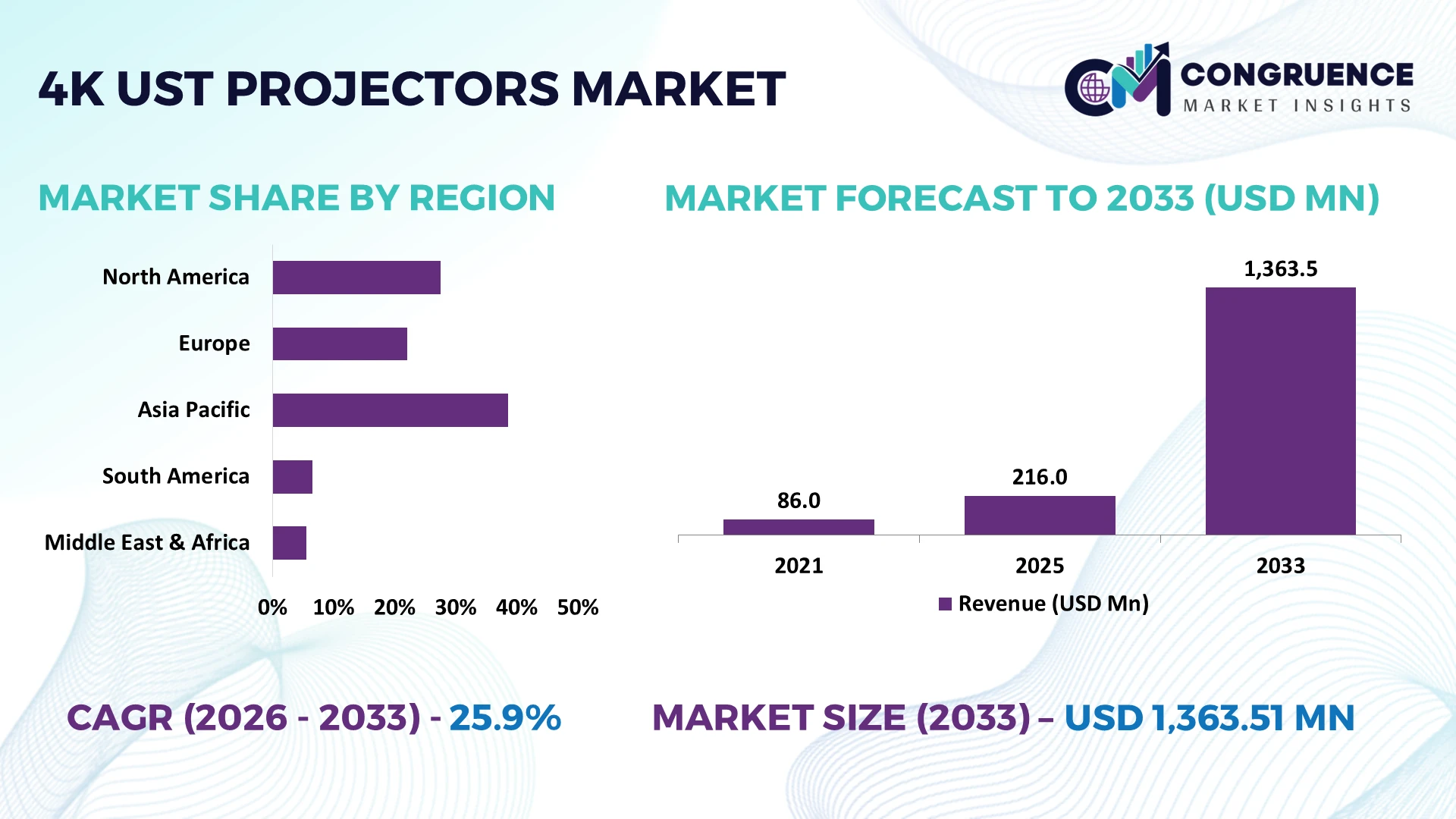
The Global 4K UST Projectors Market was valued at USD 216.0 Million in 2025 and is anticipated to reach a value of USD 1,363.5 Million by 2033 expanding at a CAGR of 25.9% between 2026 and 2033. Growth is driven by RGB triple-laser projection, declining laser light-source costs, and the replacement of large-format televisions with ultra-short-throw home cinema systems capable of projecting 100–150-inch images.
China holds a dominant position in the global 4K ultra-short-throw projector manufacturing ecosystem, supported by established optical component suppliers, laser display manufacturers, and consumer electronics production hubs. Chinese manufacturers offer 100–150-inch projection capabilities, while premium RGB laser systems deliver coverage exceeding 100% of the BT.2020 color gamut in selected models. Compared with the United States, China benefits from greater domestic integration of projection hardware manufacturing, supported by its national laser display technology development initiatives.
Manufacturers prioritizing localized optical sourcing, RGB laser innovation, and competitive installation costs will strengthen their positions in the premium home entertainment and commercial display markets.
Market Size & Growth: The global market is valued at USD 216.0 Million in 2025 and projected to reach USD 1,363.5 Million by 2033, expanding at 25.9% CAGR, driven by RGB laser commercialization and large-screen television substitution.
Top Growth Drivers: Three technology advantages include approximately 50% lower power consumption in selected laser configurations, over 100% BT.2020 color-gamut coverage in advanced models, and installation distances below 50 cm for 100-inch displays.
Short-Term Forecast: By 2028, advanced 4K UST projector development will target 15–20% improvements in optical efficiency through redesigned laser engines and thermal management.
Emerging Technologies: RGB triple-laser illumination, AI-powered image calibration, and 4K pixel-shifting technologies are improving color reproduction, alignment accuracy, and installation flexibility across 100–150-inch projection systems.
Regional Leaders: Asia Pacific, North America, and Europe lead adoption through domestic laser display manufacturing, premium home theater installations, and commercial audiovisual modernization. Regional revenue allocations require validated market-level data.
Consumer/End-User Trends: Consumers increasingly select 100–120-inch projection formats for immersive entertainment, while commercial buyers prioritize 4K resolution, 3,000 ANSI-lumen-class brightness, and integrated streaming platforms.
Pilot/Case Example: In 2024, Hisense expanded its premium Laser TV portfolio with 100-inch and larger projection solutions, demonstrating large-format home entertainment deployment without conventional ceiling-mounted projector installations.
Competitive Landscape: Hisense, Samsung, Epson, Formovie, and LG compete through laser brightness, optical performance, software integration, and distribution partnerships. Verified company-level market shares remain undisclosed.
Regulatory & ESG Impact: Laser projection systems with rated light-source lifetimes reaching 20,000–30,000 hours reduce replacement frequency and support longer equipment service intervals.
Investment & Funding: Capital investment focuses on RGB laser engines, optical manufacturing, and display integration. Aggregate investment dedicated exclusively to 4K UST projectors is not publicly established.
Innovation & Future Outlook: Next-generation 4K UST projectors target 150-inch displays, automated screen alignment, improved ambient-light performance, and AI-enabled picture optimization, strengthening premium display differentiation.
The 4K UST projectors market is evolving through premium residential entertainment, corporate presentation systems, and specialized educational installations. RGB laser engines, integrated streaming software, and ambient-light-rejecting screens improve deployment practicality. Selected systems deliver over 100% BT.2020 color-gamut coverage, supporting premium image quality. China's integrated optical manufacturing ecosystem continues to influence global pricing and product development, establishing important priorities for competitive strategy.
The 4K UST projectors market is becoming strategically important as display manufacturers compete for premium large-screen entertainment installations without the physical constraints of conventional televisions. Laser light-source development, compact optical engines, and integrated smart television platforms are transforming projector positioning from specialized audiovisual equipment into mainstream home entertainment alternatives. China's established laser display supply chain provides manufacturing advantages, while Japanese and South Korean companies emphasize optical precision, image processing, and premium consumer electronics integration.
Modern ultra-short-throw projectors produce 100-inch images from distances often below 50 cm, compared with several meters required by conventional long-throw systems. Laser light sources commonly provide 20,000–30,000 hours of rated operation, reducing replacement requirements relative to traditional lamp-based projectors. In the United States, premium residential installations emphasize cinematic image size, while Indian commercial deployments prioritize flexible installation and multipurpose room utilization.
Between 2027 and 2029, manufacturers will increasingly prioritize automated calibration, improved ambient-light performance, and compact RGB laser architectures. For example, integrated laser television systems paired with ambient-light-rejecting screens simplify installation in residential environments. Companies are strengthening optical component partnerships, expanding regional distribution, and investing in software-based image optimization. Competitive advantage will depend on delivering consistent picture quality, efficient installation, and reliable long-term performance.
RGB laser illumination and increasing adoption of large-format home entertainment systems are strengthening demand for advanced 4K UST projectors. Premium models support 100–150-inch projection sizes, while selected triple-laser systems achieve over 100% BT.2020 color-gamut coverage and laser light-source lifetimes of approximately 20,000–30,000 hours. China's established optical manufacturing ecosystem enables companies to integrate laser engines, digital light processing technologies, and smart operating systems into compact projection platforms. Hisense, Samsung, and Formovie are responding through premium product development, optical innovation, and distribution expansion. The strategic advantage lies in delivering television-like usability with significantly larger image formats, allowing manufacturers to compete directly within the premium residential display segment.
High initial equipment costs and concentrated optical component supply chains constrain broader 4K UST projector adoption. Premium RGB laser models frequently carry price premiums exceeding 30% compared with entry-level laser projection alternatives, while compatible ambient-light-rejecting screens introduce additional installation expenses. Specialized laser diodes, digital micromirror devices, and precision optical assemblies remain dependent on concentrated supplier ecosystems across China, Japan, and the United States. These dependencies expose manufacturers to component pricing volatility and procurement limitations. Companies are addressing these constraints through supplier diversification, modular optical designs, and longer-term component agreements. Reducing total installed system costs, rather than projector hardware prices alone, remains essential for expanding adoption beyond premium consumer segments.
AI-assisted calibration, improved ambient-light performance, and integrated audiovisual platforms create opportunities for 4K UST projectors across education, hospitality, and enterprise environments. Advanced systems support 100–150-inch displays, while automated keystone correction and focus optimization can reduce installation complexity compared with manually configured projection equipment. India presents opportunities through digitally equipped classrooms, corporate training facilities, and premium hospitality developments. Future RGB laser architectures targeting 15–20% optical efficiency improvements can strengthen performance in multipurpose environments. Manufacturers are investing in intelligent image processing, wireless connectivity, and commercial distribution partnerships. A significant opportunity lies in packaged projection solutions combining hardware, specialized screens, installation services, and maintenance contracts, enabling differentiated recurring service relationships.
Maintaining consistent image quality across diverse installation environments presents a significant execution challenge for 4K UST projector manufacturers. Projection systems supporting 100–150-inch displays require precise optical alignment, while ambient illumination, screen geometry, and thermal conditions influence perceived contrast and image uniformity. Laser engines rated for 20,000–30,000 hours also require reliable cooling and calibration throughout extended operating periods. In India's education and commercial sectors, inconsistent room lighting and installation conditions complicate standardized deployment. Manufacturers must improve automated geometry correction, thermal management, firmware reliability, and installer training. Partnerships with screen manufacturers and audiovisual integrators are increasingly important. Long-term competitiveness depends on ensuring repeatable installation quality and dependable performance across residential and professional environments.
Integrated Streaming Platforms Reshape Product Design: Manufacturers are incorporating Google TV, Android TV, and proprietary smart television interfaces directly into ultra-short-throw projection systems. Premium models increasingly support 4K UHD resolution of 3,840 × 2,160 pixels, HDMI 2.1 connectivity, and refresh rates reaching 120 Hz in supported configurations. Samsung, Hisense, and LG are consolidating streaming, audio processing, and display controls into unified interfaces. This reduces reliance on external media devices and strengthens customer retention through software ecosystems.
Ambient Light Screens Gain Commercial Importance: Specialized ambient-light-rejecting screens are becoming integral to premium projector installations rather than optional accessories. Screen configurations spanning 100–120 inches increasingly accompany laser television packages, while selected optical surfaces reject approximately 85–95% of off-axis ambient light under specified conditions. Chinese display manufacturers are expanding bundled screen offerings and installer partnerships. This shifts competition toward complete display-system performance, improving installation consistency and increasing accessory attachment opportunities.
Gaming Performance Influences Hardware Configuration: Premium projector manufacturers are prioritizing low-latency processing, variable refresh rate compatibility, and dedicated gaming modes. Selected 4K UST systems support 120 Hz signals, while specialized operating modes target input latency below 20 milliseconds. Epson, Hisense, and Samsung are refining signal processing and HDMI integration to accommodate console gaming. Faster switching between entertainment and gaming configurations increases product versatility and strengthens positioning against large-format televisions.
Compact Chassis Engineering Changes Manufacturing Priorities: Optical manufacturers are redesigning folded light paths, cooling assemblies, and integrated speaker systems to reduce equipment footprints. Commercial systems commonly deliver 100-inch images from approximately 20–50 cm, with selected models providing brightness exceeding 2,500 ANSI lumens. Japanese and Chinese suppliers are improving component integration and automated assembly processes. Smaller installation footprints simplify logistics, reduce placement constraints, and support standardized product configurations across international distribution channels.
Laser projectors represent the leading type in the global 4K UST projectors market, with an indicative market share of approximately 70–80%, reflecting their established position in premium ultra-short-throw display systems. Laser illumination delivers consistent brightness, precise color reproduction, and light-source lifetimes commonly reaching 20,000–30,000 hours. LED projectors serve price-sensitive and compact-display applications, offering lower thermal requirements and simplified maintenance. Lamp-based projectors retain limited relevance in legacy commercial installations but face declining competitiveness because of replacement requirements and lower operational efficiency.
LED projectors represent an emerging alternative in cost-sensitive configurations, while laser technology continues to attract the strongest premium product investment. Hisense, Samsung, and Formovie prioritize RGB laser integration, optical engine development, and manufacturing partnerships to strengthen product differentiation. The strategic distinction increasingly centers on total ownership cost, brightness stability, and installation flexibility rather than initial hardware pricing alone.
Home theater represents the dominant application in the global 4K UST projectors market, with an indicative share of approximately 45–50%, supported by premium residential entertainment installations and consumer preference for cinematic screen sizes. Ultra-short-throw systems produce 100–150-inch images without conventional long-distance projector placement, making them suitable for apartments and multipurpose living rooms. Education represents an established application, supported by digital classroom modernization, while corporate environments utilize large-format projection for collaborative presentations, training, and conference facilities.
Retail applications represent an emerging deployment category as premium stores adopt immersive product demonstrations and adaptable visual merchandising. Commercial users increasingly prioritize integrated audiovisual systems, automated display configuration, and standardized installation workflows. Manufacturers are responding through specialized screen partnerships, enterprise distribution agreements, and application-specific software integration. The competitive advantage lies in providing complete display solutions that reduce installation complexity while maintaining consistent image performance across residential and professional environments.
Residential consumers represent the largest end-user category in the global 4K UST projectors market, with an indicative share of approximately 50–55%, supported by demand for premium home cinema systems and integrated smart entertainment platforms. Consumers increasingly prioritize 100–120-inch displays, high dynamic range compatibility, and simplified streaming access. Commercial end-users constitute the second major buyer group, deploying advanced projection systems in hospitality venues, corporate facilities, and retail environments. Institutional buyers, including educational organizations, prioritize equipment reliability, installation flexibility, and centralized audiovisual management.
Institutional end-users present an emerging expansion opportunity as digital learning environments and technology-enabled training facilities adopt higher-resolution displays. Commercial buyers increasingly evaluate system integration, maintenance requirements, and long-term equipment utilization alongside image quality. Manufacturers are responding through tailored installation packages, authorized integrator networks, and differentiated service agreements. Competitive positioning depends on matching optical performance, software functionality, and support infrastructure with the operational requirements of each buyer category.
Asia-Pacific accounted for the largest market share at 38.5% in 2025 however, North America is expected to register the fastest growth, expanding at a CAGR of 28.7% between 2026 and 2033.

North America accounted for approximately 27.5% of the global 4K UST projectors market in 2025, supported by premium residential entertainment installations, advanced audiovisual infrastructure, and established consumer electronics distribution networks. The United States dominates regional adoption, with demand concentrated in home theaters, corporate presentation facilities, and specialized educational environments. Premium 4K laser projectors supporting 100–150-inch displays are gaining relevance as alternatives to large-format televisions. Manufacturers including Samsung, Epson, and Hisense are strengthening retail partnerships and integrated projection ecosystems. The expansion of smart home platforms, 4K streaming services, and gaming-oriented display configurations is influencing purchasing decisions. Laser light sources offering approximately 20,000–30,000 operating hours also improve maintenance economics. Regional competition increasingly emphasizes installation convenience, optical performance, and integrated entertainment functionality rather than projector hardware specifications alone.
United States Market Outlook: The United States represents the principal commercial market for premium 4K UST projection systems, supported by high household spending on entertainment technology and established audiovisual integration networks. Home cinema installations increasingly utilize 100–120-inch ambient-light-rejecting screens alongside laser projectors. Consumer electronics retailers, specialist installers, and technology distributors are expanding integrated display packages, while corporate facilities prioritize HDMI 2.1 connectivity, automated image adjustment, and compatibility with existing conferencing infrastructure.
Europe represented approximately 22.0% of the global 4K UST projectors market in 2025, supported by residential display upgrades, corporate audiovisual modernization, and increasing interest in energy-efficient laser technologies. Germany, the United Kingdom, and France constitute important adoption markets, particularly for premium home cinema installations and professional presentation environments. Laser projection systems offering approximately 20,000–30,000 hours of rated light-source operation reduce replacement requirements compared with conventional lamp-based equipment. European Union energy efficiency and electronic waste regulations reinforce manufacturer attention to equipment durability, repairability, and responsible product lifecycle management. Epson, Samsung, and LG are strengthening premium distribution channels and commercial integration partnerships. Demand is increasingly concentrated in compact residential spaces where ultra-short-throw optical systems provide large-format displays without ceiling-mounted equipment. Competitive differentiation depends on energy performance, localized technical support, and installation flexibility.
Germany Market Outlook: Germany holds a strategically important position within Europe's premium projection ecosystem, supported by advanced consumer electronics retail networks, corporate technology investment, and established professional audiovisual integrators. German buyers emphasize optical precision, product durability, and long-term operating efficiency. Premium installations increasingly combine 4K UHD resolution of 3,840 × 2,160 pixels with dedicated projection screens. Manufacturers are prioritizing certified distribution partners, localized technical services, and integrated audiovisual solutions for residential and enterprise applications.
Asia-Pacific dominated the global 4K UST projectors market with an estimated 38.5% share in 2025, supported by concentrated laser display manufacturing, optical component integration, and expanding premium entertainment adoption. China anchors regional production through established projector manufacturers, laser engine suppliers, and consumer electronics manufacturing clusters. Japan contributes precision optics and advanced imaging technologies, while South Korea strengthens premium display innovation and smart television integration. Manufacturers including Hisense, Formovie, Epson, and Samsung compete through RGB laser architectures, compact optical engines, and intelligent image processing. Advanced projector configurations support 100–150-inch displays and selected systems exceed 100% BT.2020 color-gamut coverage. India's expanding digital education infrastructure and premium residential construction create additional deployment opportunities. Regional manufacturing integration supports faster product development, component localization, and competitive international distribution.
China Market Outlook: China represents the central manufacturing and technology development hub for 4K UST projection systems, supported by integrated laser diode sourcing, optical engineering, and large-scale electronics assembly. Companies including Hisense, Xiaomi, and Formovie are advancing compact laser television platforms and intelligent display ecosystems. Selected premium RGB laser systems achieve brightness exceeding 2,500 ANSI lumens, supporting larger residential installations. Domestic component integration enables faster product customization, improved manufacturing coordination, and stronger export competitiveness across premium display categories.
South America accounted for approximately 6.5% of the global 4K UST projectors market in 2025, reflecting developing adoption across premium residential entertainment, corporate audiovisual systems, and specialized commercial installations. Brazil represents the largest regional opportunity, followed by Argentina and Chile, where demand is concentrated in major metropolitan areas and higher-income consumer segments. Premium projection systems capable of producing 100–120-inch images are gaining attention among buyers seeking flexible home entertainment configurations. Regional deployment remains constrained by imported hardware costs, currency volatility, and uneven availability of specialized installation services. Manufacturers and distributors are responding through selective retail expansion, authorized reseller partnerships, and bundled equipment offerings. Commercial demand is developing across hospitality, conference facilities, and premium retail environments. Competitive success depends on accessible financing, reliable technical support, and optimized distribution economics.
Brazil Market Outlook: Brazil provides the strongest commercial foundation for 4K UST projector adoption in South America, supported by consumer electronics distribution networks and professional audiovisual integrators concentrated in São Paulo and Rio de Janeiro. Premium residential buyers increasingly evaluate laser television alternatives capable of displaying 100-inch images from compact installation distances. Local distributors are strengthening relationships with international projector manufacturers while offering installation assistance, warranty coverage, and compatible projection screens to address imported equipment complexity.
The Middle East & Africa represented approximately 5.5% of the global 4K UST projectors market in 2025, supported by premium hospitality development, smart building investments, and technology-enabled commercial infrastructure. The United Arab Emirates and Saudi Arabia lead regional deployment activity through luxury residential developments, corporate facilities, and entertainment-oriented construction projects. South Africa contributes established professional audiovisual distribution networks and specialized commercial demand. Ultra-short-throw projectors supporting 100–150-inch displays are increasingly relevant for hospitality suites, executive meeting rooms, and premium entertainment installations. Saudi Arabia's Vision 2030 infrastructure transformation and the UAE's smart city initiatives provide favorable conditions for advanced display integration. Manufacturers are strengthening relationships with audiovisual contractors, hospitality technology suppliers, and regional distributors. Installation reliability, ambient-light performance, and localized maintenance capabilities remain central purchasing considerations.
Saudi Arabia Market Outlook: Saudi Arabia represents a strategically important market for advanced projection technology through large-scale hospitality, tourism, and commercial infrastructure development associated with Vision 2030. Premium hotels, entertainment venues, and corporate facilities are adopting integrated audiovisual environments requiring flexible display configurations. Ultra-short-throw systems capable of producing 120-inch images offer installation advantages in multifunctional spaces. International equipment manufacturers are targeting local systems integrators and construction technology partners to strengthen procurement access, installation quality, and long-term technical support.
The global 4K UST projectors market features intense competition between established display manufacturers Hisense, Samsung, Epson, LG, and emerging laser projection specialists Formovie, AWOL Vision, and XGIMI. The leading five brands collectively hold an estimated 55–65% share, although independently verified concentration figures remain limited. Hisense competes through integrated laser television ecosystems, while Samsung emphasizes premium design and smart connectivity. Epson differentiates through 3LCD imaging, whereas Formovie and AWOL Vision prioritize RGB laser performance and competitive pricing. Selected premium systems exceed 100% BT.2020 color coverage, while laser light sources provide approximately 20,000–30,000 operating hours. Manufacturers strengthen competitiveness through optical supplier partnerships, distribution expansion, firmware innovation, and vertically integrated manufacturing. Competition is shifting toward complete projector-screen ecosystems and automated installation capabilities. Specialized optical components, calibration expertise, and established retail networks create substantial entry barriers. Winning requires superior image quality, dependable component sourcing, competitive installed costs, and scalable customer support infrastructure across international markets.
Hisense Group
Samsung Electronics Co., Ltd.
Seiko Epson Corporation
LG Electronics Inc.
Formovie
XGIMI Technology Co., Ltd.
AWOL Vision
BenQ Corporation
Optoma Corporation
ViewSonic Corporation
JMGO
Leica Camera AG
VAVA
RGB triple-laser illumination, digital light processing, and advanced 3LCD imaging define current 4K UST projector technology. Premium RGB laser engines deliver color coverage exceeding 100% of BT.2020 in selected configurations, while laser light sources provide approximately 20,000–30,000 operating hours. Compared with conventional lamp-based projectors, laser systems can reduce light-source replacement frequency by over 80% across extended operating cycles. Hisense, Samsung, and Epson benefit through differentiated optical performance, lower maintenance requirements, and stronger positioning within premium residential and commercial display applications.
Emerging technologies emphasize AI-assisted image calibration, automated geometry correction, and improved ambient-light adaptation. Advanced processing systems support 4K UHD resolution of 3,840 × 2,160 pixels, while selected gaming-oriented configurations achieve input latency below 20 milliseconds. Integration with HDMI 2.1, streaming platforms, and wireless audiovisual systems reduces installation complexity. Manufacturers are strengthening semiconductor partnerships and software development capabilities to deliver consistent picture quality across diverse deployment environments.
Between 2026 and 2028, compact optical engines, intelligent thermal management, and next-generation laser architectures will reshape competitive priorities. Development targets include 15–20% improvements in optical efficiency and more compact projection assemblies. Manufacturers investing early in integrated hardware-software ecosystems gain advantages in product differentiation, deployment flexibility, and long-term operational reliability.
August 2024: Samsung Electronics launched The Premiere 9 and Premiere 7 ultra-short-throw projectors, delivering 4K images up to 130 inches and 3,450 ISO lumens on the flagship model. The launch strengthened Samsung's premium home cinema positioning. Source: news.samsung.com.
April 2025: Epson introduced the QS100 4K PRO-UHD ultra-short-throw laser projector, supporting images up to 160 inches. Designed for custom integrators and smart home installations, the product expanded Epson's presence in premium residential audiovisual integration and specialized distribution channels. Source: news.epson.com.
January 2025: XGIMI showcased its AURA 2 ultra-short-throw projector and Ascend concept at CES 2025, highlighting integrated home entertainment design. The AURA 2 delivers 2,300 ISO lumens, strengthening XGIMI's competitive positioning in compact premium laser projection solutions. Source: us.xgimi.com.
January 2026: AWOL Vision unveiled its Aetherion Max and Pro triple-laser UST projectors, supporting 4K images up to 200 inches. Proprietary PixelLock technology and gaming-focused processing expanded its premium positioning against established large-format home entertainment display manufacturers. Source: awolvision.com.
The Global 4K UST Projectors Market Report provides comprehensive analysis of industry performance, competitive dynamics, technology development, and investment opportunities between 2026 and 2033. The study covers segmentation by type, including laser, LED, and lamp-based projectors; application, including home theater, education, corporate, and retail; and end-user, including residential consumers, commercial enterprises, and institutional buyers. It evaluates advanced RGB laser illumination, DLP imaging, 3LCD technology, intelligent calibration, and integrated audiovisual platforms.
Geographic coverage includes North America, Europe, Asia-Pacific, South America, and Middle East & Africa, with Asia-Pacific holding an estimated 38.5% market share in 2025. The report examines manufacturing concentration, distribution strategies, emerging commercial applications, and premium residential adoption. Competitive benchmarking, technology investment priorities, and regional deployment analysis support strategic expansion, product positioning, partnership development, and long-term investment decisions.
| Report Attribute / Metric | Details |
|---|---|
| Market Revenue (2025) | USD 216.0 Million |
| Market Revenue (2033) | USD 1,363.5 Million |
| CAGR (2026–2033) | 25.9% |
| Base Year | 2025 |
| Forecast Period | 2026–2033 |
| Historic Period | 2021–2025 |
| Segments Covered |
By Type
By Application
By End-User
|
| Key Report Deliverables | Revenue Forecast; Market Trends; Growth Drivers & Restraints; Technology Insights; Segmentation Analysis; Regional Insights; Competitive Landscape; Regulatory & ESG Overview; Recent Developments |
| Regions Covered | North America; Europe; Asia-Pacific; South America; Middle East & Africa |
| Key Players Analyzed | Hisense Group; Samsung Electronics Co., Ltd.; Seiko Epson Corporation; LG Electronics Inc.; Formovie; XGIMI Technology Co., Ltd.; AWOL Vision; BenQ Corporation; Optoma Corporation; ViewSonic Corporation; JMGO; Leica Camera AG; VAVA |
| Customization & Pricing | Available on Request (10% Customization Free) |




