
Reports
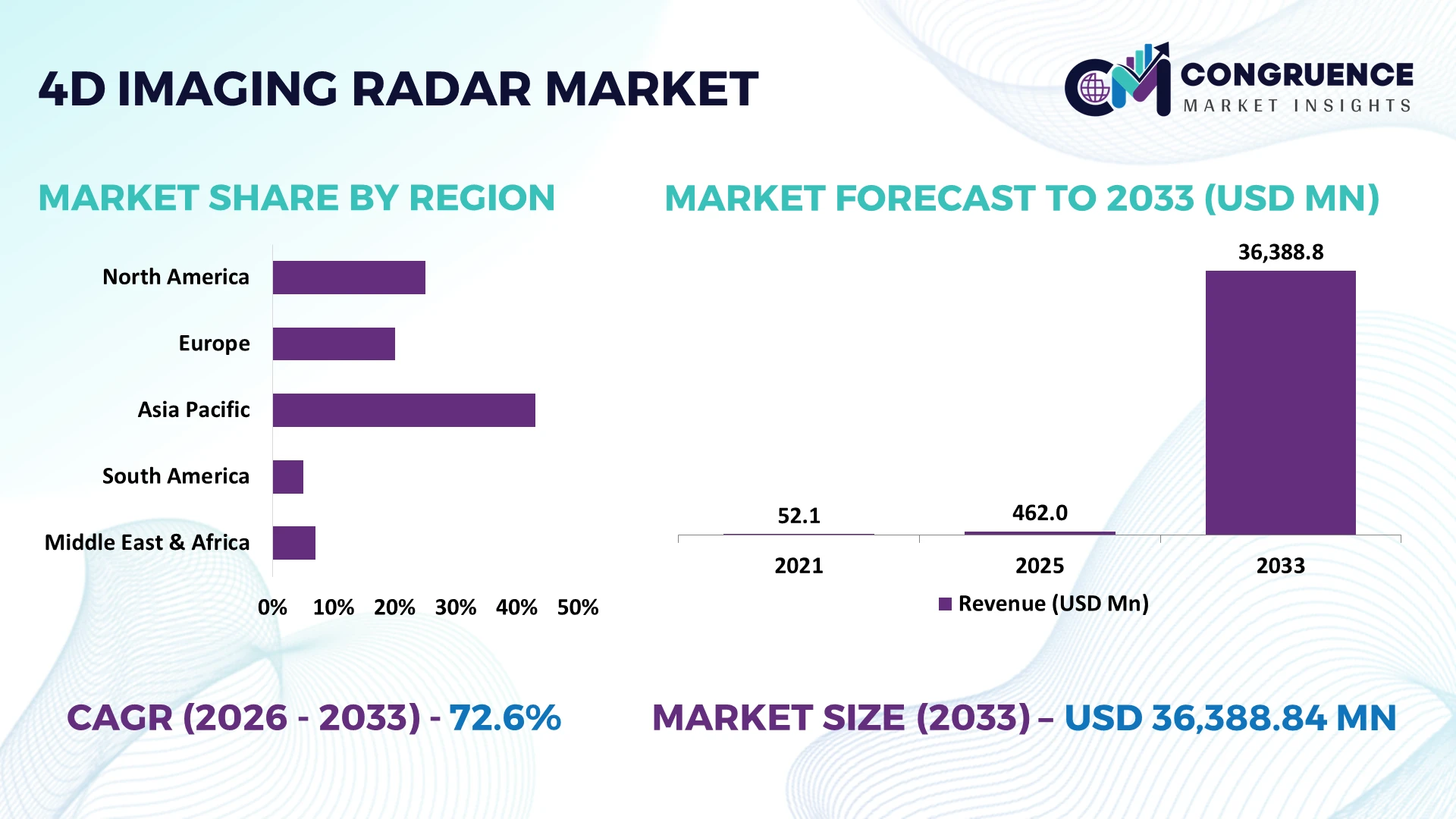
The Global 4D Imaging Radar Market was valued at USD 462 Million in 2025 and is anticipated to reach a value of USD 36388.84 Million by 2033 expanding at a CAGR of 72.6% between 2026 and 2033. Growth is driven by Level 2+ and Level 3 automated driving, centralized vehicle architectures, higher-resolution 77–81 GHz sensing, and automakers replacing conventional radar with elevation-aware perception.
China leads deployment momentum, accounting for an estimated 35% of 2025 demand as domestic EV manufacturers accelerate intelligent-driving hardware integration. The country produced more than 13 million new-energy vehicles in 2025, creating exceptional scale for radar qualification and cost reduction. Germany remains stronger in premium engineering and Tier-1 radar development but operates at lower vehicle volume. U.S.–China semiconductor restrictions are simultaneously encouraging localized automotive-chip supply chains, while advanced imaging radar delivers substantially denser point clouds than legacy radar.
Strategically, suppliers securing OEM design wins, automotive-grade semiconductor capacity, and scalable perception software now gain the strongest pathway into high-volume autonomous-driving platforms.
Market Size & Growth: USD 462 million in 2025 reaches USD 36,388.84 million by 2033 at 72.6% CAGR as Level 2+ platforms adopt imaging-grade radar.
Top Growth Drivers: Level 2 ADAS penetration above 50%, EV sales growth above 20%, and 77–81 GHz radar adoption above 60% accelerate integration.
Short-Term Forecast: By 2028, semiconductor integration and scale manufacturing are positioned to reduce advanced radar system costs by approximately 20–30%.
Emerging Technologies: AI perception, MIMO antennas, and radar-on-chip architectures enable hundreds of virtual channels and substantially richer elevation mapping.
Regional Leaders: By 2033, Asia-Pacific approaches USD 16.0 billion, Europe USD 9.5 billion, and North America USD 8.5 billion, led by automated-driving deployments.
End-User Trends: Passenger vehicles represent approximately 70% of adoption as OEMs extend premium ADAS sensing toward mass-market EV platforms.
Pilot/Case Example: In 2025, next-generation imaging radar platforms demonstrated detection ranges approaching 300 meters, strengthening highway-speed object classification.
Competitive Landscape: Continental holds an estimated 15–20% position, competing with Bosch, ZF, Aptiv, Arbe Robotics, and Uhnder across imaging-radar architectures.
Regulatory & ESG Impact: EU rules progressively require advanced safety technologies across 100% of newly registered applicable vehicle categories, strengthening sensor-content requirements.
Investment & Funding: Automotive radar and perception companies have attracted more than USD 500 million cumulatively through funding, strategic investment, and semiconductor partnerships.
Innovation & Future Outlook: 2,000+ virtual-channel architectures and AI-enhanced perception are shifting radar from object detection toward lidar-like environmental mapping in next-generation vehicles.
The 4D Imaging Radar Market is shifting from premium ADAS toward higher-volume passenger vehicles, autonomous shuttles, commercial fleets, and intelligent mobility platforms. New radar-on-chip processors, MIMO antenna arrays, AI-based point-cloud interpretation, and elevation sensing improve object separation under darkness, fog, and rain. Passenger vehicles account for roughly 70% of current adoption, while Chinese EV platforms increasingly accelerate high-resolution radar commercialization. Semiconductor localization amid U.S.–China technology restrictions is also reshaping sourcing strategies, making scalable chipsets, OEM qualification, and perception-software integration central to the market’s strategic direction.
4D imaging radar is becoming a strategic automotive sensing layer as OEMs move from driver assistance toward increasingly automated, software-defined vehicles requiring reliable depth, velocity, azimuth, and elevation measurements. Regulatory momentum reinforces the transition: Europe’s expanded vehicle-safety requirements are increasing standard ADAS content, while semiconductor localization in China is restructuring radar-chip sourcing. Automakers consequently treat high-resolution radar as a platform decision rather than an optional sensor upgrade.
Advanced imaging architectures using MIMO processing and hundreds of virtual channels generate substantially denser environmental maps than conventional radar, improving separation of vehicles, pedestrians, barriers, and overhead objects. Modern systems can approach 300-meter detection ranges while operating through rain, fog, and darkness. China provides deployment scale through high-volume intelligent EV platforms; Germany remains influential through premium vehicle engineering and Tier-1 sensing integration. By 2028, radar-on-chip integration should lower system complexity and support broader multi-radar configurations.
A practical Level 2+ architecture combines front imaging radar with cameras and corner sensors to maintain highway perception when optical visibility deteriorates. Continental, Bosch, ZF, Arbe Robotics, and semiconductor partners are investing in scalable chipsets, perception software, and OEM validation. Competitive advantage will concentrate around production-qualified hardware, efficient processing, software integration, and secured design wins.
Level 2 and higher automated-driving functions are pushing radar beyond basic range and velocity measurement toward elevation-aware environmental mapping. Level 2 functionality already appears across more than 50% of selected major-market new vehicles, while passenger vehicles represent roughly 70% of imaging-radar demand and 77–81 GHz technology dominates advanced automotive radar development. Europe’s mandatory expansion of ADAS safety functions reinforces sensor integration across mainstream models rather than premium vehicles alone. Higher automation requires dependable detection when cameras encounter darkness, spray, or glare, making imaging radar an important complementary modality. Continental, Bosch, ZF, and emerging specialists are increasing MIMO processing, antenna-channel density, and perception-software integration. The strategic shift is from adding individual sensors toward engineering redundant perception stacks capable of maintaining machine-readable environmental awareness across adverse operating conditions.
High-resolution radar requires more antennas, RF channels, computing resources, and validation than conventional automotive radar, creating a material cost barrier for volume vehicle platforms. Advanced architectures can incorporate hundreds of virtual channels, while conventional systems use substantially fewer, increasing semiconductor processing and thermal requirements. Automotive qualification cycles commonly extend 24–36 months, delaying commercialization even after functional prototypes are available. U.S.–China semiconductor restrictions also complicate access to advanced processing technologies for globally standardized platforms. These pressures make bill-of-material optimization as important as raw detection performance. Suppliers are responding through radar-on-chip integration, fewer discrete components, localized semiconductor partnerships, and common hardware platforms supporting multiple vehicle classes. The non-obvious constraint is processing economics: excessive point-cloud resolution has limited commercial value when computing cost and power consumption exceed the vehicle function’s actual perception requirement.
Radar-on-chip integration creates a pathway to move imaging capability from premium vehicles into higher-volume platforms by combining RF functions and processing within increasingly consolidated semiconductor architectures. Integration can reduce component count by 20–30%, while advanced systems approaching 300-meter detection support highway automation, vulnerable-road-user identification, and free-space mapping. China’s new-energy vehicle production exceeding 13 million units provides exceptional scale for qualifying lower-cost architectures and accelerating learning curves. Through 2028, AI-assisted radar perception and higher-channel-count processors will increasingly convert raw reflections into object-level and occupancy information. Suppliers are forming semiconductor, software, and OEM partnerships to co-optimize sensing stacks. A particularly valuable opportunity lies in software-defined performance tiers: common radar hardware can support differentiated vehicle functions through processing capability, allowing manufacturers to spread engineering costs across multiple models.
Commercial scale depends on proving that dense radar outputs remain consistent across weather, road geometry, interference, vehicle vibration, and rapidly changing traffic conditions. Imaging systems can generate hundreds to thousands of virtual measurement channels, multiplying calibration and fusion workloads relative to legacy radar. Automated-driving programs must also reconcile radar outputs with cameras, ultrasonic sensors, and, on selected platforms, lidar within millisecond-level decision cycles. Dense 77–81 GHz deployment increases interference-management requirements as more vehicles operate multiple radar units simultaneously. German premium OEM programs illustrate the extensive validation expected before safety-critical sensing reaches production. Suppliers must invest in simulation, over-the-air calibration strategies, interference mitigation, AI training datasets, and standardized interfaces. The critical execution issue is not maximum resolution; it is maintaining predictable perception quality across millions of vehicles without allowing calibration, computing, or validation complexity to erode platform economics.
Centralized Compute Reshapes Radar Design: Vehicle architectures are moving radar processing from isolated ECUs toward centralized domain controllers, reducing duplicated electronics by roughly 15–25% and simplifying sensor synchronization. Chinese EV platforms increasingly combine multiple 77–81 GHz sensors with centralized perception. Suppliers are separating sensing hardware from software layers, allowing OEMs to update detection algorithms without replacing complete radar modules.
Virtual Apertures Increase Resolution: Cascaded MIMO and advanced antenna configurations are expanding virtual channels from tens into hundreds or thousands, improving angular separation by more than 50% versus conventional radar architectures. Semiconductor suppliers are integrating RF transceivers with dedicated signal processing. Automakers benefit from better discrimination between adjacent vehicles, pedestrians, barriers, and road structures without depending exclusively on higher-cost optical sensors.
Corner Radar Gains More Intelligence: Corner units are progressing beyond blind-spot monitoring toward cross-traffic detection, lane-change assistance, and 360-degree perception. Modern configurations can detect targets beyond 150 meters while supporting fields of view approaching 120 degrees. OEMs are increasing sensor reuse across functions, while suppliers standardize compact modules that lower engineering complexity and accelerate integration across multiple vehicle platforms.
Interference Mitigation Becomes Design Priority: Rising radar content means individual vehicles increasingly carry five or more sensing units, increasing exposure to overlapping 77–81 GHz transmissions. Congested traffic amplifies interference risk as adoption scales. Chipmakers are introducing adaptive waveforms, interference detection, and digital filtering, while OEM validation teams increasingly test dense multi-vehicle scenarios. The non-obvious shift is that spectral coexistence is becoming a system-level performance differentiator.
Automotive Radar represents the leading type with an estimated 38% share, supported by established integration across passenger and commercial vehicle ADAS platforms. Its manufacturing scale, automotive qualification maturity, and compatibility with 77–81 GHz architectures support deployment across front and corner sensing. Long-Range systems remain essential for highway perception, commonly extending toward 250–300 meters, while Mid-Range and Short-Range units serve lateral monitoring, cross-traffic functions, and maneuvering. Solid-State Radar strengthens reliability through compact semiconductor-based architectures with no mechanical scanning components.
Imaging Radar is the fastest-growing type as OEMs require elevation measurement and higher angular resolution for automated-driving perception. Advanced designs using hundreds of virtual channels can deliver more than 50% improvement in object separation over conventional lower-channel architectures. Suppliers are concentrating investment on MIMO arrays, integrated processing, and software-defined configurations rather than multiplying standalone hardware variants. Investment priorities therefore favor platforms that combine Automotive Radar production economics with Imaging Radar perception quality across multiple vehicle classes.
ADAS leads applications with an estimated 42% share because radar is already integrated across adaptive driving, lane-support, and surrounding-vehicle awareness functions on high-volume production platforms. Collision Avoidance and Blind Spot Detection remain mature applications because radar maintains range and velocity measurement under poor visibility. Object Detection is becoming more sophisticated as higher-resolution point clouds improve target separation. Parking Assistance uses short-range coverage, while Traffic Monitoring applies radar where continuous operation across darkness and adverse weather is required.
Autonomous Driving is the fastest-growing application because higher automation requires perception redundancy and richer environmental reconstruction. Advanced 4D systems can detect relevant targets approaching 300 meters and provide elevation information absent from conventional 3D automotive radar. Companies are integrating AI classification, centralized sensor fusion, and multi-radar configurations to strengthen 360-degree perception. Investment is consequently shifting from isolated safety functions toward reusable sensing platforms capable of supporting several ADAS and automated-driving applications simultaneously, improving hardware utilization across vehicle architectures.
Passenger Vehicles represent the leading end-user segment with approximately 70% of current demand, reflecting substantially greater production volumes and rapid ADAS penetration across premium and increasingly mass-market models. Radar content per vehicle is also rising as manufacturers combine front-facing long-range sensing with multiple corner units. Commercial Vehicles require longer-distance detection and robust collision mitigation, while Industrial Vehicles value radar performance in dust, darkness, and variable weather. Smart Infrastructure and Defense Systems emphasize persistent sensing rather than automotive-scale unit economics.
Robotaxis are the fastest-growing end-user group as commercial autonomous fleets require redundant 360-degree perception and higher sensor content per platform. Individual automated vehicles can incorporate five or more radar units, creating disproportionate component demand despite lower fleet volumes. Autonomous Shuttles follow similar redundancy requirements in controlled operating domains. Suppliers are responding with fleet-specific perception software, high-resolution modules, centralized processing partnerships, and scalable sensor configurations. Future competitive positioning therefore depends increasingly on radar content per vehicle, not vehicle production volume alone.
Asia-Pacific accounted for the largest market share at 41.8% in 2025 however, Asia-Pacific is expected to register the fastest growth, expanding at a CAGR of 76.9% between 2026 and 2033.
Software-Defined Vehicles Elevate Radar Content
North America accounted for approximately 27.4% of 2025 demand, supported by advanced ADAS programs, autonomous-vehicle development, semiconductor expertise, and high-value automotive electronics integration. U.S. deployment centers on Level 2+ passenger vehicles, robotaxis, autonomous shuttles, and commercial fleets requiring perception redundancy beyond cameras. Advanced imaging systems approaching 300-meter detection range strengthen highway object separation and degraded-visibility operation. Automotive radar developers are integrating centralized compute, AI classification, and over-the-air perception improvements rather than treating radar as isolated hardware. Robotaxi programs in Phoenix, San Francisco, Los Angeles, and Austin provide particularly demanding validation environments. Semiconductor policy under the CHIPS and Science Act is also strengthening domestic electronics capacity, encouraging radar developers to establish more resilient processor and RF-component supply relationships.
United States Market Outlook: The United States combines autonomous-driving software expertise with major semiconductor and vehicle-technology ecosystems. Robotaxi operations have progressed to commercial driverless deployment across multiple cities, creating demanding real-world environments for redundant perception. U.S. radar developers benefit from domestic AI-processing expertise and increasingly centralized vehicle architectures, strengthening opportunities for high-resolution sensing, sensor-fusion software, and automotive-grade radar semiconductors.
Safety Regulation Accelerates Sensor Sophistication
Europe represented approximately 24.3% of global demand in 2025, with Germany, France, Sweden, and the United Kingdom concentrating automotive engineering and advanced safety-system development. EU General Safety Regulation requirements have expanded mandatory ADAS functions across new vehicles, increasing baseline sensing content and raising performance expectations for collision avoidance and vulnerable-road-user detection. German premium manufacturers provide an important commercialization channel for high-resolution radar because advanced driver-assistance packages support higher sensor value per vehicle. Continental, Bosch, ZF, and specialized technology companies are advancing 77–81 GHz architectures, centralized processing, and improved angular resolution. Euro NCAP’s increasingly demanding assisted-driving assessments reinforce multi-sensor redundancy. The region’s strategic advantage therefore lies less in vehicle production scale than in safety engineering, Tier-1 integration capability, qualification expertise, and regulatory-led technology standardization.
Germany Market Outlook: Germany anchors European radar development through its premium OEM base and globally established automotive electronics supply chain. The country manufactures several million passenger vehicles annually, providing meaningful validation and industrialization scale for sophisticated ADAS hardware. Mercedes-Benz and BMW deployments of Level 3 functions also raise perception requirements, encouraging suppliers to prioritize long-range resolution, redundancy, functional safety, and centralized sensor fusion.
Chinese Vehicle Scale Compresses Commercialization Cycles
Asia-Pacific held approximately 41.8% of global demand in 2025, driven principally by China’s high-volume EV manufacturing, intelligent-driving competition, semiconductor localization, and rapid vehicle-platform renewal. China produced more than 13 million new-energy vehicles in 2025, giving radar suppliers exceptional opportunities to scale manufacturing and reduce unit economics. Japan and South Korea contribute automotive semiconductor, sensor, and OEM engineering capabilities, while Chinese manufacturers increasingly deploy advanced ADAS functions below traditional premium price points. Local radar companies are developing higher-channel-count MIMO platforms, integrated processors, and perception algorithms alongside global Tier-1 suppliers. U.S.–China semiconductor restrictions are accelerating domestic sourcing strategies and chipset development. The operational advantage is iteration speed: large vehicle volumes allow suppliers to collect validation data and transition revised radar architectures into production considerably faster than low-volume autonomous programs.
China Market Outlook: China represents the market’s strongest volume opportunity because intelligent-driving functionality has become a competitive differentiator across domestic EV brands. Annual automobile production exceeds 30 million units, creating unmatched potential for component industrialization. Local suppliers increasingly combine RF chip development, antenna engineering, perception algorithms, and OEM partnerships, reducing reliance on imported sensing platforms while accelerating imaging-radar penetration into mid-priced vehicles.
ADAS Localization Expands Radar Addressability
South America represented approximately 2.7% of global demand in 2025, with Brazil and Argentina providing the principal automotive manufacturing base. Adoption remains concentrated in premium passenger vehicles and higher-specification models because mainstream platforms continue emphasizing lower-cost conventional radar and camera systems. Brazil’s annual light-vehicle production exceeds 2 million units, creating a meaningful future channel as global OEM platforms transfer more standardized ADAS packages into locally manufactured models. Safety-rating pressure and increasing electronic content are encouraging suppliers to localize calibration, testing, and integration capability. However, dependence on imported automotive semiconductors and comparatively lower advanced-ADAS penetration constrain immediate imaging-radar scale. Suppliers therefore prioritize modular radar platforms that can migrate from premium imports into locally assembled vehicles without requiring extensive architecture redesign.
Brazil Market Outlook: Brazil offers the clearest regional commercialization pathway through its large vehicle-production base and established operations of global automakers and Tier-1 suppliers. Increasing ADAS availability on higher-value models creates an entry point for advanced radar. Localization economics remain decisive: suppliers able to reuse globally qualified 77–81 GHz platforms while adapting software and calibration locally gain a substantial deployment advantage.
Autonomous Mobility Programs Create Premium Demand
Middle East & Africa represented approximately 3.8% of global demand in 2025, with the UAE, Saudi Arabia, Israel, and South Africa supporting distinct adoption pathways. The UAE and Saudi Arabia are investing in autonomous mobility, smart-city infrastructure, and digitally managed transport, creating specialized demand for high-resolution environmental sensing. Israel contributes radar semiconductor and perception innovation through its automotive technology ecosystem, while South Africa represents the strongest established vehicle-production platform in sub-Saharan Africa. Gulf operating conditions also strengthen radar’s practical value because dust, intense sunlight, and darkness can reduce optical-sensor effectiveness. Dubai’s autonomous-transport strategy targets 25% of journeys through autonomous modes by 2030, encouraging trials across robotaxis and connected mobility. Suppliers are consequently aligning imaging radar with autonomous fleets, infrastructure sensing, and harsh-environment perception rather than relying solely on conventional passenger-car volumes.
United Arab Emirates Market Outlook: The UAE provides the strongest near-term deployment environment through government-backed autonomous mobility programs, high-value vehicle penetration, and smart-road investment. Dubai’s 25% autonomous-transport target creates a measurable commercialization pathway for radar-supported perception. Robotaxi trials and intelligent-transport programs provide suppliers with operational environments for validating long-range sensing, multi-sensor fusion, and performance under dust and extreme temperatures.
Continental, Bosch, ZF, Aptiv, and imaging-radar specialists such as Arbe Robotics compete across OEM design wins, with established Tier-1 suppliers leveraging production scale while technology specialists differentiate through resolution and processing architecture. The top five suppliers hold an estimated 55–60% combined share. Established players benefit from automotive qualification, manufacturing networks, and OEM integration; specialists compete through higher channel counts and software-defined perception. Advanced MIMO designs can improve angular discrimination by more than 50%, while semiconductor integration can reduce component requirements by approximately 20–30%. Competition increasingly centers on centralized processing, radar-on-chip architectures, AI classification, and scalable 77–81 GHz platforms. Suppliers are forming semiconductor partnerships, integrating perception software, and localizing production around Chinese and European OEM programs. Automotive qualification cycles of 24–36 months, functional-safety requirements, RF expertise, and entrenched OEM relationships create substantial entry barriers. Winning requires production-grade resolution, competitive processing economics, software integration, and early platform design wins at scale.
Robert Bosch GmbH
Continental AG
ZF Friedrichshafen AG
Aptiv PLC
Valeo SE
DENSO Corporation
Arbe Robotics Ltd.
Uhnder, Inc.
Smartmicro
Echodyne Corp.
Oculii Corporation
NXP Semiconductors N.V.
Texas Instruments Incorporated
Infineon Technologies AG
Current 4D imaging radar combines 77–81 GHz MIMO arrays, elevation sensing, edge processing and AI-assisted object classification. Modern systems exceed 300-meter detection range, while sub-one-degree azimuth resolution improves separation of adjacent road users. Production adoption is advancing through Level 2+ platforms, giving OEMs reliable perception in darkness, fog and rain without depending exclusively on optical sensors.
Emerging architectures integrate radar-on-chip processors, centralized domain controllers and software-defined signal processing. Third-generation processors deliver up to twice the computing performance of preceding devices, while semiconductor consolidation reduces system power and component complexity. Compared with conventional 12-channel automotive radar, 192-channel imaging designs provide 16 times greater channel resolution. Tier-1 suppliers and semiconductor companies benefit by reusing scalable hardware across multiple ADAS functions and vehicle classes at commercially viable automotive power budgets.
Disruptive development through 2026–2028 centers on ultra-high-channel radar, AI occupancy mapping and deep camera-radar fusion. Dense radar can generate 20,000+ points per frame, enabling free-space mapping and stronger detection of partially obscured objects. Deployment is expanding beyond passenger vehicles into robotaxis, defense, mining and construction. Suppliers securing automotive qualification, centralized-compute compatibility and production partnerships gain the strongest advantage. Acting now matters because OEM design cycles typically span 24–36 months before series production.
February 2024 Uhnder raised $50 million in Series D funding after shipping more than 200,000 digital radar chips. The financing supports expanded automotive, industrial, and defense commercialization globally, strengthening production scale for software-defined 4D digital imaging radar. Source: GlobeNewswire
May 2025 Continental reached 200 million radar sensors produced and disclosed approximately €1.5 billion in first-quarter radar orders. Production starts scheduled for 2026–2027 reinforce its transition toward next-generation 4D long-range imaging radar for automated driving series programs. Source: Continental
May 2025 NXP introduced its S32R47 imaging-radar processors using 16-nanometer FinFET technology, delivering up to twice the processing power of the previous generation. The platform strengthens scalable Level 2+ through Level 4 perception while improving system power efficiency. Source: NXP NXP
July 2026 Arbe Robotics secured selection by a global defense and homeland-security integrator covering three joint projects. Arbe began radar-system deliveries from its production line, extending ultra-high-resolution imaging radar commercialization beyond automotive applications into demanding defense environments globally. Source: Arbe Arbe Robotics Ltd.
The 4D Imaging Radar Market Report covers Short-Range, Mid-Range, Long-Range, Imaging Radar, Solid-State Radar, and Automotive Radar technologies across Autonomous Driving, ADAS, Object Detection, Collision Avoidance, Blind Spot Detection, Parking Assistance, and Traffic Monitoring. Automotive Radar represents approximately 38% of type demand, while ADAS accounts for about 42% of applications, providing measurable benchmarks for technology investment and product positioning.
End-user analysis covers Passenger Vehicles, Commercial Vehicles, Robotaxis, Autonomous Shuttles, Industrial Vehicles, Smart Infrastructure, and Defense Systems across North America, Europe, Asia-Pacific, South America, and Middle East & Africa. Technology coverage evaluates 77–81 GHz MIMO arrays, radar-on-chip processors, centralized processing, AI perception, and camera-radar fusion. The 2026–2033 framework assesses OEM qualification, semiconductor localization, autonomous-fleet deployment, production partnerships, and emerging non-automotive applications, supporting investment planning, geographic expansion, portfolio strategy, and competitive positioning.
| Report Attribute/Metric | Report Details |
|---|---|
Market Revenue in 2025 | USD 462 Million |
Market Revenue in 2033 | USD 36388.84 Million |
CAGR (2026 - 2033) | 72.6% |
Base Year | 2025 |
Forecast Period | 2026 - 2033 |
Historic Period | 2021 - 2025 |
Segments Covered | By Type
By Application
By End-User
|
Key Report Deliverable | Revenue Forecast, Growth Trends, Market Dynamics, Segmental Overview, Regional and Country-wise Analysis, Competition Landscape |
Region Covered | North America, Europe, Asia-Pacific, South America, Middle East, Africa |
Key Players Analyzed | Robert Bosch GmbH, Continental AG, ZF Friedrichshafen AG, Aptiv PLC, Valeo SE, DENSO Corporation, Arbe Robotics Ltd., Uhnder, Inc., Smartmicro, Echodyne Corp., Oculii Corporation, NXP Semiconductors N.V., Texas Instruments Incorporated, Infineon Technologies AG |
Customization & Pricing | Available on Request (10% Customization is Free) |




