
Reports
The Global 3D Printer Market was valued at USD 16,311.8 Million in 2025 and is anticipated to reach a value of USD 34,712.3 Million by 2033 expanding at a CAGR of 9.9% between 2026 and 2033. Growth is being driven by industrial adoption of polymer and metal additive manufacturing for low-volume production, lightweight aerospace components, customized medical devices, tooling, and localized spare-part manufacturing, alongside supply-chain restructuring and reshoring initiatives.
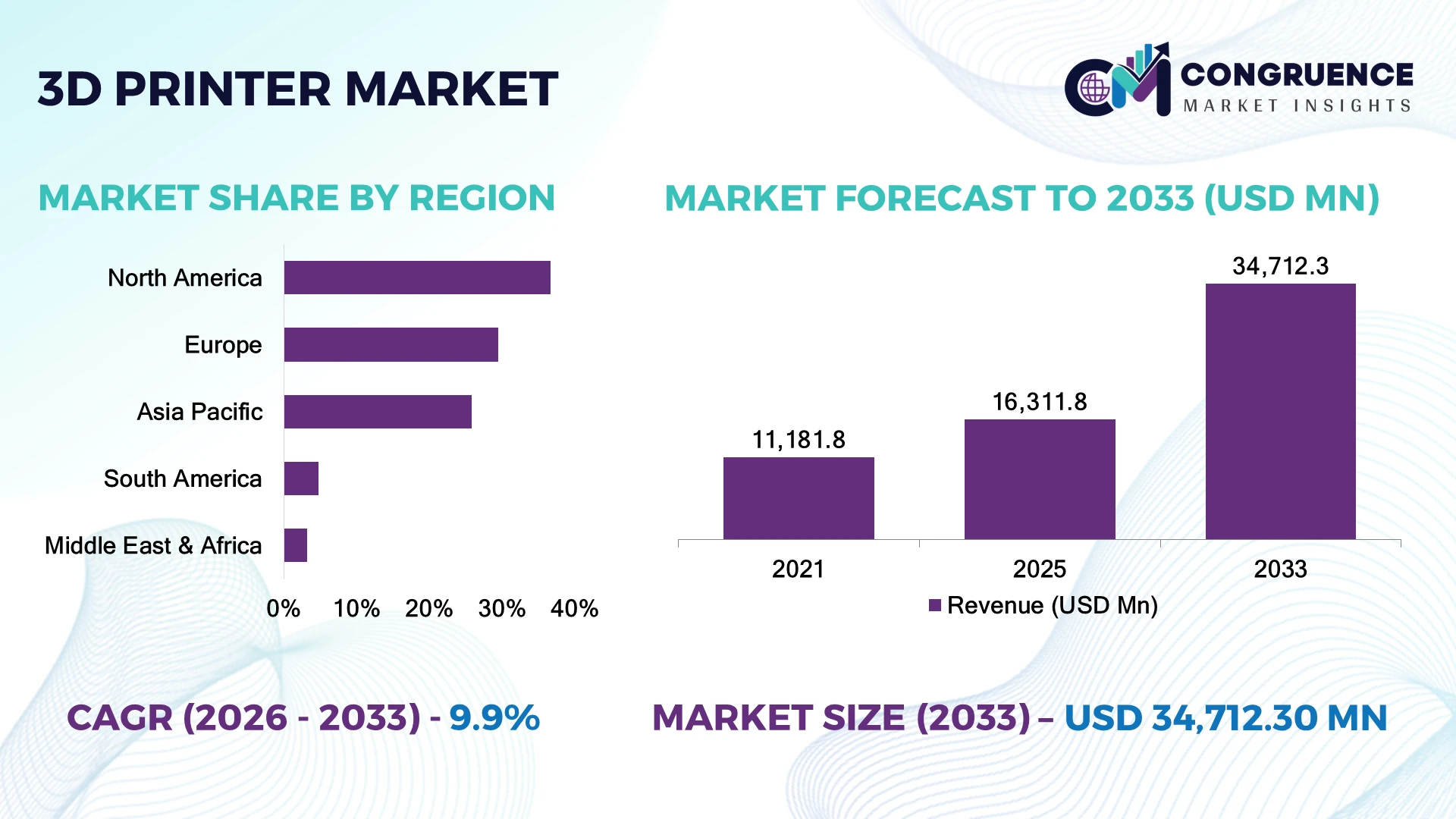
The United States remains a dominant 3D printer market, accounting for approximately 31% of global demand, supported by aerospace, defense, healthcare, automotive, and advanced manufacturing investment. China follows with roughly 25%, benefiting from large-scale electronics, automotive, industrial equipment, and localized manufacturing programs. U.S. industrial users increasingly integrate automated print monitoring, while China is expanding domestic equipment capacity and material ecosystems. North American aerospace applications already represent more than 20% of industrial additive manufacturing activity, reinforcing production-oriented adoption.
The strategic priority is shifting from printer acquisition toward high-utilization production cells, qualified materials, automated workflows, and application-specific additive manufacturing capacity.
Market Size & Growth: USD 16.3 billion in 2025 to USD 34.7 billion by 2033 at 9.9% CAGR, driven by production-grade additive manufacturing and localized supply chains.
Top Growth Drivers: Aerospace 22%, healthcare 18%, automotive 16% adoption contribution, reflecting increasing use of customized and lightweight components.
Short-Term Forecast: By 2028, automated production workflows are positioned to improve machine utilization by 15–25% as monitoring, scheduling, and post-processing become integrated.
Emerging Technologies: AI-assisted design, metal powder-bed fusion, and automated post-processing are advancing; AI-enabled workflows are targeting 20–30% reductions in design and process-development time.
Regional Leaders: North America is projected above USD 10 billion, Asia-Pacific above USD 12 billion, and Europe above USD 7 billion by 2033, with Asia-Pacific showing the strongest production-oriented adoption.
Consumer/End-User Trends: More than 30% of industrial users increasingly prioritize end-use parts over prototyping, accelerating demand for repeatable production-grade printers.
Pilot/Case Example: Metal additive manufacturing recorded a 24.4% increase in system shipments in 2023, demonstrating accelerating industrial acceptance of metal production applications.
Competitive Landscape: Leading positions are concentrated among Stratasys, 3D Systems, EOS, HP, and Materialise, with the top players competing through materials, automation, software, and application-specific platforms.
Regulatory & ESG Impact: Lightweight additive components can reduce material consumption by 20–40% in selected designs, while localized production reduces transportation requirements and supports distributed manufacturing.
Investment & Funding: Global additive manufacturing activity reached approximately USD 24.2 billion in 2025, with investment increasingly favoring production services, materials, software, and regional manufacturing ecosystems.
Innovation & Future Outlook: By 2028, multi-material printing, AI-driven generative design, autonomous production monitoring, and distributed manufacturing will shift competition from printer specifications toward complete digital production ecosystems.
3D printing is moving beyond prototyping into production environments where customization, shorter development cycles, and inventory reduction create measurable commercial value. Aerospace, healthcare, automotive, dental, and industrial tooling remain key demand areas, while polymer and metal systems are gaining capability through automated calibration, in-process monitoring, and AI-supported design. In 2026, manufacturers are also prioritizing localized production to reduce exposure to long-distance component supply disruptions. The next strategic discussion therefore centers on how additive manufacturing capacity is being integrated into competitive production models.
3D printing is becoming strategically important because manufacturers are using additive production to shorten development cycles, localize selected components, and economically produce geometrically complex parts. The shift is particularly relevant as companies redesign supply chains around regional production and lower inventory exposure. Production-oriented adoption is replacing the earlier prototype-heavy model, increasing the importance of machine utilization, material qualification, process repeatability, and post-processing capacity.
Technology selection is also becoming more consequential. Modern polymer and metal systems with automated monitoring can reduce manual intervention and process variability by approximately 20–30% compared with less automated workflows. North America remains strong in aerospace, defense, healthcare, and industrial applications, while China and other Asian manufacturing hubs are scaling equipment, materials, and production ecosystems more aggressively. Over the next 2–3 years, industrial users are expected to prioritize higher machine utilization, automated quality control, and qualified material portfolios rather than simply adding printer units.
A practical deployment model is the use of distributed printer cells for tooling and spare parts, allowing manufacturers to produce selected components closer to the point of consumption. Companies are consequently increasing investment in application engineering, materials partnerships, software integration, and production-service networks. Competitive advantage will increasingly depend on converting printer capacity into repeatable, certified production output rather than maximizing installed hardware alone.
The strongest growth driver is the transition from prototyping toward end-use production, tooling, and spare-parts manufacturing. A 2025 additive-manufacturing survey found 60% of respondents using 3D printing for end-use parts, up from 35% previously, while 52% of advanced manufacturers identified additive manufacturing as a recent investment priority. Aerospace adoption is particularly strong, with 69.1% of surveyed aerospace manufacturers using 3D printing. Supply-chain disruptions are reinforcing localized production strategies. Companies are responding by expanding metal-printing capacity, qualifying production materials, integrating automated inspection, and partnering with service bureaus. The strategic shift is significant: printer utilization and qualified production output now matter more than installed machine count.
Material qualification, machine economics, and post-processing requirements continue to restrict scalable deployment, particularly for regulated production. Industrial additive manufacturing often requires tightly controlled powders, polymers, thermal profiles, and finishing processes, while material and post-processing costs can account for a substantial portion of total part economics. Approximately 41% of advanced manufacturers are prioritizing AI investment, but only 52% prioritize additive manufacturing, indicating that competing automation investments can constrain capital allocation. Aerospace and medical users face additional certification requirements that extend commercialization cycles. Companies are reducing exposure through standardized material libraries, supplier contracts, multi-source procurement, and automated process monitoring. The operational priority is improving cost-per-qualified-part rather than simply lowering printer acquisition prices.
AI-enabled design, automated print tuning, and closed-loop quality control create a significant opportunity to improve additive manufacturing economics. In a recent manufacturing survey, 39% of respondents described AI's future production impact as very significant, while 41% identified AI as an investment priority. Advanced 3D printing workflows can combine computer vision, sensor data, generative design, and predictive maintenance to reduce manual intervention and accelerate process development. India, China, and Southeast Asian manufacturing hubs offer additional opportunities as localized production ecosystems expand. Companies are investing in AI-enabled slicers, automated inspection, material qualification, and distributed production networks. The non-obvious opportunity is converting printer fleets into data-generating production assets, allowing manufacturers to optimize parameters continuously across multiple facilities.
Moving from individual machines to multi-site additive manufacturing creates difficult challenges around process repeatability, cybersecurity, workforce capability, and digital-thread integration. A 2025 smart-manufacturing survey found 26% of organizations using additive manufacturing in pilot mode and 41% operating it at scale, demonstrating that significant execution gaps remain between experimentation and standardized production. Aerospace manufacturers also reported only 1.9% of respondents had fully automated manufacturing processes. Companies must therefore integrate manufacturing execution systems, real-time monitoring, standardized qualification protocols, and operator training. The strategic challenge is maintaining identical part quality across distributed printer cells while controlling intellectual-property exposure and process drift. Firms that solve qualification, traceability, and automated quality assurance will secure stronger production contracts.
End-Use Production Gains Ground End-use manufacturing is becoming a core workflow, with 60% of surveyed users reporting 3D-printed end-use parts compared with 35% previously. Aerospace adoption reached 69.1% in a 2025 industry survey. Manufacturers are consequently shifting investment toward production-grade machines, qualified materials, and automated post-processing rather than prototype-only systems.
AI Moves Into Print Control AI is moving from design experimentation into machine-level optimization. Around 39% of manufacturing respondents now view AI's future production impact as very significant, while 41% identify AI as an investment priority. Companies are integrating computer vision, sensor analytics, automated parameter tuning, and predictive maintenance to reduce process variability and operator intervention.
Additive Manufacturing Scales Operationally Production deployment is moving beyond pilot programs: 41% of manufacturers report additive manufacturing operating at scale, while 26% remain in pilot mode. This shift is increasing demand for MES integration, automated scheduling, material traceability, and fleet-level monitoring. Providers are responding with connected printer ecosystems designed for repeatable multi-machine production.
Supply Chains Favor Distributed Printing Companies are increasingly using additive manufacturing to address spare-parts availability, tooling lead times, and localized production requirements. More than 50% of surveyed advanced manufacturers identified additive manufacturing as a recent technology investment priority. The operational shift favors regional print cells and qualified digital inventories, allowing manufacturers to produce selected components closer to consumption points and reduce dependence on long-distance component logistics.
Industrial Systems Lead as Production Moves Beyond Prototyping
Industrial 3D printers represented the leading type, accounting for approximately 63% of global demand in 2025, supported by higher build volumes, advanced material compatibility, automation integration, and qualification for production environments. Their economics increasingly favor aerospace, automotive, healthcare, and industrial manufacturing where repeatability and complex geometries justify higher capital intensity. Professional systems held roughly 22%, serving engineering departments and specialized workshops that require faster iteration without full industrial infrastructure, while desktop printers remained important for education, design studios, and entry-level prototyping. Companies are increasingly prioritizing industrial platforms as utilization rates rise and production workflows mature.
The fastest-growing shift is toward production-oriented industrial systems, particularly metal and high-performance polymer platforms. End-use adoption has expanded sharply, with 60% of respondents in a 2025 industry survey reporting use of 3D printing for end-use parts, compared with 35% previously. This is redirecting investment from standalone prototyping equipment toward automated print cells, material qualification, inspection, and software integration. Manufacturers are also partnering with service bureaus to scale capacity before committing to additional internal fleets, making utilization and qualified output the key investment metrics.
In March 2025, an additive-manufacturing industry survey reported that 60% of respondents were using 3D printing for end-use parts, up from 35% in 2023, confirming the accelerating transition from prototyping to production.
Production Parts Accelerate the Application Mix
Prototyping remains the leading application, representing approximately 43% of 3D printer demand in 2025 because rapid design iteration, functional validation, and tooling development remain embedded in engineering workflows. Automotive, aerospace, consumer electronics, and medical-device manufacturers continue using printers to shorten design cycles and validate complex geometries before conventional production. Tooling and jigs account for about 24%, offering an established use case where customized fixtures can be produced internally with shorter lead times. Production parts, however, are expanding faster as material performance, dimensional consistency, and automated process monitoring improve.
Production parts are estimated to represent roughly 18% of application demand and are the fastest-growing use case, particularly for low-volume, customized, lightweight, and geometrically complex components. Repair and spare-parts production remains smaller but strategically important where inventory reduction and localized manufacturing improve supply continuity. Companies are scaling production through multi-machine cells, integrating printers with manufacturing execution systems, and qualifying repeatable digital workflows. The business implication is a shift from printer purchases based on engineering convenience toward deployment decisions tied directly to throughput, inventory reduction, part economics, and supply-chain resilience.
The 2025 aerospace manufacturing survey found 3D printing was used by 69.14% of respondents, ahead of CNC machining at 54.32%, demonstrating the operational importance of additive manufacturing across prototyping and manufacturing workflows.
Automotive Anchors Scale While Aerospace Intensifies Adoption
Automotive is the leading end-user, accounting for approximately 28% of global 3D printer demand in 2025, supported by extensive prototyping, customized tooling, lightweight component development, and growing electric-vehicle engineering requirements. Aerospace and defense follows at around 21%, where additive manufacturing commands higher strategic value because complex geometries, weight reduction, and localized production can directly affect aircraft and defense-system economics. Healthcare, consumer electronics, industrial manufacturing, and education collectively represent the remaining demand, with purchasing decisions varying from regulated component qualification to rapid product development. Companies serving automotive buyers are increasingly offering integrated printer-material-software packages rather than standalone equipment.
Aerospace and defense represents the fastest-growing major end-user group as qualification, advanced materials, and digital manufacturing workflows mature. Its adoption is becoming increasingly operational rather than experimental, with 69.14% of surveyed aerospace manufacturers identifying 3D printing as a current prototyping or manufacturing technology. Healthcare is also shifting toward patient-specific components and dental production, while industrial manufacturers are prioritizing spare parts and tooling. Vendors are responding with verticalized solutions, application engineering, certification support, and partnerships with material suppliers. Future demand is therefore concentrating where printers can deliver measurable reductions in tooling lead time, inventory exposure, component weight, and development cycles.
In 2025, aerospace manufacturing respondents reported 69.14% adoption of 3D printing, while 50% reported robotic manufacturing use, indicating that additive manufacturing is increasingly being deployed alongside automation rather than as an isolated production technology.
North America accounted for the largest market share at 36.7% in 2025 however, Asia-Pacific is expected to register the fastest growth, expanding at a CAGR of 12.8% between 2026 and 2033.

Production-grade additive manufacturing shifts from prototyping toward qualified component production
North America remains the largest 3D printer market, supported by dense aerospace, automotive, medical-device, defense, and industrial manufacturing clusters. The United States represents approximately 86% of regional demand, reflecting its concentration of printer manufacturers, service bureaus, advanced materials suppliers, and aerospace production. Aerospace is particularly important, with additive manufacturing used by roughly 90% of aerospace companies for prototyping or manufacturing activities. Regional investment is increasingly moving toward metal AM, automated post-processing, process qualification, and distributed production rather than standalone printer purchases. Companies are expanding application centers and integrating additive systems with digital manufacturing platforms to improve production economics. The strategic shift is significant: competitive advantage increasingly depends on qualified throughput and repeatability rather than printer specifications alone.
United States Market Outlook:
The United States dominates North American 3D printing activity through advanced aerospace, defense, medical technology, automotive, and semiconductor manufacturing infrastructure. Approximately 85.6% of the regional market is concentrated in the country, supported by substantial R&D capabilities and government-industry collaboration. Manufacturers are prioritizing production-qualified metal and polymer systems, while aerospace companies increasingly integrate additive manufacturing into serial production and maintenance workflows.
Engineering-led adoption is converging with automated, production-scale AM
Europe maintains a strong industrial 3D printing base, with Germany serving as the principal manufacturing and technology hub. Germany accounted for approximately 29.4% of the European market in 2025, while automotive represented about 24.2% of regional demand. Industrial hardware remains dominant, but manufacturing-as-a-service models are expanding as companies seek flexible capacity without committing to additional capital equipment. Europe also has a particularly deep metal-AM ecosystem, with German manufacturers accounting for more than half of the globally installed metal-AM system base. Companies are investing in process automation, AI-assisted monitoring, advanced polymers, and metal qualification to address production consistency and unit-cost pressure.
Germany Market Outlook:
Germany holds a structurally important position because approximately 44% of industrial companies with more than 100 employees already use 3D printing, while another 20% plan adoption. The country also has 37 industrial AM-system manufacturers, giving it an unusually deep domestic equipment ecosystem. Automotive, aerospace, medical technology, and dental manufacturing provide concentrated demand, supporting continued investment in industrial metal and polymer platforms.
Manufacturing scale is converting additive manufacturing into a mainstream production tool
Asia-Pacific is the fastest-expanding 3D printing market, driven by China's electronics and industrial manufacturing base alongside technology investment in Japan, South Korea, and India. China remains the regional anchor, while Shanghai and Shenzhen are strengthening as additive manufacturing and contract-production hubs. TCT Asia 2025 featured more than 450 exhibitors, reflecting the scale and increasing sophistication of the Chinese ecosystem. Electronics, aerospace, automotive, healthcare, and semiconductor manufacturing are moving beyond prototyping toward tooling and production components. Companies are scaling localized printer production, materials development, and application engineering while integrating additive manufacturing with Industry 4.0 systems. The region's strategic advantage lies in combining high-volume manufacturing infrastructure with rapidly improving domestic AM capabilities, shortening the path from experimentation to commercial deployment.
China Market Outlook:
China is the most strategically significant Asian market because of its manufacturing depth, electronics ecosystem, and substantial R&D expenditure. The country's additive manufacturing base is increasingly focused on industrial-scale metal systems, aerospace components, automotive applications, and electronics tooling. Shanghai and Shenzhen provide complementary strengths in advanced manufacturing and contract production, enabling companies to scale additive workflows rapidly. China's 2023 R&D expenditure reached an estimated USD 427 billion, reinforcing the investment environment supporting advanced manufacturing technologies.
Localized production is strengthening around aerospace, healthcare, and automotive demand
South America remains a developing 3D printing market, with Brazil serving as the principal commercial and technology hub. The country has one of Latin America's fastest-growing additive manufacturing ecosystems, supported by universities, research institutions, engineering firms, and large industrial companies. Brazil's polymer printing base was estimated at roughly 300,000 printers by 2022, with filament consumption near 30 tons per month, demonstrating substantial distributed demand. Metal additive manufacturing remains less mature than polymer printing but is gaining traction in aerospace, healthcare, and automotive applications. Companies are responding to high equipment costs and skilled-labor constraints through service bureaus, training partnerships, localized production, and application-specific deployments. The strategic opportunity is strongest where additive manufacturing reduces imported-component dependence or supports customized, low-volume production.
Brazil Market Outlook:
Brazil offers the strongest industrial platform in South America through its aerospace, automotive, healthcare, energy, and engineering sectors. Universities and research institutions play an important role in technology commercialization, while the established polymer-printing installed base creates a foundation for broader industrial adoption. Metal AM remains comparatively underpenetrated, creating opportunities for aerospace-grade systems, medical components, and advanced tooling. However, exchange-rate volatility, tariffs, implementation costs, and shortages of qualified professionals continue to influence purchasing decisions and favor partnerships with established technology providers.
National manufacturing strategies are turning additive technology into infrastructure
Middle East & Africa adoption is increasingly concentrated in Saudi Arabia and the United Arab Emirates, where national industrial strategies are linking 3D printing with aerospace, defense, healthcare, energy, automotive, and construction. Saudi Arabia is building localized additive manufacturing capabilities through partnerships and industrial investment, including initiatives involving energy and defense applications. In 2025, a strategic investment expanded a major Saudi additive manufacturing joint venture, while a five-year USD 26 million framework agreement targeted locally manufactured tungsten components for nuclear infrastructure inspection. Companies are therefore moving beyond demonstration projects toward localized production, qualification, and supply-chain integration. The competitive opportunity is strongest for providers capable of combining equipment, materials, engineering services, certification, and local maintenance rather than selling printers as standalone capital assets.
Saudi Arabia Market Outlook:
Saudi Arabia is the region's most strategically significant market because additive manufacturing is directly connected to industrial localization, defense, energy, healthcare, and Vision 2030 objectives. National investment programs are encouraging domestic production capabilities and regional maintenance infrastructure. A strategic joint venture involving additive manufacturing technology and Saudi industrial investment has already secured a USD 26 million, five-year framework agreement for specialized tungsten components, demonstrating the transition toward commercially integrated manufacturing.
The competitive landscape pits Stratasys and 3D Systems against EOS, HP, and GE Additive, while specialized players such as Formlabs and UltiMaker compete on accessibility, speed, and application focus. The top five industrial players collectively command about 35.5% share, leaving space for challengers. Competition centers on materials, throughput, software integration, certification, and total cost: automated systems can improve utilization by 20%+, materials reduce variable part costs by 40%, while faster platforms deliver productivity gains approaching 4x. Stratasys is strengthening polymer leadership through portfolio expansion; EOS is deepening aerospace partnerships; HP is combining printers, materials, software, and digital inventory; 3D Systems is emphasizing AI-enabled workflows and domestic metal manufacturing. The competitive shift is moving from hardware specifications toward qualified production ecosystems and supply-chain resilience. High entry barriers include materials qualification, application engineering, installed-base relationships, and certification. Winners will pair repeatable production economics with secure software, validated materials, service, and integration.
Stratasys Ltd.
3D Systems Corporation
EOS GmbH
HP Inc.
GE Additive
Formlabs
UltiMaker
Desktop Metal
Markforged
Materialise NV
Nikon SLM Solutions
Renishaw plc
Velo3D
XYZprinting
Industrial 3D printing is shifting toward AI-assisted process control, multi-laser metal systems, automated material handling, and integrated production software. AI-based monitoring increasingly detects process anomalies before defective parts reach post-processing, while automated nesting and workflow optimization can improve printer utilization by more than 20%. High-throughput polymer platforms are also moving beyond prototyping into repeatable production, strengthening the economics of digitally manufactured parts.
Materials innovation is equally decisive. High-reusability polymers can reduce variable part costs by up to 40%, while powder-reuse systems improve material efficiency and lower production waste. Compared with conventional manual build preparation, automated nesting can reduce build costs by about 20% while improving utilization by approximately 21%. Aerospace, defense, healthcare, and automotive manufacturers benefit most because certification, customization, and complex geometries create stronger economic justification for advanced additive workflows.
Between 2026 and 2028, connected printer fleets, AI-driven quality assurance, digital inventory, and hybrid manufacturing cells will become increasingly important. Industrial users are prioritizing systems that integrate hardware, materials, software, inspection, and post-processing rather than isolated printers. The competitive advantage will shift toward platforms capable of delivering repeatable production economics, secure digital workflows, qualified materials, and faster deployment across distributed manufacturing networks.
April 2025 EOS partnered with Godrej Enterprises Group to build an additive manufacturing ecosystem for Indian aviation and space, strengthening localized aerospace production, OEM supply, and serial AM deployment while reducing dependence on external suppliers and expanding qualified production capabilities. Source: eos.info
January 2025 Stratasys secured a $120 million equity investment from Fortissimo Capital, representing approximately 14% of outstanding shares. The funding strengthened its balance sheet for additive manufacturing expansion, technology development, and industrial production opportunities across targeted high-value applications and segments. Source: Stratasys
August 2025 3D Systems received a $7.65 million U.S. Air Force contract for a large-format metal 3D printer technology demonstrator. The two-year program advances high-temperature structures for high-speed flight and strengthens domestic defense manufacturing qualification and deployment pathways. Source: 3D Systems
November 2025 HP expanded its industrial additive portfolio with the HP IF 600HT and materials collaborations. Its PA 11 Gen2 material delivers up to 80% powder reusability and 40% lower variable part costs, improving production economics for high-volume industrial manufacturing. Source: hp.com (HP)
The 3D Printer Market Report provides comprehensive coverage across printer types, including desktop, professional, and industrial systems, with analysis spanning prototyping, tooling, production parts, repair, and customized manufacturing applications. End-user coverage includes automotive, aerospace and defense, healthcare, consumer electronics, industrial manufacturing, education, and other specialized industries. The study evaluates technology adoption across polymer, metal, composite, and emerging material platforms, alongside software, automation, post-processing, and inspection integration.
Regional analysis covers North America, Europe, Asia-Pacific, South America, and the Middle East & Africa, with country-level assessment of manufacturing concentration, technology deployment, investment activity, and supply-chain localization. Competitive analysis profiles 10–14 major participants and evaluates product portfolios, partnerships, application strategies, and technological positioning. The report supports investment planning, capacity expansion, market-entry decisions, competitive positioning, and technology prioritization through 2026–2033.
| Report Attribute/Metric | Report Details |
|---|---|
|
Market Revenue in 2025 |
USD 16,311.8 Million |
|
Market Revenue in 2033 |
USD 34,712.3 Million |
|
CAGR (2026 - 2033) |
9.9% |
|
Base Year |
2025 |
|
Forecast Period |
2026 - 2033 |
|
Historic Period |
2021 - 2025 |
|
Segments Covered |
By Type
By Application
By End-User
|
|
Key Report Deliverable |
Revenue Forecast, Growth Trends, Market Dynamics, Segmental Overview, Regional and Country-wise Analysis, Competition Landscape |
|
Region Covered |
North America, Europe, Asia-Pacific, South America, Middle East, Africa |
|
Key Players Analyzed |
Stratasys Ltd., 3D Systems Corporation, EOS GmbH, HP Inc., GE Additive, Formlabs, UltiMaker, Desktop Metal, Markforged, Materialise NV, Nikon SLM Solutions, Renishaw plc, Velo3D, XYZprinting |
|
Customization & Pricing |
Available on Request (10% Customization is Free) |




