
Reports
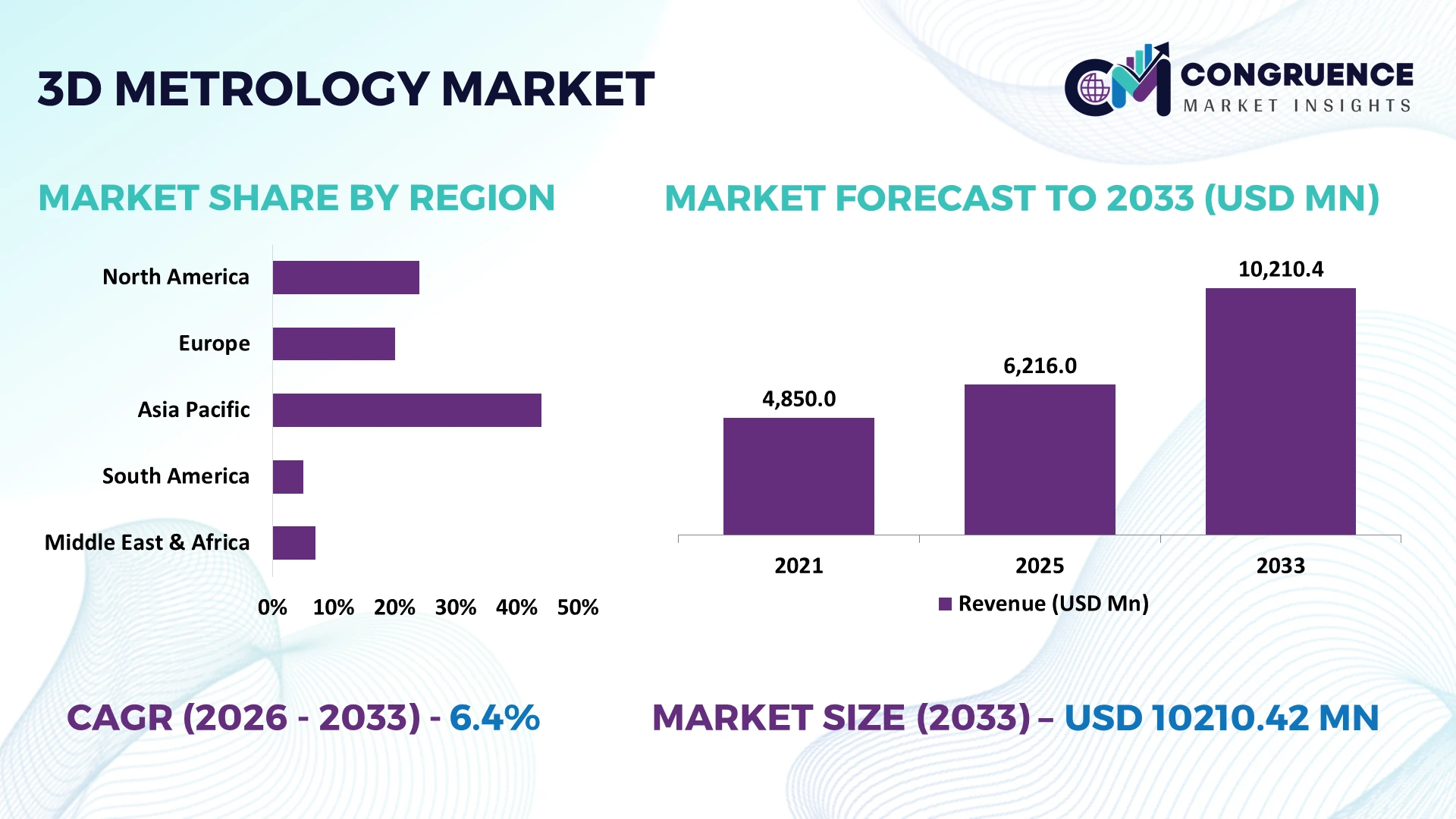
The Global 3D Metrology Market was valued at USD 6216 Million in 2025 and is anticipated to reach a value of USD 10210.42 Million by 2033 expanding at a CAGR of 6.4% between 2026 and 2033. Growth is accelerating through wider deployment of AI-assisted dimensional inspection, automated quality control, and high-precision measurement systems across aerospace, semiconductor, automotive, and advanced manufacturing facilities.
China remains the dominant country, accounting for approximately 31% of global advanced manufacturing output while supporting over 35% of regional industrial metrology equipment installations through continuous smart factory investments. Compared with Germany, where precision engineering and automotive quality systems drive higher measurement density, China leads in deployment scale, supported by industrial modernization initiatives and resilient supply-chain localization following global trade realignments in 2026.
The market's geographic concentration signals that technology providers should prioritize scalable automation, regional manufacturing partnerships, and industry-specific inspection solutions to strengthen long-term competitive positioning.
Market Size & Growth: USD 6216 Million in 2025, reaching USD 10210.42 Million by 2033 at 6.4% CAGR, driven by AI-enabled industrial quality inspection.
Top Growth Drivers: AI inspection adoption (+28%), smart factory implementation (+24%), semiconductor precision manufacturing (+21%).
Short-Term Forecast: By 2028, automated inspection workflows reduce measurement time by nearly 30% while improving production efficiency by 20%.
Emerging Technologies: AI analytics, robotic metrology cells, and digital twin integration improve inspection accuracy by over 25% across advanced production lines.
Regional Leaders: Asia-Pacific approaches USD 4.6 Billion, North America exceeds USD 2.5 Billion, Europe nears USD 2.2 Billion, supported by industrial automation and regional manufacturing expansion.
Consumer/End-User Trends: More than 60% of large manufacturers integrate non-contact 3D metrology into production quality management.
Pilot/Case Example: In 2026, an automated aerospace inspection deployment improved dimensional verification speed by 35% while reducing manual rework by 22%.
Competitive Landscape: Hexagon leads with approximately 18% market share alongside ZEISS, Nikon, FARO Technologies, and Creaform in high-precision industrial applications.
Regulatory & ESG Impact: Digital inspection reduces material scrap by around 15%, supporting stricter sustainability and manufacturing compliance objectives.
Investment & Funding: More than USD 2 Billion supports factory expansion, automation partnerships, and precision manufacturing amid global supply-chain diversification.
Innovation & Future Outlook: AI-driven autonomous inspection, cloud-connected metrology, and inline measurement platforms accelerate next-generation smart manufacturing strategies.
The 3D Metrology Market is advancing through increasing demand for automated dimensional verification in electric vehicles, semiconductor fabrication, aerospace components, and precision medical manufacturing. AI-powered inspection software, portable laser scanning, and high-speed optical measurement systems now improve inspection throughput by nearly 25%. Ongoing supply-chain localization and stricter manufacturing quality requirements are accelerating deployment of integrated metrology platforms, setting the stage for broader strategic industry transformation.
The 3D Metrology Market has become a strategic pillar for manufacturers seeking tighter production tolerances, higher automation, and faster product validation across aerospace, semiconductor, automotive, and medical device industries. Digital manufacturing expansion and ongoing supply-chain restructuring since 2026 are accelerating investment in inline inspection and automated quality assurance, allowing manufacturers to strengthen production resilience while reducing dependence on post-production defect correction.
Compared with conventional coordinate measuring machines requiring offline inspection, AI-enabled optical 3D metrology systems complete dimensional verification up to 40% faster while reducing inspection-related labor requirements by nearly 25%. Germany continues to lead in precision engineering innovation and advanced industrial deployment, whereas China demonstrates larger implementation scale through rapid smart factory expansion and electronics manufacturing. Over the next two to three years, more than 55% of newly commissioned high-value production lines are expected to integrate automated non-contact measurement technologies as digital quality ecosystems become standard practice.
Automotive manufacturers increasingly deploy robotic 3D scanning cells that inspect complex body structures in real time, shortening production validation cycles while improving traceability. In response, technology providers are expanding software capabilities, forming automation partnerships, and investing in cloud-connected inspection platforms that deliver predictive quality analytics. Companies securing integrated hardware-software ecosystems will achieve stronger competitive positioning through higher operational efficiency, scalable deployment, and consistent manufacturing performance.
The strongest catalyst for the 3D Metrology Market is the rapid integration of automated dimensional inspection into high-value manufacturing. Nearly 68% of leading automotive production facilities now deploy advanced optical inspection within quality workflows, while AI-assisted defect detection improves measurement productivity by approximately 30% and reduces rework by around 20%. China's continued smart manufacturing expansion and semiconductor capacity investments are accelerating demand for inline metrology systems capable of supporting high-volume precision production. Equipment manufacturers are responding through robotics partnerships, software-driven inspection platforms, and localized manufacturing expansion. A notable strategic shift is the transition from standalone measurement devices toward connected digital quality ecosystems that continuously optimize production accuracy rather than simply detecting defects.
High acquisition costs and complex factory integration continue to limit wider adoption, particularly among small and mid-sized manufacturers. Complete automated metrology installations often require 20–35% higher initial investment than conventional inspection systems, while integrating legacy production equipment can extend deployment schedules by nearly 30%. Japan and several European manufacturers also face component sourcing challenges for precision optics and advanced sensors following ongoing global supply-chain adjustments. These constraints directly affect production scalability and return-on-investment timelines. Companies are reducing exposure by localizing component procurement, standardizing software architectures, and negotiating long-term supplier agreements that stabilize equipment availability while improving implementation consistency.
The next wave of opportunity lies in combining 3D metrology with digital twins, industrial AI, and cloud-based manufacturing intelligence. More than 60% of large manufacturers are expanding connected production environments, while digital quality platforms reduce engineering validation time by approximately 25% and improve process optimization by nearly 18%. India's expanding electronics manufacturing ecosystem and national industrial modernization initiatives create attractive deployment opportunities for portable and automated inspection solutions. Technology vendors are increasing R&D investment, collaborating with industrial automation providers, and developing interoperable software ecosystems that enable continuous quality monitoring. A distinctive competitive advantage is shifting from hardware precision alone toward real-time production intelligence that supports predictive manufacturing decisions.
Long-term competitiveness depends on overcoming implementation complexity associated with advanced software, data interoperability, and skilled workforce availability. Approximately 40% of manufacturers report shortages of personnel capable of operating AI-enabled metrology platforms, while integrating multiple inspection systems can increase engineering implementation effort by around 25%. Growing industrial cybersecurity requirements for cloud-connected production environments further increase deployment complexity, particularly in highly regulated manufacturing sectors within the United States. Companies must address these challenges through workforce development programs, secure industrial data architectures, standardized communication protocols, and closer collaboration with automation partners. Organizations that successfully combine technical expertise with scalable digital infrastructure will establish more resilient and sustainable quality management operations.
AI-Powered Inline Inspection Expansion Advanced production facilities are replacing sample-based inspection with continuous AI-enabled inline measurement, with deployment increasing by nearly 32% across automotive and electronics manufacturing. Automated inspection reduces measurement cycles by around 28% while improving first-pass yield by 18%. Labor shortages and tighter quality requirements are accelerating adoption, prompting equipment manufacturers to strengthen robotics partnerships and integrate machine learning into industrial metrology platforms for real-time process optimization.
Portable Metrology Gains Momentum Demand for handheld scanners and portable optical systems has expanded by approximately 26% as manufacturers prioritize flexible inspection outside dedicated metrology laboratories. Field measurement time has declined by nearly 30%, allowing faster equipment commissioning and maintenance verification. Germany's precision engineering sector and India's expanding manufacturing facilities are accelerating deployment, while vendors broaden product portfolios with wireless connectivity, cloud synchronization, and modular software to improve operational responsiveness across distributed production sites.
Cloud-Connected Quality Workflows More than 58% of large manufacturers now connect metrology systems with manufacturing execution and product lifecycle management platforms, reducing reporting delays by approximately 35%. Digital traceability requirements and evolving industrial compliance standards are driving workflow integration beyond standalone inspection. Technology providers are expanding subscription-based analytics, strengthening industrial software partnerships, and delivering unified quality intelligence platforms that improve production visibility while supporting predictive maintenance and faster engineering decisions.
Multi-Sensor Measurement Integration Manufacturers increasingly combine optical scanners, laser tracking, and vision measurement within unified inspection cells, improving dimensional accuracy by nearly 22% while shortening validation processes by about 25%. Semiconductor miniaturization and electric vehicle production complexity continue to drive this transition. Companies are restructuring product strategies toward interoperable hardware ecosystems and standardized software environments, creating differentiated value through integrated measurement rather than individual device performance.
Coordinate Measuring Machines (CMM) remain the leading product category, accounting for approximately 34% of market deployment because of their proven precision, repeatability, and compatibility with aerospace, automotive, and industrial manufacturing quality systems. Their ability to inspect complex components with micron-level accuracy keeps them essential for high-value production despite increasing automation requirements. Vision Measuring Systems and Laser Trackers continue supporting specialized inspection tasks, while 3D X-ray Inspection is expanding in electronics and battery manufacturing where internal defect detection is operationally critical.
Optical Scanners represent the fastest-growing segment as manufacturers prioritize non-contact inspection, production flexibility, and automated workflows. Adoption has increased by nearly 27% across advanced manufacturing, while portable optical systems reduce inspection time by approximately 30% compared with conventional workflows. Companies are investing in AI-enabled scanning software, robotics integration, and multi-sensor platforms while expanding product portfolios through strategic partnerships. Investment priorities are steadily shifting toward scalable optical inspection technologies capable of supporting digital manufacturing and real-time production quality management.
Quality Control remains the dominant application, representing approximately 39% of total market usage as manufacturers prioritize dimensional consistency, regulatory compliance, and production traceability. Automated inspection workflows reduce defect rates by nearly 20% while improving production efficiency by approximately 24%. Inspection continues to expand alongside increasingly complex components, whereas Reverse Engineering supports product redesign, aftermarket manufacturing, and legacy component replication across industrial sectors.
Virtual Simulation is the fastest-growing application as manufacturers integrate digital engineering with physical measurement data to accelerate product validation. Product Development teams increasingly combine simulation models with real-world measurement, reducing prototype iterations by approximately 25% and engineering lead times by nearly 18%. Companies are expanding cloud-based engineering platforms, integrating metrology software with digital twin environments, and strengthening automation partnerships. Demand is shifting toward connected workflows where measurement data directly improves design accuracy and manufacturing performance rather than serving only final inspection requirements.
Automotive remains the largest end-user segment with an estimated 36% market share, supported by high-volume production, stringent dimensional tolerances, and increasing electric vehicle manufacturing. Automated metrology deployment has improved body inspection productivity by approximately 30%, while inline quality verification reduces assembly rework by nearly 20%. Industrial Manufacturing maintains broad adoption across precision machinery and heavy equipment, while Aerospace & Defense continues emphasizing ultra-high accuracy for safety-critical components.
Electronics is the fastest-growing end-user as semiconductor miniaturization and advanced consumer devices require increasingly precise measurement capabilities. Adoption of non-contact metrology has expanded by approximately 28% within electronics production facilities, supporting high-density component inspection and wafer-level quality assurance. Healthcare steadily increases demand through customized medical devices and implant manufacturing. Companies are responding with sector-specific software, modular inspection platforms, collaborative technology partnerships, and flexible pricing strategies that strengthen long-term customer ecosystems while positioning for expanding precision manufacturing requirements.
North America accounted for the largest market share at 36% in 2025 however, Asia-Pacific is expected to register the fastest growth, expanding at a 7.8% between 2026 and 2033.

Advanced Manufacturing and Digital Inspection Leadership
North America maintains the leading position through its concentration of aerospace, semiconductor, defense, and automotive manufacturing supported by extensive adoption of automated quality inspection technologies. The region contributes approximately 36% of global demand, driven by large-scale deployment of robotic inspection cells, AI-assisted metrology software, and digital manufacturing platforms. More than 62% of major production facilities integrate advanced non-contact measurement systems into quality workflows, improving inspection throughput and reducing process variability. Enterprise investment increasingly targets cloud-connected metrology, predictive quality analytics, and factory automation integration. Strategic collaborations between industrial automation providers and precision measurement companies continue strengthening manufacturing productivity while supporting resilient domestic production capabilities and higher-value industrial output.
United States Market Outlook: The United States leads regional deployment through its extensive aerospace, semiconductor, medical technology, and defense manufacturing ecosystem. More than 65% of advanced industrial facilities utilize automated dimensional inspection for critical production processes. Strong investment in semiconductor fabrication, digital manufacturing infrastructure, and industrial AI integration continues accelerating enterprise adoption. Equipment suppliers are expanding software capabilities, localized technical support, and automation partnerships to improve manufacturing precision while supporting next-generation industrial production requirements.
Precision Engineering and Sustainable Industrial Modernization
Europe remains a highly mature market where precision engineering, industrial automation, and sustainability objectives reinforce demand for advanced metrology technologies. The region accounts for approximately 28% of global deployment, supported by automotive, aerospace, and industrial equipment manufacturing. Nearly 58% of high-value production facilities have integrated digital quality management with automated measurement systems to improve traceability and reduce production waste. Modernization initiatives encourage greater adoption of AI-enabled inspection platforms alongside energy-efficient manufacturing practices. Companies continue expanding software interoperability and factory automation partnerships to strengthen operational consistency while supporting advanced engineering applications.
Germany Market Outlook: Germany serves as Europe's operational center for precision metrology through its globally competitive automotive, industrial machinery, and engineering sectors. Around 60% of large manufacturing facilities employ automated dimensional inspection technologies across production environments. Continuous investment in Industry 4.0 infrastructure, robotics integration, and intelligent factory systems strengthens demand for highly accurate measurement platforms. Domestic manufacturers increasingly prioritize connected inspection ecosystems that combine precision hardware with advanced industrial software.
Manufacturing Scale Accelerates Automated Inspection
Asia-Pacific is emerging as the fastest-expanding market through rapid manufacturing modernization, electronics production, semiconductor investment, and industrial automation. The region represents approximately 31% of global deployment and continues increasing production capacity across automotive, precision engineering, and consumer electronics industries. More than 35% of newly commissioned smart factories incorporate advanced optical inspection systems within production lines, improving quality consistency and reducing inspection delays. Export-oriented manufacturing and expanding industrial infrastructure continue encouraging investment in automated metrology, robotics integration, and digital quality management solutions across enterprise operations.
China Market Outlook: China dominates regional demand through its extensive electronics, automotive, aerospace, and industrial manufacturing capacity. Nearly 40% of newly deployed automated inspection systems within Asia-Pacific are installed in Chinese manufacturing facilities. Government-backed industrial modernization initiatives, domestic equipment production, and increasing semiconductor investment continue strengthening enterprise adoption. Technology providers are expanding local manufacturing, research collaboration, and intelligent inspection software development to support large-scale industrial transformation.
Industrial Modernization Supports Adoption
South America is steadily expanding through investments in automotive manufacturing, mining equipment production, industrial maintenance, and precision engineering. The region contributes approximately 5% of global market activity, with manufacturers increasingly deploying portable measurement technologies to improve production efficiency. Around 22% of large industrial facilities have expanded digital inspection capabilities over the past two years, reducing equipment downtime and improving maintenance accuracy. Infrastructure limitations remain a constraint, but industrial modernization programs and technology partnerships continue supporting gradual deployment of advanced metrology solutions across manufacturing operations.
Brazil Market Outlook: Brazil leads regional demand through its automotive manufacturing, aerospace production, and industrial equipment sectors. Approximately half of South America's advanced manufacturing investment is concentrated within the country, encouraging wider adoption of automated inspection technologies. Local enterprises increasingly integrate portable scanning systems and digital quality software into production environments while international suppliers strengthen distribution networks, technical training, and localized engineering services to improve operational efficiency.
Infrastructure Investment Drives Precision Manufacturing
The Middle East & Africa market continues advancing through industrial diversification, infrastructure modernization, aerospace maintenance, and energy-sector investment. The region accounts for approximately 4% of global deployment while increasing adoption of advanced inspection systems across manufacturing and engineering facilities. More than 20% of newly developed industrial projects now incorporate automated quality inspection technologies during production planning. Government-backed industrial development initiatives and technology transfer partnerships are strengthening local manufacturing capabilities, encouraging companies to invest in intelligent inspection platforms that improve operational reliability and production quality.
Saudi Arabia Market Outlook: Saudi Arabia has become the region's most strategically significant market through industrial diversification, advanced manufacturing investment, and infrastructure expansion. Large industrial projects increasingly integrate digital quality management and automated dimensional inspection into production facilities. Continued investment in aerospace, energy equipment, and precision manufacturing supports wider deployment of advanced metrology technologies, while international technology partnerships strengthen domestic engineering capability and accelerate industrial modernization.
The competitive landscape is led by Hexagon, ZEISS, FARO Technologies, Nikon Corporation, and Creaform, competing directly with regional precision metrology manufacturers and specialized optical scanning providers. Global technology leaders emphasize integrated hardware-software ecosystems, while regional suppliers compete through lower pricing, faster customization, and localized engineering support. The top five players collectively control approximately 54% of the market, creating strong competitive intensity around innovation rather than price alone. AI-enabled inspection software improves measurement productivity by nearly 30%, while cloud-connected quality platforms shorten reporting cycles by about 35%, making digital capabilities a primary differentiator. Companies increasingly strengthen market position through automation partnerships, localized manufacturing, software acquisitions, and vertical integration of sensors, analytics, and industrial robotics. Competition is shifting toward complete digital quality ecosystems instead of standalone measurement devices as manufacturers demand interoperable production environments. High precision engineering expertise, application-specific software, and extensive service networks remain significant entry barriers. Winning requires scalable automation, intelligent analytics, rapid deployment, and industry-specific solution customization.
Hexagon AB
Carl Zeiss AG
FARO Technologies, Inc.
Nikon Corporation
Creaform Inc.
KEYENCE Corporation
Renishaw plc
Mitutoyo Corporation
3D Systems Corporation
Artec 3D
Perceptron, Inc.
InnovMetric Software Inc.
LK Metrology Ltd.
Shining 3D
Current technology adoption is centered on AI-powered dimensional inspection, non-contact optical scanning, and cloud-enabled quality management platforms. More than 60% of advanced manufacturing facilities now integrate automated metrology into production workflows, improving inspection productivity by approximately 28% while reducing manual verification effort by nearly 22%. Multi-sensor measurement systems combining optical scanners, laser trackers, and vision technologies provide higher measurement consistency for complex industrial components.
Emerging technologies are transforming metrology from standalone inspection toward connected manufacturing intelligence. Digital twins, edge computing, and industrial AI enable real-time process optimization, reducing engineering validation time by around 25%. Compared with conventional offline coordinate measurement workflows, AI-assisted inline optical inspection completes dimensional verification nearly 40% faster while supporting continuous production monitoring. Automotive, semiconductor, and aerospace manufacturers gain the greatest operational advantage because rapid inspection directly improves throughput and reduces quality-related production interruptions.
Between 2026 and 2028, intelligent metrology platforms will increasingly integrate robotics, predictive analytics, and interoperable industrial software. Approximately 45% of newly deployed enterprise inspection systems are expected to include cloud-based analytics and automated reporting capabilities. Companies investing early in software-driven metrology ecosystems, AI-enabled measurement algorithms, and connected factory infrastructure will strengthen competitive differentiation through faster decision-making, improved traceability, and scalable quality management across global manufacturing operations.
April 2025: Hexagon completed the acquisition of Geomagic software from 3D Systems, strengthening reverse engineering and inspection capabilities across scanner-agnostic workflows. The platform maintains compatibility with 100% of major 3D scanner brands, expanding digital manufacturing interoperability. Source: hexagon.com
May 2025: Hexagon partnered with ZeroTouch to introduce high-speed inline non-contact metrology systems across Germany, France, and Switzerland. The solution delivers inspection cycles in under 30 seconds, enabling faster process control, reduced scrap, and higher manufacturing throughput.
July 2025: Thales signed a five-year strategic framework agreement with Hexagon to standardize metrology equipment and digital quality processes across EMEA operations. The partnership supports 5-year harmonized deployment, accelerating production ramp-up and enterprise-wide quality consistency.
April 2026: ZEISS presented new AI-powered automation and industrial quality solutions at Hannover Messe 2026, targeting semiconductor and advanced manufacturing environments. The portfolio combines 3 technology pillars—automation, digitalization, and AI analytics—to improve precision, productivity, and sustainable manufacturing performance. Source: zeiss.com
The report provides comprehensive coverage of the global 3D Metrology Market across Coordinate Measuring Machines (CMM), Optical Scanners, Laser Trackers, Vision Measuring Systems, and 3D X-ray Inspection. It evaluates demand across Quality Control, Reverse Engineering, Inspection, Product Development, and Virtual Simulation while assessing adoption within Automotive, Aerospace & Defense, Electronics, Industrial Manufacturing, and Healthcare. The analysis spans North America, Europe, Asia-Pacific, South America, and the Middle East & Africa, highlighting deployment trends, technology integration, and evolving enterprise purchasing patterns. More than 60% of advanced manufacturing facilities now prioritize automated dimensional inspection, reflecting the market's transition toward intelligent quality ecosystems.
The report further examines competitive positioning, technology evolution, supply-chain developments, and strategic investment priorities shaping the industry between 2026 and 2033. It evaluates adoption of AI-enabled metrology, cloud-connected inspection platforms, robotics integration, and digital quality management while identifying emerging opportunities in semiconductor manufacturing, electric vehicles, precision medical devices, and smart factories. The assessment supports expansion planning, product strategy, partnership evaluation, and long-term competitive decision-making through detailed segmentation, regional benchmarking, operational analysis, and technology-driven market intelligence.
| Report Attribute/Metric | Report Details |
|---|---|
Market Revenue in 2025 | USD 6216 Million |
Market Revenue in 2033 | USD 10210.42 Million |
CAGR (2026 - 2033) | 6.4% |
Base Year | 2025 |
Forecast Period | 2026 - 2033 |
Historic Period | 2021 - 2025 |
Segments Covered | By Type
By Application
By End-User
|
Key Report Deliverable | Revenue Forecast, Growth Trends, Market Dynamics, Segmental Overview, Regional and Country-wise Analysis, Competition Landscape |
Region Covered | North America, Europe, Asia-Pacific, South America, Middle East, Africa |
Key Players Analyzed |
|
Customization & Pricing | Available on Request (10% Customization is Free) |




