
Reports
The Global 3D Game Development Services Market was valued at USD 7,781.2 Million in 2025 and is anticipated to reach a value of USD 18,588.6 Million by 2033 expanding at a CAGR of 11.5% between 2026 and 2033. Growth is driven by AI-assisted game production, cross-platform deployment, live-service gaming expansion, and rising enterprise outsourcing for high-fidelity 3D content creation.
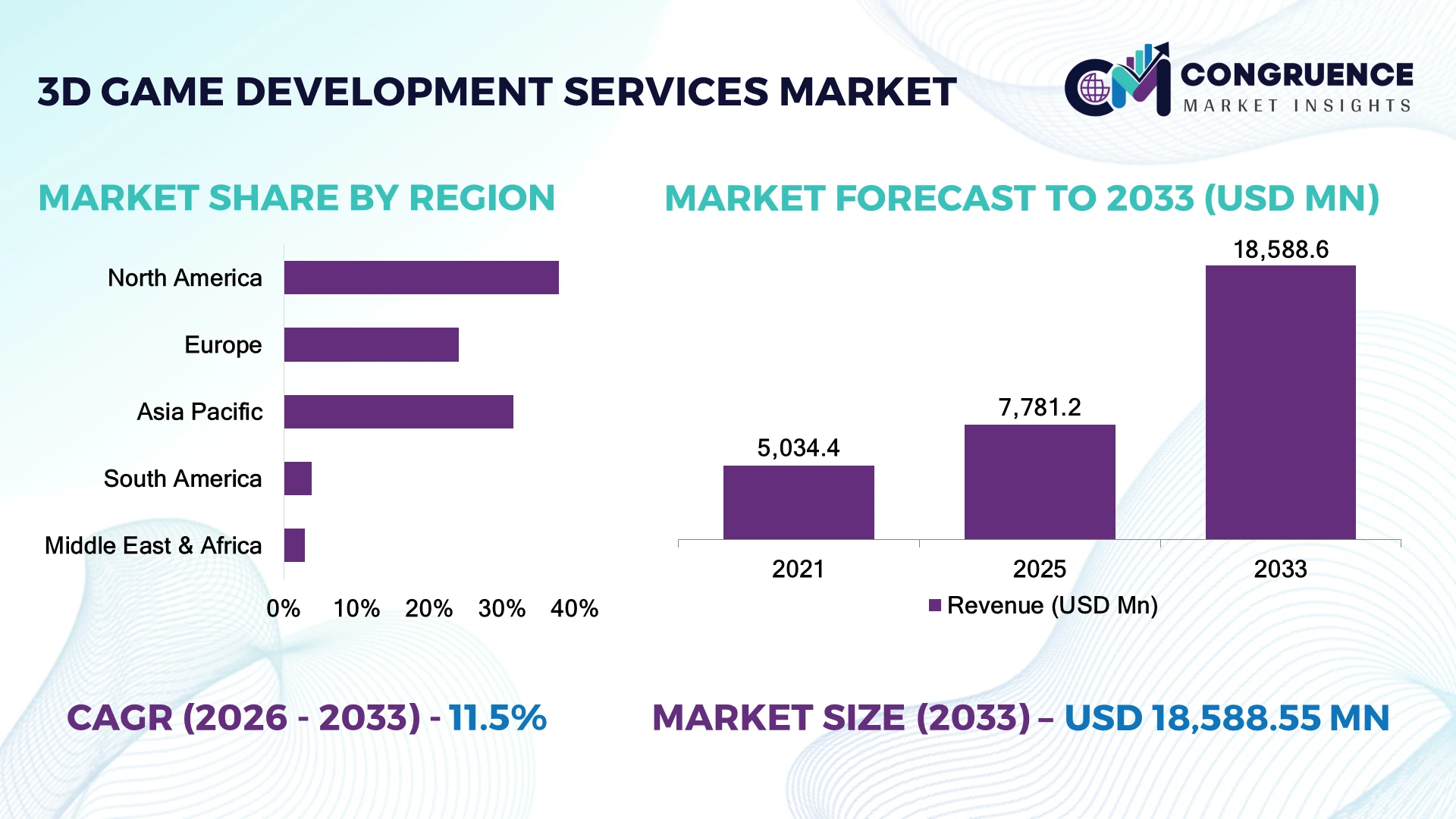
The United States leads the global 3D Game Development Services market with approximately 39% share, supported by AAA game studios, cloud gaming providers, and advanced graphics technology ecosystems. Compared with China, which dominates mobile game production volume, the United States maintains stronger adoption of AI-assisted development pipelines, with nearly 67% of large studios integrating procedural content generation and automated asset optimization. Continued geopolitical restrictions on cross-border technology collaboration are encouraging diversified outsourcing partnerships across Canada, Eastern Europe, and Southeast Asia.
Studios investing in scalable development ecosystems, AI-enabled production workflows, and global co-development partnerships are strengthening delivery capacity while reducing production risk for next-generation gaming experiences.
Market Size & Growth: USD 7,781.2 million (2025) to USD 18,588.6 million (2033) at 11.5% CAGR, fueled by AI-assisted content creation and cross-platform game development.
Top Growth Drivers: AI asset generation (+36%), cloud gaming (+31%), outsourcing demand (+28%).
Short-Term Forecast: By 2028, development cycles decline 24% while asset production efficiency improves 30%.
Emerging Technologies: Generative AI, Unreal Engine 5, real-time ray tracing, procedural world generation.
Regional Leaders: North America (~USD 7.1 billion), Asia-Pacific (~USD 5.9 billion), Europe (~USD 3.8 billion), supported by expanding game studio ecosystems.
Consumer/End-User Trends: More than 72% of multiplayer titles now launch with live-service content strategies.
Pilot/Case Example: A 2026 co-development project reduced environment creation time by 34% through AI-assisted asset workflows.
Competitive Landscape: Top studios and outsourcing providers collectively control approximately 42% of premium development contracts.
Regulatory & ESG Impact: Digital content compliance automation reduces publishing review time by nearly 18%.
Investment & Funding: More than USD 8.4 billion supports gaming studios, middleware, AI tools, and developer ecosystem expansion.
Innovation & Future Outlook: AI-driven production pipelines and immersive 3D experiences redefine global game development competitiveness.
The 3D Game Development Services market continues expanding across console, PC, mobile, XR, and metaverse-oriented experiences as studios prioritize scalable production, photorealistic graphics, and continuous live operations. Nearly 61% of outsourced projects now involve AI-assisted art production or procedural asset generation. Increasing global diversification of development teams is strengthening production resilience while setting the stage for deeper strategic transformation.
The 3D Game Development Services market has become strategically important as publishers seek faster content delivery, larger open-world environments, and continuous live-service engagement without proportionally increasing internal development resources. AI-enabled production, cloud collaboration, and global co-development models are reshaping competitive dynamics across console, PC, mobile, and immersive gaming ecosystems. Expanding remote production infrastructure and diversified outsourcing networks have become central to studio resilience and project scalability.
AI-assisted asset generation now improves environment production efficiency by approximately 35% compared with conventional manual workflows while reducing repetitive modelling effort by nearly 40%. North America continues leading premium AAA development and engine innovation, whereas Asia-Pacific has become the largest execution hub for scalable art production, animation, and engineering services. Over the next two to three years, more than 70% of large game studios are expected to integrate AI-powered production tools into mainstream development pipelines to improve scheduling accuracy and creative throughput.
Studios increasingly deploy distributed development teams using cloud-native collaboration platforms, enabling simultaneous production across multiple countries while maintaining version consistency. Publishers are expanding strategic partnerships with specialised outsourcing firms for environment design, multiplayer engineering, cinematic production, and live operations support. Organizations combining AI-enhanced creativity, efficient production management, and globally integrated delivery capabilities will secure stronger competitive positioning and accelerate next-generation game development.
AI-assisted development workflows are transforming 3D game production by reducing asset creation time and improving development scalability. Nearly 68% of large game studios now integrate AI into animation, environment generation, or quality assurance, while procedural content tools shorten production cycles by approximately 32% and lower repetitive design effort by around 27%. The widespread adoption of Unreal Engine 5 and advanced graphics pipelines in the United States has accelerated demand for specialized co-development partners capable of delivering high-fidelity content at scale. This structural shift enables publishers to launch larger, continuously updated titles with greater operational efficiency. Service providers are expanding AI engineering teams, investing in proprietary production frameworks, and establishing long-term partnerships with publishers to strengthen delivery capacity and reduce project risk.
Rising production complexity and specialized talent shortages continue constraining market scalability despite increasing outsourcing activity. High-end 3D projects require multidisciplinary teams spanning technical art, gameplay engineering, animation, and visual effects, increasing labour costs by approximately 24% over the past three years. Around 41% of mid-sized studios report delays caused by shortages of experienced Unreal Engine and graphics programmers. Poland and Canada remain attractive outsourcing hubs, but increasing wage competition is narrowing historical cost advantages. These structural pressures reduce project profitability and extend production schedules. Service providers are mitigating risks through distributed delivery centres, long-term hiring partnerships with universities, standardized production pipelines, and expanded use of AI-assisted development to improve workforce productivity without compromising quality.
The convergence of spatial computing, cloud gaming, and mixed reality is creating new opportunities for specialized 3D development services beyond traditional game production. More than 57% of publishers are expanding investment in cross-platform content, while reusable asset pipelines reduce production costs by approximately 29% across multiple devices. South Korea is accelerating deployment of immersive entertainment ecosystems supported by advanced 5G infrastructure and interactive digital experiences. Studios are strengthening research partnerships, investing in real-time rendering technologies, and developing scalable content pipelines for XR, digital twins, and virtual social environments. A significant strategic opportunity lies in transforming high-value game assets into reusable intellectual property across gaming, simulation, education, and enterprise visualization markets.
Managing geographically distributed production teams while maintaining consistent quality has become a major execution challenge for large-scale game development projects. Approximately 46% of outsourced projects experience workflow inefficiencies linked to version control, asset synchronization, or communication delays, while cybersecurity requirements increase project management effort by nearly 18%. Increasing digital asset protection requirements in Japan and Europe are compelling studios to strengthen secure collaboration environments across external partners. Without standardized production governance, project delays and inconsistent content quality reduce competitive performance. Companies are investing in cloud-native production platforms, zero-trust security architectures, automated asset validation, and integrated DevOps pipelines to improve operational consistency across globally distributed development ecosystems.
AI-Assisted Asset Creation Expands: Leading studios increasingly automate concept art, environment modelling, and animation workflows, reducing asset production time by approximately 35% while improving developer productivity by nearly 28%. Growing competition for skilled artists is accelerating enterprise investment in AI-enabled production tools and strategic technology partnerships.
Global Co-Development Networks Mature: Publishers are restructuring production across Canada, Vietnam, and Eastern Europe, increasing outsourced development participation to approximately 54% of large projects while reducing delivery bottlenecks by nearly 21%. Distributed development models improve resource flexibility and strengthen business continuity across multi-year game productions.
Real-Time Engine Standardization Accelerates: Unreal Engine 5 and advanced real-time rendering workflows now support approximately 63% of new premium game developments, reducing iteration cycles by nearly 26%. Studios are standardizing shared production pipelines and expanding technical partnerships to accelerate cross-platform deployment and visual consistency.
Live Operations Become Core: Continuous post-launch content delivery now influences more than 70% of multiplayer game strategies, with automated deployment pipelines reducing update preparation time by approximately 24%. The non-obvious shift is that service providers increasingly compete on long-term operational support rather than initial development alone, expanding DevOps capabilities and live-service engineering teams.
Full-Cycle Game Development Services account for approximately 44% of the global market as publishers increasingly outsource end-to-end production covering concept design, programming, art, testing, deployment, and live operations. This model offers stronger project governance, shorter production timelines, and lower coordination costs than managing multiple specialist vendors. Co-Development Services remain the largest complementary segment for AAA studios requiring additional engineering and content production capacity, while Art & Animation Services continue supporting large-scale asset creation for visually intensive titles.
Co-Development Services represent the fastest-growing segment as publishers adopt distributed production strategies to handle increasingly complex projects. Collaborative development improves production efficiency by approximately 29%, while shared engineering resources reduce development bottlenecks by nearly 24%. QA & Testing, Live Operations Support, and Porting Services continue expanding alongside cross-platform releases and live-service games. Service providers are strengthening global delivery centres, investing in AI-assisted production pipelines, and forming long-term publishing partnerships to capture larger multi-year contracts. Investment priorities increasingly favour scalable co-development ecosystems capable of supporting continuous content delivery.
According to a 2026 enterprise study published by the International Game Developers Association (IGDA), more than 64% of professional studios outsourced at least one major production function, with co-development and full-cycle delivery representing the highest-growth engagement models.
Mobile Game Development represents the leading application segment with approximately 47% market share, supported by high release frequency, broad consumer reach, and continuous live-service monetization. Publishers increasingly prioritize scalable mobile production using shared asset libraries and cloud-native development workflows. PC and Console Games remain strategically important for premium experiences, while Virtual Reality and Augmented Reality applications continue expanding through enterprise investment in immersive entertainment and interactive content.
Cross-Platform Game Development is the fastest-growing application as studios seek simultaneous deployment across mobile, PC, console, and cloud ecosystems. Unified development frameworks improve asset reuse by approximately 33% while reducing production costs by nearly 21% across multiple platforms. Metaverse-oriented experiences, simulation-based gaming, and multiplayer live-service environments are strengthening demand for advanced 3D development expertise. Service providers are expanding automation capabilities, integrating AI-assisted testing, and optimizing production pipelines to accelerate multi-platform releases and improve operational scalability.
A 2025 global developer survey conducted by the Game Developers Conference (GDC) found that cross-platform development remained one of the fastest-growing production priorities as studios increasingly adopted unified content pipelines and simultaneous multi-device launches.
Game Publishers account for approximately 53% of global demand due to large production budgets, multi-title portfolios, and continuous requirements for content creation, engineering, and live-service operations. Major publishers increasingly establish long-term outsourcing agreements to improve production flexibility while accelerating release schedules. Independent Game Studios remain an important customer group, particularly for specialized engineering, art production, and technical support services, whereas media companies and enterprise simulation developers continue expanding demand for advanced interactive content.
Independent Game Studios represent the fastest-growing end-user segment as accessible game engines, digital distribution, and AI-enabled development tools reduce production barriers. Outsourced development lowers production costs by approximately 26%, while shared technical expertise shortens development cycles by nearly 22%. Service providers are targeting this segment through modular pricing models, cloud collaboration platforms, and flexible production partnerships. Competitive differentiation increasingly depends on delivering scalable expertise that supports both premium publishers and rapidly expanding independent developers.
According to a 2026 industry survey conducted by the International Game Developers Association (IGDA), independent studios increasingly relied on external development partners to strengthen engineering capacity, accelerate production schedules, and access specialized technical expertise unavailable through internal teams alone.
North America accounted for the largest market share at 37.8% in 2025 however, Asia-Pacific is expected to register the fastest growth, expanding at a CAGR of 13.2% between 2026 and 2033.
AI-Driven AAA Production Reshapes Studio Operations
North America remains the largest regional market, contributing approximately 37.8% of global demand through its concentration of AAA publishers, independent studios, middleware developers, and cloud gaming infrastructure. The region leads in AI-assisted content creation, real-time rendering, and cross-platform production, enabling faster development cycles for high-budget game titles. More than 65% of large studios have integrated automated asset generation and cloud collaboration into core production workflows. Continuous investment in game engines, virtual production technologies, and co-development partnerships is strengthening outsourcing ecosystems while improving production scalability. Growing demand for live-service titles is also increasing long-term development contracts and post-launch support services across established game development hubs.
United States Market Outlook: The United States dominates the regional market through its strong ecosystem of game publishers, technology companies, and specialized development studios. Major publishers continue expanding external production partnerships to accelerate content delivery while maintaining premium production quality. Around 70% of large-scale game projects now combine internal development with outsourced engineering, art production, or live operations support. Strong venture investment in gaming technologies and AI-powered development tools continues reinforcing the country's leadership in advanced 3D game production.
Co-Development Ecosystems Strengthen Production Capacity
Europe has established itself as a major hub for premium co-development, technical art, and game engineering services. The region accounts for approximately 24% of the global market, supported by experienced development talent, advanced digital infrastructure, and strong independent studio ecosystems. Increasing demand for cross-platform production and high-quality visual content is encouraging publishers to establish long-term partnerships with European development specialists. More than 52% of outsourcing contracts now include multi-disciplinary development services combining engineering, art, animation, and quality assurance under unified delivery models.
Poland Market Outlook: Poland serves as Europe's leading game development outsourcing destination due to its highly skilled engineering workforce, competitive operating costs, and internationally recognized development studios. The country has become a preferred location for AAA co-development, gameplay programming, and technical art services. Approximately 60% of large Polish game studios now participate in international co-development projects, reinforcing the country's strategic importance within the global production network.
Scalable Development Talent Accelerates Global Delivery
Asia-Pacific is becoming the fastest-expanding market through large-scale outsourcing capacity, mobile gaming leadership, and increasing investment in cloud-based development infrastructure. The region supports a significant share of global art production, animation, engineering, and quality assurance services for international publishers. More than 58% of outsourced mobile game production is executed within Asia-Pacific development centres, supported by growing adoption of AI-assisted production workflows and advanced game engine technologies. Expanding digital infrastructure and skilled technical talent continue strengthening the region's competitiveness.
China Market Outlook: China remains the region's largest game production market through its extensive development ecosystem, strong mobile gaming industry, and advanced digital infrastructure. Domestic studios are expanding expertise in high-fidelity 3D content, multiplayer game development, and AI-assisted production. More than 66% of leading Chinese game developers have integrated procedural asset generation or intelligent production tools to improve development efficiency and accelerate large-scale content delivery.
Independent Studios Drive Outsourcing Demand
South America is steadily expanding its position within the global market through a growing base of independent studios, digital creative industries, and international outsourcing partnerships. Brazil, Argentina, and Colombia continue attracting development contracts for art production, animation, and game engineering services. Nearly 41% of regional studios now participate in international co-development projects, supported by expanding cloud collaboration infrastructure and competitive operating costs. Although access to investment remains uneven, increasing participation in global publishing ecosystems continues improving long-term market opportunities.
Brazil Market Outlook: Brazil leads the regional market with the largest concentration of game studios, digital talent, and technology accelerators. Strong demand for mobile and independent game development has encouraged greater investment in production capabilities and technical training. Around 48% of medium-sized Brazilian studios now deliver outsourced services for overseas publishers, strengthening the country's role as a strategic development partner for international gaming companies.
Government-Led Digital Investment Expands Industry Capabilities
The Middle East & Africa market is progressing through public investment in digital entertainment, creative industries, and gaming infrastructure. Countries across the Gulf are supporting local game development ecosystems through technology hubs, incubation programmes, and investment initiatives. Approximately 36% of newly established game studios in key Gulf markets focus on mobile and immersive 3D game production. International partnerships with established developers are accelerating knowledge transfer while strengthening regional production capabilities and attracting global publishers seeking new development locations.
Saudi Arabia Market Outlook: Saudi Arabia has emerged as the region's leading market through substantial investment in gaming infrastructure, esports, digital content, and creative technology. Government-backed initiatives continue attracting international publishers and development studios while supporting local talent development. More than 50% of recent gaming-sector investment programmes have included game development capabilities, studio expansion, or digital content production, positioning the country as a long-term strategic hub for regional 3D game development services.
Global outsourcing leaders Keywords Studios, Virtuos, Room 8 Group, and PTW compete with specialised co-development studios and regional engineering partners for AAA publishing contracts, while independent creative studios compete through niche expertise and production flexibility. The top five providers collectively command approximately 46% of premium outsourcing engagements. Competition centres on production scalability, technical expertise, delivery speed, and multi-platform capabilities rather than pricing alone. AI-assisted production pipelines improve asset creation efficiency by approximately 30%, distributed delivery models shorten development schedules by nearly 22%, and reusable production frameworks reduce engineering costs by around 18%. Leading firms expand through acquisitions, global delivery centres, strategic publisher partnerships, and integrated art-to-live-operations service portfolios. Competitive momentum is shifting toward full-cycle development supported by AI-enabled production rather than project-based outsourcing. High talent requirements, proprietary production workflows, and long-term publisher relationships remain significant entry barriers. Success depends on scalable execution, specialised expertise, predictable delivery, and trusted partnerships.
Keywords Studios
Virtuos
Room 8 Group
PTW (Pole To Win)
Sumo Digital
Tose Co., Ltd.
Behaviour Interactive
Sperasoft
Winking Studios
Starloop Studios
Studio Gobo
Flix Interactive
Pingle Studio
Generative AI, Unreal Engine 5, procedural content generation, and cloud-native collaboration platforms are transforming modern 3D game development. AI-assisted asset creation improves production efficiency by approximately 34%, while automated testing reduces quality assurance effort by nearly 27%. Around 66% of large studios now integrate AI into at least one production stage, enabling faster iteration, improved asset consistency, and shorter release cycles across console, PC, and mobile projects.
Emerging technologies include photogrammetry, digital humans, real-time ray tracing, cloud rendering, and advanced DevOps pipelines integrated with distributed development environments. Compared with conventional manual production, AI-enabled asset pipelines reduce environment creation time by approximately 38% while improving cross-platform optimization efficiency by nearly 25%. Large outsourcing providers benefit from standardized workflows and reusable technology stacks, whereas specialised studios compete through technical innovation, proprietary tools, and advanced visual engineering capabilities.
Between 2026 and 2028, autonomous asset generation, AI-powered animation systems, and intelligent production orchestration will redefine competitive performance. Studios investing in scalable cloud infrastructure, secure collaboration platforms, and integrated AI workflows will strengthen delivery predictability, accelerate global co-development, and improve resource utilization. Early adopters will secure stronger publisher partnerships by delivering premium-quality content with greater operational efficiency and shorter production schedules.
August 2024 – Keywords Studios acquired Wushu Studios, adding approximately 160 employees and strengthening its full-game development, co-development, and live support capabilities for major global publishers. Business impact: broader end-to-end production capacity. Source: Keywords Studios
October 2024 – Keywords Studios completed its acquisition by an EQT-led investor consortium, transitioning to private ownership and strengthening long-term investment capacity for global expansion and service innovation. Business impact: enhanced strategic flexibility. Source: Keywords Studios
January 2025 – Virtuos acquired Abstraction, Pipeworks, and Umanaïa to expand North American and European development capabilities, strengthening full-game development, engineering, and live services through integrated global operations. Business impact: significantly expanded production capacity. Source: GameDeveloper.com
February 2025 – Room 8 Group restructured its business by consolidating game development and technology operations under unified leadership, strengthening end-to-end production capabilities and specialised engineering services. Business impact: improved operational integration and enterprise delivery scale. Source: Room 8 Group corporate announcement.
This report provides a comprehensive assessment of the global 3D Game Development Services market across service types, gaming platforms, end-user categories, and major geographic markets. It evaluates full-cycle development, co-development, art and animation, quality assurance, porting, and live operations while analysing demand across mobile, PC, console, cloud, VR, and AR game development. The study also examines deployment patterns, outsourcing strategies, technology adoption, and competitive positioning across established publishers and independent studios.
The report further covers AI-assisted production, real-time rendering, procedural content generation, photogrammetry, cloud collaboration, and distributed development workflows shaping the industry between 2026 and 2033. More than 60% of enterprise outsourcing engagements now involve integrated multi-service delivery models rather than standalone production support. Strategic insights support investment prioritisation, outsourcing decisions, partnership development, geographic expansion, and competitive benchmarking by identifying evolving production models, technology transitions, and emerging opportunities across the global game development ecosystem.
| Report Attribute/Metric | Report Details |
|---|---|
|
Market Revenue in 2025 |
USD 7,781.2 Million |
|
Market Revenue in 2033 |
USD 18,588.6 Million |
|
CAGR (2026 - 2033) |
11.5% |
|
Base Year |
2025 |
|
Forecast Period |
2026 - 2033 |
|
Historic Period |
2021 - 2025 |
|
Segments Covered |
By Type
By Application
By End-User
|
|
Key Report Deliverable |
Revenue Forecast, Growth Trends, Market Dynamics, Segmental Overview, Regional and Country-wise Analysis, Competition Landscape |
|
Region Covered |
North America, Europe, Asia-Pacific, South America, Middle East, Africa |
|
Key Players Analyzed |
Keywords Studios, Virtuos, Room 8 Group, PTW (Pole To Win), Sumo Digital, Tose Co., Ltd., Behaviour Interactive, Sperasoft, Winking Studios, Starloop Studios, Studio Gobo, Flix Interactive, Pingle Studio |
|
Customization & Pricing |
Available on Request (10% Customization is Free) |




