
Reports
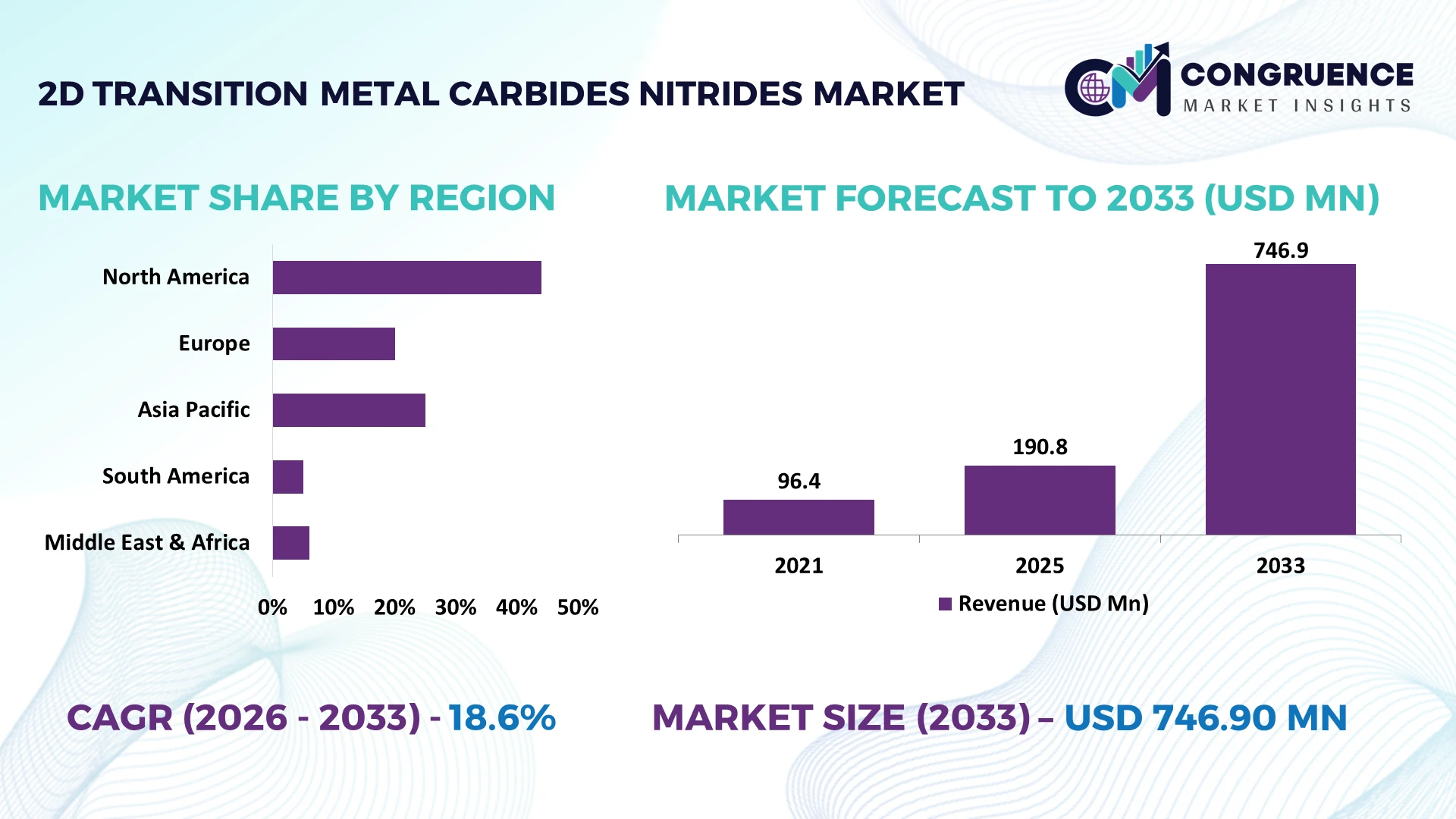
The Global 2D Transition Metal Carbides Nitrides Market was valued at USD 190.82 Million in 2025 and is anticipated to reach a value of USD 746.9 Million by 2033 expanding at a CAGR of 18.6% between 2026 and 2033. Growth is driven by MXene integration into electromagnetic interference shielding, advanced energy storage electrodes, flexible electronics, and multifunctional sensing technologies.
China occupies a prominent position in global MXene research and intellectual property development. A 2026 patent landscape study attributed approximately 77.5% of identified MXene composite patent families to China, reflecting extensive research activity across energy storage, conductive polymers, and electromagnetic shielding. An earlier bibliometric study covering biomedical MXene research identified 1,079 Chinese publications, compared with 160 from the United States. Chinese research institutions are advancing scalable synthesis, composite manufacturing, and surface engineering, strengthening the country's position in developing commercially applicable advanced nanomaterials.
Manufacturers should prioritize scalable MXene synthesis, intellectual property access, oxidation stability, and partnerships with established electronics and energy storage producers.
Market Size & Growth: USD 190.82 million in 2025, reaching USD 746.9 million by 2033 at 18.6% CAGR, supported by advanced electromagnetic shielding and energy storage applications.
Top Growth Drivers: Three principal demand areas are electromagnetic shielding, electrochemical energy storage, and flexible sensing. Verified market contribution percentages remain unavailable.
Short Term Forecast: By 2028, production competitiveness will increasingly depend on scalable synthesis, material stability, and manufacturing yield. Verified industrywide efficiency improvement percentages remain unavailable.
Emerging Technologies: Three important innovation areas are artificial intelligence assisted material discovery, automated MXene synthesis, and engineered multifunctional nanocomposites.
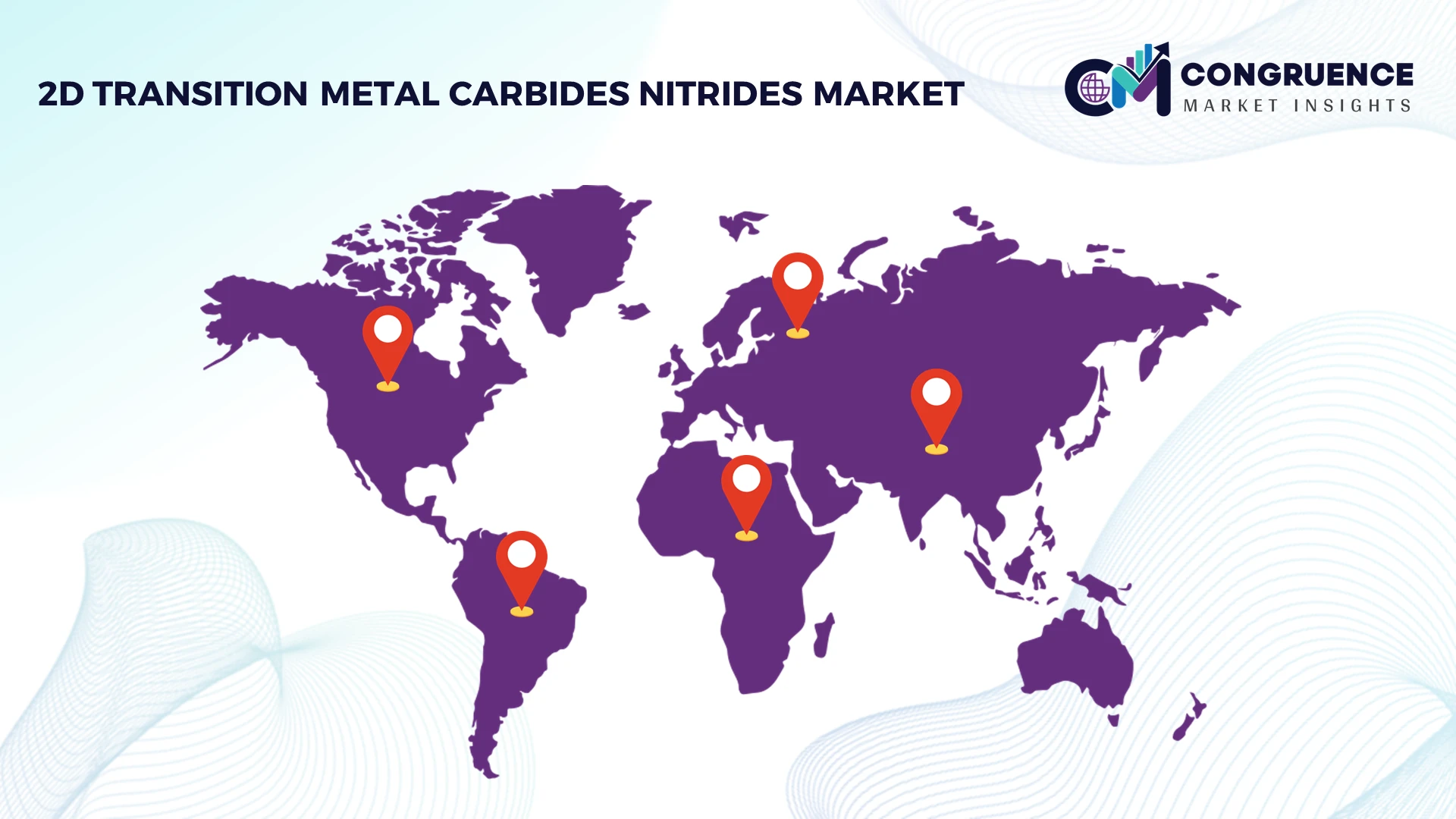
Regional Leaders: Asia Pacific, North America, and Europe represent important research and commercialization regions. Verified regional revenue forecasts and comparable adoption percentages remain unavailable.
Consumer and End User Trends: Research demonstrates MXene integration into flexible electronics, advanced batteries, and electromagnetic shielding. Experimental conductive composites have achieved 2,667 S/m conductivity at 1.2% MXene volume loading.
Pilot and Case Example: In 2025, researchers demonstrated MXene composite aerogels achieving 86 dB electromagnetic shielding effectiveness and electrical conductivity of 1,912 S/m, establishing measurable performance benchmarks for multifunctional materials.
Competitive Landscape: China's research ecosystem has a substantial intellectual property presence, accounting for approximately 77.5% of MXene composite patent families identified in a 2026 study. This percentage does not represent commercial market share.
Regulatory & ESG Impact: Safer synthesis processes are an important development priority as manufacturers investigate alternatives to conventional hazardous chemical etching. Verified industrywide environmental improvement percentages remain unavailable.
Investment & Funding: Research funding, university collaborations, and industrial partnerships support MXene commercialization. A verified consolidated global investment figure is not established.
Innovation & Future Outlook: Advanced MXene films, engineered composites, and artificial intelligence assisted materials development are shaping next generation applications. Commercial differentiation increasingly depends on manufacturing scalability and consistent material performance.
The global 2D Transition Metal Carbides Nitrides Market is evolving through advances in conductive nanomaterials, flexible electronics, electrochemical energy storage, and electromagnetic interference shielding. Recent research demonstrates the commercial relevance of multifunctional MXene composites, including experimental materials achieving 86 dB shielding effectiveness. Meanwhile, artificial intelligence assisted material design, improved surface engineering, and alternative synthesis technologies are addressing performance and manufacturing challenges. China's extensive intellectual property activity highlights the importance of international research partnerships and technology access. These developments establish material stability, manufacturing economics, and application specific performance as central considerations for strategic market positioning.
The 2D Transition Metal Carbides Nitrides Market is gaining strategic importance as electronics manufacturers pursue advanced conductive materials for electromagnetic shielding, energy storage, and flexible devices. MXene materials combine electrical conductivity, adjustable surface chemistry, and solution processing capabilities, creating opportunities to replace conventional materials in specialized applications. Supply chain priorities are shifting toward scalable synthesis, reliable precursor availability, and improved material stability.
Technological innovation is strengthening commercial feasibility. Experimental copper protected MXene films retained 72% of their electrical conductivity after 30 days of air exposure, compared with 44.3% for unprotected films. China demonstrates substantial research and patent activity, while the United States emphasizes advanced materials research and application development. These differences influence technology licensing, manufacturing partnerships, and intellectual property strategies.
Between 2026 and 2028, industrial development will increasingly emphasize production consistency, protective surface engineering, and application qualification. Research involving electrochemical synthesis has demonstrated material yields reaching 80%, establishing a measurable benchmark for alternative processing technologies. Electronics manufacturers are evaluating MXene composite films for electromagnetic shielding and thermal management, while material developers are investing in protective coatings and scalable processing. Competitive positioning will depend on translating laboratory performance into reliable industrial manufacturing.
The increasing need for lightweight electromagnetic shielding and advanced energy storage materials is strengthening demand for MXene technology. Experimental copper protected MXene films achieved electrical conductivity of 1.17 million S/m and electromagnetic shielding effectiveness of 77.1 dB. Their conductivity retention reached 72% after 30 days, compared with 44.3% for untreated MXene films. These performance characteristics support applications in compact electronic devices, telecommunications equipment, and advanced conductive composites. China's expanding advanced materials research ecosystem is accelerating developments in surface engineering and functional coatings. Material manufacturers are prioritizing protective film technologies, collaborative research, and application specific product development to improve commercial readiness and strengthen their competitive positioning.
Complex synthesis requirements and oxidation sensitivity remain significant structural restraints affecting commercial MXene production. Conventional synthesis frequently relies on concentrated hydrofluoric acid solutions containing approximately 40% to 50% acid, creating substantial chemical handling and waste treatment requirements. Alternative electrochemical research has demonstrated yields ranging from 50% to 60%, highlighting differences between processing technologies and experimental conditions. Furthermore, untreated MXene films demonstrated only 44.3% conductivity retention after 30 days of atmospheric exposure in one controlled experiment. These limitations increase material preservation requirements and complicate manufacturing economics. Producers are investigating alternative etching processes, localized precursor procurement, protective surface treatments, and specialized storage systems to reduce operational exposure.
Advanced functional composites present opportunities across flexible electronics, protective coatings, electromagnetic shielding, and specialized industrial sensing. Research involving copper protected MXene films demonstrated 72% conductivity retention after 30 days, compared with 44.3% for untreated materials, establishing a measurable advantage for protective surface engineering. Separately, experimental functionalized MXene films demonstrated shielding effectiveness between 52 and 77 dB at thicknesses of 5 to 40 micrometers. These characteristics create opportunities for compact electronic assemblies requiring thin conductive protection. Chinese material developers and international electronics manufacturers can pursue joint development of application specific coatings. Investment priorities include automated deposition, surface functionalization, and partnerships that connect materials research with industrial component qualification.
Achieving consistent industrial performance across different MXene formulations presents a major commercialization challenge. Experimental functionalized MXene films have demonstrated flexibility across 10,000 bending cycles and shielding effectiveness ranging from 52 to 77 dB. However, these laboratory results do not establish equivalent performance across different production environments, substrates, or operating conditions. Another experimental composite achieved 72% conductivity retention after 30 days, emphasizing the importance of extended durability assessment. Electronics manufacturers in China, Japan, and the United States require repeatable material specifications before integrating advanced nanomaterials into established production systems. Suppliers must invest in standardized characterization, automated quality inspection, accelerated aging tests, and collaborative application validation to achieve dependable manufacturing performance.
Precision Engineering of MXene Architectures: Researchers are shifting toward controlling material architecture during precursor synthesis rather than relying exclusively on subsequent processing. In 2026, South Korean researchers demonstrated MXene nanosheets achieving conductivity of approximately 23,300 S/cm and electromagnetic shielding effectiveness of 108 dB at 100 GHz. Their research also demonstrated 99.4% capacitance retention over 12,000 cycles using MXene nanoscrolls. Material developers are investigating precursor engineering to manufacture application specific structures with more predictable performance.
Increasing Adoption of Continuous Film Processing: Manufacturing research increasingly emphasizes continuous deposition techniques for producing aligned MXene films. A 2025 study demonstrated centrifugal spraying technology that produced films achieving 45 dB electromagnetic shielding across frequencies of 8.2 to 40 GHz and 59 dB in the terahertz range. This processing approach supports more consistent film alignment and thickness control. Manufacturers are evaluating automated coating processes to improve production repeatability.
Multifunctional Material Integration Gains Momentum: Composite engineering is combining electrical conductivity, mechanical reinforcement, and thermal functionality within individual material structures. Chinese researchers demonstrated hybrid aerogels containing 28% conductive polymer and 20% MXene, achieving electromagnetic shielding effectiveness of 41.27 dB. Such integration supports component consolidation in compact electronic assemblies. Material developers are investigating hybrid fabrication processes and partnerships with specialized polymer manufacturers.
Growing Emphasis on Structural Optimization: Advanced surface patterning is changing how manufacturers evaluate electromagnetic shielding materials. Recent research demonstrated lattice structured MXene with conductivity of 3,500 S/cm, compared with 2,500 S/cm for conventional flat films, representing a 40% improvement. Shielding effectiveness also increased from 38.6 dB to 50.4 dB. Electronics suppliers are evaluating patterned architectures to improve shielding performance without relying exclusively on additional material loading.
Ti₃C₂Tₓ represents the most extensively researched MXene type, supported by established synthesis methods, excellent electrical conductivity, and compatibility with solution processing. A 2025 research review identified Ti₃C₂Tₓ in approximately 35% of published MXene battery research, demonstrating its substantial technological presence. However, this research percentage does not establish its commercial market share. Manufacturers favor Ti₃C₂Tₓ for its established processing knowledge and suitability for conductive coatings, advanced electrodes, and multifunctional composites. Ti₂CTₓ represents another titanium based alternative, offering different structural characteristics and opportunities for application specific material development.
Multimetallic MXenes represent an emerging research direction because combining transition metals enables greater control over electronic properties and surface chemistry. Their commercial growth ranking remains unverified. Nb₂CTₓ and V₂CTₓ attract research interest for electrochemical applications, while Mo₂CTₓ offers opportunities in catalysis and advanced energy technologies. Material developers are diversifying precursor research and investing in specialized synthesis capabilities. Commercial differentiation increasingly depends on reproducible material specifications, application qualification, and production economics rather than laboratory performance alone.
Energy Storage represents one of the most extensively investigated MXene applications, supported by research into supercapacitors and advanced battery electrodes. Ti₃C₂Tₓ accounts for approximately 35% of published MXene battery research, demonstrating substantial scientific interest in its electrochemical properties. However, verified commercial application market shares remain unavailable. EMI Shielding represents another prominent application, supported by demand for lightweight conductive materials in compact electronic assemblies. Experimental MXene films have achieved shielding effectiveness of 108 dB at 100 GHz, illustrating their potential for specialized electronic protection.
Sensors represent an emerging application as researchers investigate flexible electrochemical detection and wearable monitoring technologies. Electronic Devices benefit from MXene conductivity and compatibility with thin film processing. Water Filtration and Catalysis are attracting research interest through surface functionalization and engineered membrane structures, while Biomedical Devices remain focused on experimental applications requiring extensive biocompatibility assessment. Manufacturers are adapting material formulations and deposition processes to meet application specific performance requirements. Investment priorities increasingly reflect differences in qualification complexity, manufacturing compatibility, and commercial deployment readiness.
Electronics represents a strategically important end-user category because MXene materials offer electrical conductivity, electromagnetic shielding, and compatibility with flexible electronic architectures. Experimental lattice structured MXene demonstrated a 40% conductivity improvement over conventional flat films, increasing from 2,500 S/cm to 3,500 S/cm. Such performance characteristics support research into specialized electronic components and conductive coatings. Nevertheless, verified commercial end-user market shares remain unavailable. Battery Manufacturers constitute another important customer group, particularly for advanced electrodes requiring improved electrochemical performance and material stability.
Automotive and Aerospace manufacturers are investigating advanced lightweight materials for electromagnetic shielding and multifunctional components. Healthcare applications remain research intensive because biomedical integration requires stringent safety and performance validation. Chemical Industries contribute through specialized material synthesis and processing, while Research Institutes remain essential customers for experimental MXene formulations. The fastest-growing commercial end-user category cannot currently be established from verified comparative adoption data. Suppliers are prioritizing application specific formulations, technical collaboration, and material qualification partnerships to strengthen commercialization prospects.
Asia Pacific accounted for the largest reported MXene market share at approximately 40% in 2025. Asia Pacific is also identified as the fastest growing region, with a published forecast CAGR of 37.1%.
Advanced Materials Research and Industrial Commercialization
North America accounted for approximately 31% of the global MXene market in a published 2025 assessment, reflecting its established nanotechnology research infrastructure and specialized materials suppliers. The United States drives regional activity through advanced energy storage research, electromagnetic interference shielding development, and commercial nanomaterial distribution. Drexel University's MXene research ecosystem has contributed significantly to synthesis technologies and material characterization. A three year international research collaboration involving approximately USD 5 million demonstrates the investment directed toward industrial MXene manufacturing and application development. Regional suppliers are concentrating on high purity materials, functionalized nanomaterials, and application specific formulations. Commercial differentiation increasingly depends on translating laboratory performance into repeatable production processes while developing domestic supply chains for advanced conductive materials.
United States Market Outlook: The United States benefits from specialized material suppliers, established research institutions, and advanced electronics manufacturing capabilities. American Elements, ACS Material, and Alfa Chemistry participate in the commercial supply of advanced materials. Research institutions are investigating MXene applications in energy storage, flexible electronics, and electromagnetic shielding. Commercial opportunities increasingly depend on material qualification, intellectual property development, and partnerships between specialized suppliers and industrial manufacturers.
Sustainable Synthesis and Industrial Material Integration
Europe represented approximately 24% of the global MXene market in a published 2025 assessment, supported by established chemical manufacturing capabilities and advanced materials research. Germany, France, and the United Kingdom maintain research ecosystems relevant to electrochemical technologies, functional coatings, and conductive nanomaterials. European manufacturers are investigating alternatives to conventional chemical etching processes to improve processing safety and reduce hazardous chemical exposure. The European Union's chemical regulatory framework reinforces the commercial importance of safer material synthesis and waste management. Industrial development also benefits from automotive electrification, specialized electronics manufacturing, and advanced energy storage research. Companies are emphasizing application specific formulations, manufacturing partnerships, and material characterization. Commercial competitiveness increasingly depends on combining technical performance with regulatory compliance and dependable industrial processing.
Germany Market Outlook: Germany benefits from established chemical manufacturing infrastructure and advanced automotive engineering capabilities. Merck KGaA participates in the advanced materials supply ecosystem, supporting access to specialized research materials. German research institutions are investigating conductive composites and electrochemical applications. The country's industrial manufacturing infrastructure creates opportunities to integrate MXene development into existing materials research, electronics engineering, and specialized component production.
Manufacturing Concentration and Advanced Materials Commercialization
Asia Pacific accounted for approximately 40% of the global MXene market in a published 2025 assessment. Its forecast CAGR of 37.1% reflects an external industry projection rather than a calculation based on this report's global forecast. China leads regional research and manufacturing activity, supported by established electronics supply chains and extensive advanced materials research. Japan and South Korea contribute specialized manufacturing capabilities in electronic components, batteries, and advanced functional materials. China's intellectual property position is particularly significant, with approximately 77.5% of patent families identified in one MXene composite patent landscape study attributed to the country. Manufacturers are investing in scalable synthesis, functional material formulations, and application development. Regional competitiveness increasingly depends on manufacturing consistency, precursor availability, and integration with established electronics production infrastructure.
China Market Outlook: China occupies a prominent position in MXene research, specialized material production, and intellectual property development. Its established battery manufacturing and electronics supply chains provide an industrial foundation for commercial material integration. Companies including Beike 2D Materials, Nanjing XFNANO Materials, and 6Carbon Technology participate in the specialized materials ecosystem. Commercial priorities include production scalability, material consistency, and advanced electrode development.
Research Commercialization and Specialized Industrial Applications
South America represents an emerging MXene market, with development concentrated in academic research and specialized industrial applications. The three largest reported regional markets collectively account for approximately 95% of global MXene demand, leaving around 5% for other regions combined within that particular assessment. A separate South American market share is not established by those figures. Brazil provides an important foundation through established chemical manufacturing capabilities, materials science research, and electrochemical technology development. Regional research activities include energy storage materials, environmental sensing, and specialized functional coatings. Commercial expansion remains constrained by limited domestic MXene manufacturing infrastructure and dependence on specialized imported materials. Research institutions and industrial organizations are investigating international partnerships to improve material accessibility, application validation, and technical capabilities.
Brazil Market Outlook: Brazil represents an important development center because of its established academic research network and industrial chemical processing capabilities. Research institutions are investigating advanced nanomaterials for electrochemical applications, environmental monitoring, and specialized industrial technologies. Commercial development depends on partnerships with international material suppliers, specialized processing infrastructure, and application specific product validation.
Advanced Research Investment and Industrial Diversification
The Middle East and Africa represent an emerging MXene development ecosystem, supported by advanced materials research investments and industrial diversification initiatives. The United Arab Emirates and Saudi Arabia are developing scientific infrastructure relevant to nanomaterials, energy technologies, and environmental applications. In 2025, Khalifa University participated in an international MXene research collaboration involving approximately USD 5 million over three years. The project targets industrial MXene production by 2028, with applications in water desalination and biomedical analysis. This development creates opportunities for specialized manufacturing, technology transfer, and international research partnerships. Commercial progress depends on translating laboratory research into reproducible industrial processes while establishing technical expertise and specialized materials supply chains.
United Arab Emirates Market Outlook: The United Arab Emirates is strengthening its advanced materials research capabilities through Khalifa University's Research and Innovation Center for Graphene and 2D Materials. Its participation in the MX Innovation project supports international collaboration involving MXene manufacturing, water desalination, and biomedical technologies. The project's 2028 industrial production objective provides a measurable commercialization milestone and supports the country's advanced manufacturing ambitions.
Competition in the global 2D Transition Metal Carbides Nitrides Market involves specialized Chinese manufacturers, established international chemical suppliers, and advanced materials innovators. Beike 2D Materials, ACS Material, 6Carbon Technology, Nanjing XFNANO Materials, and Merck KGaA collectively accounted for approximately 55% of the market in a published 2024 industry assessment. Beike individually held more than 18%, reflecting its established commercial position. Chinese suppliers compete through specialized synthesis capabilities, production expansion, and material customization. International suppliers emphasize product specifications, distribution infrastructure, and application development.
Competitive differentiation increasingly depends on manufacturing consistency and technical performance. Experimental MXene films have demonstrated conductivity exceeding 10,000 S/cm, while advanced formulations achieve electromagnetic shielding effectiveness above 90 dB. Manufacturers are investing in alternative synthesis methods, research partnerships, and protective material technologies. Oxidation sensitivity and specialized precursor requirements remain important commercialization barriers. Sustained competitiveness requires reliable production, consistent material specifications, and successful industrial application qualification.
Beike 2D Materials
ACS Material
6Carbon Technology
Nanjing XFNANO Materials
Merck KGaA
American Elements
Alfa Chemistry
Japan Material Technologies Corporation
Beijing Zhongkeleiming Technology
Nanoshel
2D Semiconductors
Otto Chemie
MXene manufacturing is advancing through controlled chemical etching, automated delamination, and continuous material processing. Conventional synthesis remains established, while molten salt processing offers alternative production pathways. Carbon Ukraine demonstrated MXene production of 1 kg daily using molten salt technology, establishing a measurable industrial scalability benchmark. Automated processing improves batch consistency and supports specialized material manufacturing. Electronics and energy storage manufacturers benefit from more reliable material availability and application specific formulations.
Emerging microwave synthesis is transforming production efficiency. Carnegie Mellon University demonstrated MXene synthesis within 90 minutes, compared with conventional processes requiring up to 40 hours, while reducing energy consumption by 75%. This represents approximately 96% shorter processing time under the reported experimental conditions. Meanwhile, protective surface engineering and engineered composite architectures address material degradation and improve functional performance. Companies integrating these technologies gain advantages in processing speed, energy efficiency, and product customization.
Disruptive technologies include flash Joule heating, direct chemical vapor deposition, and advanced precursor engineering. These approaches target conventional processing limitations and expand opportunities for industrial manufacturing. During 2026 to 2028, development priorities include continuous production, improved material stability, and integration into electronics manufacturing. Specialized suppliers benefit from establishing reproducible production methods before widespread industrial qualification. Partnerships connecting research institutions, material manufacturers, and electronics producers will determine commercialization readiness and manufacturing competitiveness across applications.
February 2025: Carbon Ukraine achieved MXene production of 1 kg daily through molten salt reactor technology under the GREENCAP project. The development demonstrated progress toward industrial manufacturing and established a measurable production benchmark for advanced energy storage material supply. Source: greencap-project.eu
March 2025: Carnegie Mellon University researchers introduced microwave MXene synthesis, reducing processing time to 90 minutes from conventional processes requiring up to 40 hours. Energy consumption decreased by 75%, establishing an alternative manufacturing pathway with substantially improved laboratory processing efficiency. Source: cmu.edu
July 2025: Carbon Ukraine joined Drexel University, Khalifa University, and the University of Padua in a USD 5 million international research collaboration. The three year project targets industrial MXene production by 2028 for water desalination and biomedical applications. Source: drexel.edu
August 2026: Environmental Clean Technologies signed a 12 month engineering agreement with Metallium to advance MXene production at its Texas facility. Access to established flash Joule heating infrastructure supports manufacturing development without independently constructing equivalent production facilities. Source: marketindex.com.au
The 2D Transition Metal Carbides Nitrides Market Report examines industry development between 2026 and 2033, covering material technologies, production capabilities, application demand, and competitive positioning. Type segmentation includes Ti₃C₂Tₓ, Ti₂CTₓ, Nb₂CTₓ, V₂CTₓ, Mo₂CTₓ, and multimetallic MXenes. Application coverage includes energy storage, electromagnetic shielding, sensors, water filtration, catalysis, electronic devices, and biomedical devices. End users include electronics, battery manufacturing, automotive, aerospace, healthcare, chemical industries, and research institutions.
Regional analysis examines North America, Europe, Asia Pacific, South America, and the Middle East and Africa. Technology assessment evaluates molten salt synthesis, microwave processing, flash Joule heating, and advanced surface engineering. Documented production benchmarks include 1 kg daily output and 75% lower experimental synthesis energy consumption. Competitive analysis addresses manufacturing scalability, intellectual property, strategic partnerships, supply chain development, and industrial commercialization opportunities.
| Report Attribute/Metric | Report Details |
|---|---|
Market Revenue in 2025 | USD 190.82 Million |
Market Revenue in 2033 | USD 746.9 Million |
CAGR (2026 - 2033) | 18.6% |
Base Year | 2025 |
Forecast Period | 2026 - 2033 |
Historic Period | 2021 - 2025 |
Segments Covered | By Type
By Application
By End-User
|
Key Report Deliverable | Revenue Forecast, Growth Trends, Market Dynamics, Segmental Overview, Regional and Country-wise Analysis, Competition Landscape |
Region Covered | North America, Europe, Asia-Pacific, South America, Middle East, Africa |
Key Players Analyzed | Beike 2D Materials, ACS Material, 6Carbon Technology, Nanjing XFNANO Materials, Merck KGaA, American Elements, Alfa Chemistry, Japan Material Technologies Corporation, Beijing Zhongkeleiming Technology, Nanoshel, 2D Semiconductors, Otto Chemie |
Customization & Pricing | Available on Request (10% Customization is Free) |




