
Reports
The Global 1-Octene Market was valued at USD 2117 Million in 2025 and is anticipated to reach a value of USD 2964.79 Million by 2033 expanding at a CAGR of 4.3% between 2026 and 2033. Growth is being driven by greater 1-octene loading in high-performance LLDPE, HDPE and polyolefin elastomers, alongside expansion of flexible-packaging films, photovoltaic encapsulation materials and metallocene polyethylene grades.
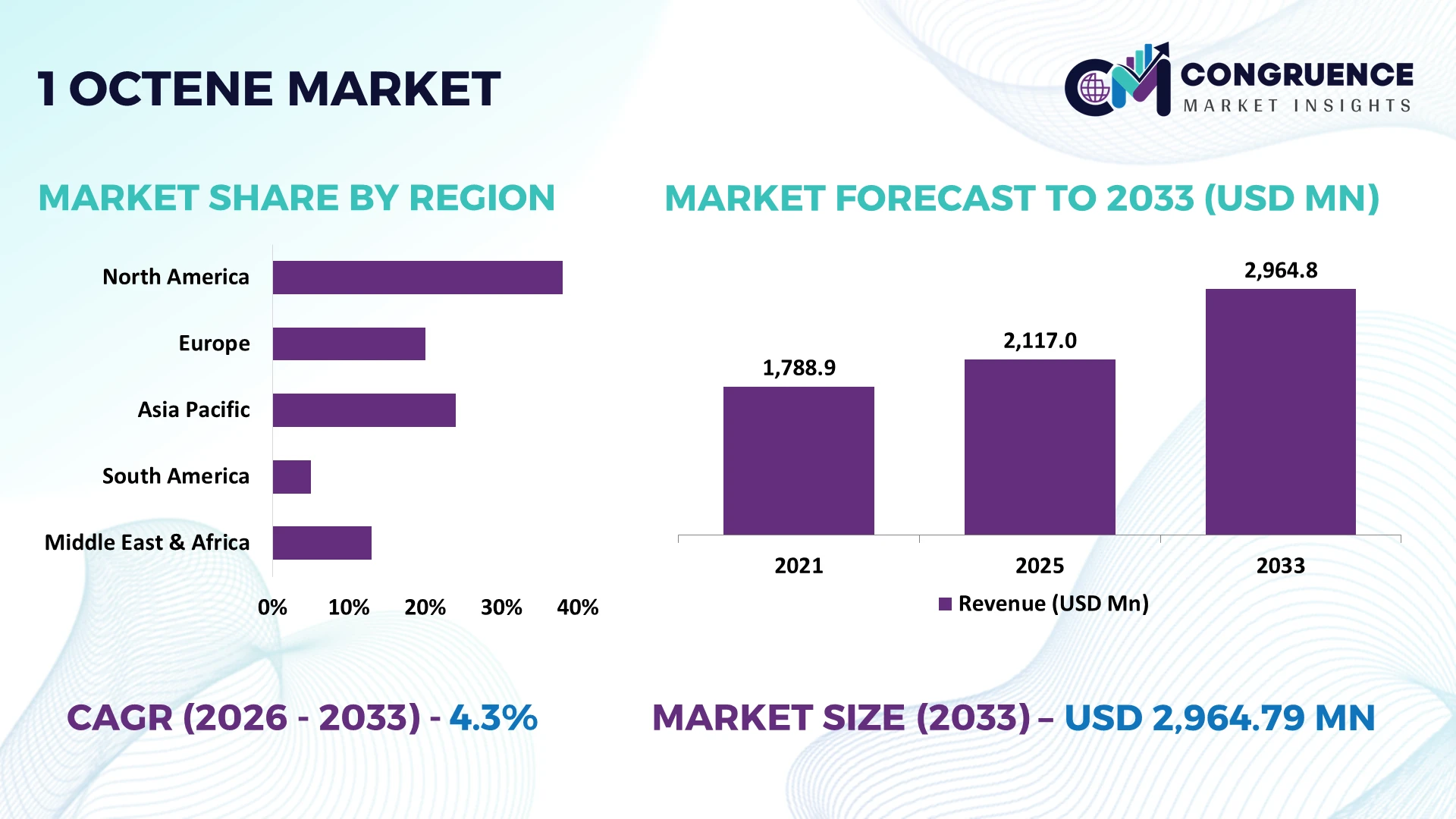
The United States remains a dominant global 1-octene production and consumption hub, supported by integrated ethylene and alpha-olefin infrastructure and North America’s roughly 36% market position. Polyethylene absorbs nearly 80% of global 1-octene demand, while advanced LLDPE formulations commonly use 8–10% comonomer. U.S. shale-linked feedstock advantages contrast with China’s faster downstream POE expansion for solar and specialty-film applications. Qatar’s 345,000-ton annual normal alpha-olefins complex and South Africa’s approximately 196,000-ton dedicated 1-octene capacity reinforce Middle Eastern and African supply relevance as geopolitical and shipping disruptions increase the value of diversified sourcing.
Strategically, producers controlling integrated ethylene feedstock, selective oligomerization technology and proximity to high-growth polyethylene converters hold the strongest position to capture premium global 1-octene demand.
Market Size & Growth: USD 2,117 million in 2025 advances toward USD 2,964.79 million by 2033 at 4.3%, supported by increased 1-octene use in high-performance polyethylene and specialty elastomers.
Top Growth Drivers: Polyethylene applications represent nearly 80% of consumption, LLDPE formulations use approximately 8–10% comonomer, and high-purity polymer applications account for more than 70% of downstream demand.
Short-Term Forecast: By 2028, advanced catalyst and process optimization is positioned to improve selective alpha-olefin yield by approximately 5–10%, lowering purification intensity and strengthening plant economics.
Emerging Technologies: Selective ethylene tetramerization, metallocene polymerization and advanced catalyst-control systems are improving 1-octene selectivity, resin consistency and production efficiency across integrated petrochemical complexes.
Regional Leaders: At the prevailing regional structure, 2033 market potential approaches USD 1.08 billion in North America, USD 962 million in Asia-Pacific and USD 649 million in Europe, with Asia emphasizing POE and solar-material adoption.
End-User Trends: Polyethylene accounts for nearly 80% of 1-octene consumption as packaging converters increasingly specify tougher LLDPE and HDPE grades for downgauged films, industrial sacks and multilayer structures.
Pilot/Case Example: Advanced selective tetramerization systems demonstrate 1-octene selectivity above 60% under optimized catalyst configurations, materially exceeding conventional broad-distribution alpha-olefin routes and reducing downstream separation requirements.
Competitive Landscape: Chevron Phillips Chemical, INEOS, Sasol, Shell and other integrated suppliers control substantial global capacity, while the leading five producers collectively account for roughly 58% of competitive market activity.
Regulatory & ESG Impact: Polymer downgauging programs are targeting material reductions of 10–20% in selected flexible-packaging structures, raising demand for stronger octene-based polyethylene grades that preserve puncture and sealing performance.
Investment & Expansion: Qatar’s approximately USD 2 billion Q-Chem II development includes 345,000 tons of annual normal alpha-olefin capacity, illustrating continued investment in integrated feedstock-to-polymer supply chains serving Asia, Europe and Africa.
Innovation & Future Outlook: High-growth demand is shifting toward POE, specialty LLDPE and high-purity 1-octene, positioning selective catalysts, localized supply and integrated polyethylene production as decisive competitive advantages through 2033.
The 1-Octene Market is increasingly centered on high-performance polyethylene, flexible packaging, automotive polymers and photovoltaic encapsulation materials. Nearly 80% of consumption is linked to polyethylene applications, while selective tetramerization and metallocene technologies are improving product purity and resin performance. Expanding Asian POE capacity and greater supply-chain localization are consequently reshaping sourcing priorities, creating a stronger strategic case for integrated producers and downstream partnerships.
1-Octene is becoming strategically important because polymer producers increasingly require comonomers that deliver higher tensile strength, puncture resistance and downgauging performance in LLDPE, HDPE and polyolefin elastomers. Supply is simultaneously shifting toward integrated ethylene-to-alpha-olefin complexes, reducing dependence on merchant shipments exposed to Red Sea logistics disruption. Qatar’s integrated configuration combines 345,000 tons of annual normal alpha-olefin capacity with substantial polyethylene production, illustrating this restructuring.
Technology is reinforcing the shift. Selective ethylene tetramerization can achieve 1-octene selectivity above 70%, compared with conventional oligomerization that produces a broad alpha-olefin distribution requiring greater separation. Improved catalyst structures can also reduce selected C6 cyclic and C16+ by-products below 3%, improving feedstock utilization and purification efficiency. North America benefits from established ethylene integration, while China is expanding downstream polyethylene and specialty-polymer capability as its ethylene-equivalent self-sufficiency reaches 78.1%.
Through 2026–2028, investment will increasingly target selective production, integrated cracking and polymer-grade purification. A practical model is Mesaieed, where integrated NAO and HDPE operations lifted combined HDPE capacity by 77%. Producers are prioritizing catalyst partnerships, feedstock security and downstream polymer integration. Competitive advantage will increasingly depend on controlling both 1-octene selectivity and proximity to high-value polymer conversion.
1-octene demand is being structurally strengthened by the transition toward tougher, thinner and higher-performance polyethylene grades used in flexible packaging, pipes, geomembranes and specialty molding. Selective tetramerization can deliver more than 70% 1-octene selectivity, while optimized catalyst structures reduce certain undesirable C6 cyclic and C16+ fractions below 3%. Qatar’s integrated petrochemical expansion increased Q-Chem HDPE capacity by 77%, demonstrating how comonomer availability supports downstream polymer scale. The operational shift is toward integrated ethylene, alpha-olefin and polyethylene manufacturing rather than isolated merchant supply. Producers are consequently investing in selective catalyst systems, debottlenecking and resin partnerships. The non-obvious advantage is formulation flexibility: secure 1-octene access lets polyethylene producers optimize downgauging and mechanical properties without fundamentally redesigning existing extrusion assets.
1-octene economics remain tightly linked to ethylene availability, cracker operating rates and international chemical logistics. European ethylene facilities operated at roughly 60–70% through 2024 versus about 87% on the U.S. Gulf Coast, highlighting a significant utilization and cost disadvantage for European derivative producers. Meanwhile, Asia-to-Europe container freight rates reached increases of approximately 270% during Red Sea disruption, sharply raising landed-cost uncertainty for internationally traded chemicals. These pressures constrain spot-market flexibility and reduce profitability for non-integrated suppliers that purchase ethylene or depend on long-distance movements. Producers are responding with longer-term feedstock agreements, geographically diversified sourcing and greater integration around U.S., Middle Eastern and Asian petrochemical hubs. The strategic constraint is therefore not absolute 1-octene availability, but reliable access to competitively priced molecules when cracker utilization and shipping conditions diverge sharply between countries.
A high-value opportunity is emerging from polyolefin elastomers, advanced LLDPE and solar encapsulation structures requiring controlled comonomer incorporation. POE currently represents roughly 11–14% of photovoltaic encapsulation material use, while China has already achieved approximately 70% local supply in EVA resin and an ethylene-equivalent self-sufficiency rate of 78.1%. The next competitive step is localization of higher-value POE materials, which creates an indirect demand pathway for polymer-grade 1-octene beyond traditional packaging applications. Chinese chemical companies are expanding specialty-polymer R&D while international producers are strengthening catalyst, comonomer and resin partnerships. Selective tetramerization exceeding 70% 1-octene selectivity gives integrated suppliers an efficiency advantage in serving these specifications. The non-obvious opportunity lies in solar-material qualification: once encapsulant formulations are certified, supplier switching becomes operationally difficult, creating durable demand for consistent high-purity comonomer supply.
Long-term competitiveness requires more than adding nominal 1-octene capacity; producers must maintain catalyst performance, feedstock quality, separation efficiency and downstream polymer consistency across complex integrated sites. European chemical operating rates fell to approximately 57% during a 2024 low point versus a historical global operating benchmark near 77%, while Red Sea rerouting increased global shipping ton-miles by about 17% during 2024. These conditions expose the execution risk of balancing continuous-process economics against volatile logistics and uneven regional asset utilization. Unlike short-term feedstock constraints, this challenge concerns maintaining competitive production performance over complete asset cycles. Companies must modernize process control, strengthen predictive maintenance, secure catalyst expertise and develop alternate logistics pathways. The key strategic issue is asset resilience: highly selective production technology creates value only when plants sustain dependable operating rates, product purity and customer qualification across changing industrial conditions.
Selective Production Gains Momentum: Producers are tightening catalyst control as selective ethylene tetramerization pushes 1-octene selectivity above 70%, while optimized systems constrain heavier C16+ fractions to below 3%. Automated reactor monitoring is improving product consistency and reducing separation loads. Integrated operators are prioritizing catalyst upgrades and process analytics rather than adding broad-distribution alpha-olefin capacity, improving utilization of existing ethylene infrastructure.
Asset Rationalization Reshapes Trade: European ethylene operating rates around 70–75%, versus the conventional 80–90% target range, are accelerating petrochemical restructuring. With natural-gas costs remaining materially above pre-crisis levels, producers are closing inefficient assets and redirecting procurement toward feedstock-advantaged U.S. and Middle Eastern complexes. Suppliers are consequently expanding contractual sourcing and inventory visibility, making geographic integration increasingly important to 1-octene availability.
Digital Optimization Reaches Olefin Plants: AI-based process analytics, predictive maintenance and digital twins are moving deeper into continuous chemical operations. More than 18% of chemical-sector capital investment has targeted operating efficiency, while 26% has supported plant and equipment replacement. Alpha-olefin operators are deploying advanced controls to stabilize catalyst conditions, reduce unplanned downtime and improve separation performance, converting digitalization into measurable manufacturing discipline.
Portfolio Mix Moves Upmarket: Specialty-chemical positioning is accelerating as commodity overcapacity pressures conventional petrochemical economics. Chemical-sector capital expenditure fell 8.4% in 2024, forcing tighter project selection, while 2025 first-half M&A activity dropped to 243 transactions. Producers are reallocating resources toward higher-purity grades, customer-specific specifications and downstream integration; the less obvious shift is from maximizing tonnage toward maximizing qualified applications per production line.
Polymer Grade leads the 1-octene type landscape with an estimated 55–60% share, reflecting its extensive consumption as a comonomer for LLDPE, HDPE, plastomers and elastomers. Polymer manufacturers prioritize consistent purity and controlled molecular structure because relatively small comonomer additions, commonly around 5–10% depending on resin formulation, materially influence flexibility, impact resistance and density. Linear Alpha-Olefins retain strategic importance as the broader production platform supplying 1-octene alongside other carbon-chain fractions, favoring vertically integrated petrochemical complexes.
High-Purity Grade is the fastest-expanding type as advanced polyolefin elastomers and tightly specified specialty polymers demand lower impurity levels and greater batch consistency. Chemical Grade remains established in synthesis routes for surfactants and intermediates, while Industrial Grade serves applications where polymer-grade specifications are unnecessary. Producers are therefore shifting purification investment toward premium streams, with selective processes capable of exceeding 70% 1-octene selectivity. This differentiation allows suppliers to capture specialized applications without competing solely on commodity-scale output.
Polyethylene Production dominates 1-octene applications with approximately 75–80% of consumption because the molecule provides controlled short-chain branching in LLDPE and selected HDPE grades. Octene-modified polyethylene delivers enhanced puncture resistance, toughness and film performance, supporting downgauging across flexible packaging and industrial films. Plasticizers and Chemical Intermediates represent smaller established outlets, where 1-octene functions as a synthesis building block rather than a high-volume polymer comonomer. Producers consequently align most purification and logistics infrastructure with polyethylene manufacturing centers.
Chemical Intermediates are developing faster from a smaller base as specialty synthesis increasingly values controlled carbon-chain feedstocks for performance chemicals. Lubricants use 1-octene-derived molecules in synthetic formulations requiring viscosity stability, while Surfactants retain specialized demand in formulated chemical systems. Selective tetramerization exceeding 70% 1-octene selectivity strengthens supply economics for these higher-specification applications. Companies are responding by integrating comonomer production with polyethylene assets, automating quality control and reserving differentiated high-purity output for applications where specification consistency supports stronger margins.
Polymer Manufacturers represent the dominant end-user group with an estimated 60–65% share, reflecting continuous 1-octene requirements across LLDPE, HDPE, plastomers and elastomer production. Large resin plants require stable polymer-grade supply because comonomer consistency directly affects density distribution, mechanical properties and extrusion performance. Petrochemical Companies form another major buyer group, particularly where alpha-olefin production and downstream polymer assets are integrated within the same industrial complex, reducing logistics exposure and improving feedstock coordination.
Specialty Chemical Producers are the fastest-developing buyer group as higher-purity olefins gain relevance in differentiated intermediates and performance formulations. Chemical Manufacturers consume 1-octene across synthesis chains, while Lubricant Producers remain a smaller but technically demanding segment focused on synthetic base-stock and additive chemistry. With European ethylene assets operating around 70–75% during recent industry restructuring, buyers are placing greater emphasis on contractual supply security. Producers are responding through specification customization, long-term offtake agreements, integrated customer qualification and geographically diversified supply arrangements, shifting competition from transactional volume toward dependable molecule-to-application partnerships.
North America accounted for the largest market share at 36% in 2025 however, Asia-Pacific is expected to register the fastest growth, expanding at a CAGR of 5.4% between 2026 and 2033.
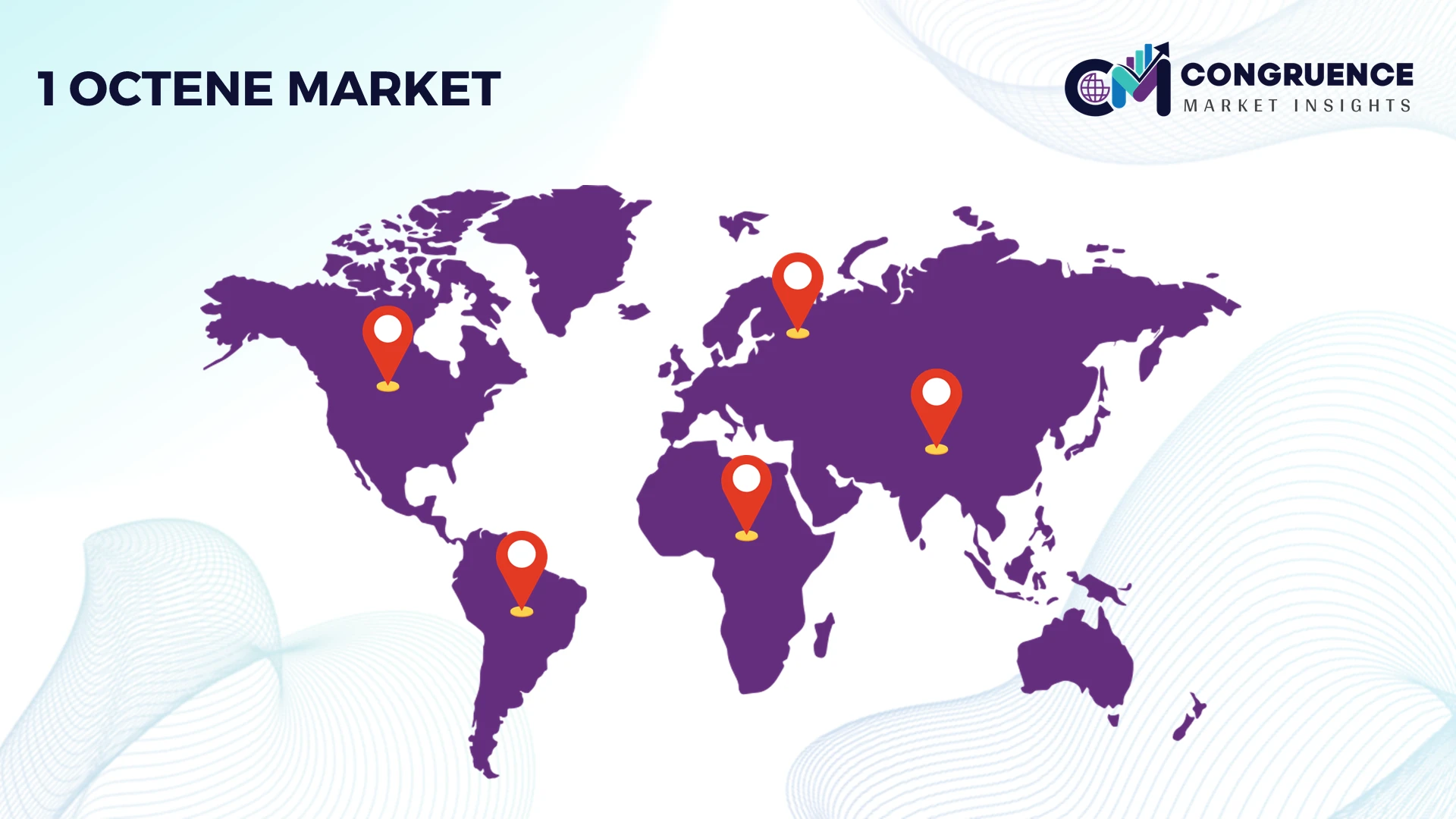
Feedstock Integration Strengthens Supply Economics
North America holds approximately 36% of global 1-octene demand, anchored by the United States’ integrated ethylene, linear alpha-olefin and polyethylene manufacturing base. Gulf Coast producers benefit from ethane-rich cracker economics and direct connectivity to high-volume LLDPE and HDPE plants, shortening feedstock movements and supporting reliable polymer-grade supply. The region’s competitive advantage increasingly rests on selective alpha-olefin processing, automated plant controls and integrated logistics rather than standalone capacity additions. U.S. polyethylene producers also continue shifting toward higher-performance resin formulations for flexible packaging, industrial film and molding applications. Large operators are prioritizing debottlenecking and product-mix optimization, while established pipeline, terminal and export infrastructure supports shipments to Latin America, Europe and Asia. This integrated operating model reduces merchant-feedstock exposure and enables faster adjustment between domestic polymer consumption and export requirements.
United States Market Outlook: The United States is the region’s strategic center because Gulf Coast ethylene crackers, alpha-olefin facilities and polyethylene plants operate within a highly connected petrochemical corridor. Advanced ethane cracking and access to shale-derived feedstock reinforce production economics, while polyethylene remains the principal downstream outlet. Producers are increasingly emphasizing high-purity comonomer specifications and long-term customer qualification rather than competing exclusively through commodity volumes.
Asset Rationalization Redefines Procurement Strategy
Europe represents approximately 22% of global 1-octene consumption, supported by sophisticated polyethylene, specialty chemical, lubricant and intermediate manufacturing. However, structural pressure on upstream olefins is reshaping procurement. European steam crackers operated at roughly 57% of nameplate capacity in 2024, while Western European utilization remained near 75% during 2025, materially below desirable operating levels. Announced cracker closures in Italy, the Netherlands, Germany and Belgium are forcing downstream manufacturers to reassess merchant ethylene and alpha-olefin exposure. At the same time, Antwerp’s new 1.45-million-ton ethane cracker strengthens feedstock competitiveness at a key chemical cluster. Polymer producers are responding through longer-term sourcing agreements, higher inventory visibility and greater emphasis on premium octene-based polyethylene grades. Regulation-driven packaging redesign also favors stronger resins capable of delivering material efficiency without sacrificing mechanical performance.
Germany Market Outlook: Germany remains strategically important through its extensive chemical conversion, polymer processing and automotive-material ecosystem. Its competitive position increasingly depends on securing imported or regionally integrated feedstocks as domestic chemical assets face high energy and operating costs. German converters are emphasizing efficient resin formulations, process optimization and specialty polyethylene applications, reinforcing demand for dependable polymer-grade comonomer quality despite upstream rationalization.
Polymer Scale Accelerates Supply Localization
Asia-Pacific accounts for approximately 32% of global 1-octene demand and is becoming the principal arena for new downstream capacity, particularly in China, South Korea and India. China’s large ethylene and polyethylene build-out is reducing dependence on imported commodity resins while shifting investment toward higher-value LLDPE, polyolefin elastomers and specialty materials. Ethylene-equivalent self-sufficiency has reached approximately 78%, strengthening the economic case for localized comonomer and catalyst supply. South Korean petrochemical clusters retain advanced polymer-processing capabilities, while India is expanding domestic polyethylene infrastructure to serve packaging, infrastructure and consumer-product conversion. Producers are increasingly linking 1-octene procurement with resin qualification, selective catalyst technology and long-term supply arrangements. The operational shift is therefore from import-led molecule purchasing toward integrated local ecosystems combining crackers, comonomers, advanced polymers and downstream converters.
China Market Outlook: China is the region’s decisive demand center as its petrochemical strategy moves from basic capacity expansion toward specialty-polymer localization. Domestic POE, metallocene polyethylene and advanced packaging-material projects require increasingly consistent comonomer specifications. With ethylene-equivalent self-sufficiency around 78%, Chinese producers are directing investment toward technology licensing, catalyst development and integrated chemical parks, creating stronger local pull for high-purity 1-octene.
Polyethylene Modernization Drives Concentrated Demand
South America represents approximately 5% of global 1-octene demand, with consumption concentrated in Brazil’s polyethylene and chemical-processing industries. Regional requirements remain predominantly import-linked because dedicated alpha-olefin production is limited, making logistics, exchange rates and supplier contracts important procurement variables. Brazil nevertheless provides substantial downstream scale: domestic HDPE, LLDPE and UHMWPE capacity exceeds 2.4 million tons annually, creating a meaningful comonomer consumption base. Investment is moving toward modernization rather than broad greenfield expansion. A planned Rio de Janeiro petrochemical project is designed to add 220,000 tons of annual ethylene capacity with corresponding polyethylene volumes, strengthening future demand for performance comonomers. Producers and converters are also developing lower-carbon polymer portfolios, while infrastructure limitations outside Brazil constrain broader regional deployment and favor centralized supply relationships.
Brazil Market Outlook: Brazil dominates South American market activity through its integrated petrochemical complexes and large polyethylene conversion base. Domestic ethylene capacity exceeds 3.7 million tons annually, while HDPE, LLDPE and UHMWPE facilities provide significant downstream absorption potential. Expansion in Rio de Janeiro and modernization of existing assets strengthen Brazil’s role as the principal regional procurement center for polymer-grade 1-octene and related comonomers.
Integrated Complexes Build Export Advantage
Middle East & Africa accounts for approximately 5% of global 1-octene demand but holds disproportionate strategic importance in export-oriented alpha-olefin supply. Qatar’s Mesaieed complex demonstrates the region’s integrated model, combining a 345,000-ton annual normal alpha-olefin unit with 350,000 tons of HDPE capacity. Feedstock arrives from the 1.3-million-ton Ras Laffan ethylene cracker through a 135-kilometer pipeline, minimizing intermediate logistics and supporting large-scale polymer integration. Qatar’s Q-Chem configuration increased combined HDPE capacity by 77%, illustrating how infrastructure integration can strengthen both comonomer and downstream resin economics. South Africa remains relevant through established 1-octene technology and production expertise, while Gulf producers increasingly leverage advantaged hydrocarbon feedstocks and export infrastructure. Investment priorities center on integrated derivatives, plant efficiency and closer access to Asian polymer customers.
Qatar Market Outlook: Qatar provides the strongest regional integration advantage through direct coordination between Ras Laffan feedstock production and Mesaieed derivative manufacturing. Approximately 700,000 tons of ethylene from Ras Laffan are allocated annually to Q-Chem II through dedicated pipeline infrastructure. This configuration supports reliable alpha-olefin and polyethylene operations while strengthening Qatar’s ability to serve customers across Asia, Europe and Africa with reduced internal logistics complexity.
Chevron Phillips Chemical, INEOS, Shell, Sasol and Idemitsu Kosan anchor competition between integrated global alpha-olefin producers and specialty suppliers targeting polymer-grade applications. The top five represent approximately 65% of global 1-octene supply, reflecting high technology and feedstock barriers. Competition centers on product purity, catalyst selectivity and logistics: advanced tetramerization can exceed 70% 1-octene selectivity, while integrated complexes reduce handling requirements by roughly 10–15% and optimized purification can lower energy intensity around 5–10%. Chevron Phillips Chemical competes through feedstock integration and proprietary processing; INEOS and Shell leverage broad olefin portfolios and customer networks; Sasol differentiates through selective 1-octene technology; Idemitsu emphasizes Asian polymer relationships. Current rivalry is shifting from merchant-volume expansion toward high-purity grades, secured ethylene supply and downstream polymer integration. Capital-intensive crackers, proprietary catalysts, complex purification and customer qualification remain formidable entry barriers. Winning requires advantaged feedstock, consistent polymer-grade specifications, selective technology and dependable multi-region supply.
Chevron Phillips Chemical
INEOS
Shell
Sasol
Idemitsu Kosan
Mitsubishi Chemical Group
PJSC Nizhnekamskneftekhim
SABIC
ExxonMobil
Dow
LyondellBasell
Formosa Plastics Corporation
Current 1-octene production increasingly relies on selective ethylene tetramerization, advanced fractionation, and digital process control. Modern catalyst systems can achieve above 70% 1-octene selectivity while cutting heavy C16+ by-products below 3%. Compared with broad-distribution oligomerization, selective routes improve target-product yield by roughly 20–30%, lowering separation intensity and strengthening feedstock utilization for polymer-grade output.
Emerging technologies center on catalyst optimization, inline spectroscopy, predictive maintenance, and tighter integration with polyethylene and polyolefin-elastomer plants. Automated reactor control can reduce process variability by 10–15%, while high-purity product streams exceeding 99% olefin content support demanding LLDPE, HDPE, and specialty elastomer formulations. Adoption is strongest at integrated petrochemical complexes, where co-location reduces intermediate handling and enables faster specification changes for downstream resin customers.
From 2026–2028, disruptive gains will come from AI-assisted catalyst management, selective on-purpose production, and digitally coordinated ethylene-to-polymer workflows. Producers using dedicated tetramerization and advanced purification gain the clearest advantage because they can prioritize C8 output instead of managing broad LAO slates. Efficiency improvements of 5–10% in purification and energy use will increasingly separate technology leaders from commodity suppliers. Companies acting now can secure lower conversion costs, more consistent purity, and stronger positioning in high-performance polyethylene, POE, and specialty-chemical applications across global customer portfolios.
July 2026 PetroChina’s Daqing Petrochemical commissioned China’s first domestically developed 50,000-ton-per-year 1-hexene/1-octene co-production unit, including 25,900 tons of annual 1-octene output. The flexible product-slate design strengthens domestic polymer-grade supply and reduces dependence on imported high-end alpha-olefin feedstocks for converters globally. Source: cnpc.com.cn
January 2025 Shell and CNOOC approved expansion of their Huizhou petrochemical complex, adding a 1.6-million-ton-per-year ethylene cracker and downstream linear alpha-olefin units. The integrated project expands Chinese feedstock availability and strengthens supply flexibility for polyethylene, lubricants, and specialty-chemical value chains. Source: shell.com
July 2024 Sasol completed an independent environmental compliance audit covering its three-train Secunda 1-octene plant, which upgrades C6–C10 stabilized light oil into 95%-purity 1-octene. The review reinforces operating continuity, regulatory discipline, and supply reliability from South Africa’s established production base. Source: sasol.com
March 2024 Dow commercialized a polyolefin-elastomer artificial-leather solution with HIUV Materials Technology for automotive seating, securing qualification from an electric-vehicle manufacturer. The application broadens ethylene-octene copolymer deployment beyond traditional film uses and strengthens downstream pull for high-performance 1-octene-based polymer systems. Source: dow.com
The 1-Octene Market report evaluates supply, technology, demand, and competitive positioning across Linear Alpha-Olefins, Polymer Grade, Chemical Grade, High-Purity Grade, and Industrial Grade products. Application coverage includes Polyethylene Production, Plasticizers, Lubricants, Surfactants, and Chemical Intermediates, while end-user analysis spans petrochemical companies, polymer manufacturers, lubricant producers, chemical manufacturers, and specialty chemical producers. Polyethylene-related consumption represents roughly 75–80% of market demand, making polymer-grade supply security a central analytical focus.
Regional coverage includes North America, Europe, Asia-Pacific, South America, and Middle East & Africa, with country-level assessment of production integration, feedstock economics, and downstream polymer capacity. The report examines selective ethylene tetramerization, advanced purification, catalyst optimization, digital process control, and emerging POE-linked demand. It supports 2026–2033 investment planning by identifying capacity gaps, localization opportunities, competitive barriers, expansion priorities, and technology-led differentiation across established and emerging 1-octene value chains.
| Report Attribute/Metric | Report Details |
|---|---|
Market Revenue in 2025 | USD 2117 Million |
Market Revenue in 2033 | USD 2964.79 Million |
CAGR (2026 - 2033) | 4.3% |
Base Year | 2025 |
Forecast Period | 2026 - 2033 |
Historic Period | 2021 - 2025 |
Segments Covered | By Type
By Application
By End-User
|
Key Report Deliverable | Revenue Forecast, Growth Trends, Market Dynamics, Segmental Overview, Regional and Country-wise Analysis, Competition Landscape |
Region Covered | North America, Europe, Asia-Pacific, South America, Middle East, Africa |
Key Players Analyzed | Chevron Phillips Chemical, INEOS, Shell, Sasol, Idemitsu Kosan, Mitsubishi Chemical Group, PJSC Nizhnekamskneftekhim, SABIC, ExxonMobil, Dow, LyondellBasell, Formosa Plastics Corporation |
Customization & Pricing | Available on Request (10% Customization is Free) |




