
Reports
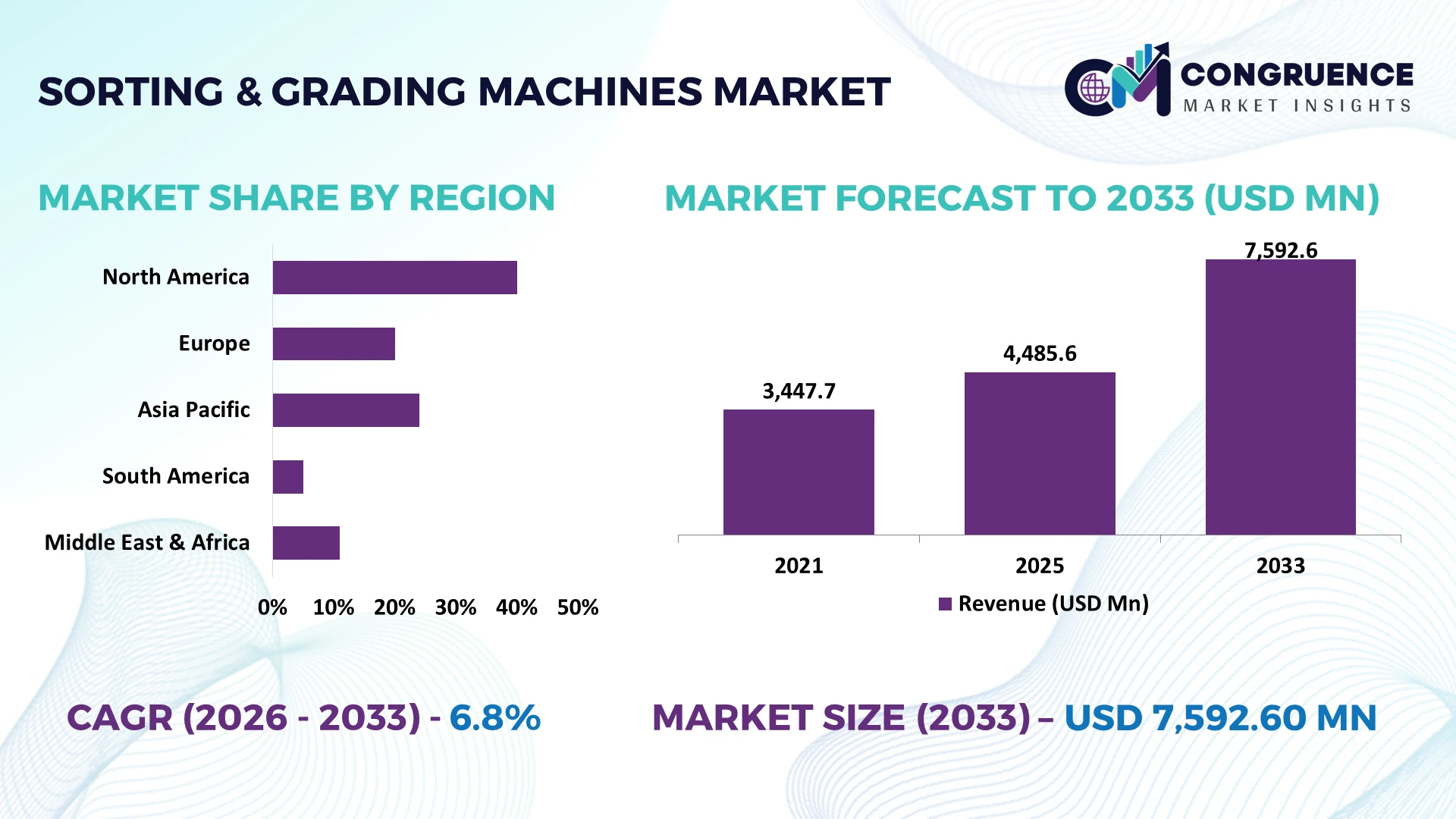
The Global Sorting & Grading Machines Market was valued at USD 4485.6 Million in 2025 and is anticipated to reach a value of USD 7592.6 Million by 2033 expanding at a CAGR of 6.8% between 2026 and 2033. Growth is driven by AI-enabled optical sorting, hyperspectral imaging, robotic handling, and automated quality classification replacing labor-intensive inspection across food processing, agriculture, recycling, and mining operations.
China represents the dominant country market, accounting for approximately 28% of global machine deployment, supported by large-scale food processing, fruit grading, grain handling, and recycling investments; AI-enabled inspection adoption exceeds 35% among advanced processors. India follows with roughly 12%, while China maintains a significantly broader automated processing base amid supply-chain localization and industrial upgrading under China’s manufacturing strategy.
Strategically, suppliers combining AI vision, high-speed automation, and localized service networks are positioned to capture replacement and capacity-expansion investments.
Market Size & Growth: USD 4,485.6 million in 2025 to USD 7,592.6 million by 2033 at 6.8% CAGR, driven by AI optical sorting and automation.
Top Growth Drivers: AI inspection 31%, labor-cost pressure 24%, food-safety automation 19%.
Short-Term Forecast: By 2028, automated inspection efficiency is expected to improve 15%, while sorting costs decline 8%.
Emerging Technologies: AI vision, hyperspectral imaging, robotic grading, and edge analytics are reshaping advanced sorting lines.
Regional Leaders: Asia-Pacific approaches USD 3.2 billion, Europe USD 1.9 billion, and North America USD 1.7 billion, led by automation adoption.
Consumer/End-User Trends: Over 35% of advanced food processors are adopting automated quality inspection for consistent grading.
Pilot/Case Example: 2024 AI-enabled sorting deployments delivered up to 20% higher throughput and reduced manual inspection requirements.
Competitive Landscape: Leading suppliers collectively command roughly 35% of the market, with TOMRA, Bühler, Key Technology, Sesotec, and Binder+Co prominent.
Regulatory & ESG Impact: Food-traceability and waste-reduction initiatives are driving 10%–15% improvements in material utilization.
Investment & Funding: More than USD 1 billion is flowing into automation, optical-sorting expansion, AI integration, and strategic manufacturing partnerships.
Innovation & Future Outlook: Next-generation machines integrate AI, digital twins, robotics, and real-time analytics, accelerating the shift toward autonomous grading.
Sorting and grading machines are gaining traction across fruit and vegetable processing, grains, pulses, meat, seafood, recycling, and mining, where precision classification directly affects yield and product consistency. AI vision and hyperspectral systems are improving detection accuracy by approximately 15%, while compact modular platforms support faster line upgrades. Supply-chain localization and stricter food-quality controls are accelerating automation adoption, creating a stronger strategic case for intelligent sorting infrastructure.
Sorting and grading machines are becoming strategic production assets as food processors, recyclers, and agricultural exporters compete on yield, consistency, traceability, and labor productivity. The shift from manual inspection toward AI-enabled optical sorting is accelerating as supply chains restructure and quality-control requirements tighten. In the next 2–3 years, automated inspection penetration in high-volume processing lines is positioned to rise toward 45%, strengthening throughput and reducing dependence on scarce skilled labor.
Technology economics increasingly favor intelligent systems: AI vision and multisensor sorting can deliver 15–25% higher inspection throughput than conventional mechanical grading while reducing manual quality checks by approximately 20%. China is leading deployment at industrial scale, while India is expanding adoption across rice, pulses, spices, and horticulture; European processors emphasize precision, traceability, and resource efficiency. This regional contrast is shifting investment toward modular platforms capable of integrating with existing lines.
A practical deployment involves AI optical sorters positioned between cleaning and packaging stages, enabling processors to remove defects without slowing downstream operations. Over the next three years, manufacturers are prioritizing retrofit packages, predictive-maintenance software, local service centers, and technology partnerships. Companies that combine detection accuracy, interoperability, and lower lifecycle costs will secure stronger competitive positioning as intelligent sorting becomes integral to modern processing infrastructure.
AI-powered optical inspection is becoming a primary growth catalyst as processors target higher yield and consistent product specifications. Advanced systems can increase sorting throughput by 15–25% and reduce manual inspection requirements by approximately 20%, while defect-detection accuracy can improve by 10–15% versus conventional mechanical inspection. China’s large food-processing base is accelerating deployment across grains, nuts, fruits, and vegetables, while Indian processors are investing in automated rice, pulse, and spice grading. Companies are responding through AI software upgrades, multisensor equipment, and partnerships with machine-vision specialists. The non-obvious advantage is data capture: each sorting cycle generates quality information that supports process optimization, supplier evaluation, and predictive maintenance.
Capital intensity remains a structural constraint, particularly for small and mid-sized processors operating with aging production infrastructure. Advanced optical systems can require 20–35% higher upfront investment than basic mechanical graders, while customized line integration can add another 10–15% to project costs. In India and Southeast Asian processing hubs, inconsistent plant layouts and limited automation infrastructure frequently complicate deployment. Semiconductor, camera, sensor, and pneumatic-component dependencies also expose manufacturers to supply-chain volatility. Equipment suppliers are mitigating these pressures through modular configurations, retrofit packages, localized assembly, and multi-year service contracts. The critical operational issue is lifecycle economics: processors increasingly evaluate payback through labor savings, yield recovery, maintenance costs, and rejected-product reduction rather than purchase price alone.
The strongest opportunity lies in retrofitting existing grading lines with AI vision, hyperspectral sensing, edge analytics, and cloud-connected monitoring. Modular upgrades can raise inspection efficiency by 15–20% and reduce manual quality-control workloads by approximately 20%, allowing processors to modernize without replacing entire production systems. India offers an attractive opportunity across horticulture, rice, pulses, spices, and packaged foods, where fragmented processing capacity creates demand for scalable automation. European manufacturers are also prioritizing resource-efficient sorting to reduce food and material waste. Companies are increasing R&D spending on self-learning algorithms, digital twins, and sensor fusion while forming partnerships with automation providers. A key strategic opening is software-led revenue: continuous algorithm updates can extend machine relevance and create recurring service relationships.
Integrating intelligent sorting equipment into heterogeneous processing environments remains a major execution challenge. Approximately 25–30% of modernization projects require significant interface or conveyor modifications, while workforce shortages can increase commissioning and training requirements by 10–15%. Older plants in India and other developing processing hubs frequently lack standardized data infrastructure, limiting real-time integration between sorting, packaging, and enterprise systems. Cybersecurity exposure also rises as connected machines exchange production and quality data across networks. Manufacturers are addressing these barriers through standardized communication protocols, remote diagnostics, operator training, and cybersecurity-by-design. The strategic challenge extends beyond machine performance: suppliers that simplify integration and build local technical capabilities will achieve more consistent deployment and stronger long-term customer retention.
AI Sorting Moves Mainstream: Deep-learning systems are moving beyond premium installations, with AI-enabled sorting increasingly integrated into high-volume processing lines. Adoption of intelligent inspection is estimated at 30%–35% among advanced facilities, improving defect detection by 10%–15%. Companies are expanding machine-learning libraries and sensor integration to reduce operator intervention and maintain consistent quality across variable raw-material batches.
Precision Grading Gets Granular: Vision systems increasingly classify defects by severity, size, shape, color, and structural quality rather than simple pass-or-reject decisions. Advanced platforms can improve inspection throughput by 15%–20% and reduce unnecessary rejection by approximately 5%–10%. Processors are responding by integrating multispectral cameras and AI analytics into existing grading workflows, particularly for fruits, vegetables, grains, and nuts.
Modular Automation Gains Ground: Processors are shifting toward modular sorting equipment that integrates with existing conveyors, cleaning systems, and packaging lines. Retrofit-based deployments can reduce modernization costs by approximately 10%–15% compared with complete line replacement while shortening commissioning periods by nearly 20%. Labor shortages and supply-chain uncertainty are encouraging companies to prioritize scalable upgrades, localized servicing, and interoperable equipment architectures.
Sorting Becomes Data Infrastructure: Connected machines are evolving from standalone inspection assets into production intelligence platforms, with approximately 20%–25% of advanced installations incorporating real-time monitoring or analytics. Operational data increasingly supports yield optimization, maintenance scheduling, supplier-quality assessment, and traceability. Companies are responding through cloud connectivity, edge analytics, and digital dashboards, creating a non-obvious shift toward software-led differentiation in traditionally equipment-focused markets.
Optical Sorters represent the leading type with approximately 39% market share, supported by high throughput, multispectral detection, scalability, and integration with automated processing lines. Their ability to identify foreign material, color variation, structural defects, and quality differences provides broader functionality than conventional mechanical systems. Color Sorters remain established across grain and seed processing, while Weight Graders and Size Graders retain strong relevance where physical classification is sufficient. Companies increasingly combine these systems, with integrated optical technologies improving sorting consistency by approximately 15%–20% and reducing manual inspection requirements by nearly 20%.
Vision-Based Systems are the fastest-growing type, with adoption increasing at approximately 14% as AI-powered defect recognition becomes more commercially viable. Their ability to interpret complex visual characteristics is shifting investment toward software-enhanced quality control, encouraging manufacturers to expand machine-learning capabilities and sensor partnerships. This transition strengthens demand for intelligent systems while maintaining Weight and Size Graders as cost-effective solutions for standardized applications.
Food Processing leads the application landscape with approximately 36% market share because processors require continuous defect removal, contamination control, standardized grading, and high-throughput quality assurance. Grain Processing and Seed Processing remain mature applications, with automated classification improving consistency by approximately 12%–18% compared with labor-intensive inspection. Fruit & Vegetable Sorting is the fastest-growing application, supported by machine vision capable of identifying bruising, ripeness, shape, and structural defects. Companies are integrating sorting directly with packing operations to reduce handling and product losses.
Recycling is gaining strategic importance as operators require finer material separation and higher-value recovery. Advanced sorting can reduce manual classification requirements by approximately 20% while improving usable material recovery by 10%–15%. Companies are therefore shifting investment toward integrated platforms capable of handling multiple feedstock grades. Food processors remain the largest demand center, but recycling is changing the technology mix by accelerating adoption of AI-based material recognition and multisensor systems.
Food Processors account for approximately 42% of demand, reflecting their high-volume production environments, strict quality requirements, and dependence on continuous inspection. Grain Mills and Agricultural Producers represent significant established users, increasingly deploying automated systems to improve grading consistency and reduce manual quality-control requirements by approximately 15%–20%. Packaging Companies are integrating sorting with filling and pack-out operations, while Recycling Facilities increasingly require specialized classification technologies. Companies are responding with application-specific configurations, modular equipment, and integrated service packages.
Recycling Facilities are the fastest-growing end-user group, with adoption expanding at approximately 13% as operators pursue higher material recovery and increasingly precise separation. Their purchasing behavior differs from traditional food processors because investment emphasizes AI retrofits, sensor fusion, and software-enabled classification rather than standalone machinery. Suppliers are targeting this segment through partnerships and customized platforms, while Food Processors continue prioritizing throughput and food-quality consistency. The resulting shift is moving competitive advantage toward adaptable systems that maintain performance despite changing feedstock characteristics.
Asia-Pacific accounted for the largest market share at 38% in 2025 however, Asia-Pacific is expected to register the fastest growth, expanding at a CAGR of 8.1% between 2026 and 2033.

AI-enabled inspection strengthens high-throughput processing
North America remains a major market for sorting and grading machines, supported by advanced food-processing, agricultural, recycling, and packaging infrastructure. The United States represents the dominant deployment center, particularly across potato, nut, grain, frozen-food, fruit, and vegetable processing. Automated optical and vision-based systems are increasingly integrated with conveyors, packaging equipment, robotic handling, and digital quality-control platforms. Advanced sorting can reduce manual inspection requirements by approximately 15%–20%, strengthening throughput and consistency. Labor availability and stricter quality requirements are encouraging processors to retrofit existing lines rather than undertake complete facility replacement. Equipment manufacturers are responding through modular systems, AI-enabled inspection, predictive-maintenance capabilities, and expanded technical-service networks. The regional competitive advantage increasingly depends on integration quality, uptime, and lifecycle efficiency rather than machine capacity alone.
United States Market Outlook: The United States represents the region’s strongest deployment base because of its extensive agricultural-processing and recycling infrastructure. High-volume facilities increasingly use automated optical sorting for potatoes, nuts, grains, fresh produce, and packaged foods. Large processors are prioritizing systems capable of continuous operation, real-time defect detection, and integration with downstream packaging equipment.
Precision automation advances resource-efficient processing
Europe is shifting toward intelligent sorting systems that combine precision classification with food-quality control, traceability, and resource efficiency. Germany, Italy, France, Spain, and the Netherlands remain important processing and machinery hubs, with demand supported by sophisticated food, agricultural, and recycling industries. European processors increasingly deploy optical, multispectral, and vision-based systems to identify defects while reducing unnecessary product rejection. Automated inspection can improve sorting consistency by approximately 15%–20% and lower manual quality-control requirements by nearly 20%. Food-waste reduction policies are reinforcing investment in technologies that improve usable output and minimize avoidable losses. Companies are responding with hygienic machine designs, energy-efficient systems, digital monitoring, and integrated sorting-to-packaging platforms. Competitive positioning increasingly favors suppliers that combine regulatory compatibility, precision, interoperability, and measurable resource-efficiency improvements.
Germany Market Outlook: Germany holds a strategically important position through its advanced machinery manufacturing base, automated food-processing infrastructure, and mature recycling industry. Industrial buyers emphasize interoperability, hygienic engineering, and continuous monitoring. Suppliers with established engineering and service networks are well positioned to provide retrofit-compatible optical and vision-based sorting systems.
Large-scale processing accelerates intelligent automation
Asia-Pacific represents the largest demand center for sorting and grading machines, supported by extensive agricultural production, expanding food-processing capacity, and rising automation investment. China, India, Japan, South Korea, and Australia demonstrate strong deployment activity across grains, rice, pulses, seeds, nuts, fruits, and vegetables. China benefits from large-scale processing infrastructure and domestic equipment manufacturing, while India is rapidly adopting automated grading in rice, pulses, spices, and horticulture. Optical sorting systems can improve classification consistency by approximately 15%–20%, encouraging processors to replace labor-intensive inspection with automated sensing. Manufacturers are expanding local production, distributor networks, technical partnerships, and modular product configurations to serve different plant scales. The region’s strongest competitive advantage is its combination of agricultural processing volume, manufacturing capacity, and increasing acceptance of AI-enabled inspection technologies.
China Market Outlook: China is the most strategically significant national market because of its extensive grain, rice, nut, fruit, vegetable, and processed-food industries. High-volume processors increasingly prioritize optical sorting and automated quality inspection. Domestic manufacturing capabilities support faster customization, localized servicing, and shorter equipment supply chains.
Export agriculture drives automated quality classification
South America is expanding adoption of sorting and grading equipment across coffee, grains, nuts, fruits, vegetables, pulses, and other export-oriented commodities. Brazil represents the dominant deployment center because of its extensive agricultural production and processing infrastructure. Automated grading is becoming increasingly important for exporters managing large harvest volumes and variable raw-material quality. Optical and vision-based systems can reduce manual inspection requirements by approximately 15%–20% while improving consistency across production batches. Infrastructure differences between major processing hubs and smaller facilities remain an important deployment consideration. Companies are therefore emphasizing modular equipment, localized technical support, distributor partnerships, and retrofit-compatible systems. Demand is particularly strong where automated classification directly protects export quality, improves product allocation, and reduces labor-intensive inspection. Suppliers that combine reliable equipment with regional service capabilities are gaining an operational advantage.
Brazil Market Outlook: Brazil offers the strongest national opportunity through its large agricultural-processing ecosystem covering coffee, grains, fruits, vegetables, and nuts. Export-focused processors increasingly require automated classification to maintain consistent specifications across high-volume batches. Investment is moving toward optical sorting, digital quality monitoring, and integrated processing systems.
Food-security programs accelerate processing modernization
The Middle East & Africa market is increasingly influenced by food-security initiatives, agricultural modernization, post-harvest-loss reduction, and investment in domestic food-processing infrastructure. Saudi Arabia, the United Arab Emirates, South Africa, and Egypt represent important deployment centers across grains, dates, fruits, vegetables, seeds, and packaged foods. Automated sorting can reduce manual inspection requirements by approximately 15%–20%, improving consistency where skilled labor availability is uneven. Gulf countries are investing in technologically advanced food-processing infrastructure, while African processors increasingly favor cost-efficient equipment capable of handling variable feedstock quality. Companies are responding through local partnerships, modular installations, operator training, and after-sales service networks. Suppliers that combine advanced optical sensing with simplified operation have an advantage because infrastructure readiness, technical support, and workforce capability strongly influence equipment utilization.
Saudi Arabia Market Outlook: Saudi Arabia holds strong strategic potential through food-security programs, agricultural modernization, controlled-environment agriculture, and expanding domestic food-processing infrastructure. Processors are increasingly adopting automated inspection and grading for fruits, vegetables, grains, and packaged foods, supporting demand for intelligent systems that improve consistency and reduce processing losses.
TOMRA and Bühler compete as global technology leaders, while Satake, Sesotec, Key Technology, and Binder+Co strengthen competition across specialized applications and regional markets. The top five players collectively hold an estimated 35%–40% share, leaving substantial space for regional OEMs and niche system integrators. Competition centers on optical accuracy, AI functionality, throughput, customization, service coverage, and lifecycle economics. Advanced systems can improve inspection efficiency by approximately 15%–20%, while modular integration can reduce modernization costs by nearly 10%–15%. Leading suppliers are expanding AI capabilities, multisensor detection, application-specific platforms, partnerships, and regional service networks. The competitive shift is moving from hardware specifications toward software, data analytics, interoperability, and after-sales support. High engineering requirements, application datasets, installed equipment bases, and service networks create significant entry barriers. Winning requires superior detection accuracy, dependable integration, localized support, competitive lifecycle costs, and continuous technology innovation.
TOMRA
Bühler Group
Satake Corporation
Sesotec GmbH
Key Technology, Inc.
Binder+Co AG
Allgaier Process Technology
Cimbria
GREEFA
Meyer Optoelectronic Technology Limited
Anhui Zhongke Optic-electronic Color Sorter Machinery Co., Ltd.
Hefei Taiho Optical Technology Co., Ltd.
AI-powered optical sorting is now the core technology shift, with deep-learning systems analyzing whole-product images instead of limited pixel patterns. TOMRA reports LUCAi processing up to 40,000 images per second and 99%+ defect detection. Adoption is expanding across fruit, vegetables, grains, and nuts, improving grading consistency and reducing operator intervention by roughly 15%–20%. The business impact is stronger packout control and fewer false rejects across high-volume lines.
Multispectral imaging, NIR sensing, hyperspectral cameras, and sensor fusion are emerging as integrated platforms, increasing detection precision by about 10%–15% for difficult defects and contaminants. Connected monitoring adds real-time throughput, rejection, and quality data, while AI models adapt to changing feedstock. These capabilities favor technology leaders with large image libraries and software expertise, while supporting traceability and production planning.
By 2026–2028, autonomous sorting, edge analytics, digital twins, and predictive maintenance will move from advanced installations toward broader deployment. Compared with legacy mechanical grading, intelligent vision platforms can deliver 15%–25% higher inspection efficiency while cutting manual quality checks around 20%. Processors benefit through higher yield and faster changeovers; suppliers combining AI, retrofit compatibility, and service networks gain the strongest competitive position. Early action matters as labor constraints and quality standards widen the productivity gap.
June 2026, Satake launched SLASH β PLUS globally, using high-efficiency ejectors that cut acceptable-product loss in rejects by approximately 10%. The compact sorter improves yield, reduces air and power consumption, and integrates with upstream and downstream equipment globally. Source: satake-group.com
May 2025, Bühler launched SORTEX AI700 for oat and cereal processing, using deep learning to identify gluten-containing grains. The system targets higher defect removal and yield while simplifying operation through digital monitoring, strengthening food-safety control for processors worldwide. Source: buhlergroup.com
October 2024, Recycling Today reported TOMRA’s expansion of GAINnext with PET Cleaner and Paper Cleaning applications for North American recyclers. The systems identify thousands of objects in milliseconds and reduce manual sorting, improving purity and recovery efficiency commercially. Source: recyclingtoday.com
March 2024, Packaging Insights reported TOMRA’s food-grade plastic sorting breakthrough using GAINnext deep learning for PET, PP, and HDPE. The technology combines AI with conventional sensors to separate difficult materials at scale, strengthening recycled-plastic quality and compliance standards. Source: packaginginsights.com
The report covers the Sorting & Grading Machines Market across Optical Sorters, Color Sorters, Weight Graders, Size Graders, and Vision-Based Systems, with applications spanning Food Processing, Seed Processing, Grain Processing, Fruit & Vegetable Sorting, and Recycling. End-user coverage includes Food Processors, Agricultural Producers, Grain Mills, Recycling Facilities, and Packaging Companies. The assessment also examines AI vision, deep learning, multispectral imaging, NIR sensing, hyperspectral detection, automation, and connected monitoring.
Geographically, the study evaluates North America, Europe, Asia-Pacific, South America, and the Middle East & Africa, with country-level emphasis on major processing and technology hubs. The report tracks adoption intensity, deployment patterns, competitive positioning, technology transitions, and infrastructure readiness. Between 2026 and 2033, these insights support investment prioritization, regional expansion, product development, partnerships, and capacity planning by identifying where intelligent sorting adoption is accelerating and where integration constraints require targeted execution.
| Report Attribute/Metric | Report Details |
|---|---|
Market Revenue in 2025 | USD 4485.6 Million |
Market Revenue in 2033 | USD 7592.6 Million |
CAGR (2026 - 2033) | 6.8% |
Base Year | 2025 |
Forecast Period | 2026 - 2033 |
Historic Period | 2021 - 2025 |
Segments Covered | By Type
By Application
By End-User
|
Key Report Deliverable | Revenue Forecast, Growth Trends, Market Dynamics, Segmental Overview, Regional and Country-wise Analysis, Competition Landscape |
Region Covered | North America, Europe, Asia-Pacific, South America, Middle East, Africa |
Key Players Analyzed | TOMRA, Bühler Group, Satake Corporation, Sesotec GmbH, Key Technology, Inc., Binder+Co AG, Allgaier Process Technology, Cimbria, GREEFA, Meyer Optoelectronic Technology Limited, Anhui Zhongke Optic-electronic Color Sorter Machinery Co., Ltd., Hefei Taiho Optical Technology Co., Ltd. |
Customization & Pricing | Available on Request (10% Customization is Free) |




