
Reports
The Global Panic & Emergency Exit Devices Market was valued at USD 2,503.9 Million in 2025 and is anticipated to reach a value of USD 4,669.0 Million by 2033 expanding at a CAGR of 8.1% between 2026 and 2033. Growth is driven by stricter fire safety enforcement, smart access-control integration, and rising deployment of electronic panic hardware in commercial and public infrastructure projects.
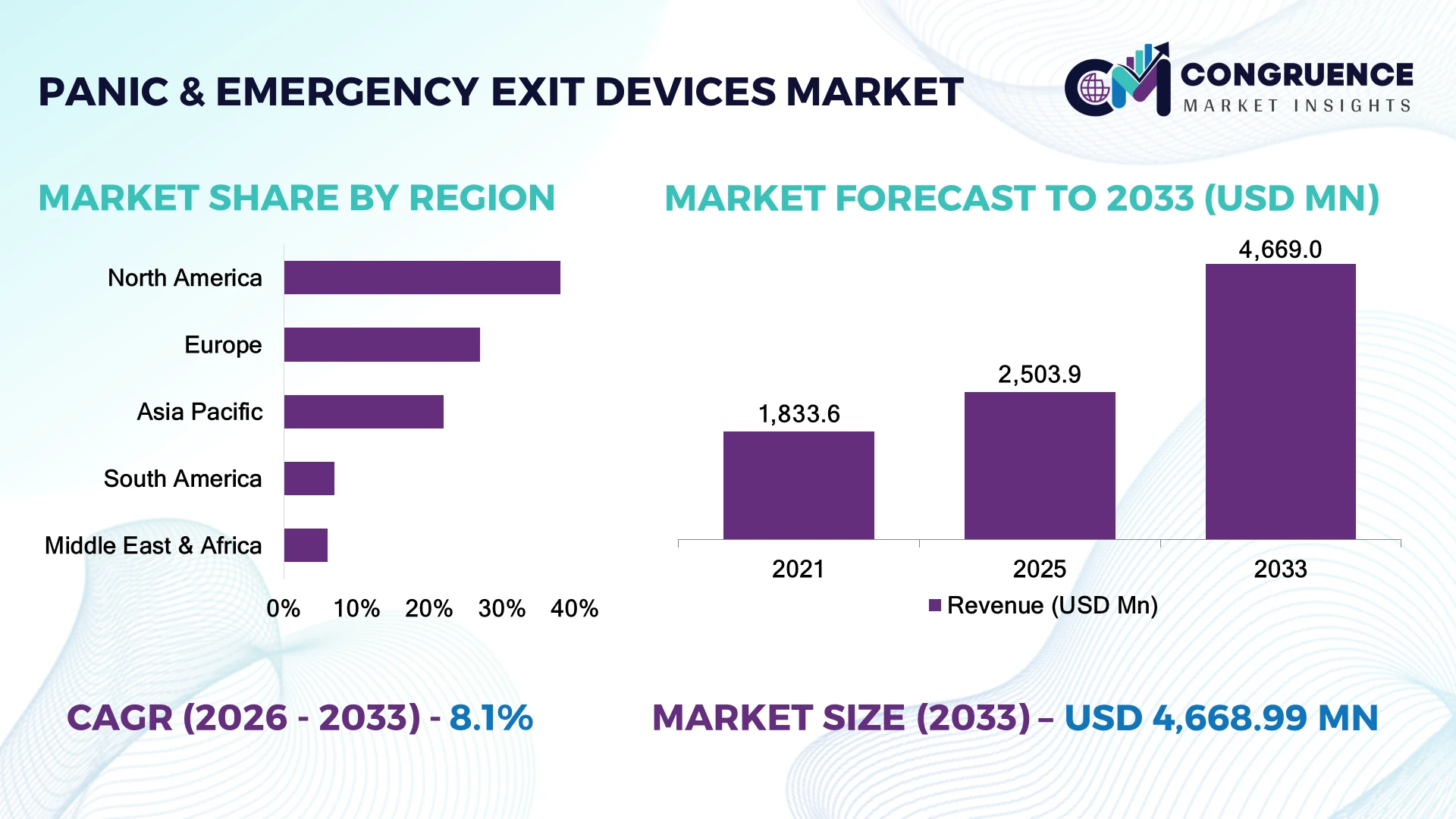
The United States remains a dominant market, supported by extensive building safety modernization and adoption across commercial facilities, with North America accounting for approximately 38% share of global demand. The U.S. installed base includes more than 5 million commercial buildings requiring compliant exit hardware upgrades, while China is expanding rapidly through large-scale infrastructure programs under urban safety initiatives. Compared with India, where adoption is concentrated in new airports, malls, and industrial facilities, the U.S. market shows higher replacement-driven demand.
Strategic focus on connected safety systems and regulatory compliance will define competitive advantage.
Market Size & Growth: USD 2,503.9 Million (2025) to USD 4,669.0 Million (2033) at 8.1% CAGR, driven by smart emergency hardware adoption and building safety upgrades.
Top Growth Drivers: Fire safety compliance (+35%), smart access integration (+28%), commercial infrastructure renovation (+22%).
Short-Term Forecast: By 2028, digital exit-device installations increase by over 25%, improving monitoring efficiency and reducing maintenance response time.
Emerging Technologies: AI-enabled access monitoring, IoT-connected exit devices, and advanced electronic locking systems gain adoption across modern facilities.
Regional Leaders: North America reaches approximately USD 1.8 Billion, Europe USD 1.2 Billion, and Asia-Pacific USD 1.1 Billion, supported by automation and infrastructure modernization.
Consumer/End-User Trends: Commercial buildings account for more than 55% of deployments as enterprises prioritize automated evacuation compliance.
Pilot/Case Example: 2024 smart building safety projects reduced emergency inspection time by nearly 30% through connected monitoring platforms.
Competitive Landscape: ASSA ABLOY leads with an estimated 20%+ share, followed by Allegion, dormakaba, dormakaba, and Stanley Black & Decker.
Regulatory & ESG Impact: Updated safety standards improve compliance rates by over 40% in newly constructed commercial facilities.
Investment & Funding: More than USD 500 Million directed toward smart security infrastructure partnerships, manufacturing expansion, and connected hardware development.
Innovation & Future Outlook: Next-generation wireless exit systems and predictive maintenance platforms are shifting the industry toward intelligent safety ecosystems.
Panic & Emergency Exit Devices are becoming critical components of modern safety infrastructure, particularly across airports, healthcare facilities, educational campuses, and high-occupancy commercial buildings. Recent innovations include sensor-based monitoring, modular hardware designs, and cloud-connected emergency systems, with electronic adoption increasing by nearly 30% as facility operators seek faster compliance verification. Supply-chain diversification after global logistics disruptions is encouraging manufacturers to expand regional production capabilities and strengthen local partnerships, creating new opportunities for integrated safety solutions.
The Panic & Emergency Exit Devices Market is becoming strategically important as governments and enterprises prioritize safer, digitally managed buildings. Regulatory modernization after incidents such as fire safety upgrades across European commercial facilities and expanded safety codes in the United States is accelerating replacement of traditional mechanical hardware with connected emergency systems.
Digital exit devices equipped with sensors and remote monitoring improve inspection efficiency by nearly 30% compared with manual systems, reducing downtime and maintenance costs. North America leads through replacement-driven modernization, while China and India are expanding deployments through airports, metro projects, industrial parks, and commercial complexes. European markets emphasize compliance, energy-efficient buildings, and integrated security platforms.
Over the next 2–3 years, manufacturers are increasing investments in IoT-enabled hardware, cloud monitoring partnerships, and localized production networks. Companies are collaborating with building automation providers to integrate emergency exits with broader security ecosystems. The strategic advantage will shift toward suppliers capable of delivering compliant, intelligent, and scalable safety platforms rather than standalone hardware products.
Growing adoption of intelligent building systems is accelerating demand for connected panic and emergency exit devices. Smart hardware installations increased by nearly 30% as commercial operators integrate access control, monitoring, and evacuation management platforms. In the U.S., updated workplace safety requirements are pushing enterprises toward electronically supervised exit solutions, while Germany and Japan continue upgrading high-occupancy facilities. Companies are responding through R&D investments, cloud-based monitoring partnerships, and expansion of electronic product portfolios. The shift from manual inspection toward real-time diagnostics improves operational visibility and reduces compliance risks, creating stronger demand for advanced exit technologies across commercial and industrial environments.
High installation costs and compatibility challenges remain key barriers, particularly for older buildings requiring complete hardware modernization. Retrofitting expenses can increase project budgets by 20–35% when mechanical systems are replaced with electronic alternatives. Dependence on specialized components from international suppliers also exposes manufacturers to logistics disruptions and component shortages. Smaller facility operators in countries such as India and Brazil often delay upgrades due to budget constraints and limited technical expertise. Companies are reducing these pressures through localized manufacturing, supplier diversification, and modular product designs that simplify installation. Strategic cost optimization is becoming essential for maintaining profitability while expanding adoption.
The expansion of smart buildings creates significant opportunities for next-generation panic and emergency exit solutions. IoT-connected devices are expected to represent more than 35% of new premium installations as facility owners demand remote monitoring and predictive maintenance capabilities. Countries including India are witnessing increased opportunities through airport expansion, healthcare infrastructure, and industrial development projects. Artificial intelligence-based safety analytics and wireless communication technologies are enabling faster response management. Companies are strengthening market positions through partnerships with security technology providers and investment in interoperable platforms. The emerging opportunity lies in transforming exit devices from passive safety equipment into active building intelligence systems.
Increasing digitalization introduces challenges related to interoperability, cybersecurity, and system reliability. Connected emergency devices require secure communication networks, with cybersecurity concerns influencing nearly 25% of smart building technology decisions. Integration difficulties between legacy infrastructure and advanced access-control systems remain significant in older commercial properties across Europe and North America. Workforce skill gaps also affect installation consistency and maintenance quality. Companies must invest in cybersecurity frameworks, installer training programs, and standardized communication protocols to ensure reliable deployment. Long-term competitiveness will depend on balancing intelligent functionality with dependable emergency performance and regulatory compliance.
Smart Exit System Integration: Connected panic devices are gaining adoption as commercial buildings integrate IoT monitoring and access-control platforms, with smart installations increasing by nearly 30% and reducing inspection workloads by approximately 25%. Companies are expanding digital product portfolios and partnering with building automation providers to improve real-time safety management.
Modular Hardware Deployment Growth: Facility operators are shifting toward modular panic hardware that enables faster retrofits, reducing installation time by around 20% and lowering replacement complexity in older buildings. Manufacturers are restructuring supply networks and increasing localized production, particularly after global component availability disruptions affected hardware delivery schedules.
Electronic Monitoring Expansion: Electronic exit devices are replacing traditional mechanical systems in premium facilities, with adoption rising by nearly 35% across airports, healthcare centers, and corporate campuses. Companies are investing in wireless communication technologies and predictive maintenance features to improve operational efficiency and minimize emergency system downtime.
Compliance-Driven Product Evolution: Updated safety regulations in markets such as the United States and Europe are accelerating demand for advanced exit solutions, with compliance-focused upgrades increasing by over 40% in newly developed facilities. Manufacturers are prioritizing certified designs, cybersecurity enhancements, and integrated emergency management solutions to address evolving building standards.
Electronic panic & emergency exit devices represent the leading segment, accounting for approximately 55% of market adoption due to superior monitoring capabilities, remote management, and integration with smart building platforms. Mechanical panic devices maintain strong demand in cost-sensitive projects, representing nearly 35% of installations because of reliability and lower upfront costs. The fastest-growing segment is electronic-assisted systems, supported by rising demand for connected security infrastructure and automated compliance tracking. Manufacturers are shifting investments toward sensor-enabled hardware, wireless connectivity, and cloud-based management solutions, while mechanical solutions continue serving schools, small businesses, and replacement markets. Hybrid solutions are gaining relevance by combining traditional durability with digital monitoring capabilities. Approximately 30% of new commercial construction projects now prioritize integrated emergency hardware specifications during planning stages, encouraging companies to expand advanced product offerings and strategic partnerships.
Commercial buildings represent the leading application segment, contributing approximately 60% of deployments due to strict occupancy regulations and continuous demand from offices, retail complexes, and hospitality facilities. Industrial facilities follow with around 25% adoption, supported by worker safety requirements and manufacturing compliance programs. The fastest-growing application is healthcare and institutional infrastructure, where emergency reliability and rapid evacuation management are becoming operational priorities. Airports, educational campuses, and government buildings are increasing investments in advanced exit solutions as digital building management expands. Companies are developing application-specific products with improved durability, access integration, and remote diagnostics. Healthcare facilities are showing nearly 30% higher adoption of monitored exit systems compared with traditional installations due to safety-critical operational requirements.
Commercial enterprises remain the dominant end-user group, representing approximately 50% of demand due to large-scale office buildings, retail chains, and hospitality infrastructure requiring standardized safety systems. Government and public infrastructure users account for nearly 20% of installations, supported by transportation hubs and public facility modernization programs. The fastest-growing end-user segment is healthcare and education, driven by increasing investment in high-occupancy safety infrastructure. Large enterprises are adopting centralized emergency management platforms that improve operational visibility across multiple locations. Healthcare providers and educational institutions are prioritizing reliable evacuation systems, with adoption increasing by nearly 30% as regulatory inspections become more technology-focused. Manufacturers are responding through customized solutions, service agreements, and partnerships with facility management companies.
North America accounted for the largest market share at 38% in 2025 however, Asia-Pacific is expected to register the fastest growth, expanding at a CAGR of 9.2% between 2026 and 2033.
North America held the leading position with approximately 38% market share in 2025, supported by strict workplace safety standards, commercial renovation activity, and advanced building automation adoption. The United States represents the largest contributor due to extensive deployment across offices, healthcare facilities, airports, and educational infrastructure. More than 60% of newly developed commercial buildings integrate electronic access and emergency monitoring systems. Manufacturers are increasing investments in connected hardware, cloud-based monitoring platforms, and regional production capabilities to address rising demand for intelligent safety solutions.
United States Market Outlook: The United States remains the key market due to strong regulatory enforcement, large commercial infrastructure, and technology adoption. Over 5 million commercial buildings require periodic safety compliance upgrades, encouraging replacement-driven demand. Companies are expanding partnerships with security integrators and facility management providers to strengthen smart emergency system deployments.
Europe accounted for nearly 27% of global demand in 2025, supported by strict fire safety regulations, aging commercial infrastructure, and modernization of public facilities. Countries including Germany, the United Kingdom, and France are increasing adoption of electronic exit devices integrated with building management systems. More than 40% of new commercial projects prioritize digitally monitored safety equipment. Manufacturers are focusing on energy-efficient production, certified solutions, and partnerships with construction firms to meet evolving compliance requirements.
Germany Market Outlook: Germany represents the strongest European market due to industrial infrastructure strength and advanced safety standards. The country’s manufacturing facilities, logistics centers, and commercial buildings increasingly utilize automated safety systems, with smart building projects accounting for a growing share of new construction investments. Companies are emphasizing precision engineering and integrated security solutions.
Asia-Pacific accounted for approximately 22% of the market in 2025 and is emerging as the fastest-expanding market due to rapid urbanization, infrastructure development, and commercial construction growth. China, India, Japan, and South Korea are increasing adoption across airports, metro systems, industrial parks, and high-rise buildings. China contributes significantly through large-scale construction programs, while India is expanding safety infrastructure through new commercial and transportation projects. Regional manufacturers are increasing production capacity and developing cost-effective electronic solutions to support broader adoption.
China Market Outlook: China maintains a leading position due to large infrastructure investments and extensive commercial development. More than 30% of new urban construction projects incorporate advanced safety and access-control systems. Domestic manufacturers are expanding smart hardware production and strengthening partnerships with construction developers to capture growing demand.
South America accounted for approximately 7% of global demand in 2025, driven by modernization of commercial buildings, industrial facilities, and transportation infrastructure. Brazil represents the largest contributor as businesses upgrade safety systems in offices, shopping centers, and manufacturing facilities. Adoption remains concentrated in major urban areas due to infrastructure disparities. Around 20% of new commercial developments incorporate improved emergency access systems. Companies are addressing market limitations through localized distribution networks, cost-efficient product ranges, and partnerships with regional installers.
Brazil Market Outlook: Brazil leads the South American market due to its large commercial base and industrial activity. Major cities are witnessing increased deployment of compliant emergency hardware in retail, hospitality, and manufacturing sectors. Companies are expanding local partnerships and distribution channels to improve accessibility and reduce installation barriers.
Middle East & Africa accounted for approximately 6% of global demand in 2025, supported by large-scale infrastructure projects, hospitality expansion, and commercial development programs. Countries such as Saudi Arabia and the United Arab Emirates are investing heavily in airports, smart cities, and luxury commercial facilities requiring advanced safety systems. More than 25% of new premium infrastructure projects incorporate integrated access and emergency monitoring technologies. Manufacturers are strengthening regional partnerships and expanding service capabilities to support complex deployment environments.
Saudi Arabia Market Outlook: Saudi Arabia represents the most significant market due to ongoing infrastructure transformation and large construction programs. Smart city initiatives and commercial developments are increasing demand for advanced emergency systems. Companies are targeting partnerships with construction groups and facility operators to support technology-driven safety upgrades.
The Panic & Emergency Exit Devices Market features global leaders such as ASSA ABLOY, Allegion, dormakaba, and Stanley Black & Decker competing with regional manufacturers and specialized security hardware suppliers. Technology-focused players compete through electronic integration, while cost-driven suppliers focus on manufacturing efficiency and distribution reach. The top five companies collectively account for approximately 45% of market share, creating a moderately consolidated structure. Competition is shaped by smart hardware adoption, with electronic solutions improving operational monitoring by nearly 30%, while customized solutions increase project efficiency by around 20%. Players are expanding through acquisitions, installer partnerships, localized production, and connected safety platforms. The market is shifting toward digital ecosystems, cybersecurity-enabled devices, and integrated building management solutions. High certification requirements, engineering expertise, and established distribution networks create entry barriers. Winning companies must combine regulatory compliance, innovation speed, supply reliability, and scalable smart safety solutions.
Allegion plc
dormakaba International Holding AG
Stanley Black & Decker, Inc.
Hörmann Group
GEZE GmbH
ISEO Serrature S.p.a.
Gretsch-Unitas GmbH (GU Group)
Adams Rite Manufacturing Co.
Detex Corporation
Fapim S.p.A.
Hager Companies
CRL (C.R. Laurence)
Sargent Manufacturing Company
The market is transitioning from mechanical exit hardware toward electronic and connected emergency systems. IoT-enabled exit devices, wireless monitoring, and cloud-based management platforms are improving inspection efficiency by nearly 30% and reducing manual compliance checks by approximately 25%. Large commercial facilities, airports, and healthcare buildings are increasingly deploying connected safety systems to improve operational visibility.
Advanced technologies such as AI-based predictive maintenance, biometric access integration, and sensor-enabled monitoring are reshaping emergency management. Compared with traditional mechanical systems, smart exit solutions improve fault detection speed by around 35% and enable faster maintenance response. Technology leaders benefit through stronger integration capabilities, while traditional suppliers are investing in digital upgrades to remain competitive.
Between 2026 and 2028, adoption of intelligent emergency hardware will accelerate as smart buildings expand globally. Companies focusing on cybersecurity, interoperability, and automated diagnostics will gain competitive advantages. The next phase of development will prioritize integrated safety ecosystems where exit devices communicate with broader building management networks, improving reliability, compliance, and operational efficiency.
July 2025 Allegion acquired Waitwhile, a cloud-based software platform, expanding its connected access solutions portfolio beyond traditional hardware. The platform supports more than 300 million user visits and strengthens integration between digital access management and physical security systems. The move enhances Allegion’s enterprise access ecosystem strategy. Source: www.allegion.com
July 2025 Allegion acquired Gatewise, a smart access control provider focused on multifamily properties, strengthening its electronic access capabilities. The acquisition expanded Allegion’s cloud-based security portfolio and improved retrofit-friendly deployment options for property operators. The development supports broader adoption of connected entry and emergency management solutions. Source: www.allegion.com
March 2025 dormakaba showcased new access solutions at ISC West 2025, including integrated security systems designed for scalable commercial applications. The company highlighted layered protection approaches across access points and demonstrated solutions supporting critical infrastructure environments. The launch strengthens dormakaba’s position in digitally managed safety and access markets. Source: www.dormakaba.com
January 2025 dormakaba presented advanced access technologies at BAU 2025, focusing on cloud-based access control, intelligent door systems, and sustainable building solutions. The company emphasized digital planning and simplified installation workflows to improve deployment efficiency. The innovation direction supports the shift toward connected emergency and building management systems.
The Panic & Emergency Exit Devices Market Report covers detailed analysis across product types, applications, end-users, technologies, and geographic markets from 2026 to 2033. The study evaluates mechanical, electronic, and hybrid exit solutions across commercial buildings, industrial facilities, healthcare institutions, transportation infrastructure, and public facilities. Regional assessment includes North America, Europe, Asia-Pacific, South America, and Middle East & Africa with country-level insights.
The report examines technology adoption trends, smart building integration, competitive positioning, supply-chain developments, and emerging opportunities in connected safety systems. Coverage includes market segmentation patterns, deployment trends, company strategies, and innovation priorities. The analysis supports investment planning, expansion decisions, partnership evaluation, and competitive positioning by identifying high-potential applications, evolving customer requirements, and future technology directions shaping the industry.
| Report Attribute / Metric | Details |
|---|---|
| Market Revenue (2025) | USD 2,503.9 Million |
| Market Revenue (2033) | USD 4,669.0 Million |
| CAGR (2026–2033) | 8.1% |
| Base Year | 2025 |
| Forecast Period | 2026–2033 |
| Historic Period | 2021–2025 |
| Segments Covered |
By Type
By Application
By End-User
|
| Key Deliverables | Revenue Forecast; Market Trends; Growth Drivers & Restraints; Technology Insights; Segmentation Analysis; Regional Insights; Competitive Landscape; Regulatory & ESG Overview; Recent Developments |
| Regions Covered | North America; Europe; Asia-Pacific; South America; Middle East & Africa |
| Companies Profiled | ASSA ABLOY; Allegion plc; dormakaba International Holding AG; Stanley Black & Decker, Inc.; Hörmann Group; GEZE GmbH; ISEO Serrature S.p.A.; Gretsch-Unitas GmbH (GU Group); Adams Rite Manufacturing Co.; Detex Corporation; Fapim S.p.A.; Hager Companies; CRL (C.R. Laurence); Sargent Manufacturing Company |
| Customization & Pricing | Available on Request (10% Customization Free) |




