
Reports
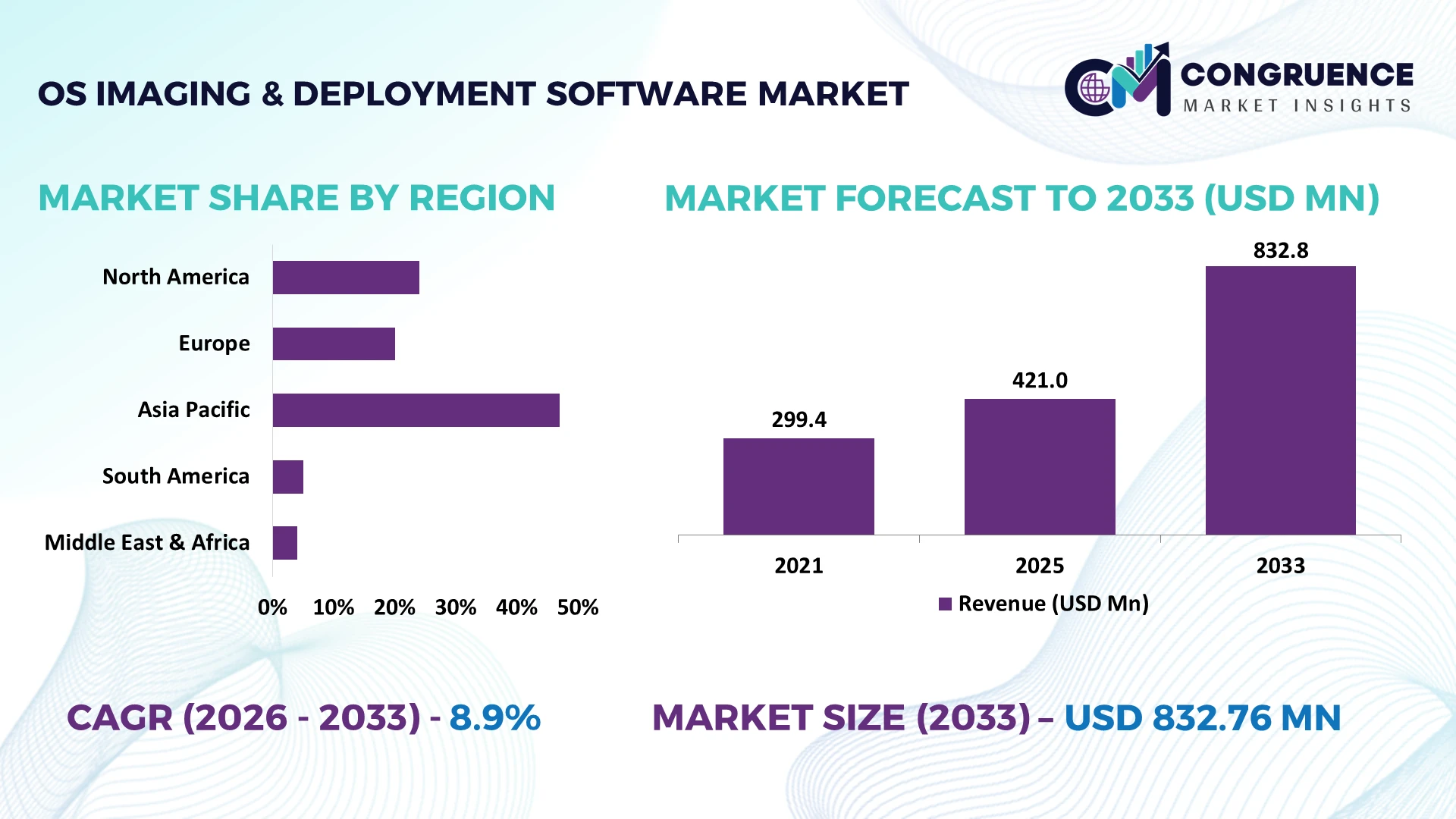
The Global OS imaging & deployment software Market was valued at USD 421.01 Million in 2025 and is anticipated to reach a value of USD 832.76 Million by 2033 expanding at a CAGR of 8.9% between 2026 and 2033. Growth is driven by Windows 11 migration, zero-touch endpoint provisioning, cloud-native device management, and replacement of labor-intensive custom OS images with automated policy-based deployment.
The United States accounts for approximately 35% of global OS imaging and deployment software activity, supported by large enterprise PC estates, federal IT modernization, healthcare, financial services, education, and technology deployments. Windows Autopilot supports 4 principal deployment modes, while TPM 2.0 underpins self-deploying environments. U.S. adoption remains ahead of India, where rapid enterprise digitization is accelerating cloud-managed endpoint provisioning. Microsoft’s October 2025 end of Windows 10 support created a global migration inflection point, pushing enterprises toward Windows 11, automated re-provisioning, and modern endpoint lifecycle management.
Strategically, vendors combining zero-touch deployment, multi-OS orchestration, endpoint security, and cloud-based policy automation are positioned to capture the highest-value enterprise modernization programs.
Market Size & Growth: USD 421.01 million in 2025 advances to USD 832.76 million by 2033 at 8.9% CAGR, reinforced by Windows 11 migration and cloud-native endpoint provisioning.
Top Growth Drivers: Windows 11 migration contributes an estimated 34% of deployment momentum, zero-touch provisioning 28%, and distributed-workforce endpoint automation approximately 21%.
Short-Term Forecast: By 2027, advanced automated deployment workflows are positioned to reduce hands-on IT provisioning effort by approximately 30% compared with traditional image-centric processes.
Emerging Technologies: AI-assisted remediation, zero-touch provisioning, and cloud-native policy orchestration increasingly replace static imaging; 3 integrated capabilities—identity, applications, and configuration—are converging within unified deployment workflows.
Regional Leaders: North America represents roughly USD 160 million, Europe USD 118 million, and Asia-Pacific USD 105 million of 2025 activity, with cloud-first provisioning, compliance automation, and fleet modernization respectively supporting adoption.
Consumer/End-User Trends: Large organizations increasingly prioritize direct-to-user device delivery; modern provisioning can reduce traditional IT touchpoints to approximately 3 basic user actions: regional setup, network connection, and authentication.
Pilot/Case Example: In 2025, Windows Autopilot-based deployment eliminated the requirement to maintain custom images across supported device models, targeting near-100% automated policy and application assignment after enrollment.
Competitive Landscape: Microsoft-linked deployment ecosystems command an estimated 30%+ influence in enterprise workflows, while Broadcom, SmartDeploy, ManageEngine, Acronis, and Ivanti strengthen competition across imaging, migration, recovery, and endpoint automation.
Regulatory & ESG Impact: Windows 10 support ended on October 14, 2025, forcing supported-device migration decisions while automated redeployment can extend usable hardware cycles and reduce unnecessary PC replacement volumes.
Investment & Funding: Enterprise endpoint modernization represents a multi-billion-dollar broader IT-management investment pool, with partnerships increasingly connecting OEM shipment, cloud identity, endpoint security, and zero-touch deployment into 1 lifecycle workflow.
Innovation & Future Outlook: By 2028, cloud-native provisioning, AI remediation, and multi-platform orchestration will shift competitive advantage from image creation toward continuous endpoint configuration, compliance, and automated recovery.
OS imaging & deployment software is becoming a strategic endpoint lifecycle layer as enterprises replace static disk images with cloud-driven provisioning, automated application delivery, and policy-based recovery. Zero-touch workflows can remove roughly 30% of hands-on provisioning effort, while Windows 10’s support transition has accelerated fleet modernization. Multi-OS orchestration and AI-assisted remediation now frame the market’s next strategic phase.
OS imaging & deployment software is becoming strategically important as endpoint provisioning shifts from technician-led disk imaging toward cloud-controlled, identity-driven lifecycle management. Microsoft ending Windows 10 support in October 2025 accelerated infrastructure modernization across large PC estates, while hybrid work makes centralized deployment economically important. Enterprises increasingly prioritize zero-touch provisioning, application automation, configuration enforcement, and remote recovery rather than maintaining hardware-specific golden images.
Modern provisioning can cut hands-on deployment effort by roughly 30–50% versus legacy imaging workflows that require image capture, storage, driver maintenance, and repeated technician intervention. The United States leads enterprise-scale adoption through mature cloud identity and endpoint-management environments, while India is advancing through IT services, digital banking, and expanding corporate device fleets. Through 2028, automated enrollment and policy-based deployment should become standard across a growing share of managed enterprise endpoints.
A practical example is shipping laptops directly from OEMs to employees, where Windows Autopilot registers devices and automatically applies corporate applications and policies after authentication. Vendors are consequently investing in unified endpoint management, AI-assisted remediation, OEM partnerships, and cross-platform automation. Competitive advantage will increasingly depend on controlling the complete endpoint lifecycle rather than simply producing OS images.
Windows 11 migration is the strongest immediate deployment catalyst as enterprises replace legacy imaging with cloud-based provisioning and automated configuration. Windows 10 support ended on October 14, 2025, while Windows 11 requires TPM 2.0 and compatible processors, forcing organizations to reassess endpoint fleets. Modern zero-touch workflows can reduce technician involvement by approximately 30–50%, while standardized application deployment can shorten device preparation by more than 40% in highly automated environments. U.S. enterprises managing thousands of endpoints are increasingly integrating Microsoft Intune, Autopilot, and complementary deployment platforms. Vendors are responding with cloud-native migration tools, automated driver management, hardware-independent imaging, and OEM integrations. The non-obvious advantage is lifecycle standardization: migration spending increasingly converts one-time OS refresh projects into recurring endpoint automation deployments.
Installed legacy infrastructure limits rapid replacement of traditional imaging environments, particularly where organizations operate mixed Windows versions, specialized applications, disconnected networks, and older hardware. Windows 11’s TPM 2.0 requirement excludes portions of aging PC fleets, while organizations with thousands of devices can encounter application compatibility rates below 100%, requiring manual remediation. Air-gapped government, manufacturing, and defense environments also restrict cloud-first deployment models. In Germany and the United States, stringent data-governance and security requirements increase configuration complexity for centralized endpoint platforms. Vendors are reducing exposure through hybrid deployment architectures, offline imaging capabilities, hardware-independent packages, and multi-platform management. Strategically, compatibility—not software licensing—often determines migration economics because a small percentage of mission-critical legacy applications can delay fleet-wide standardization.
AI-assisted remediation and adaptive provisioning create an opportunity to move OS deployment from scheduled IT activity toward continuous endpoint lifecycle automation. Automated workflows can eliminate 30–50% of repetitive provisioning tasks, while predictive remediation can reduce technician intervention across common configuration failures. India presents substantial expansion potential because its IT services, banking, telecom, and digital-native enterprises operate increasingly distributed endpoint estates. Through 2028, deployment platforms will increasingly combine OS provisioning, application packaging, compliance policies, telemetry, and automated recovery within unified workflows. Vendors are investing in AI diagnostics, API-based orchestration, OEM alliances, and multi-OS management spanning Windows, macOS, and Linux. A less obvious opportunity lies in device reuse: automated secure re-provisioning can materially shorten turnaround time for reassigned hardware, improving asset utilization alongside IT efficiency.
Scaling zero-touch deployment introduces execution risks across identity, firmware, APIs, application repositories, device enrollment, and privileged administrative controls. With automated workflows potentially configuring nearly 100% of a newly enrolled device without technician supervision, compromised credentials or configuration policies can propagate errors across thousands of endpoints rapidly. U.S. enterprises must also align deployment automation with zero-trust architectures as distributed workforces expand the number of off-network provisioning events. Cross-platform estates add another layer of complexity because Windows, macOS, and Linux require different enrollment and configuration mechanisms. Providers must strengthen role-based access, deployment validation, rollback automation, encryption, and integration testing while expanding cybersecurity partnerships. The strategic challenge is maintaining automation speed without creating centralized failure points; deployment consistency increasingly depends on security architecture as much as imaging performance.
Cloud Provisioning Replaces Static Images: Enterprises are shifting from hardware-specific golden images toward identity-driven cloud provisioning. Modern workflows can reduce technician touchpoints by 30–50% and image-maintenance effort by over 40%. U.S. organizations are integrating enrollment, applications, and security policies, while software vendors expand OEM integrations, automated configuration profiles, and cloud management capabilities.
Application Deployment Becomes Automated: Distributed endpoint estates are accelerating automated application packaging and installation. Centralized workflows can reduce repetitive packaging activity by approximately 25–40% and shorten software deployment cycles by nearly 30%. Enterprises are standardizing application catalogs and dependency management, prompting vendors to integrate package automation, deployment rings, and policy-based software distribution into endpoint platforms.
Hardware-Agnostic Imaging Expands: Multi-OEM procurement is weakening dependence on device-specific deployment images. Hardware-independent workflows can reduce maintained image inventories by more than 50% and lower driver-management effort by around 30%. Supply-chain diversification across Dell, HP, Lenovo, and other device ecosystems is encouraging enterprises to adopt dynamic driver injection, universal deployment templates, and model-independent configuration architectures.
Recovery Integrates With Deployment: Endpoint restoration is moving into the provisioning lifecycle rather than remaining a separate support function. Automated rebuild and configuration recovery can shorten restoration workflows by 30–50% and improve configuration consistency across distributed devices. Providers are integrating deployment telemetry, rollback automation, remote recovery, and policy restoration, turning recoverability into an important enterprise platform-selection criterion.
Disk Imaging leads the type segment with an estimated 30% share, supported by established use across enterprise workstation refreshes, computer laboratories, secure environments, and standardized endpoint fleets. System Cloning remains valuable where organizations need rapid duplication of identical configurations, while Bare-Metal Deployment supports endpoints and servers requiring complete installation without a pre-existing operating environment. These mature approaches remain operationally relevant where deterministic builds and offline deployment outweigh cloud flexibility.
Cloud-Based Deployment is the fastest-growing type as organizations transfer identity, configuration, applications, and security policies from static images into internet-managed provisioning. Automated cloud workflows can reduce hands-on deployment activity by approximately 30–50%, while hardware-independent architectures can cut maintained image inventories by over 50%. Network Deployment remains important for campuses and centralized offices requiring high-volume LAN provisioning. Vendors are investing in cloud orchestration, dynamic driver management, hybrid imaging, and zero-touch enrollment, redirecting product development toward flexible deployment architectures rather than image creation alone.
OS Migration leads application demand with an estimated 31% share as enterprises modernize operating systems, replace incompatible hardware, validate applications, and standardize security configurations. PC Provisioning represents another major workload because hybrid employment requires devices to reach users with minimal IT handling. Automated provisioning can reduce technician involvement by approximately 30–50%, improving deployment speed while reducing configuration differences between office-based and remote endpoints.
Disaster Recovery is the fastest-expanding application as enterprises integrate endpoint rebuilding with resilience and business-continuity processes. Automated restoration can reduce recovery handling time by approximately 30–40% compared with manual reimaging and application reinstallation. System Recovery remains critical for corrupted devices and configuration failures, while Server Deployment supports repeatable infrastructure builds in enterprise data centers. Software providers are consequently integrating migration assessment, application compatibility, automated recovery, and policy restoration. Investment is shifting toward platforms capable of supporting migration, provisioning, and recovery through one orchestration layer rather than separate administrative tools.
Enterprises account for an estimated 45% share of end-user demand because large device estates require standardized imaging, application installation, security configuration, and remote lifecycle control. Organizations managing thousands of endpoints obtain substantial productivity gains from automation, with zero-touch workflows capable of removing approximately 30–50% of technician intervention. IT Service Providers also represent significant demand because repeatable deployment frameworks improve technician utilization across multiple managed customer environments.
Data Centers are the fastest-growing end-user group as infrastructure teams automate bare-metal server deployment, operating-system standardization, and recovery across heterogeneous environments. Government Agencies emphasize controlled images, security baselines, and offline deployment, while Educational Institutions prioritize economical mass reimaging of laboratories and shared PCs. Vendors are responding through enterprise licensing, MSP multi-tenancy, government-focused security capabilities, and education volume programs. Competitive differentiation increasingly depends on serving large centralized estates while retaining specialized deployment options for disconnected, regulated, and high-security environments.
North America accounted for the largest market share at approximately 38% in 2025 however, Asia-Pacific is expected to register the fastest growth, expanding at a CAGR of approximately 10.6% between 2026 and 2033.
Cloud-Managed Endpoint Operations Dominate
North America holds approximately 38% of global demand, anchored by large enterprise endpoint estates, mature cloud identity infrastructure, managed IT services, and frequent corporate hardware-refresh programs. U.S. organizations increasingly combine OS deployment with Microsoft Intune, Windows Autopilot, security policies, and application orchestration, shifting purchasing decisions from standalone imaging toward lifecycle management. Hybrid work reinforces remote provisioning because devices increasingly ship directly from OEMs to employees instead of passing through corporate IT facilities. Microsoft’s retirement of the Deployment Toolkit in 2026 further increases pressure to modernize established task-sequence environments. Vendors are responding with hardware-independent imaging, cloud delivery, remote deployment, and automated driver management. Canadian enterprises add demand through financial services, government modernization, healthcare, and geographically distributed operations where centralized endpoint configuration materially reduces technician travel and deployment complexity.
United States Market Outlook: The United States represents approximately 85% of North American market activity, supported by extensive enterprise PC fleets, hyperscale cloud infrastructure, federal IT modernization, and mature managed-service ecosystems. Large employers increasingly connect device enrollment with identity verification, zero-trust controls, application installation, and compliance policies, creating strong demand for integrated deployment platforms rather than isolated imaging utilities.
Digital Sovereignty Reshapes Deployment Architecture
Europe represents approximately 27% of global market activity, with endpoint modernization increasingly shaped by data sovereignty, cybersecurity controls, hybrid cloud architectures, and regulated-sector requirements. In 2025, 52.7% of EU enterprises purchased cloud computing services, up 7.4 percentage points from 2023, creating a stronger foundation for cloud-assisted endpoint provisioning. However, sovereign-cloud requirements are encouraging hybrid architectures that preserve local control over deployment data and administrative credentials. Enterprises in financial services, manufacturing, government, and healthcare increasingly require encrypted configuration, controlled application distribution, and auditable deployment policies. Finland reached 79.2% enterprise paid-cloud adoption, compared with 17.8% in Bulgaria, illustrating substantial deployment-readiness differences across the bloc. Vendors are therefore expanding hybrid management, European data-residency options, private-cloud deployment, and compliance-oriented endpoint orchestration.
Germany Market Outlook: Germany combines a large industrial enterprise base with stringent security and data-governance requirements. In 2025, 54% of German enterprises used paid cloud services, rising to 86% among organizations employing at least 250 people. This enterprise concentration supports advanced deployment software integrating secure imaging, private-cloud management, automated security baselines, and hybrid endpoint administration.
Enterprise Scale Accelerates Automation Adoption
Asia-Pacific accounts for approximately 24% of global demand and combines enormous endpoint volumes with expanding cloud infrastructure, IT outsourcing, electronics manufacturing, financial digitization, and enterprise modernization. India, Japan, Australia, Singapore, and South Korea increasingly automate device provisioning as distributed workforces and multi-site operations make technician-led deployment inefficient. Japanese energy company INPEX, for example, used Windows Autopilot during its Windows 11 modernization, demonstrating how established enterprises are replacing manual deployment with centralized device management and security configuration. India contributes a distinct scale advantage through global IT service providers managing large customer endpoint estates, while Australia and Singapore emphasize cloud-managed workplace environments. Vendors are expanding multi-tenant management, remote imaging, automated application packaging, and OEM integrations, positioning deployment software as an operational layer connecting hardware procurement, identity, configuration, and endpoint security.
India Market Outlook: India is strategically positioned through its extensive IT services ecosystem, rapidly digitizing banks, telecom operators, technology companies, and multinational delivery centers. Large service providers administer device estates spanning multiple customer environments, strengthening demand for multi-tenant deployment automation. Cloud-managed provisioning increasingly complements traditional network imaging as enterprises expand hybrid workplaces and distributed technology operations across major business hubs.
Enterprise Modernization Broadens Remote Deployment
South America represents approximately 6% of global market activity, with Brazil accounting for the majority of enterprise-scale deployment demand. Banks, telecommunications companies, government agencies, outsourcing providers, and large retailers are replacing fragmented endpoint administration with centralized provisioning and configuration management. Cloud infrastructure expansion improves the feasibility of remote deployment, although uneven connectivity and smaller IT budgets preserve demand for hybrid and offline imaging. Argentina, Chile, and Colombia increasingly support cloud-first corporate environments, while Brazil's much larger enterprise base favors scalable automation across distributed branch networks. Vendors are adapting through subscription pricing, localized technical support, cloud-hosted consoles, and partnerships with managed service providers. A key operational distinction is the continued requirement for low-bandwidth deployment options, making efficient image caching and branch-level distribution strategically valuable alongside zero-touch cloud provisioning.
Brazil Market Outlook: Brazil offers the region’s strongest enterprise technology base and is accelerating digital infrastructure investment. In 2026, the country announced approximately BRL 2.3 billion for advanced AI computing projects split across Chinese and U.S.-linked technology ecosystems. Broader infrastructure modernization strengthens requirements for standardized endpoint deployment across government, financial services, telecommunications, and expanding data-center operations.
Government Digitalization Drives Endpoint Modernization
Middle East & Africa contributes approximately 5% of global market demand, with the UAE, Saudi Arabia, Israel, and South Africa forming the principal enterprise technology centers. Gulf governments are accelerating cloud migration, digital public services, cybersecurity modernization, and smart-government programs, increasing requirements for standardized endpoint provisioning across ministries and government-linked enterprises. Large infrastructure projects also create temporary and distributed workforces that benefit from automated device configuration. African markets remain more fragmented because connectivity, IT budgets, and legacy hardware constrain cloud-only deployment, sustaining demand for offline and network-based imaging. Vendors are consequently emphasizing hybrid architectures, centralized security policies, remote administration, and partnerships with local systems integrators. Gulf adoption increasingly favors integrated endpoint platforms capable of coordinating operating systems, applications, identity, and security rather than narrowly focused disk-imaging utilities.
United Arab Emirates Market Outlook: The UAE provides the strongest cloud-first deployment environment within the region, supported by the UAE Digital Government Strategy and extensive government technology modernization. Federal organizations are integrating advanced digital systems into operational workflows, creating demand for automated endpoint configuration, centralized policy enforcement, secure remote administration, and deployment architectures suited to highly digitized public-sector environments.
Microsoft, Broadcom, ManageEngine, SmartDeploy, Acronis, and Quest compete across cloud provisioning, traditional imaging, endpoint automation, and recovery-oriented deployment. The top five vendors account for an estimated 55–60% share, giving established platform providers an advantage through installed enterprise ecosystems. Microsoft pressures imaging specialists through Intune and Autopilot, while SmartDeploy and ManageEngine compete through hardware-independent imaging, remote deployment, and administrative simplicity. Automation can reduce technician involvement by 30–50%, while universal driver management can cut maintained image inventories by over 50%; these efficiency gains increasingly outweigh license-price differences. Vendors are expanding OEM integrations, cloud orchestration, application automation, and managed-service partnerships. Microsoft Deployment Toolkit's retirement accelerates migration away from unsupported legacy workflows, intensifying competition for replacement deployments. Integration complexity and enterprise switching costs remain significant entry barriers because deployment software touches identity, security, applications, firmware, and recovery. Winning requires reliable automation, hybrid flexibility, cross-platform integration, strong security controls, and measurable reductions in endpoint administration.
Microsoft Corporation
Broadcom Inc.
Zoho Corporation (ManageEngine)
SmartDeploy
Acronis International GmbH
Quest Software
Ivanti
AOMEI International Network Limited
Paragon Software Group
Red Hat, Inc.
Canonical Ltd.
SUSE
2BrightSparks Pte. Ltd.
N-able Technologies
Current deployment stacks are moving from monolithic disk images toward cloud-native, hardware-independent provisioning using Microsoft Intune, Autopilot, Endpoint Central, and comparable orchestration platforms. Zero-touch enrollment can cut technician involvement by 30–50%, while dynamic driver injection reduces image-maintenance effort by about 25%. Adoption is strongest among large enterprises managing distributed Windows estates, where cloud-managed provisioning increasingly replaces depot-based staging. The business advantage is faster onboarding, lower support labor, and more consistent security baselines.
Emerging technologies center on AI-assisted remediation, application packaging automation, and policy-driven recovery. AI-generated install logic can reduce software-deployment errors by up to 90%, while NPU-assisted endpoint processing can lower CPU load by as much as 92%. Compared with legacy task-sequence imaging, modern cloud orchestration can improve provisioning efficiency by roughly 40%. MSPs and large enterprises benefit most because one administrative plane can coordinate imaging, applications, security, and recovery across thousands of endpoints.
From 2026–2028, disruptive momentum will come from autonomous endpoint management, cloud-to-bare-metal recovery, and unified multi-OS orchestration. Deployment platforms will increasingly integrate telemetry, identity, security, and rollback automation, pushing adoption beyond Windows-only environments. Vendors that automate remediation and recovery fastest gain competitive advantage; enterprises delaying modernization face higher support overhead and shrinking compatibility with retired deployment tooling.
May 2024 Microsoft unveiled Windows Autopilot device preparation, introducing simpler policy-based provisioning with near-real-time monitoring and support for up to 10 applications during OOBE. The shift reduces imaging infrastructure and accelerates direct-to-user deployment for large distributed enterprises worldwide. Source: microsoft.com
January 2026 Microsoft retired the Deployment Toolkit, pushing enterprises toward Intune, Autopilot, and hybrid alternatives. Recast data cited by ITPro showed 48% using Intune-only management and 40% hybrid models, intensifying replacement demand for legacy imaging workflows worldwide rapidly. Source: itpro.com
August 2025 ManageEngine added digital employee experience capabilities to Endpoint Central, advancing autonomous endpoint management through one platform and agent. A Forrester study reported 442% ROI, reinforcing enterprise demand for consolidated endpoint automation, remediation, and lifecycle management globally. Source: manageengine.com
August 2025 Acronis partnered with Intel to run AI-driven endpoint threat detection on Core Ultra NPUs, reducing CPU load by up to 92%. The integration improves endpoint performance while combining security, management, and recovery workflows for MSP deployments.
The OS imaging & deployment software market report evaluates deployment architectures across Disk Imaging, System Cloning, Bare-Metal Deployment, Cloud-Based Deployment, and Network Deployment. It assesses applications spanning OS Migration, System Recovery, PC Provisioning, Server Deployment, and Disaster Recovery, while tracking adoption among Enterprises, IT Service Providers, Data Centers, Government Agencies, and Educational Institutions. Enterprise buyers account for roughly 45% of demand, reflecting high endpoint volumes and automation intensity.
Regional coverage includes North America, Europe, Asia-Pacific, South America, and Middle East & Africa, with analysis of cloud provisioning, hardware-independent imaging, zero-touch deployment, AI-assisted remediation, and recovery orchestration. The report also examines hybrid and air-gapped deployment niches, vendor positioning, integration strategies, and endpoint lifecycle convergence. These insights support investment planning, geographic expansion, product prioritization, partnership decisions, and competitive positioning through 2026–2033 as enterprises shift from static imaging toward policy-driven, automated deployment environments.
| Report Attribute/Metric | Report Details |
|---|---|
Market Revenue in 2025 | USD 421.01 Million |
Market Revenue in 2033 | USD 832.76 Million |
CAGR (2026 - 2033) | 8.9% |
Base Year | 2025 |
Forecast Period | 2026 - 2033 |
Historic Period | 2021 - 2025 |
Segments Covered | By Type
By Application
By End-User
|
Key Report Deliverable | Revenue Forecast, Growth Trends, Market Dynamics, Segmental Overview, Regional and Country-wise Analysis, Competition Landscape |
Region Covered | North America, Europe, Asia-Pacific, South America, Middle East, Africa |
Key Players Analyzed | Microsoft Corporation, Broadcom Inc., Zoho Corporation (ManageEngine), SmartDeploy, Acronis International GmbH, Quest Software, Ivanti, AOMEI International Network Limited, Paragon Software Group, Red Hat, Inc., Canonical Ltd., SUSE, 2BrightSparks Pte. Ltd., N-able Technologies |
Customization & Pricing | Available on Request (10% Customization is Free) |




