
Reports
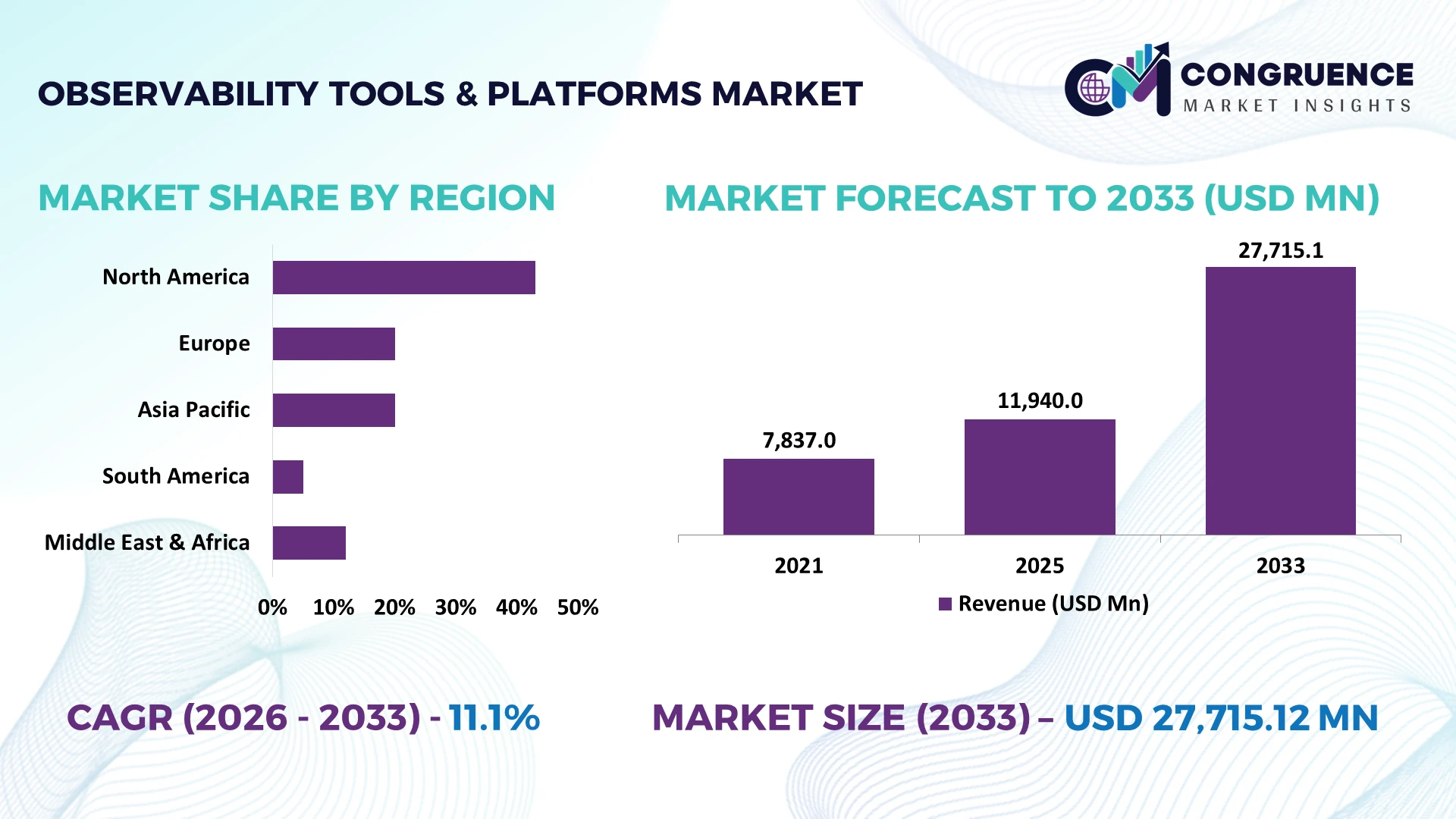
The Global Observability Tools & Platforms Market was valued at USD 11940 Million in 2025 and is anticipated to reach a value of USD 27715.12 Million by 2033 expanding at a CAGR of 11.1% between 2026 and 2033. Growth is driven by AI workload monitoring, cloud-native application complexity, OpenTelemetry standardization, Kubernetes adoption, and enterprise efforts to consolidate fragmented monitoring stacks while controlling infrastructure costs.
The United States remains the dominant country, supported by hyperscalers, SaaS providers, financial services, healthcare, and telecommunications, with AI-monitoring adoption reaching approximately 54% globally and U.S. enterprises maintaining significantly deeper deployments of cloud-native observability technologies. Telecommunications organizations report adoption levels approaching 74%, compared with the 54% global average, while severe digital-service outages can expose enterprises to losses of around USD 2 million per hour. The rapid expansion of AI infrastructure and data-center capacity further strengthens U.S. leadership.
Strategically, enterprises should prioritize unified, AI-native observability platforms that reduce tool fragmentation, accelerate incident resolution, improve cloud-cost governance, and strengthen resilience across increasingly distributed digital operations.
Market Size & Growth: USD 11.94 billion in 2025 is projected to reach USD 27.72 billion by 2033 at a 11.1% CAGR, supported by AI workloads, cloud-native applications, and increasingly distributed IT environments.
Top Growth Drivers: AI-monitoring adoption at 54%, tool consolidation at approximately 52%, and critical-process monitoring at nearly 74% are strengthening demand for advanced observability platforms.
Short-Term Forecast: By 2027, AI-assisted incident detection, automated remediation, and unified telemetry are positioned to reduce troubleshooting costs by approximately 20% while improving operational efficiency.
Emerging Technologies: AI observability, OpenTelemetry, agentic AI, continuous profiling, and observability-as-code are becoming core technologies for monitoring complex Kubernetes, multi-cloud, and AI infrastructure.
Regional Leaders: North America leads enterprise deployments, Europe emphasizes regulated and resilient digital infrastructure, while Asia-Pacific accelerates AI and cloud adoption, creating three major growth centers.
Consumer/End-User Trends: Approximately 74% of technology organizations increasingly prioritize monitoring critical business processes, shifting observability from infrastructure visibility toward customer experience, revenue protection, and business performance.
Pilot/Case Example: A 2024 cloud-cost observability implementation achieved approximately 30% lower infrastructure costs, demonstrating how unified telemetry can convert operational visibility into measurable financial improvement.
Competitive Landscape: Datadog, Splunk, Dynatrace, New Relic, and Elastic remain major competitors, while platform consolidation accelerates as approximately 52% of organizations seek fewer monitoring tools.
Regulatory & ESG Impact: Around 64% of organizations recognize stronger collaboration between security and observability teams as important for reducing performance and infrastructure risks, strengthening governance and operational resilience.
Investment & Funding: Enterprise investment is increasingly directed toward AI-native monitoring, cloud optimization, and integrated security-observability platforms, with strategic partnerships and acquisitions reshaping competitive positioning.
Innovation & Future Outlook: Agentic AI, business-context telemetry, automated root-cause analysis, unified data fabrics, and predictive incident management will shift observability toward autonomous operations and higher measurable ROI.
The Observability Tools & Platforms Market is expanding around cloud-native applications, AI infrastructure, microservices, Kubernetes, and real-time digital experiences. AI-monitoring adoption reached approximately 54% in 2025, while OpenTelemetry has achieved strong production-level penetration among modern observability teams. Enterprises are also consolidating fragmented monitoring environments as cloud expenditure, application complexity, and resilience requirements increase. Geopolitical uncertainty and regional infrastructure expansion are reinforcing the need for real-time visibility, automated incident response, and stronger digital operational continuity, creating a sustained transition toward unified, AI-driven observability platforms.
Observability is becoming a strategic control layer for enterprises as AI workloads, microservices, Kubernetes, and multi-cloud environments increase operational complexity. Organizations using unified observability increasingly connect application, infrastructure, security, and business telemetry, turning monitoring from an IT support function into a competitive capability. This shift is accelerating infrastructure modernization and investments in AI-native operational intelligence.
The market is also shaped by digital adoption and supply-chain restructuring. OpenTelemetry is gaining traction as an interoperable telemetry framework, reducing dependence on proprietary data collection. Compared with fragmented legacy monitoring, automated correlation and AI-assisted root-cause analysis can reduce incident investigation effort by around 20–30%. The United States maintains deeper enterprise deployment, while India and Singapore are expanding cloud-native adoption through rapidly scaling digital-service ecosystems.
Over the next 2–3 years, enterprises are expected to increase automated remediation, predictive monitoring, and business-process observability, with adoption of AI-assisted operations moving toward mainstream enterprise deployment. A practical example is cloud-cost observability, where companies identify idle workloads, excessive telemetry volumes, and inefficient infrastructure allocation. Vendors are responding through partnerships, platform consolidation, and regional data infrastructure expansion. Competitive advantage will increasingly depend on delivering unified visibility with measurable operational savings and faster digital-service resilience.
AI-driven application complexity is accelerating observability investment, with approximately 54% of organizations adopting AI monitoring and around 74% of technology teams prioritizing visibility into critical business processes. Kubernetes and microservices further increase telemetry requirements across distributed workloads. In the United States, hyperscalers and financial institutions are expanding AI infrastructure while integrating logs, metrics, traces, and security signals into unified platforms. Companies are responding through acquisitions, ecosystem partnerships, and investment in automated root-cause analysis. The non-obvious driver is the transition from infrastructure monitoring to business observability: platforms increasingly connect technical incidents with customer experience and operational KPIs, allowing enterprises to prioritize incidents by financial impact rather than severity scores alone.
Telemetry volume remains a structural constraint as AI workloads generate substantially more logs, traces, and high-cardinality metrics. Approximately 52% of organizations are pursuing tool consolidation, while 64% emphasize closer security and observability collaboration, highlighting fragmented technology stacks as an operational burden. Enterprises operating across the United States and Europe also face data-governance requirements that complicate centralized telemetry architectures. Excessive data ingestion increases storage and processing expenditure while slowing analytics workflows. Companies are reducing exposure through sampling, tiered retention, OpenTelemetry-based interoperability, and workload-specific data policies. The key operational insight is that collecting more telemetry does not automatically improve visibility; intelligent data selection increasingly determines observability economics.
AI agents, predictive analytics, continuous profiling, and observability-as-code create high-value opportunities beyond conventional monitoring. Approximately 54% AI-monitoring adoption and rising demand for automated remediation indicate strong enterprise readiness for intelligent operations. India offers an expanding deployment opportunity as digital payments, cloud services, and large-scale software platforms increase application complexity, while Singapore provides a concentrated environment for regulated, high-availability workloads. Companies are directing R&D toward agentic incident response, business-context telemetry, and cloud-cost optimization while forming partnerships across cloud, security, and developer ecosystems. A particularly valuable opportunity lies in linking observability data with FinOps, enabling organizations to identify infrastructure inefficiencies and convert technical telemetry directly into measurable cost controls.
Scaling observability across hybrid environments remains an execution challenge as enterprises operate increasingly diverse cloud, edge, container, and AI infrastructures. Around 52% of organizations pursuing tool consolidation illustrates the integration burden, while approximately 64% emphasizing security collaboration signals the need for consistent cross-functional telemetry governance. In the United States, multi-cloud enterprises must maintain visibility across hyperscaler-native services and third-party platforms without creating isolated monitoring silos. Companies are addressing this through OpenTelemetry adoption, standardized data schemas, automated instrumentation, and workforce training. The deeper challenge is maintaining consistent observability during rapid application releases and infrastructure changes; enterprises that fail to automate telemetry governance risk inconsistent coverage, higher operational overhead, and weaker long-term resilience.
AI Monitoring Becomes Standard: AI-monitoring adoption increased from 42% in 2024 to 54% in 2025, while 45% of executives identify AI adoption as a leading observability-demand driver. Enterprises are expanding model telemetry, automated anomaly detection, and AI-aware tracing to control opaque failures and improve operational response.
Tool Consolidation Accelerates: Enterprises are reducing fragmented observability stacks, with organizations using approximately 27% fewer tools than earlier deployments and 52% actively pursuing consolidation. This shift lowers integration overhead and pushes vendors toward unified platforms combining logs, metrics, traces, and security telemetry.
Business Visibility Gains Priority: Approximately 74% of organizations consider monitoring critical business processes important, while 65% report positive business impact from observability. Companies are connecting technical telemetry with customer experience, productivity, and operational KPIs, moving purchasing decisions beyond traditional infrastructure monitoring.
Security Teams Converge: Around 64% of organizations report fewer application and infrastructure performance issues through security collaboration, while 62% actively troubleshoot with security teams. Regulatory scrutiny and expanding attack surfaces are accelerating shared workflows, prompting enterprises to integrate observability with security operations rather than maintain isolated monitoring processes.
Infrastructure Monitoring remains the leading type, accounting for an estimated 24% share, supported by broad deployment across servers, containers, cloud resources, and hybrid environments. Its mature integration with enterprise operations makes it a foundational observability layer, while Application Performance Monitoring and Log Management each command roughly 20–22% as enterprises prioritize application reliability and searchable event data. Distributed Tracing is the fastest-growing type, gaining momentum as microservices and Kubernetes increase transaction complexity. Companies are therefore shifting investment from isolated infrastructure visibility toward correlated telemetry that connects infrastructure behavior with application dependencies.
Network Monitoring retains strategic importance at approximately 16%, particularly for telecommunications and distributed enterprises, while Log Management remains essential for compliance, troubleshooting, and historical analysis. Vendors are responding by embedding tracing, infrastructure metrics, and logs into unified platforms, reducing duplicated tooling and improving cross-domain correlation.
IT Operations leads application demand with an estimated 28% share because enterprises still depend on centralized visibility for incident detection, infrastructure health, service availability, and operational governance. Application Performance follows at approximately 24%, supported by growing microservices complexity and continuous software delivery. Cloud Monitoring represents about 21% and is gaining rapidly as enterprises expand hybrid and multi-cloud workloads. Companies are integrating automated alert correlation and service-level objectives to reduce manual troubleshooting while improving deployment consistency.
Cloud Monitoring is emerging as the fastest-growing application, driven by infrastructure modernization and distributed workloads. Security Monitoring accounts for roughly 15%, increasingly integrated with observability workflows, while Digital Experience Monitoring holds about 12% and is strengthening as customer-facing services become operationally critical. Enterprises are shifting budgets toward platforms that correlate backend performance with user journeys, particularly in digital commerce and financial services.
IT & Software represents the leading end-user group at an estimated 29% share, reflecting intensive dependence on cloud-native applications, DevOps workflows, APIs, and continuous deployment. Telecommunications follows at approximately 23%, while Banking & Finance accounts for around 21%, supported by high transaction volumes and stringent availability requirements. These mature buyers increasingly demand unified telemetry, automated incident response, and application-to-infrastructure correlation rather than standalone monitoring tools.
Telecommunications is the fastest-growing end-user segment, driven by AI deployment, network modernization, and the financial impact of service interruptions. Healthcare represents approximately 13%, with emphasis on reliability and controlled digital infrastructure, while Retail & E-Commerce holds nearly 14% and increasingly prioritizes Digital Experience Monitoring. Vendors are responding with sector-specific dashboards, managed services, cloud integrations, and strategic partnerships. The competitive shift favors providers capable of combining operational visibility with measurable business outcomes.
North America accounted for the largest market share at 42% in 2025 however, Asia-Pacific is expected to register the fastest growth, expanding at a CAGR of 13.8% between 2026 and 2033.
AI infrastructure is reshaping enterprise observability deployment
North America holds approximately 42% of global market activity, supported by dense hyperscaler infrastructure, advanced SaaS ecosystems, and large-scale deployments across financial services, healthcare, telecommunications, and technology companies. U.S. enterprises are increasingly consolidating telemetry across Kubernetes, multi-cloud, and AI environments, with AI-monitoring adoption reaching roughly 54%. Major vendors are expanding integrations with cloud platforms and security operations to improve incident correlation and reduce monitoring fragmentation. Investment is shifting toward AI-assisted root-cause analysis, automated remediation, and business-process observability rather than standalone infrastructure monitoring. The region's mature developer ecosystem and high cloud penetration create a strong deployment advantage, while data-governance requirements are increasing demand for granular telemetry controls.
United States Market Outlook:
The United States remains the principal North American deployment hub, supported by hyperscalers, software developers, banks, and digitally intensive enterprises. AI infrastructure expansion is increasing demand for high-cardinality telemetry, model monitoring, distributed tracing, and automated incident response. More than half of surveyed organizations report AI-monitoring adoption, reinforcing the country's technology leadership.
Regulated digital infrastructure drives telemetry modernization
Europe represents approximately 27% of market activity, with Germany, the United Kingdom, and France driving enterprise deployment across manufacturing, banking, telecommunications, and public-sector infrastructure. GDPR requirements and expanding cybersecurity regulation are increasing emphasis on controlled telemetry, data residency, and audit-ready monitoring. Enterprises are replacing fragmented monitoring environments with interoperable platforms, while OpenTelemetry adoption strengthens flexibility across heterogeneous cloud estates. Approximately 52% of organizations pursuing tool consolidation reflects a wider restructuring of enterprise monitoring architectures. European manufacturers are also integrating observability into Industry 4.0 environments to identify production-system disruptions and improve operational continuity. Vendors are responding through regional cloud infrastructure, compliance-focused features, and partnerships with managed-service providers.
Germany Market Outlook:
Germany provides a strong industrial deployment base because manufacturers increasingly connect production systems, cloud applications, and operational technology. Automotive and engineering enterprises require continuous visibility across distributed digital processes, while stricter cybersecurity expectations encourage centralized telemetry governance. Industrial modernization is strengthening demand for observability platforms capable of supporting complex hybrid environments.
Cloud-native scale is accelerating enterprise deployment
Asia-Pacific is emerging as the fastest-expanding deployment market, representing approximately 21% of current activity as enterprises in India, China, Japan, Singapore, and South Korea scale cloud infrastructure and digital platforms. Rapid growth in fintech, telecommunications, e-commerce, gaming, and software services is increasing telemetry volumes and application complexity. India is particularly important because large digital-service ecosystems require continuous monitoring across APIs, microservices, and distributed databases. Approximately 74% of telecommunications organizations report AI-monitoring deployment, highlighting stronger adoption intensity in communication infrastructure. Companies are increasing investment in localized cloud services, managed observability, and AI-assisted operations while partnering with hyperscalers and DevOps providers. The region's key advantage is deployment scale combined with fast modernization cycles.
India Market Outlook:
India is becoming a strategic observability hub because of its expanding software-services ecosystem, digital payments infrastructure, cloud adoption, and telecommunications modernization. Large enterprises increasingly require real-time application monitoring across high-volume digital platforms. AI-monitoring adoption among telecommunications organizations reaching approximately 74% demonstrates the sector's accelerated shift toward intelligent operational visibility.
Cloud migration is widening enterprise monitoring adoption
South America contributes approximately 6% of global market activity, with Brazil accounting for the largest deployment concentration across financial services, telecommunications, retail, and digital commerce. Cloud migration and growing dependence on online banking and consumer platforms are increasing demand for application performance monitoring, log management, and digital experience visibility. Brazil's large fintech ecosystem creates particularly strong requirements for continuous transaction monitoring and rapid incident detection. Approximately 40% of enterprises in digitally intensive industries are increasing cloud-based infrastructure usage, supporting observability adoption. Companies are responding through managed-service partnerships, localized cloud deployments, and integrated security monitoring. Infrastructure variability and skills availability remain operational constraints, making managed observability an important route to faster deployment and lower internal administration requirements.
Brazil Market Outlook:
Brazil dominates regional deployment because of its large banking, fintech, telecommunications, and e-commerce ecosystems. High transaction volumes require reliable application and infrastructure visibility, while cloud modernization is increasing demand for centralized monitoring. Financial institutions are prioritizing automated alerting and distributed tracing to improve service continuity across increasingly complex digital environments.
Digital infrastructure investment is reshaping enterprise monitoring
The Middle East & Africa market represents approximately 4% of global activity, with Saudi Arabia, the United Arab Emirates, and South Africa driving deployment through data-center expansion, cloud modernization, telecommunications upgrades, and smart-city initiatives. Gulf economies are investing heavily in digital infrastructure, creating demand for observability across government platforms, financial services, energy systems, and telecommunications. Saudi Arabia and the UAE are particularly focused on AI-enabled services requiring continuous infrastructure and application visibility. Cloud adoption is increasing rapidly, while approximately 60% of large enterprises in leading Gulf markets are progressing toward hybrid or multi-cloud architectures. Vendors are responding through local data infrastructure, hyperscaler partnerships, managed services, and sector-specific platforms. Sovereignty requirements are simultaneously strengthening demand for locally controlled telemetry.
Saudi Arabia Market Outlook:
Saudi Arabia is emerging as a leading regional deployment hub through large-scale digital transformation, cloud infrastructure development, telecommunications modernization, and AI investment. National digital programs are increasing enterprise demand for real-time monitoring across public and private platforms. Expanding data-center capacity and localized cloud infrastructure are strengthening the country's long-term observability deployment potential.
The Observability Tools & Platforms market is led by technology specialists such as Datadog, Dynatrace, New Relic, Elastic, and Splunk, competing with broader cloud and software ecosystems. The top five players collectively hold an estimated 35% share, reflecting a moderately concentrated structure. Competition centers on AI-driven analytics, platform integration, telemetry economics, deployment speed, and developer usability. Approximately 52% of enterprises pursuing tool consolidation increases pressure for unified platforms, while AI-monitoring adoption near 54% shifts differentiation toward intelligent automation. Vendors are competing through cloud partnerships, acquisitions, OpenTelemetry integration, and expanded security capabilities. The competitive shift is moving from standalone monitoring products toward converged observability, security, and business-performance platforms. High switching costs, telemetry migration complexity, ecosystem depth, and enterprise-grade reliability create substantial entry barriers. Regional providers compete through customization and managed services, while global vendors leverage scale. Winning requires superior correlation, automation, interoperability, and measurable operational efficiency.
Datadog
Dynatrace
New Relic
Elastic
Splunk
Grafana Labs
IBM
Cisco
ScienceLogic
SolarWinds
LogicMonitor
Sumo Logic
AppDynamics
Broadcom
Modern observability now centers on OpenTelemetry, AI-assisted anomaly detection, eBPF, continuous profiling, and unified logs-metrics-traces correlation. OpenTelemetry has more than 12,000 contributors across 2,800 companies, while nearly 20% of cloud-native respondents use profiling. AI-assisted correlation can improve troubleshooting efficiency by about 2%, strengthening platform consolidation and operational visibility. This architecture reduces duplicate instrumentation, supports multi-cloud portability, and helps engineering teams correlate service dependencies without maintaining separate monitoring silos.
Emerging agentic observability connects telemetry with autonomous remediation, AI-model monitoring, and developer workflows. New Relic’s 2025 data covered 85,000 businesses, while Datadog introduced three agentic-AI monitoring capabilities. Compared with legacy siloed monitoring, correlated telemetry can improve incident-analysis productivity by 20–30%, reducing manual triage and favoring vendors with integrated automation. This convergence shifts spending toward platforms combining telemetry analytics, security context, and automated workflow actions.
From 2026–2028, observability will shift toward predictive, autonomous operations spanning applications, infrastructure, security, and AI factories. OpenTelemetry graduation strengthens interoperability, while AI coding observability extends visibility upstream into development. Companies adopting unified telemetry can target 1–2% lower operational overhead and faster performance diagnosis, giving cloud-native leaders a competitive edge as AI workloads scale. Competitive differentiation will increasingly depend on telemetry quality, model-aware diagnostics, low-latency detection, and automated remediation.
June 2025 Datadog launched three agentic-AI observability capabilities, including AI Agent Monitoring, LLM Experiments, and AI Agents Console, strengthening governance and testing for autonomous systems and helping enterprises measure AI performance before production scaling across distributed workloads globally. Source: Datadog
February 2025 New Relic launched DeepSeek observability across its AI monitoring platform, supporting DeepSeek on Microsoft Azure AI Foundry and giving enterprises model-level visibility into performance, quality, security, and cost for generative-AI deployments at enterprise scale rapidly. Source: New Relic
May 2025 Dynatrace integrated AI and LLM observability into NVIDIA’s Enterprise AI Factory design for Blackwell infrastructure, enabling monitoring and automated anomaly detection across on-premises AI deployments. The integration strengthens deployment transparency and operational control for AI workloads. Source: Dynatrace
May 2026 CNCF announced OpenTelemetry graduation after the project surpassed 12,000 contributors from more than 2,800 companies, establishing a mature vendor-neutral telemetry standard and reducing instrumentation lock-in across enterprise cloud environments. The milestone strengthens interoperability and observability adoption. Source: CNCF
The Observability Tools & Platforms Market Report covers Infrastructure Monitoring, Application Performance Monitoring, Log Management, Distributed Tracing, and Network Monitoring across IT Operations, Application Performance, Cloud Monitoring, Security Monitoring, and Digital Experience Monitoring. End-user analysis spans Banking & Finance, Healthcare, Retail & E-Commerce, Telecommunications, and IT & Software, with regional assessment across North America, Europe, Asia-Pacific, South America, and Middle East & Africa.
The report evaluates AI observability, OpenTelemetry, agentic automation, continuous profiling, cloud-native telemetry, and security integration, alongside adoption patterns, deployment concentration, tool consolidation, and enterprise modernization. Coverage highlights leading vendors, emerging technology priorities, regional investment signals, and niche opportunities in AI infrastructure and hybrid-cloud environments. These insights support investment planning, market-entry decisions, expansion priorities, partnership strategy, competitive positioning, and technology selection through 2026–2033.
| Report Attribute/Metric | Report Details |
|---|---|
Market Revenue in 2025 | USD 11940 Million |
Market Revenue in 2033 | USD 27715.12 Million |
CAGR (2026 - 2033) | 11.1% |
Base Year | 2025 |
Forecast Period | 2026 - 2033 |
Historic Period | 2021 - 2025 |
Segments Covered | By Type
By Application
By End-User
|
Key Report Deliverable | Revenue Forecast, Growth Trends, Market Dynamics, Segmental Overview, Regional and Country-wise Analysis, Competition Landscape |
Region Covered | North America, Europe, Asia-Pacific, South America, Middle East, Africa |
Key Players Analyzed | Datadog, Dynatrace, New Relic, Elastic, Splunk, Grafana Labs, IBM, Cisco, ScienceLogic, SolarWinds, LogicMonitor, Sumo Logic, AppDynamics, Broadcom |
Customization & Pricing | Available on Request (10% Customization is Free) |




