
Reports
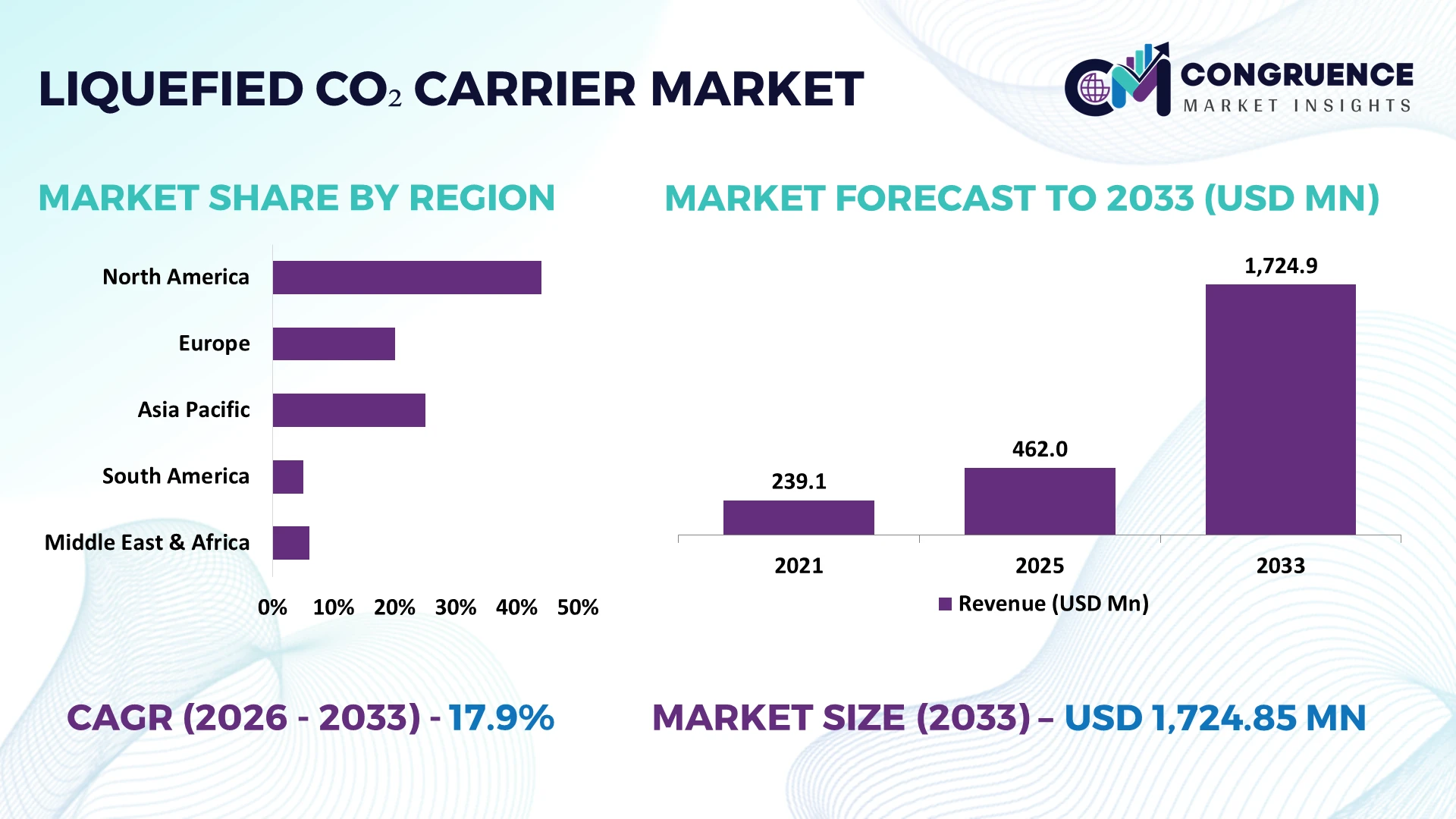
The Global Liquefied CO₂ Carrier Market was valued at USD 462 Million in 2025 and is anticipated to reach a value of USD 1724.85 Million by 2033 expanding at a CAGR of 17.9% between 2026 and 2033. Growth is driven by offshore carbon capture and storage expansion, European cross border CO₂ transportation agreements, and increasing deployment of specialized liquefied CO₂ carriers connecting industrial emission sources with permanent geological storage facilities.
Norway leads commercial liquefied CO₂ shipping infrastructure through the Northern Lights project, supported by Equinor, Shell, and TotalEnergies. Its initial storage capacity of 1.5 million tonnes annually is expanding to at least 5 million tonnes, representing growth exceeding 233%. The project employs dedicated vessels with approximately 7,500 cubic meters of cargo capacity. Compared with the Netherlands, Norway has established an operational advantage through offshore storage infrastructure, maritime transportation integration, and industrial carbon capture agreements covering European cement, fertilizer, and energy operations.
Strategically, investment in 7,500 cubic meter carriers and storage infrastructure exceeding 5 million tonnes annually strengthens fleet utilization, transportation contract security, and access to Europe's expanding industrial carbon management network.
Market Size & Growth: USD 462 million in 2025, reaching USD 1,724.85 million by 2033 at 17.9% CAGR, driven by offshore CCS commercialization.
Top Growth Drivers: Modeled demand weighting assigns 40% to offshore carbon storage, 35% to industrial decarbonization, and 25% to cross border shipping requirements.
Short Term Forecast: By 2028, Northern Lights targets at least 233% higher annual transport and storage capacity, expanding from 1.5 million to 5 million tonnes.
Emerging Technologies: AI voyage optimization, automated pressure control, and wind assisted propulsion advance efficiency; Northern Lights vessels demonstrate approximately 34% lower carbon intensity than conventional ships.
Regional Leaders: Illustrative 2033 market allocations place Europe at USD 793.43 million, Asia Pacific at USD 517.46 million, and North America at USD 310.47 million, supported by CCS infrastructure development.
Consumer / End User Trends: Stockholm Exergi's contracted 900,000 tonnes annually represents 18% of Northern Lights' minimum planned 5 million tonne capacity.
Pilot / Case Example: In August 2025, Northern Lights commenced permanent CO₂ injection, establishing operational infrastructure designed for 1.5 million tonnes annually.
Competitive Landscape: Northern Lights' 3 delivered vessels represent 22,500 cubic meters of aggregate cargo capacity; participants include K Line, MOL, NYK, and Hanwha Ocean.
Regulatory & ESG Impact: The EU Net Zero Industry Act establishes a 50 million tonne annual CO₂ injection capacity target for 2030, accelerating storage infrastructure planning.
Investment & Funding: Northern Lights Phase 2 secured NOK 7.5 billion in planned investment, including EUR 131 million in European funding, supporting terminal expansion.
Innovation & Future Outlook: Four 7,500 cubic meter sister ships represent 30,000 cubic meters of planned fleet capacity, strengthening scalable maritime carbon logistics.
The global liquefied CO₂ carrier industry is transitioning toward integrated maritime carbon management networks serving cement, fertilizer, waste processing, and energy intensive manufacturing. Specialized containment tanks operating around minus 35°C and pressures up to 19 barg support reliable transportation of captured emissions. Northern Lights' expansion to at least 5 million tonnes annually by 2028 represents a minimum 233% capacity increase, reinforcing the commercial importance of dedicated shipping infrastructure. Cross border agreements involving Norway, Sweden, Denmark, and the Netherlands demonstrate growing demand for coordinated capture, transportation, and geological storage services, establishing clear priorities for fleet investment and long term infrastructure partnerships.
Liquefied CO₂ carriers are becoming strategically important as industrial decarbonization shifts from isolated carbon capture facilities toward integrated maritime transportation and offshore geological storage networks. Norway's Northern Lights project demonstrates this structural transformation, expanding annual storage capacity from 1.5 million to at least 5 million tonnes, an increase exceeding 233%. The European Union's target of 50 million tonnes of annual CO₂ injection capacity by 2030 reinforces investment in specialized vessels, receiving terminals, and cross border transportation infrastructure.
Technological modernization is improving shipping economics through automated cargo pressure management, advanced insulation, and digital voyage optimization. Compared with conventional high pressure CO₂ transportation concepts, medium pressure systems operating around 15 barg enable larger cargo volumes, although efficiency advantages depend on vessel design. Norway leads commercial deployment, while Japan advances specialized carrier engineering and South Korea strengthens shipbuilding capabilities. During 2026 to 2028, fleet expansion and terminal integration will become decisive operational priorities.
Northern Lights illustrates practical deployment through dedicated 7,500 cubic meter carriers connecting European industrial emitters with Norwegian offshore storage. Shipping companies are strengthening partnerships with carbon capture developers, terminal operators, and shipyards to secure long duration transportation contracts. Competitive advantage increasingly depends on integrated logistics capabilities, reliable cargo handling, and access to certified permanent storage infrastructure.
Industrial carbon capture commercialization is accelerating specialized liquefied CO₂ shipping requirements as cement, fertilizer, and waste processing facilities connect with offshore geological storage infrastructure. Norway's Northern Lights project is expanding annual injection capacity by more than 233%, from 1.5 million to at least 5 million tonnes. The European Union's legally binding climate framework targets at least 55% net greenhouse gas emissions reduction by 2030, strengthening industrial decarbonization commitments. Dedicated vessels provide flexible transportation where pipeline infrastructure remains economically impractical. Shipping operators and industrial emitters are responding through long duration charter agreements, fleet procurement, and coordinated terminal investments. Securing storage access alongside vessel capacity creates a competitive advantage over standalone transportation providers.
High vessel construction costs, specialized containment requirements, and insufficient liquefied CO₂ handling terminals constrain commercial deployment. Cargo systems operating near minus 35°C and approximately 15 barg require dedicated pressure vessels, refrigeration equipment, and compatible loading infrastructure. A 20% increase in shipbuilding expenditure or 15% reduction in annual vessel utilization, used as sensitivity scenarios, materially weakens project economics. Norway possesses operational receiving infrastructure, while many industrial ports in Germany and Poland still require dedicated CO₂ export facilities. Operators are reducing exposure through long duration transportation contracts, standardized cargo containment designs, and coordinated port development. The central profitability constraint is insufficient contracted cargo throughput rather than vessel capacity alone, making terminal readiness essential to investment decisions.
Next generation liquefied CO₂ carriers create opportunities through larger cargo containment systems, automated terminal integration, and digital fleet optimization. Japan's shipbuilding industry is advancing low temperature cargo handling technologies, while South Korean manufacturers are developing scalable vessel designs for international carbon transportation networks. A modeled 12% reduction in port turnaround time and 8% improvement in fleet utilization would increase annual transportation productivity without proportional fleet expansion. AI supported voyage scheduling offers an additional potential 5% reduction in fuel consumption under optimized operating conditions. Shipping companies are investing in digital cargo monitoring, modular tank configurations, and partnerships with storage developers. Integrated transportation and storage contracts offer stronger commercial differentiation than conventional vessel chartering alone.
Scaling liquefied CO₂ shipping networks requires consistent cargo specifications, terminal interoperability, qualified crews, and coordinated offshore injection schedules. Differences in CO₂ purity, moisture concentration, and pressure conditions create operational complexity across industrial capture facilities. A modeled 10% cargo scheduling disruption or 15% reduction in terminal availability can materially affect fleet productivity and storage delivery commitments. Norway's Northern Lights network illustrates the importance of coordinating industrial collection, maritime transportation, and offshore injection within one operating system. Shipping companies must invest in standardized cargo quality protocols, predictive maintenance, specialist workforce training, and integrated digital scheduling. Long term competitiveness depends on maintaining reliable transportation performance as vessel fleets, customer networks, and storage destinations expand simultaneously.
Commercial Fleet Commissioning Gains Momentum: Norway's Northern Lights transportation network entered commercial operation in 2025, deploying specialized vessels with approximately 7,500 cubic meters of cargo capacity each. The first three vessels represent 22,500 cubic meters of combined capacity, establishing a repeatable maritime transportation model. Shipping operators are shifting from demonstration voyages toward scheduled industrial CO₂ shipments, strengthening vessel availability planning, cargo scheduling, and contractual delivery reliability.
Standardized Cargo Containment Designs Advance: Japanese and South Korean shipbuilders are increasingly prioritizing standardized liquefied CO₂ containment systems operating around minus 35°C and 15 barg. Current 7,500 cubic meter vessels provide a commercial reference point, while proposed 20,000 cubic meter designs offer approximately 167% greater cargo capacity. Manufacturers are adapting tank configurations, material specifications, and fabrication processes to simplify vessel procurement and improve shipyard production consistency.
Multimodal Carbon Logistics Networks Expand: European industrial exporters are coordinating liquefaction facilities, intermediate storage, and maritime collection schedules. Northern Lights' receiving terminal connects approximately 100 kilometers of offshore pipeline infrastructure with permanent geological storage. Its initial 1.5 million tonne annual handling capacity provides a reference for synchronized vessel arrivals and injection scheduling. Terminal operators are restructuring cargo acceptance procedures to reduce berth congestion and improve storage continuity.
Cargo Quality Monitoring Becomes Critical: Industrial CO₂ shipments require controlled moisture, pressure, and impurity concentrations to protect containment systems and downstream injection infrastructure. Commercial carrier designs commonly reference temperatures near minus 35°C and pressures around 15 barg. Operators are introducing continuous cargo monitoring, automated documentation, and standardized acceptance procedures. The operational advantage lies in reducing rejected shipments and avoiding costly cargo reconditioning between industrial collection terminals and offshore storage facilities.
Medium Scale CO₂ Carriers represent the leading segment, with an indicative 45% share of the global liquefied CO₂ carrier market in 2025, supported by commercial deployment of vessels around 7,500 cubic meters. Their dominance reflects compatibility with emerging carbon capture terminals, manageable port infrastructure requirements, and flexibility across industrial shipping routes. Norway's Northern Lights fleet demonstrates the operational suitability of this category for transporting captured emissions to offshore storage facilities. Small Scale CO₂ Carriers account for an estimated 30% share, serving shorter transportation routes, smaller industrial emission clusters, and facilities with limited storage infrastructure.
Large Scale CO₂ Carriers represent approximately 25% of the market and are positioned as the fastest expanding segment as industrial carbon transportation networks increase shipment volumes. Proposed vessels with 20,000 cubic meters of cargo capacity provide approximately 167% more carrying volume than 7,500 cubic meter designs. Shipbuilders in South Korea and Japan are prioritizing larger containment systems, improved cargo handling arrangements, and standardized vessel platforms. Investment priorities are consequently shifting toward scalable designs capable of supporting multiple industrial customers and longer maritime routes.
Carbon Capture and Storage represents the leading application, accounting for an indicative 42% of global liquefied CO₂ carrier demand in 2025. Its position reflects increasing requirements to transport captured industrial emissions from coastal facilities to permanent geological storage locations. Norway's Northern Lights infrastructure demonstrates this commercial model through an initial 1.5 million tonne annual storage capacity. Offshore CO₂ Storage represents approximately 28% of demand and is the fastest expanding application as dedicated offshore injection infrastructure becomes operational. Its growth is supported by the integration of specialized shipping fleets with subsea storage networks.
Industrial CO₂ Transport accounts for an estimated 20% share, serving industrial clusters requiring scheduled cargo movements between capture facilities, intermediate terminals, and receiving ports. Carbon Capture and Utilization represents the remaining 10%, supporting applications where captured carbon dioxide becomes an industrial feedstock. Companies are responding by developing dedicated transportation agreements, improving terminal interoperability, and integrating cargo tracking with storage operations. Commercial priorities increasingly favor applications with predictable shipment volumes, contracted storage access, and established receiving infrastructure.
Carbon Capture Operators represent the dominant end user segment, accounting for an indicative 38% of global liquefied CO₂ carrier demand in 2025. Their leadership reflects direct responsibility for coordinating captured emissions, liquefaction facilities, transportation contracts, and permanent storage arrangements. Oil and Gas Companies hold an estimated 27% share, supported by established offshore infrastructure and geological storage expertise. Norway's Northern Lights project demonstrates how integrated transportation and storage partnerships strengthen commercial deployment. Industrial Gas Suppliers account for approximately 15%, concentrating on cargo conditioning, purification, and industrial distribution requirements.
Shipping Companies represent an estimated 12% share and the fastest expanding end user category as specialized vessel ownership and transportation service contracts become increasingly important. Chemical Manufacturers contribute approximately 8%, particularly where concentrated CO₂ streams support commercial capture projects. Shipping operators are strengthening partnerships with storage developers and industrial emitters while introducing dedicated fleet management capabilities. Competitive positioning increasingly depends on securing transportation commitments before vessel construction, reducing utilization uncertainty and improving financing conditions for specialized maritime assets.
Europe accounted for the largest market share at an estimated 46% in 2025 however, Asia Pacific is expected to register the fastest growth, expanding at a CAGR of an estimated 20.8% between 2026 and 2033.
Industrial Carbon Transport Infrastructure Reshapes Maritime Logistics
North America represents an estimated 18% of the global liquefied CO₂ carrier market in 2025, supported by carbon capture development across the United States Gulf Coast and Canadian industrial corridors. Texas and Louisiana provide strategic advantages through concentrated petrochemical manufacturing, refining facilities, existing CO₂ handling expertise, and access to offshore geological storage formations. The United States has established a federal Section 45Q tax credit of up to USD 85 per tonne for qualifying permanently stored industrial CO₂, strengthening project economics. However, established pipeline transportation networks continue to compete with dedicated shipping solutions. Maritime deployment opportunities concentrate around coastal industrial facilities lacking direct pipeline connections. Developers are evaluating port liquefaction infrastructure, intermediate storage terminals, and specialized vessel chartering arrangements to improve transportation flexibility. Commercial competitiveness depends on matching vessel capacity with contracted capture volumes and accessible storage sites.
United States Market Outlook: The United States benefits from extensive industrial carbon capture expertise, offshore geological assessment capabilities, and established maritime engineering infrastructure. The Gulf Coast combines major refining and chemical manufacturing clusters with access to potential offshore storage locations. Federal incentives support investment decisions, while specialized shipbuilders and engineering contractors can adapt existing pressure vessel technologies for liquefied CO₂ transportation. Commercial deployment depends on coordinated terminal permitting and long duration industrial transportation agreements.
Commercial Offshore Storage Networks Establish Regional Leadership
Europe holds an estimated 46% of the global liquefied CO₂ carrier market in 2025, reflecting advanced offshore storage infrastructure and commercial maritime transportation deployment. Norway, the Netherlands, Denmark, and the United Kingdom are developing interconnected carbon management networks serving cement, chemicals, fertilizers, and waste processing industries. Northern Lights commenced commercial operations in 2025 with an initial annual storage capacity of 1.5 million tonnes, establishing a practical operating model for specialized CO₂ shipping. Its approved expansion targets at least 5 million tonnes annually, increasing planned capacity by more than 233%. The European Union's Net Zero Industry Act targets 50 million tonnes of annual CO₂ injection capacity by 2030. Industrial emitters are consequently prioritizing shipping agreements, terminal connectivity, and permanent storage certification. European shipowners gain competitive advantages through early operational experience, established industrial partnerships, and integrated carbon transportation contracts.
Norway Market Outlook: Norway leads commercial deployment through Northern Lights, supported by Equinor, Shell, and TotalEnergies. Dedicated liquefied CO₂ carriers with approximately 7,500 cubic meters of cargo capacity connect industrial capture facilities with the Øygarden receiving terminal. The country's offshore petroleum engineering expertise, geological storage capabilities, and established maritime services support specialized vessel operations. Norway's regulatory framework for subsea storage strengthens its position as a transportation and permanent storage destination for European industrial emissions.
Advanced Shipbuilding Capacity Accelerates Specialized Vessel Development
Asia Pacific accounts for an estimated 30% of global liquefied CO₂ carrier market activity in 2025, supported by specialized shipbuilding capabilities in South Korea, Japan, and China. South Korean shipyards are developing larger liquefied CO₂ containment systems, while Japanese shipping companies are advancing demonstration projects and cargo handling technologies. Japan's liquefied CO₂ transportation demonstration activities have included a 1,450 cubic meter class vessel, establishing operational experience with low temperature cargo containment. Industrial carbon capture development across Japan, South Korea, and Australia supports future maritime transportation requirements. Manufacturers are evaluating vessel designs approaching 20,000 cubic meters, offering approximately 167% more capacity than established 7,500 cubic meter platforms. Regional competitiveness increasingly depends on standardized tank engineering, fabrication efficiency, and collaboration between shipbuilders, industrial emitters, and offshore storage developers.
Japan Market Outlook: Japan demonstrates technological leadership through specialized CO₂ carrier research, maritime demonstration programs, and advanced cargo containment engineering. Kawasaki Kisen Kaisha and Mitsubishi Shipbuilding participate in the development of liquefied CO₂ transportation capabilities. Japan's industrial decarbonization strategy also encourages international carbon storage partnerships, particularly where domestic geological storage availability is constrained. Demonstration vessels provide operational knowledge supporting future commercial fleet procurement and specialized equipment exports.
Coastal Industrial Clusters Create Emerging Shipping Demand
South America represents an estimated 3% of the global liquefied CO₂ carrier market in 2025, reflecting limited dedicated vessel deployment and an early commercial development stage. Brazil provides the strongest potential demand base through offshore petroleum operations, industrial processing facilities, and extensive Atlantic coastal infrastructure. Petrobras has accumulated carbon management experience through CO₂ reinjection operations associated with offshore oil production. The company reported cumulative CO₂ reinjection exceeding 50 million tonnes in its pre salt operations by 2023, demonstrating substantial technical expertise in offshore carbon handling. However, reinjection through existing offshore infrastructure does not directly establish demand for liquefied CO₂ carriers. Commercial shipping opportunities depend on connecting industrial capture facilities with suitable offshore storage locations. Developers are assessing port infrastructure compatibility, project aggregation, and long duration transportation agreements to support future specialized vessel deployment.
Brazil Market Outlook: Brazil holds a strategic advantage through Petrobras' offshore engineering capabilities, established petroleum logistics networks, and industrial concentration around Rio de Janeiro and São Paulo. Its Atlantic coastline provides potential maritime connections between industrial emitters and offshore geological formations. Existing CO₂ reinjection expertise supports technical development, while future commercial shipping investment depends on dedicated storage regulation, capture project commitments, and viable coastal transportation economics.
Carbon Management Investments Strengthen Maritime Infrastructure Potential
The Middle East and Africa account for an estimated 3% of global liquefied CO₂ carrier market activity in 2025, supported by emerging carbon capture investments across Saudi Arabia, the United Arab Emirates, and selected African industrial economies. Saudi Arabia's Jubail carbon capture and storage initiative targets approximately 9 million tonnes of annual CO₂ capture and storage capacity in its initial development phase. The region benefits from concentrated petrochemical facilities, established export terminals, and extensive maritime logistics infrastructure. However, many carbon management projects initially prioritize pipeline connections and nearby geological storage rather than specialized shipping. Future vessel deployment depends on cross border transportation economics and the availability of dedicated liquefaction terminals. Energy companies are evaluating integrated capture networks, storage partnerships, and port modernization to establish commercially viable maritime carbon transportation services.
Saudi Arabia Market Outlook: Saudi Arabia combines extensive petrochemical production, large industrial emission clusters, and established maritime export infrastructure. Saudi Aramco and its industrial partners are advancing carbon management initiatives linked to the Eastern Province. The Jubail industrial complex provides opportunities to aggregate captured emissions from multiple facilities, potentially improving transportation economics. Commercial liquefied CO₂ shipping will depend on terminal investment, storage accessibility, and integration with the country's industrial decarbonization strategy.
The liquefied CO₂ carrier market features competition between established maritime operators, specialized shipbuilders, and integrated carbon transportation providers. Kawasaki Kisen Kaisha, Mitsui O.S.K. Lines, and NYK Line compete through shipping expertise, while Hanwha Ocean and HD Hyundai Heavy Industries emphasize vessel engineering and containment technologies. The leading five participants represent an indicative 55% of competitive activity, reflecting concentrated technical capabilities rather than verified market ownership. Larger vessel concepts offer approximately 167% greater cargo capacity than existing 7,500 cubic meter platforms, strengthening scale advantages. Automated cargo handling targets 10% shorter terminal operations, while digital voyage optimization offers modeled fuel savings of 5%. Companies are expanding through shipbuilding partnerships, specialized fleet investments, and integrated storage agreements. Competition increasingly favors operators controlling vessel specifications, cargo compatibility, and terminal access. Specialized containment certification, substantial capital requirements, and limited operational experience constrain new entrants. Winning requires reliable deployment, competitive transportation economics, and secured industrial shipping contracts.
Kawasaki Kisen Kaisha, Ltd.
Mitsui O.S.K. Lines, Ltd.
Nippon Yusen Kabushiki Kaisha (NYK Line)
Hanwha Ocean Co., Ltd.
HD Hyundai Heavy Industries Co., Ltd.
Mitsubishi Shipbuilding Co., Ltd.
Samsung Heavy Industries Co., Ltd.
Dalian Shipbuilding Industry Co., Ltd.
Northern Lights JV DA
Capital Clean Energy Carriers Corp.
Knutsen OAS Shipping AS
Bernhard Schulte Shipmanagement
EXMAR NV
Jiangnan Shipyard (Group) Co., Ltd.
Current liquefied CO₂ carriers employ pressurized cargo containment, refrigeration systems, and automated pressure monitoring to maintain stable transportation conditions. Northern Lights vessels operate with approximately 7,500 cubic meters of cargo capacity, establishing a commercial deployment benchmark. Advanced insulation and automated refrigeration controls target modeled energy savings of 8% compared with conventional manually optimized systems. Digital cargo monitoring improves temperature stability, reduces handling interruptions, and strengthens compliance with industrial carbon transportation specifications. Operators integrating vessel and terminal monitoring gain better scheduling visibility and lower operational exposure.
Emerging technologies include larger cylindrical containment tanks, AI assisted voyage optimization, and integrated cargo quality sensors. Proposed 20,000 cubic meter vessels offer approximately 167% greater carrying capacity than existing 7,500 cubic meter platforms. Predictive maintenance systems target 10% fewer equipment interruptions, while automated loading controls support 12% shorter terminal turnaround periods under optimized conditions. South Korean and Japanese shipbuilders benefit from scalable tank manufacturing, standardized vessel designs, and specialized engineering capabilities.
Between 2026 and 2028, disruptive developments will emphasize integrated maritime carbon logistics, digital twins, and intelligent terminal coordination. Advanced fleet scheduling targets 5% lower fuel consumption through improved routing and vessel utilization. Companies securing interoperable cargo systems and storage partnerships gain competitive advantages through dependable transportation capacity.
November 2024: Kawasaki Kisen Kaisha confirmed Northern Pioneer's delivery readiness at Dalian Shipbuilding Industry. The vessel joined Northern Lights' four ship program, establishing dedicated maritime transportation capacity for Norway's commercial carbon capture and storage network. Source: kline.co.jp.
June 2025: Mitsubishi Shipbuilding and Mitsui O.S.K. Lines secured ClassNK Approval in Principle for the world's first combined liquefied CO₂ and methanol carrier concept. The dual cargo design supports integrated carbon utilization and synthetic fuel transportation logistics. Source: mhi.com.
August 2025: Northern Lights completed its first commercial CO₂ injection, transporting captured emissions into geological storage 2,600 meters beneath the seabed. The milestone validated integrated shipping, terminal handling, and offshore storage operations for industrial carbon management. Source: norlights.com.
January 2026: HD Korea Shipbuilding secured an order for two 12,000 cubic meter liquefied CO₂ carriers for Mitsui O.S.K. Lines, with delivery scheduled for 2029. The agreement strengthens South Korean shipbuilding capabilities and specialized fleet expansion. Source: yna.co.kr.
The Liquefied CO₂ Carrier Market Report examines specialized maritime transportation infrastructure, vessel technologies, competitive developments, and industrial carbon management requirements between 2026 and 2033. Segmentation covers Small Scale, Medium Scale, and Large Scale CO₂ Carriers; Carbon Capture and Storage, Carbon Capture and Utilization, Industrial CO₂ Transport, and Offshore CO₂ Storage applications; and five end user categories. Indicative segment analysis identifies Medium Scale Carriers with 45% market participation and Carbon Capture Operators with 38% demand concentration.
Regional coverage includes North America, Europe, Asia Pacific, South America, and the Middle East and Africa, highlighting Norway's commercial deployment and Asian shipbuilding capabilities. Technology assessment addresses cargo containment, refrigeration automation, digital monitoring, and vessel scalability. The report supports fleet procurement, infrastructure investment, strategic partnerships, competitive benchmarking, and emerging carbon transportation opportunities.
| Report Attribute/Metric | Report Details |
|---|---|
Market Revenue in 2025 | USD 462 Million |
Market Revenue in 2033 | USD 1724.85 Million |
CAGR (2026 - 2033) | 17.9% |
Base Year | 2025 |
Forecast Period | 2026 - 2033 |
Historic Period | 2021 - 2025 |
Segments Covered | By Type
By Application
By End-User
|
Key Report Deliverable | Revenue Forecast, Growth Trends, Market Dynamics, Segmental Overview, Regional and Country-wise Analysis, Competition Landscape |
Region Covered | North America, Europe, Asia-Pacific, South America, Middle East, Africa |
Key Players Analyzed | Kawasaki Kisen Kaisha, Ltd., Mitsui O.S.K. Lines, Ltd., Nippon Yusen Kabushiki Kaisha (NYK Line), Hanwha Ocean Co., Ltd., HD Hyundai Heavy Industries Co., Ltd., Mitsubishi Shipbuilding Co., Ltd., Samsung Heavy Industries Co., Ltd., Dalian Shipbuilding Industry Co., Ltd., Northern Lights JV DA, Capital Clean Energy Carriers Corp., Knutsen OAS Shipping AS, Bernhard Schulte Shipmanagement, EXMAR NV, Jiangnan Shipyard (Group) Co., Ltd. |
Customization & Pricing | Available on Request (10% Customization is Free) |




