
Reports
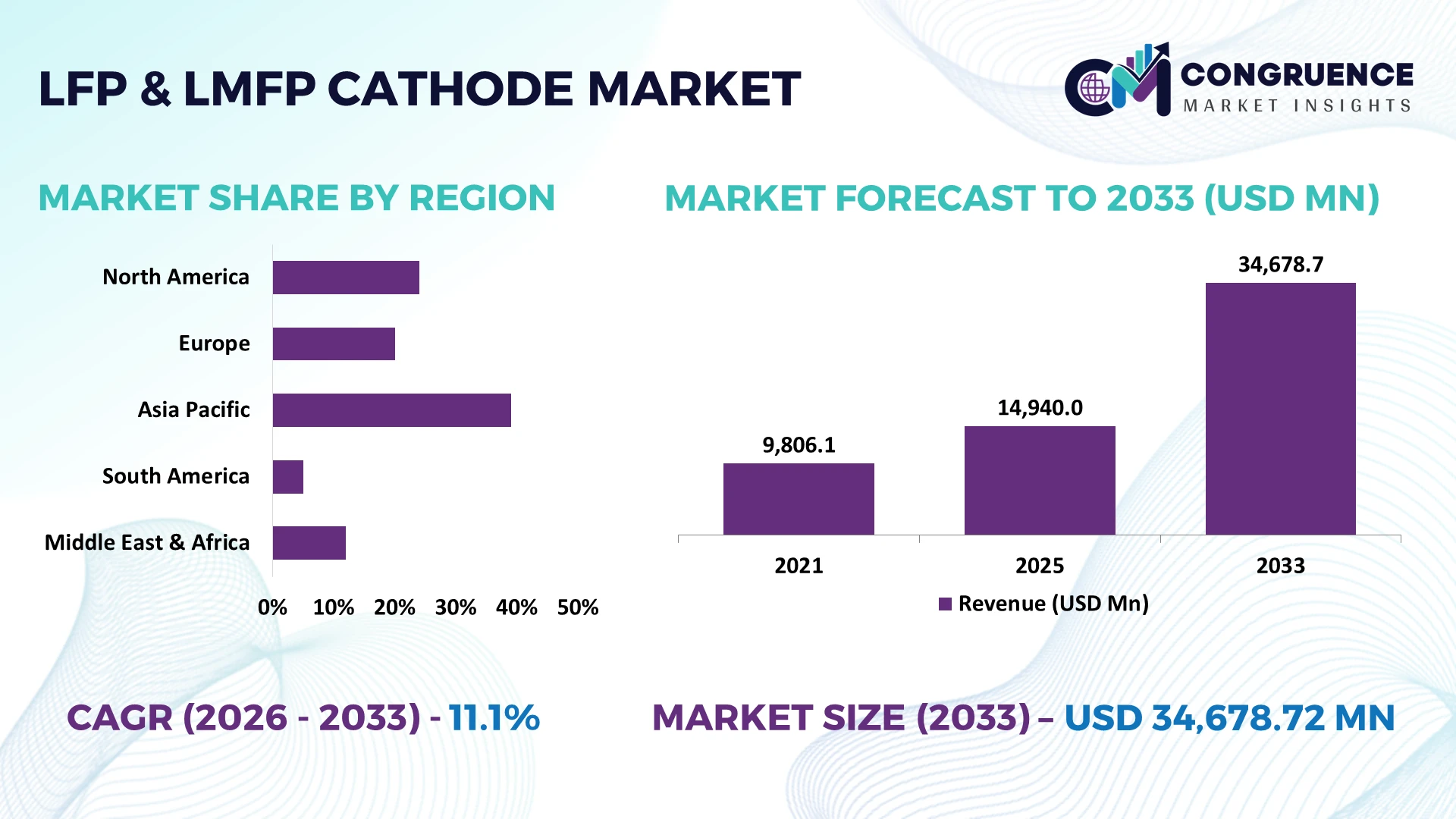
The Global LFP & LMFP Cathode Market was valued at USD 14940 Million in 2025 and is anticipated to reach a value of USD 34678.72 Million by 2033 expanding at a CAGR of 11.1% between 2026 and 2033. Growth is driven by LFP’s widening cost advantage over NMC, rapid stationary-storage deployment, EV platform standardization, and LMFP commercialization targeting higher-voltage, manganese-rich cathodes without cobalt or nickel.
China dominates global LFP & LMFP cathode manufacturing, producing more than 98% of LFP cathode material and supplying about 85% of total cathode active materials globally. Chinese LFP cathode shipments reached roughly 3.47 million tons in 2025, representing about 72% of total cathode shipments, versus substantially smaller production bases in South Korea and Japan. LFP accounted for over 55% of global EV battery deployment, while U.S. tariffs and European de-risking policies are accelerating non-Chinese capacity investments.
For battery-material suppliers and automakers, competitive positioning now depends on securing localized phosphate, manganese, lithium, and processing capacity while preparing LMFP portfolios that narrow LFP’s energy-density gap without sacrificing cost control or safety.
Market Size & Growth: USD 14.94 billion in 2025 is projected to reach USD 34.68 billion by 2033 at 11.1% CAGR, supported by EV platform migration toward lower-cost phosphate chemistries and rapid stationary-storage deployment.
Top Growth Drivers: LFP represents over 55% of global EV battery deployment, more than 90% of stationary-storage installations, and approximately 72% of cathode-material shipments.
Short-Term Forecast: By 2028, LMFP commercialization is positioned to deliver 15–20% higher theoretical energy density than conventional LFP while preserving cobalt-free and nickel-free material economics.
Emerging Technologies: LMFP’s ~4.1 V operating voltage, nanoscale carbon coating, morphology control, and AI-assisted calcination optimization are becoming central to next-generation phosphate cathode performance.
Regional Leaders: Asia remains the production center with China supplying over 98% of LFP cathode material; North America is reallocating over 50 GWh of battery capacity toward LFP; Europe is building localized supply through new cathode projects.
Consumer/End-User Trends: LFP powered more than 55% of global EV battery deployment in 2025, while emerging economies recorded approximately two-thirds LFP penetration among electric-car sales.
Pilot/Case Example: POSCO Future M’s Korean LFP program targets up to 50,000 tons of annual capacity, with supply beginning from converted cathode lines before dedicated production scales further.
Competitive Landscape: Hunan Yuneng shipped approximately 1.14 million tons of cathode material in 2025, ahead of Hubei Wanrun and Dynanonic, reinforcing China’s scale and manufacturing-cost advantage.
Regulatory & ESG Impact: Chinese LFP export-technology controls and U.S. sourcing restrictions are accelerating localization; European production technologies are targeting energy consumption reductions of roughly 50% versus conventional processes.
Investment & Funding: Ford committed USD 3 billion to its Michigan LFP battery facility, while European and Korean producers are adding dedicated cathode lines through partnerships and long-term supply agreements.
Innovation & Future Outlook: LMFP offers approximately 15–20% higher theoretical energy density than LFP, positioning manganese-rich phosphate cathodes as the next strategic bridge between low-cost LFP and higher-energy nickel chemistries.
The LFP & LMFP Cathode Market is shifting from a cost-driven chemistry segment into a strategic battery-material platform serving electric vehicles, grid storage, data-center backup systems, and increasingly high-performance mobility applications. LFP battery packs were more than 40% cheaper than NMC alternatives in 2025, strengthening adoption among mass-market EV and ESS manufacturers. LMFP development is now targeting the remaining energy-density limitation through manganese substitution and higher-voltage operation. At the same time, U.S., Korean, Indian, and European localization programs are reshaping procurement strategies, creating a clear transition toward diversified phosphate-cathode supply chains and next-generation material architectures.
LFP and LMFP cathodes are becoming strategically important because battery manufacturers are prioritizing lower-cost, cobalt-free chemistries across electric vehicles and stationary storage. LFP exceeded 55% of global EV battery deployment in 2025 and surpassed 90% of stationary-storage installations, shifting procurement toward phosphate, lithium, manganese, and graphite-linked supply chains. At the same time, U.S. sourcing rules and European de-risking strategies are accelerating non-Chinese cathode localization.
LFP battery prices fell by more than 15% in 2025 versus less than 5% for NMC, leaving LFP over 40% cheaper on average. China remains the scale leader, producing about 85% of global cathode active material, while South Korea, Europe, and the United States are prioritizing localized LFP capacity. LMFP adds a higher-voltage pathway, targeting roughly 15–20% better energy density than conventional LFP without introducing nickel or cobalt.
A practical example is the reallocation of more than 50 GWh of U.S. battery manufacturing capacity toward LFP in 2025. Through 2028, suppliers will intensify LMFP qualification, localized precursor sourcing, and long-term offtake agreements. Competitive advantage will depend on low-cost synthesis, stable manganese management, and geographically resilient cathode supply.
LFP adoption is accelerating because automakers and storage developers are prioritizing cost, cycle life, thermal stability, and raw-material simplicity over maximum nickel-based energy density. LFP represented more than 55% of global EV battery deployment in 2025 and over 90% of stationary-storage installations, while its share in emerging-market electric-car sales reached roughly 67%. China’s vertically integrated phosphate ecosystem reinforces this shift, enabling faster scaling and lower conversion costs. Battery manufacturers are responding by converting existing lines, securing lithium-phosphate inputs, and expanding dedicated cathode capacity. More than 50 GWh of U.S. battery manufacturing capacity was redirected toward LFP in 2025. The operational insight is decisive: chemistry standardization now improves procurement leverage and factory utilization alongside cell-cost reduction.
The primary structural restraint is extreme concentration across cathode active material, precursor processing, and LFP intellectual property. China produced approximately 85% of global cathode active material in 2025 and more than 80% of battery cells, while nearly all LFP batteries used in European and U.S. electric vehicles remained linked to Chinese production. In the European Union, LFP exceeded 10% of EV battery demand, yet about 30% arrived as direct battery imports and nearly 70% through imported LFP-equipped vehicles. Tariffs and sourcing restrictions increase landed costs and complicate qualification cycles. Companies are responding through Korean, European, Indian, and U.S. localization, long-term phosphate contracts, licensing structures, and diversified equipment sourcing. The strategic pressure point is qualification speed: duplicating China’s integrated cost base outside China requires scale before economics converge.
LMFP creates a significant opportunity by addressing LFP’s energy-density constraint without reintroducing nickel or cobalt dependency. Manganese substitution raises operating voltage toward approximately 4.1 V and can deliver around 15–20% higher theoretical energy density than conventional LFP, expanding phosphate chemistry into longer-range passenger vehicles and compact mobility platforms. China is leading early LMFP commercialization, while Korean and European material suppliers are increasing manganese-phosphate R&D and pilot qualification. Advanced carbon coating, nanoscale particle engineering, and digital calcination control can improve conductivity and stabilize manganese dissolution. Companies are positioning through LMFP pilot lines, cathode-blending strategies, joint qualification with cell makers, and precursor partnerships. A non-obvious opportunity lies in blended LMFP-LFP formulations, which can improve pack-level performance without requiring entirely new factory infrastructure.
The central long-term challenge is translating LMFP laboratory performance into stable, high-volume cathode manufacturing. Increasing manganese content improves voltage but introduces conductivity limitations, manganese dissolution, particle-surface instability, and tighter calcination requirements. Commercial lines must maintain particle-size consistency within narrow tolerances while preserving >99% active-material utilization and limiting first-cycle efficiency losses to low-single-digit percentages. China currently holds the strongest process-learning advantage because its battery industry accounts for more than 80% of global cell production, giving domestic suppliers substantially greater feedback volumes than newer plants elsewhere. Companies must invest in precursor uniformity, carbon-coating control, inline spectroscopy, digital quality systems, and joint cell qualification. The strategic challenge is not chemistry availability; it is achieving repeatable performance at scale without eroding LMFP’s intended cost advantage through excessive processing complexity.
LFP Penetration Broadens Beyond China: LFP exceeded 55% of global EV battery deployment in 2025, up from nearly 50% in 2024, while two-thirds of electric-car sales in emerging economies used the chemistry. Automakers are standardizing phosphate-based platforms, and suppliers are reallocating cell lines toward LFP to reduce material-cost exposure and improve sourcing flexibility.
Stationary Storage Reshapes Cathode Demand: LFP accounted for more than 90% of global stationary battery storage installations in 2025, while 108 GW of new storage capacity was deployed, 40% above 2024. Battery producers are increasingly designing dedicated ESS lines, prioritizing long cycle life, thermal stability, and standardized prismatic formats over maximum gravimetric energy density.
LMFP Moves Toward Commercial Qualification: LMFP adoption is shifting from laboratory development toward pilot-scale validation as producers target operating voltages near 4.1 V and approximately 15–20% higher energy density than standard LFP. Chinese cathode suppliers are scaling manganese-rich formulations, while Korean and European companies expand carbon-coating, particle-engineering, and precursor-control programs for automotive qualification.
Localization Alters Procurement Economics: More than 50 GWh of U.S. battery manufacturing capacity was redirected toward LFP production in 2025 as tariffs and sourcing rules reduced reliance on Chinese imports. European producers are also pursuing localized phosphate supply. Companies are restructuring procurement, licensing technology, and forming long-term precursor partnerships to secure non-Chinese production pathways.
LFP Cathodes remain the leading type, accounting for approximately 80–85% of combined LFP and LMFP cathode demand because the chemistry benefits from established precursor supply, mature calcination processes, proven safety performance, and broad compatibility with EV and stationary-storage cells. Standard LFP offers lower material complexity than manganese-enriched variants and remains the preferred chemistry where cost per cycle outweighs maximum energy density. Coated Cathodes and Modified Cathodes are gaining relevance because carbon coatings, dopants, and morphology control improve conductivity, low-temperature behavior, and rate capability without changing established cell architecture.
LMFP Cathodes represent the fastest-growing type as manufacturers target roughly 15–20% higher energy density than conventional LFP and operating voltages near 4.1 V. High-Manganese LMFP remains earlier-stage but is attracting R&D because additional manganese can further raise voltage while retaining nickel-free and cobalt-free positioning. Producers are shifting investment toward precursor consistency, nanoscale coating, and blended LFP-LMFP formulations, creating a strategic transition from commodity phosphate cathodes toward application-specific performance grades.
Electric Vehicles represent the largest application, accounting for approximately 60–65% of LFP & LMFP cathode demand due to high battery-volume requirements, expanding mass-market EV production, and wider adoption of phosphate chemistry in standard-range passenger cars. LFP powered over 55% of global EV battery deployment in 2025, while penetration reached roughly two-thirds of electric-car sales across emerging economies. Electric Buses and Commercial Vehicles remain important because operators prioritize long cycle life, thermal stability, and predictable total cost of ownership over maximum pack energy density.
Energy Storage is the fastest-growing application shift as utility-scale installations increasingly standardize around LFP. More than 90% of global stationary battery installations used LFP in 2025, and 108 GW of new storage capacity was deployed. Power Tools remain a smaller application because high-power cylindrical chemistries still retain advantages in compact formats. Cathode suppliers are responding through ESS-specific particle design, automotive LMFP qualification, and differentiated grades optimized for cycle life, fast charging, or higher voltage.
Battery Manufacturers are the dominant end-user group, representing approximately 55–60% of direct LFP & LMFP cathode procurement because they manage electrode formulation, cell chemistry qualification, production yield, and long-term cathode sourcing. Automotive OEMs increasingly influence specifications through dedicated platform strategies and supply agreements, especially as LFP penetration exceeds 55% of global EV battery deployment. Commercial Vehicle Manufacturers and Power Tool Manufacturers purchase more selectively, emphasizing application-specific cycle life, discharge rate, safety, and temperature performance.
Energy Storage Companies represent the fastest-growing end-user segment as stationary battery deployment scales rapidly. LFP accounted for more than 90% of storage installations in 2025, strengthening direct collaboration between cathode suppliers, cell producers, and system integrators. Cathode companies are responding with long-term offtake agreements, localized production, customized particle morphology, and differentiated coating systems. Competitive positioning is shifting toward chemistry co-development with anchor customers rather than standardized spot-market supply, improving qualification stickiness and supporting more predictable utilization of new cathode capacity.
Asia-Pacific accounted for the largest market share at 78% in 2025 however, North America is expected to register the fastest growth, expanding at a CAGR of 14.2% between 2026 and 2033.
Domestic LFP Manufacturing Reshapes Battery Sourcing
North America accounts for approximately 9% of LFP & LMFP cathode demand, with the United States driving localization through EV manufacturing, stationary storage, and federal domestic-content incentives. The region remains dependent on imported LFP cathode material, creating a significant mismatch between growing cell capacity and upstream material availability. Ford's BlueOval Battery Park Michigan is designed for approximately 20 GWh of annual LFP cell capacity and entered production ramp-up during 2026, while U.S. battery producers are redirecting additional manufacturing lines toward stationary-storage LFP cells. Domestic cathode projects increasingly emphasize iron-phosphate precursor security, licensing, and qualification with automotive customers. The strategic shift is from importing finished LFP cells toward establishing integrated domestic cell ecosystems, creating opportunities for localized cathode producers capable of meeting traceability, performance, and incentive requirements.
United States Market Outlook: The United States is the region's primary demand and localization center, supported by EV assembly, utility storage, data-center power requirements, and advanced manufacturing incentives. Ford invested USD 3 billion in its Michigan LFP facility, which targets approximately 1,700 jobs. Growing domestic cell capacity creates a clear procurement gap for locally produced cathode active material, strengthening opportunities for qualified LFP suppliers.
Localization Moves Upstream Into Cathode Materials
Europe accounts for approximately 8% of LFP & LMFP cathode demand, but local cathode production remains substantially below battery-cell requirements. LFP penetration is increasing across entry-level EVs and stationary storage as manufacturers prioritize lower cell costs, thermal stability, and reduced nickel-cobalt exposure. The EU Battery Regulation is simultaneously raising traceability, carbon-footprint, and recycling requirements, increasing the strategic value of regional material processing. European producers are therefore evaluating phosphate precursor, LFP, and LMFP projects alongside existing nickel-based cathode infrastructure. Automotive manufacturers are also diversifying chemistry strategies as LFP gains share in standard-range vehicles. The region's competitive opportunity lies less in matching China's immediate manufacturing scale and more in supplying traceable, lower-carbon cathodes integrated with European battery plants, recycling networks, and automotive qualification systems.
Germany Market Outlook: Germany combines Europe's largest automotive manufacturing base with expanding battery-cell and materials infrastructure. More than 4 million passenger vehicles are produced annually, giving cathode suppliers direct access to major EV qualification programs. German manufacturers increasingly require battery materials with documented carbon footprints, recycled-content pathways, and regional supply security, favoring locally integrated LFP and future LMFP supply chains.
China's Integrated Scale Defines Global Economics
Asia-Pacific controls approximately 78% of market demand and an even larger proportion of production, anchored by China's vertically integrated phosphate, lithium processing, cathode, cell, and EV manufacturing ecosystem. China produces more than 98% of global LFP cathode material, while LFP represented approximately 72% of total cathode shipments in 2025, up 8 percentage points year over year. Hunan Yuneng alone shipped roughly 1.14 million tons, illustrating the production scale available to leading suppliers. South Korea is responding with new LFP investments and LMFP development, while Japan maintains advanced materials expertise but remains less exposed to high-volume phosphate production. Companies are expanding high-density LFP, manganese-rich formulations, precursor integration, and automated calcination capacity as competition shifts from basic volume toward density, fast charging, and manufacturing consistency.
China Market Outlook: China remains the decisive LFP & LMFP manufacturing hub because its cathode producers operate alongside the world's largest battery-cell and EV manufacturing ecosystem. LFP cathode shipments reached approximately 3.47 million tons in 2025. Leading suppliers are now moving beyond conventional grades toward high-compaction-density LFP and LMFP, using established precursor networks and large qualification volumes to accelerate commercialization.
Lithium Resources Create Downstream Integration Potential
South America represents approximately 2% of current LFP & LMFP cathode demand, with activity concentrated around EV adoption, renewable-energy storage, lithium extraction, and early battery industrialization. Chile, Argentina, and Brazil possess strategic upstream or downstream advantages, yet local conversion into battery-grade cathode material remains limited. Brazil provides the strongest demand base through vehicle manufacturing and grid-scale renewable integration, while Argentina and Chile strengthen lithium-resource availability. The region contains more than half of identified global lithium resources when the Lithium Triangle is considered, but much of the material leaves the region before cathode conversion. Governments and industrial groups are increasingly evaluating local refining and battery manufacturing partnerships. The key business opportunity is converting mineral advantage into precursor and cathode capability rather than remaining primarily an upstream lithium supplier.
Brazil Market Outlook: Brazil offers the most developed downstream platform through its automotive industry, established chemical sector, renewable-electricity base, and growing stationary-storage requirements. Annual vehicle production exceeds 2 million units, supporting future demand for locally integrated battery supply. LFP is particularly relevant for buses, commercial fleets, and stationary systems where cycle life and thermal stability carry greater operational value than maximum energy density.
Morocco Emerges as Export-Oriented Cathode Hub
Middle East & Africa represents approximately 3% of market demand but is becoming strategically relevant through Morocco's battery-material industrialization and Gulf investment in energy storage. Morocco combines phosphate reserves, automotive manufacturing, renewable power, and proximity to European customers, providing an unusually integrated foundation for LFP production. A major battery-material complex under development targets 60,000 tons of annual LFP cathode capacity alongside 120,000 tons of NMC precursor capacity and 30,000 tons of black-mass recycling. Gulf states are simultaneously expanding utility storage to support solar-heavy electricity systems, strengthening downstream LFP demand. The regional model differs from China's domestic scale: Morocco is positioning primarily as an export-oriented materials hub, while Saudi Arabia and the UAE emphasize storage deployment and emerging battery-industrial ecosystems.
Morocco Market Outlook: Morocco holds the strongest regional cathode-manufacturing position through phosphate availability, established automotive exports, free-trade access, and proximity to European battery customers. Planned LFP cathode capacity of 60,000 tons annually establishes a meaningful industrial base. Local phosphate integration and renewable electricity provide additional leverage as European buyers increasingly evaluate supply-chain carbon intensity and material traceability.
Hunan Yuneng, Wanrun New Energy, Dynanonic, Lopal Tech, and Gotion compete on LFP scale, particle engineering, customer qualification, and integrated Chinese supply chains, while POSCO Future M and other non-Chinese suppliers challenge through localization and automotive-grade supply security. The top five LFP suppliers account for approximately 45% of global cathode shipments, with Hunan Yuneng alone shipping about 1.14 million tons in 2025. Competition is intensifying as LFP reached 72% of total cathode shipments, up 8 percentage points year over year, shifting investment away from ternary-focused capacity. Leaders are expanding calcination lines, developing high-density LMFP, signing battery-maker offtake agreements, and vertically integrating iron-phosphate precursors. Outside China, suppliers compete on traceability, local-content compliance, and shorter logistics chains rather than price. Chinese control of more than 98% of LFP cathode production remains the entry barrier. Winning requires scale-efficient synthesis, qualified LMFP technology, precursors, and localized customer integration without sacrificing consistency or cost competitiveness.
Hunan Yuneng New Energy Battery Material Co., Ltd.
Hubei Wanrun New Energy Technology Co., Ltd.
Shenzhen Dynanonic Co., Ltd.
Jiangsu Lopal Tech Co., Ltd.
Gotion High-tech Co., Ltd.
Xiamen Tungsten New Energy Materials Co., Ltd.
Beijing Easpring Material Technology Co., Ltd.
Ningbo Ronbay New Energy Technology Co., Ltd.
POSCO Future M Co., Ltd.
LG Chem Ltd.
BASF SE
Umicore
Aleees
Pulead Technology Industry Co., Ltd.
Current LFP production is advancing through high-density particle engineering, carbon coating, single-crystal control, and precursor-free synthesis. Enhanced calcination and coating can raise electrode rolling density toward 2.6–2.7 g/cc, improving volumetric energy density by roughly 5–8% versus earlier LFP generations. Direct synthesis also removes precursor-processing stages, cutting wastewater generation and reducing manufacturing complexity. These technologies favor producers with integrated iron-phosphate feedstocks, automated kilns, and particle-size control.
Emerging LMFP technology adds manganese to conventional LFP, lifting operating voltage from about 3.4 V toward 4.1 V and increasing theoretical energy density by approximately 15–20%. High-manganese formulations approaching 80% manganese are targeting around 150 mAh/g specific capacity while retaining phosphate chemistry’s thermal stability. Compared with legacy LFP, advanced LMFP therefore offers roughly 20% higher energy performance without adopting nickel-cobalt systems. Adoption remains concentrated in pilot qualification, with Chinese suppliers leading early scale-up and Korean and European producers expanding validation programs.
Disruptive development centers on precursor-free synthesis, digitally controlled calcination, AI-assisted quality analytics, and closed-loop coating optimization. Between 2026 and 2028, manufacturers will prioritize lower-energy processing, localized feedstocks, and application-specific LFP/LMFP grades. Suppliers combining process automation with proprietary particle engineering gain lower conversion costs, faster customer qualification, and stronger positioning across EV and stationary-storage programs.
September 2024 Hyundai Motor and Kia launched a four-year LFP cathode development project with Hyundai Steel and EcoPro BM, using direct synthesis to eliminate precursor processing, lower emissions, improve low-temperature charging performance, and strengthen domestic Korean battery-material competitiveness. Source: hyundai.com
January 2025 ICL and Shenzhen Dynanonic signed a European LFP cathode joint venture for Sallent, Spain, backed by approximately €285 million initial investment and ICL’s planned 80% stake, strengthening phosphate-based battery-material supply for European automakers and storage customers. Source: icl-group.com
July 2025 General Motors announced conversion of Spring Hill, Tennessee battery lines to LFP production, with commercial output targeted for late 2027; the factory employs roughly 1,300 workers, reducing dependence on higher-cost nickel-based chemistries for mainstream EV programs. Source: reuters.com
April 2026 IBU-tec completed the topping-out milestone for its Bitterfeld-Wolfen LFP facility, designed for 15,000 tonnes annual cathode capacity and roughly 50% lower energy consumption than conventional Chinese processes, strengthening Europe’s localized battery-material manufacturing base and supply resilience. Source: ibu-tec.de
The report covers LFP Cathodes, LMFP Cathodes, High-Manganese LMFP, Coated Cathodes, and Modified Cathodes, alongside applications in Electric Vehicles, Energy Storage, Electric Buses, Commercial Vehicles, and Power Tools. End-user analysis spans Battery Manufacturers, Automotive OEMs, Energy Storage Companies, Power Tool Manufacturers, and Commercial Vehicle Manufacturers. LFP remains the dominant chemistry, while LMFP is emerging with approximately 15–20% higher theoretical energy density than conventional LFP.
Regional analysis covers North America, Europe, Asia-Pacific, South America, and Middle East & Africa, with Asia-Pacific holding the strongest manufacturing concentration. Technology coverage includes precursor-free synthesis, high-density particle engineering, carbon coating, manganese optimization, automated calcination, and quality analytics. The report supports 2026–2033 investment planning through supplier benchmarking, localization assessment, capacity strategy, technology qualification, partnership evaluation, and competitive positioning across EV and stationary-storage value chains.
| Report Attribute/Metric | Report Details |
|---|---|
Market Revenue in 2025 | USD 14940 Million |
Market Revenue in 2033 | USD 34678.72 Million |
CAGR (2026 - 2033) | 11.1% |
Base Year | 2025 |
Forecast Period | 2026 - 2033 |
Historic Period | 2021 - 2025 |
Segments Covered | By Type
By Application
By End-User
|
Key Report Deliverable | Revenue Forecast, Growth Trends, Market Dynamics, Segmental Overview, Regional and Country-wise Analysis, Competition Landscape |
Region Covered | North America, Europe, Asia-Pacific, South America, Middle East, Africa |
Key Players Analyzed | Hunan Yuneng New Energy Battery Material Co., Ltd., Hubei Wanrun New Energy Technology Co., Ltd., Shenzhen Dynanonic Co., Ltd., Jiangsu Lopal Tech Co., Ltd., Gotion High-tech Co., Ltd., Xiamen Tungsten New Energy Materials Co., Ltd., Beijing Easpring Material Technology Co., Ltd., Ningbo Ronbay New Energy Technology Co., Ltd., POSCO Future M Co., Ltd., LG Chem Ltd., BASF SE, Umicore, Aleees, Pulead Technology Industry Co., Ltd. |
Customization & Pricing | Available on Request (10% Customization is Free) |




