
Reports
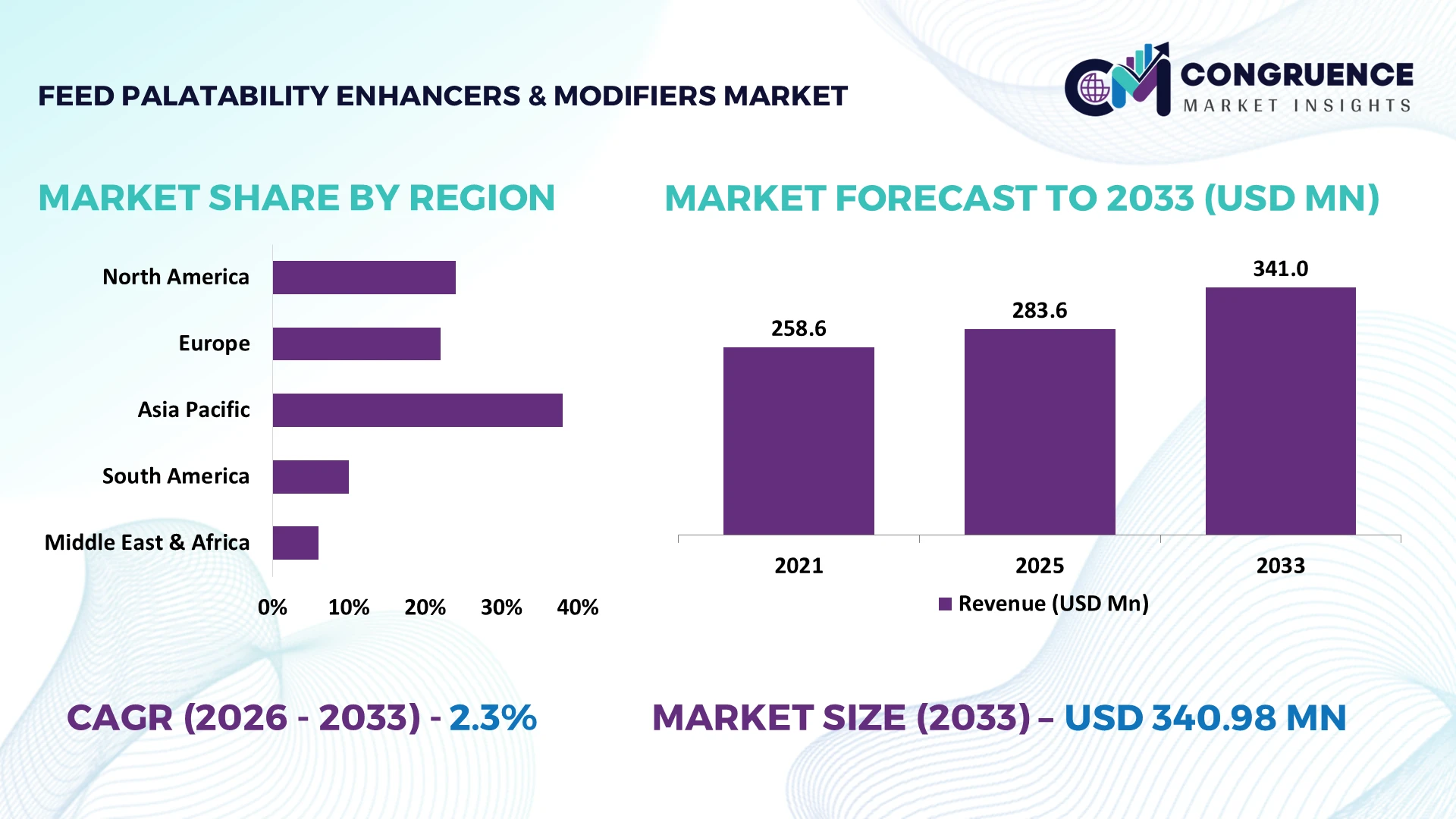
The Global Feed Palatability Enhancers & Modifiers Market was valued at USD 283.6 Million in 2025 and is anticipated to reach a value of USD 341.0 Million by 2033 expanding at a CAGR of 2.33% between 2026 and 2033. Growth is anchored in the reformulation of livestock diets following antibiotic growth promoter bans, which elevates palatability enhancers from optional sensory additives to essential intake-security tools across poultry, swine, and aquaculture systems.
China dominates the global landscape, commanding an estimated 35–40% of Asia-Pacific consumption, with compound feed output reaching 280 million metric tons in 2024 and palatant penetration in commercial feeds climbing to 58%. The country’s swine and aquaculture sectors absorb the largest volumes, supported by sustained investment in precision nutrition infrastructure. In contrast, the United States maintains a premiumization-led model, where super-premium pet food sales grew 14% year-over-year and wet diets command a 32% price premium over dry kibble, driving higher-value palatant adoption.
This divergence—volume-driven Asian expansion versus value-driven Western sophistication—means suppliers must calibrate formulation portfolios and regulatory documentation by market rather than pursue uniform global strategies.
Market Size & Growth: Valued at USD 283.6 Million in 2025, projected to reach USD 341.0 Million by 2033 at 2.33% CAGR; antibiotic reduction mandates in major livestock economies constitute the structural demand catalyst.
Top Growth Drivers: Antibiotic growth promoter phase-outs (affecting 60%+ of commercial poultry operations in regulated markets), aquaculture intensification (Asia-Pacific shrimp and fish feed volumes rising), and pet food humanization (super-premium wet diets at 32% price premium).
Short-Term Forecast: By 2027, microencapsulation adoption in pelleted feed is expected to reduce active-ingredient degradation during processing by 25–30%, improving cost-in-use for integrators.
Emerging Technologies: AI-driven sensory profiling for species-specific flavor optimization, advanced microencapsulation for heat-stable palatants in extruded feeds, and botanical-derived clean-label flavor systems.
Regional Leaders: Asia-Pacific (~45% share, driven by China’s 280 million metric ton compound feed base), North America (premium pet food and integrated poultry), Europe (compliant additive systems for antibiotic-free production).
Consumer/End-User Trends: 58% palatant penetration in China’s commercial feeds reflects integrator shift toward intake-security strategies; US pet owners demonstrate willingness to pay USD 0.40 more per pouch for no-artificial-flavor claims.
Pilot/Case Example: Thailand’s contract broiler sector recorded 22% increase in palatant adoption (2023–2024) following colistin and zinc bacitracin phase-out, correlating with maintained daily weight gain.
Competitive Landscape: Fragmented tier-one field including Kerry Group, Kemin Industries, DuPont/Danisco, Cargill, and ADM; flavors command 37.45% of product-type share, with leaders leveraging fermented fish-protein and umami-replicating systems.
Regulatory & ESG Impact: FDA Veterinary Feed Directive tightening (2023) and India’s proposed antibiotic restrictions (2024, covering 850 million birds annually) expand palatant addressable market while demanding documented efficacy.
Investment & Funding: Major players prioritize regional formulation hubs and partnerships with premix companies and academic trial facilities; Brazil and India emerge as scalable production and application markets.
Innovation & Future Outlook: Next-generation palatants integrate enzyme stabilization, insect-protein extracts, and data-driven sensory modeling; strategic shift moves products from taste improvement toward feed-intake security and return-on-feed investment positioning.
Feed palatability enhancers now function as intake-security instruments in antibiotic-free production, with 58% penetration in China’s commercial feeds signaling mainstream integration. Innovations in microencapsulation and fermented protein palatants extend shelf-life and support clean-label claims, while Thailand’s 22% adoption surge following antimicrobial restrictions illustrates regulatory-driven demand acceleration. This operational reality—where palatants protect performance during diet transitions and medicated-feed withdrawal—frames the strategic discussion that follows.
The market’s strategic weight has shifted decisively: palatants are no longer sensory add-ons but risk-mitigation assets for integrators navigating antibiotic withdrawal, volatile raw-material costs, and species-specific intake challenges. Regulatory restructuring—particularly FDA VFD tightening and India’s proposed antibiotic restrictions covering 850 million birds—has converted compliance pressure into a durable demand floor for documented, heat-stable palatant systems.
Technology comparison underscores the shift. Legacy unencapsulated flavor systems lose 30–40% of active compounds during pelleting and extrusion; microencapsulated alternatives preserve release profiles through thermal processing, delivering measurable feed-intake consistency and reducing over-fortification costs. Regionally, China scales volume through 280 million metric tons of compound feed with 58% palatant penetration, while the United States pursues value capture through premium pet food, where wet diets command a 32% price premium and super-premium sales grew 14%. Thailand’s broiler sector exemplifies operational adaptation: following colistin and zinc bacitracin phase-out, contract growers increased palatant adoption 22% between 2023 and 2024 while maintaining weight-gain targets. Companies are responding by localizing formulation hubs near integrator clusters and securing long-term botanical and hydrolysate supply contracts, as yeast-extract prices rose 22% in 2024 alone. The strategic conclusion is unambiguous: competitive positioning now depends on evidence-backed, region-specific palatant systems that protect feed efficiency under regulatory and supply-chain stress, not on generic taste enhancement claims.
The phase-out of antibiotic growth promoters across major livestock economies constitutes the primary structural driver, forcing integrators to replace sub-therapeutic antimicrobials with intake-management strategies. Thailand’s contract broiler sector recorded a 22% increase in palatant adoption between 2023 and 2024 following colistin and zinc bacitracin restrictions, while India’s proposed compound feed restrictions cover 850 million birds annually. China’s palatant penetration in commercial feeds rose from 42% in 2020 to 58% in 2024 as integrators adopted nutritional strategies replacing banned antibiotics. This regulatory shift creates a cause-effect-response chain: withdrawal reduces natural feed intake and weight-gain consistency, elevating palatability enhancers from discretionary additives to performance-critical inputs. Companies are responding by co-developing species-specific palatant systems with integrators and investing in trial data that documents intake and feed-conversion outcomes, effectively converting regulatory compliance into a differentiated product claim.
Raw-material price instability directly limits palatant affordability and formulation flexibility, particularly for smaller producers lacking vertical integration. Yeast-extract prices rose 22% between January and September 2024 due to Brazilian sugarcane shortages reducing molasses feedstock availability, while rosemary-extract quotations surged 31% following drought-driven harvest cuts of 40% in Spain’s Andalusia region. These shocks disproportionately impact natural and clean-label palatant lines, where alternative sourcing options remain limited and qualification cycles are lengthy. The business impact is immediate: formulators face compressed margins or must pass costs to integrators already operating on thin livestock margins, dampening adoption velocity in price-sensitive markets across Southeast Asia and Latin America. Companies are mitigating exposure through multi-year supply contracts, geographic diversification of botanical sourcing, and reformulation toward synthetic-natural blends that reduce dependence on single-origin actives.
Aquaculture intensification across Asia-Pacific presents an underexploited growth avenue, as feed acceptance variability in shrimp and marine fish creates acute demand for specialized chemo-attractants and ingestible flavor systems. Vietnam’s shrimp export ambitions and India’s expanding aquaculture output require palatant solutions tailored to crustacean olfactory physiology—a segment poorly served by terrestrial-livestock-derived formulations. The opportunity extends beyond volume: aquaculture palatants command premium pricing due to species specificity and the high cost of feed rejection in intensive pond systems. Companies are positioning through dedicated marine-derived ingredient development, including fermented fish-protein systems and crustacean-specific amino acid profiles, while partnering with hatchery operators to capture formulation influence at the earliest production stage. This upstream engagement creates switching costs and establishes specification lock-in before grow-out operations finalize procurement.
Long-term scalability depends on resolving the tension between region-specific regulatory documentation and the operational need for globally standardized palatant platforms. The United States requires FDA-CVM and AAFCO-aligned efficacy data, Europe enforces compliant additive dossiers under Farm to Fork sustainability criteria, and India’s FSSAI framework for compound feed additives remains under active revision. This fragmentation forces suppliers to maintain redundant trial datasets and reformulate for market-specific approval status, inflating development costs and delaying launch timelines. The operational consequence is particularly acute for mid-sized innovators lacking regulatory affairs infrastructure across multiple jurisdictions. Companies must invest in modular dossier architectures that allow rapid adaptation to local requirements, and pursue proactive engagement with authorities in emerging markets where rules are still forming—turning regulatory complexity into a barrier that favors established players with compliance depth.
Heat-Stable Encapsulation Gains Traction Microencapsulated palatant systems are displacing conventional uncoated flavor compounds as integrators push pelleted and extruded feed through high-temperature processing. Encapsulation preserves 25–30% more active volatiles during conditioning, directly reducing over-fortification costs and stabilizing intake response across batch variations. Kerry Group’s 2025 fermented fish-protein line for feline wet diets exemplifies the shift toward process-compatible actives, while suppliers increasingly co-develop coated systems with premix partners to lock in specifications before commercial feed runs.
AI-Driven Sensory Formulation Scales Machine-learning models now map raw-material chemical profiles against species-specific intake data, compressing trial cycles that previously required multiple barn-side evaluations. DSM Nutritional Products deploys AI flavor profiling to predict palatant performance before physical prototyping, cutting development iterations by measurable margins. This capability matters most in markets where ingredient substitution is routine—formulators can model bitterness masking for DDGS-heavy or insect-meal rations without waiting for full feed trials, accelerating reformulation speed in Brazil and India where input variability runs high.
Natural Aroma Shift Reshapes Sourcing Clean-label pressure is redirecting procurement toward botanical and fermentation-derived aroma systems, with natural aromas forecast to grow at roughly 10% annually through 2032. Yeast-extract prices rose 22% in 2024 after Brazilian molasses shortages, forcing buyers to diversify toward rosemary and fermentation-derived alternatives—yet Spanish rosemary harvests fell 40% on drought, exposing single-origin fragility. Companies are responding with dual-sourcing contracts and blended synthetic-natural architectures that satisfy “no artificial flavors” claims while insulating formulation economics from botanical shocks.
Aquaculture Palatants Move Upstream Shrimp and marine fish feed acceptance variability is pushing palatant specification into hatchery-stage procurement, creating switching costs before grow-out contracts finalize. North American aquaculture palatant demand is accelerating as coastal operations invest in water-stable chemo-attractant systems that survive immersion longer than terrestrial-livestock formats. Suppliers are partnering with hatchery operators in Vietnam and India to embed species-specific amino acid profiles early, converting a formulation choice into a multi-cycle supply relationship.
Flavor systems command the dominant position, holding approximately 37.45% of segment value in 2025, sustained by their cross-species versatility and effectiveness in masking bitter notes from high-inclusion protein meals. Flavors integrate seamlessly into both mash and pelleted formats, giving feed manufacturers a single platform across poultry, swine, and aquatic species—a scalability advantage that texturants and standalone sweeteners cannot match. Within the flavor category, starter-diet systems targeting early nursery and brooding phases represent a high-value niche, where intake dips during feed transitions create outsized performance penalties and justify premium pricing.
Natural aromas constitute the fastest-moving segment, with clean-label reformulation in European and North American pet food driving adoption away from synthetic top-notes. Sweeteners retain relevance in swine and calf milk replacers but face formulation constraints from regional approval divergence, while texturants gain ground in pet treat applications where pellet durability and dental-chew hardness must coexist with sensory appeal. Companies are responding by co-formulating flavors with texturants—BASF’s 2024 combined system for pet treats illustrates the convergence strategy—and prioritizing botanical sourcing diversification to protect natural-aroma margins.
Improving feed appeal anchors the application hierarchy, capturing an estimated 48% share in 2025 as the foundational use case across all species categories. This dominance reflects the universal operational reality that feed rejection begins at the sensory interface—before digestibility or nutrient density can exert any effect—making appeal the first gate that palatant investment must clear. Feed manufacturers prioritize appeal enhancement in reformulated rations where alternative proteins, DDGS, or cassava by-products introduce off-notes that depress voluntary intake.
Stimulating feed consumption is the fastest-expanding application, driven by antibiotic-free production systems where palatants substitute for the intake-promoting effects of withdrawn growth promoters. In Thailand’s contract broiler sector, palatant adoption rose 22% following colistin and zinc bacitracin phase-out, explicitly to maintain consumption levels during diet transitions. Diet transition support and medicated-feed acceptance represent smaller but operationally critical niches, particularly in swine nursery and aquaculture, where rejection carries immediate mortality or growth-stall consequences. Companies are adapting by positioning products around measurable intake-security outcomes rather than generic taste claims, with trial data quantifying consumption lift becoming a procurement prerequisite.
Livestock feed manufacturers represent the dominant buyer group, absorbing approximately 70% of palatant volume in 2025 through high-throughput compound feed operations that demand consistent, cost-effective intake solutions across poultry, swine, and ruminant lines. This concentration reflects the structural reality that commercial integrators formulate at scale—China’s 280 million metric ton compound feed base alone creates procurement volumes that dwarf specialty channels—and that palatant efficacy must survive pelleting, storage, and multi-species deployment without reformulation. Demand intensity is highest in antibiotic-free poultry and swine systems where intake consistency directly determines margin.
Pet food producers constitute the fastest-growing end-user segment, expanding at a pace that outpaces livestock volume growth as premiumization and humanization elevate palatability from formulation variable to brand differentiator. Super-premium wet diets command a 32% price premium over dry kibble in the United States, and pet owners demonstrate willingness to pay USD 0.40 more per pouch for no-artificial-flavor claims. This pricing power supports higher palatant loading rates and tolerance for natural-ingredient cost volatility. Aquaculture producers represent an emerging buyer class with distinct requirements—water-stable attractants and crustacean-specific chemo-attractants—where specification decisions increasingly migrate upstream to hatchery procurement. Companies are responding by segmenting commercial teams: volume-oriented livestock sales leverage premix and integrator partnerships, while pet food engagement centers on co-development with brand formulators and claim-substantiation data packages.
Asia-Pacific accounted for the largest market share at 38% in 2025 however, South America is expected to register the fastest growth, expanding at a CAGR of 5.1% between 2026 and 2033.
North America commands 24% of global market share, with the United States accounting for 75.5% of regional consumption . Demand concentrates in premium pet food formulations and antibiotic-free poultry operations, where palatant systems protect intake consistency during diet transitions. The region’s integrated livestock-production model supports specification lock-in at the integrator level, while FDA Veterinary Feed Directive compliance has institutionalized intake-security purchasing criteria. ADM and Kemin maintain application laboratories in the U.S. corn belt, enabling rapid reformulation cycles for DDGS-heavy rations.
United States Market Outlook: The U.S. represents the operational core of North American demand, supported by large-scale poultry and swine integrators that formulate at national scale. USDA Rural Development funding has directed capital toward sustainable agriculture infrastructure, indirectly elevating feed-additive specification standards. With 75.5% regional share, U.S. procurement decisions set formulation benchmarks that Canadian and Mexican operations frequently follow .
Europe holds 22% of global market share, with Germany commanding approximately 26% of regional demand . The EU’s 2022 zinc oxide ban for weaned piglets created a structural demand floor for palatants that support post-weaning feed intake without pharmacological interventions. European compound feed production of roughly 158 million tonnes annually provides the industrial base, while FEDIAF’s EUR 23 billion pet food market sustains premium wet-diet and treat applications . Formulation complexity has increased as producers stack functional ingredients, elevating the sensory-masking role of palatants.
Germany Market Outlook: Germany’s dominance rests on its position as Europe’s largest pig and poultry producer, combined with a highly professionalized compound feed manufacturing sector. German integrators operate under strict documentation requirements that favor palatant suppliers capable of substantiating efficacy claims. The country’s premix and additive cluster supplies neighboring markets, extending German formulation standards across Central Europe.
Asia-Pacific represents 38% of global market share, anchored by China’s 280 million metric ton compound feed base. The region’s volume advantage stems from intensive swine and poultry production systems where palatant penetration continues rising as antibiotic growth promoters are phased out. Southeast Asian broiler integrators, particularly in Thailand and Vietnam, have accelerated adoption to maintain weight-gain consistency during medicated-feed withdrawal. Japan and South Korea contribute high-value pet food demand, though at smaller volumes. The region’s fragmentation creates opportunities for local formulators alongside multinational suppliers.
China Market Outlook: China’s palatant demand is inseparable from its swine and aquaculture production scale. The country’s compound feed output supports palatant volumes that dwarf most national markets, and integration among top-tier producers creates concentrated procurement channels. Feed manufacturers increasingly demand heat-stable formulations compatible with high-temperature pelleting, pushing suppliers to localize encapsulation capacity rather than import finished products.
South America accounts for 10% of global market share, with Brazil driving the overwhelming majority of demand. The region’s competitive advantage lies in vertically integrated poultry and swine operations that export to stringent markets, requiring documented feed-additive performance. Argentina’s smaller, price-sensitive feed mill sector limits premium palatant adoption, while Andean markets show gradual alignment with regional standards. Infrastructure constraints and currency volatility temper near-term scaling, though Brazil’s integrated model provides a stable demand core.
Brazil Market Outlook: Brazil’s poultry and swine export complex demands palatant systems that maintain performance across varied raw-material quality, particularly as corn and soybean meal specifications fluctuate seasonally. ADM’s 2026 investment in a Paraná premix and additive facility, with initial capacity of 40,000 metric tons annually, signals confidence in regional demand growth and localization priorities . Brazilian integrators favor suppliers offering on-site formulation support rather than transactional ingredient supply.
The Middle East & Africa region holds 6% of global market share, with Saudi Arabia commanding 23.4% of regional demand . The Kingdom’s Vision 2030 food-security agenda targets a 30% increase in local livestock production by 2030, channeling investment into modern feed mills and advanced nutritional technologies . High ambient temperatures make palatants operationally essential for maintaining feed intake in dairy and poultry during summer months. The UAE functions as a technology and trade hub, with over AED 2 billion committed to agritech and food-security initiatives . Israeli precision-livestock operations contribute disproportionate innovation influence relative to volume.
Saudi Arabia Market Outlook: Saudi Arabia’s dominance reflects the convergence of national strategy, corporate scale, and climatic necessity. Integrated agribusinesses including Almarai and NADEC prioritize consistent feed performance across temperature extremes, creating specification standards that smaller producers emulate. Government subsidies for feed grains and additives lower adoption barriers, while Saudi Food and Drug Authority regulations favor approved natural and synthetic modifiers with documented safety profiles.
The competitive field pits global taste-and-nutrition leaders—Kerry, Kemin, Cargill, ADM, and BASF—against regional palatant specialists and cost-driven local formulators. The top five players hold an estimated 35–40% combined share, leaving a fragmented long tail. Competition hinges on heat-stable encapsulation technology (25–30% active retention advantage), supply-chain reliability for botanical actives, and species-specific customization speed. Kerry leverages AI-driven flavor modeling and biofermentation; Kemin targets wet pet food with retort-stable PALIVATE™; Cargill integrates postbiotics with essential oils for gut-health positioning. Players are expanding through regional application labs and premix partnerships rather than greenfield capacity. The decisive competitive shift is from generic palatant supply toward documented intake-security outcomes—suppliers who cannot substantiate feed-conversion gains in antibiotic-free systems face displacement by integrator-preferred brands. Entry barriers include regulatory dossier depth across FDA, EU, and FSSAI regimes and multi-year qualification cycles with large integrators. Winning requires proven efficacy data, localized formulation support, and dual-sourcing resilience against botanical price shocks.
Kerry Group
Kemin Industries
Cargill
ADM (Archer Daniels Midland)
BASF
DSM
Danisco
Adisseo France
Alltech
Biovet JSC
Chr. Hansen
Evonik Industries
FMC Corporation
HealthTech Bio Actives (HTBA)
Microencapsulation now anchors commercial palatant performance, preserving 25–30% more volatile actives through pelleting and extrusion versus uncoated legacy systems. This retention directly reduces over-fortification costs and stabilizes intake response across batch variation. Adoption is concentrated among large integrators in the U.S. and Brazil, where high-temperature processing is standard; mid-tier mills remain partial adopters due to per-unit cost premiums.
AI-assisted sensory modeling is emerging as a formulation accelerator, compressing trial-and-error cycles by predicting species-specific intake response before physical prototyping. Kerry’s 2025 integration of AI into its Smart Taste™ platform signals competitive repositioning toward data-backed reformulation services . Suppliers lacking predictive capability will increasingly compete on price rather than performance specification.
Disruptive potential sits in fermentation-derived chemo-attractants and NHDC-based solubility-enhanced systems. HTBA’s Sugarex® AQUA demonstrated 34% higher specific growth rates in Atlantic salmon under medicated-diet conditions—a measurable performance leap that shifts aquaculture palatant benchmarks . Between 2026 and 2028, advantage will accrue to suppliers who combine encapsulation engineering with biological efficacy data; those without documented outcome metrics will be relegated to commodity flavor supply.
September 2025 — HTBA: Launched Sugarex® AQUA, an NHDC-based fish feed intake enhancer; trials demonstrated 34% higher specific growth rates and 11.7% FCR reduction in Atlantic salmon under medicated-diet conditions. Business impact: establishes performance benchmark for aquaculture palatants. Source: htba.com
March 2025 — Kemin Industries: Introduced PALIVATE™ for wet pet food, engineered to withstand retort processing while minimizing texture and pH effects at low inclusion rates. Business impact: targets high-value retort-stable palatant niche in premium pet food. Source: globalpetindustry.com
September 2025 — Kerry Group: Launched Smart Taste™ platform combining flavor science with AI and biofermentation to address cocoa volatility and sugar reduction; cocoa boosters enable up to 50% cocoa reduction with 40% cost savings. Business impact: repositions palatant capability within broader supply-resilience offering. Source: kerry.com
April 2025 — Cargill: Launched Biostrong™ Dual in Brazil, combining postbiotics with essential oils for poultry gut health and feed conversion; formulation maintains efficacy through thermal feed processing. Business impact: integrates palatant-adjacent intake and gut-health functionality for Brazilian integrators. Source: cargill.com.br
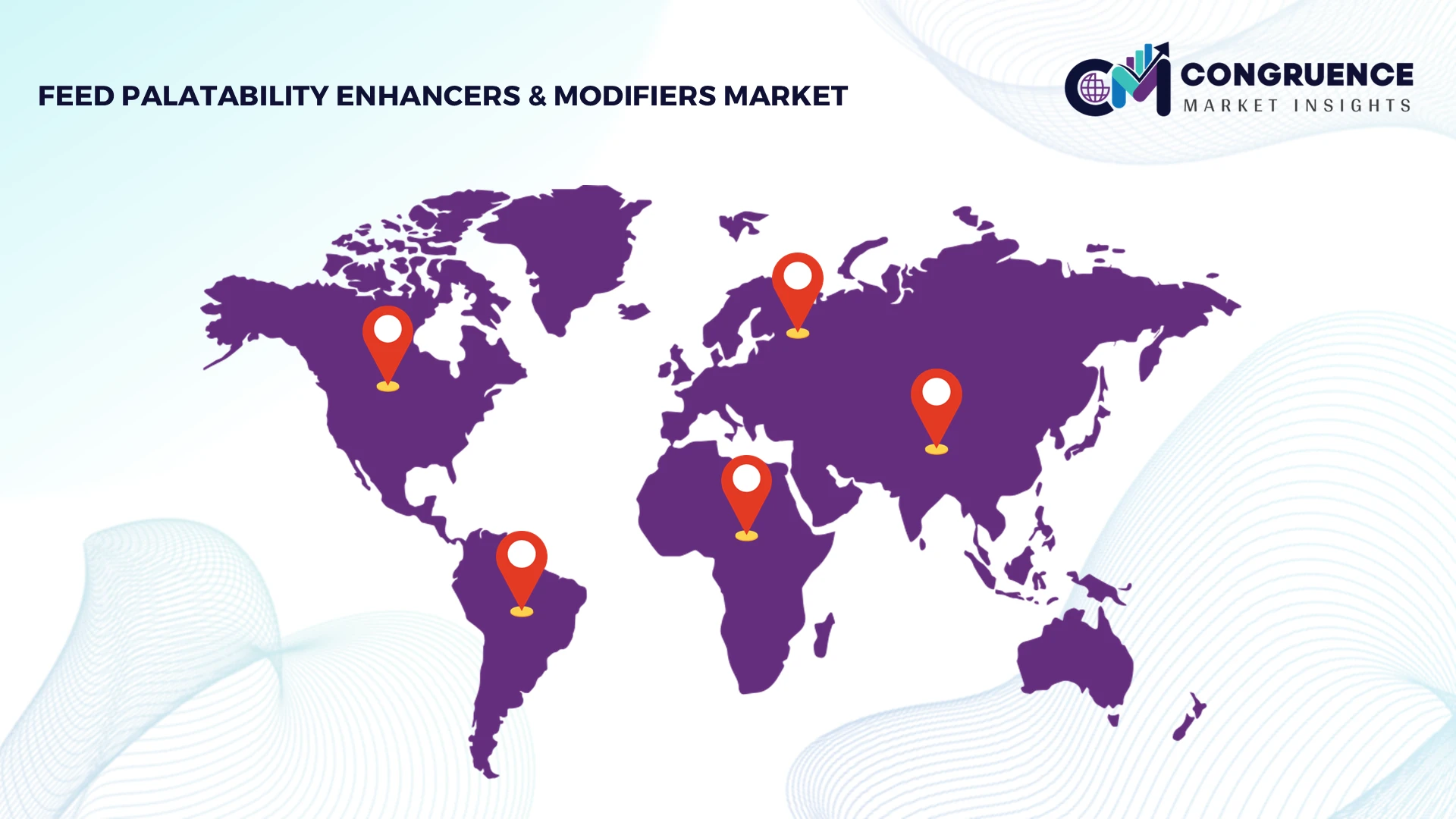
This report delivers a full-spectrum assessment of the global feed palatability enhancers and modifiers market, segmented by type (flavors, natural aromas, sweeteners, texturants), application (feed appeal, intake stimulation, diet transition support, medicated-feed acceptance), and end-user (livestock feed manufacturers, pet food producers, aquaculture operations). Regional coverage spans North America, Europe, Asia-Pacific, South America, and Middle East & Africa, with country-level analysis of China, the United States, Germany, Brazil, and Saudi Arabia as strategic demand centers.
The scope integrates technology adoption tracking—microencapsulation penetration, AI-assisted formulation deployment, and fermentation-derived attractant commercialization—alongside competitive positioning of leading suppliers. Quantitative indicators include segment distribution shares, palatant penetration rates in commercial feed systems, and adoption differentials across antibiotic-free production regimes. The report supports investment planning by mapping where volume growth concentrates versus where value capture is strongest, guides expansion strategy through regulatory-regime comparison and localization requirements, and enables competitive benchmarking against efficacy documentation depth and formulation support infrastructure. Coverage extends to emerging aquaculture palatant specialization and clean-label botanical sourcing risks, positioning decision-makers for the 2026–2033 operating environment.
| Report Attribute / Metric | Details |
|---|---|
| Market Revenue (2025) | USD 286.3 Million |
| Market Revenue (2033) | USD 341.0 Million |
| CAGR (2026–2033) | 2.33% |
| Base Year | 2025 |
| Forecast Period | 2026–2033 |
| Historic Period | 2021–2025 |
| Segments Covered |
By Type
By Application
By End-User
|
| Key Deliverables | Revenue Forecast; Market Trends; Growth Drivers & Restraints; Technology Insights; Segmentation Analysis; Regional Insights; Competitive Landscape; Regulatory & ESG Overview; Recent Developments |
| Regions Covered | North America; Europe; Asia-Pacific; South America; Middle East & Africa |
| Companies Profiled | Kerry Group; Kemin Industries; Cargill; ADM (Archer Daniels Midland); BASF; DSM; Danisco; Adisseo France; Alltech; Biovet JSC; Chr. Hansen; Evonik Industries; FMC Corporation; HealthTech Bio Actives (HTBA) |
| Customization & Pricing | Available on Request (10% Customization Free) |




