
Reports
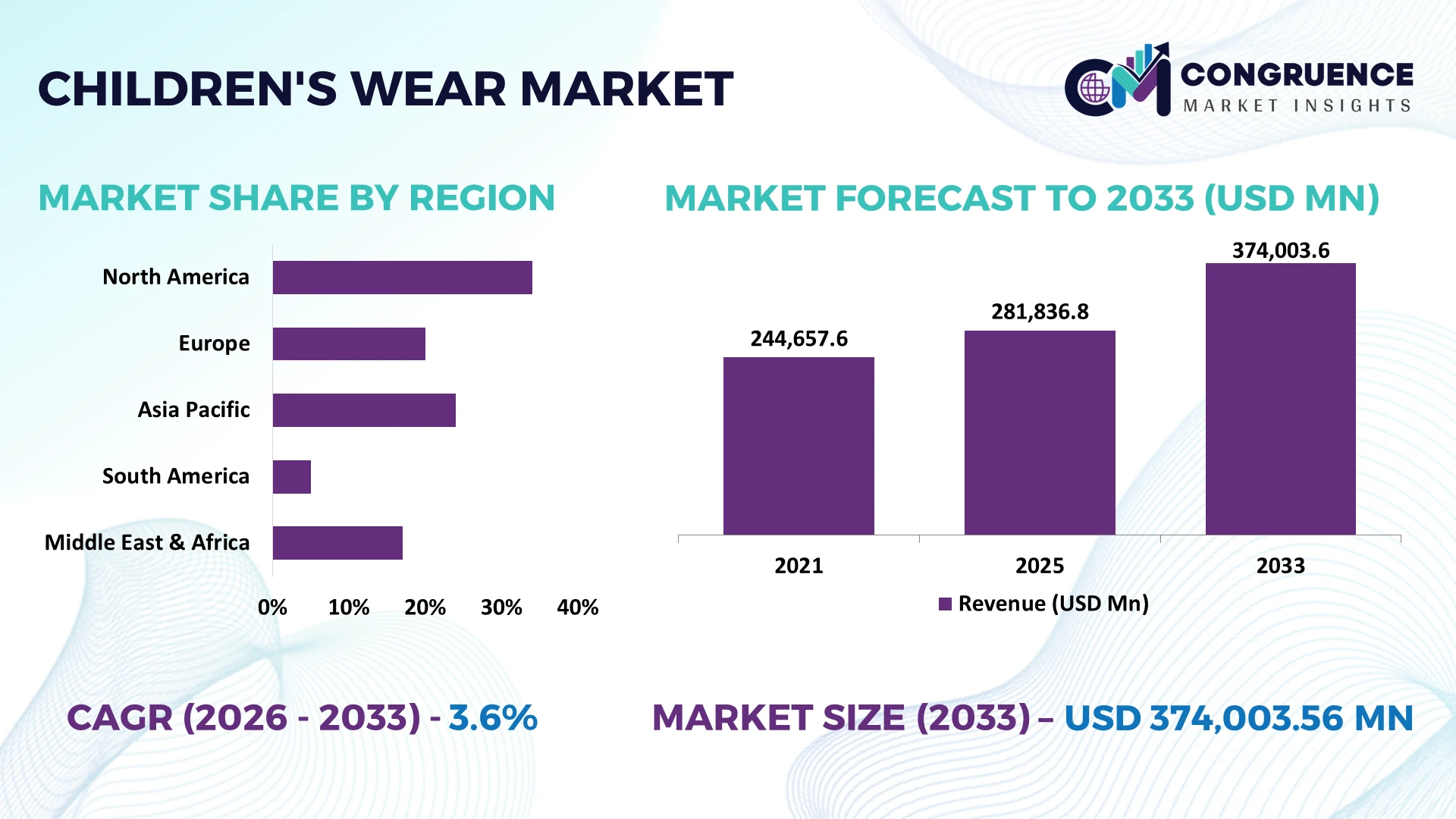
The Global Children's Wear Market was valued at USD 281836.79 Million in 2025 and is anticipated to reach a value of USD 374003.56 Million by 2033 expanding at a CAGR of 3.6% between 2026 and 2033. Growth is driven by rapid replacement cycles as children outgrow garments, premium branded apparel penetration, character licensing, social-commerce expansion, and rising demand for durable, sustainable fabrics.
China represents an estimated 18–20% of global children's wear consumption and anchors manufacturing through its integrated textile, garment, dyeing, and e-commerce ecosystem. Online retail exceeds 25% of apparel purchasing in major Chinese urban markets, while India offers a larger child population and lower manufacturing costs. U.S.–China trade tensions continue accelerating sourcing diversification toward India, Bangladesh, and Vietnam.
Strategically, brands combining diversified Asian sourcing, digital-first merchandising, rapid assortment turnover, and affordable premium positioning will secure stronger global children's apparel competitiveness.
Market Size & Growth: USD 281,836.79 million in 2025 advances to USD 374,003.56 million by 2033 at 3.6%, supported by frequent size replacement and digital apparel purchasing.
Top Growth Drivers: Replacement-led purchasing contributes approximately 40%, branded-fashion penetration 25%, and e-commerce accessibility 20% to structural demand momentum.
Short-Term Forecast: By 2027, AI-assisted demand planning can reduce children's apparel inventory forecasting errors by approximately 10–15%, limiting markdown exposure.
Emerging Technologies: AI forecasting, automated cutting and 3D digital sampling are shortening product-development workflows by approximately 15–25% across advanced apparel operations.
Regional Leaders: By 2033, Asia-Pacific approaches USD 155 billion, North America USD 92 billion, and Europe USD 85 billion, led respectively by scale, omnichannel adoption, and premiumization.
Consumer/End-User Trends: Online channels account for more than 25% of apparel purchasing in several major markets, strengthening mobile-first children's fashion discovery and replenishment.
Pilot/Case Example: In 2025, AI-enabled fashion planning deployments demonstrated approximately 10–20% inventory optimization potential by improving assortment and demand matching.
Competitive Landscape: Nike holds an estimated 4–5% global branded children's wear position, competing with adidas, H&M, Inditex, Carter's and Fast Retailing across price tiers.
Regulatory & ESG Impact: EU textile policy targets separate textile collection from 2025, accelerating recycled fibers, garment durability, take-back programs, and circular-design investment.
Investment & Funding: More than USD 500 million in apparel manufacturing and supply-chain modernization initiatives supports automation, sourcing diversification, digital commerce, and production expansion.
Innovation & Future Outlook: Digital product creation can cut physical sampling requirements by 30–50%, shifting children's wear development toward virtual prototyping, smaller production runs, and faster assortment refreshes.
Children's wear demand concentrates around everyday clothing, schoolwear, sportswear, occasionwear, and infant apparel, where frequent size replacement creates recurring purchasing cycles. AI-assisted merchandising, 3D product development, recycled textiles, and adaptive sizing are modernizing portfolios, with digital sampling capable of reducing physical prototypes by approximately 30–50%. Supply-chain diversification beyond China is simultaneously reshaping sourcing decisions, setting up the market's strategic priorities.
Children's wear is becoming strategically important as frequent size replacement, digital retail, branded sportswear, and premium infant clothing create recurring demand less dependent on conventional fashion cycles. Supply chains are simultaneously restructuring as brands reduce concentrated China exposure and expand procurement across India, Bangladesh, and Vietnam. India's 250+ million child population strengthens its importance as both a consumption base and manufacturing alternative.
Technology is changing assortment economics. AI-assisted demand planning can reduce forecasting errors by roughly 10–15%, while 3D digital sampling can cut physical prototype requirements by 30–50% versus traditional sample-intensive development. China retains superior integrated manufacturing scale; the United States leads omnichannel branded consumption, while India combines lower production costs with expanding organized retail. Digital product development therefore increasingly connects design teams directly with Asian manufacturing partners.
Through 2026–2028, automated cutting, digital sampling, RFID inventory visibility, and localized fulfillment will gain deployment. A practical model is virtual prototyping before factory sampling, reducing iterations and accelerating seasonal launches. Major brands are investing in supplier diversification, traceability, recycled materials, and digital merchandising partnerships. Competitive advantage will increasingly belong to companies combining rapid product cycles, accurate inventory allocation, compliant sourcing, and resilient multi-country manufacturing.
Rapid physical growth creates an unusually resilient replacement cycle because children's garments become unusable through sizing changes before reaching normal apparel lifespans. Children aged 0–14 represent roughly 25% of India's population, while this cohort accounts for approximately 17% in the United States and 18% globally, supporting substantial recurring apparel requirements. Organized retail and smartphone commerce are converting this demographic scale into branded demand, particularly across India and China. At the same time, school participation, sportswear adoption, and occasion dressing broaden purchase frequency beyond basic clothing. Brands are expanding age-specific collections, affordable multipacks, schoolwear, and digital-exclusive ranges. The strategic advantage comes from managing size progression effectively: accurate age-size segmentation increases repeat purchasing while improving inventory allocation across rapidly changing children's assortments.
Children's wear faces structural margin pressure because cotton, synthetic fibers, labor, freight, testing, and compliance costs must be absorbed while consumers expect lower unit prices than adult fashion. Cotton prices can fluctuate by more than 15% during volatile supply periods, while sourcing and logistics can represent 20–30% of landed garment costs for internationally distributed apparel. Bangladesh, Vietnam, India, and China remain critical production locations, exposing brands to freight disruption, currency movements, and trade-policy changes. Children's products also require stringent chemical, drawstring, flammability, and component controls. Companies are responding with multi-country sourcing, longer supplier agreements, fabric standardization, and localized procurement. Operationally, reducing style complexity can deliver greater margin protection than aggressive retail price increases because children's categories remain particularly sensitive to affordability.
Digital product creation offers a high-value pathway for reducing development waste while serving fragmented children's sizes, styles, and age groups more precisely. 3D sampling can lower physical prototype requirements by approximately 30–50%, while AI-assisted assortment planning can improve forecasting accuracy by 10–15%. RFID-supported inventory systems can also raise stock accuracy beyond 95% in well-integrated retail environments. These capabilities are especially relevant in India, where expanding organized retail intersects with a 250+ million child population and increasing mobile-commerce penetration. Companies are investing in virtual design, automated pattern development, RFID, and marketplace analytics while partnering with flexible manufacturers capable of smaller production batches. The non-obvious opportunity is SKU economics: digital development makes narrower age-, climate-, and occasion-specific assortments commercially viable without proportionally increasing sampling costs.
Execution complexity remains high because children's apparel requires multiple age bands, rapidly changing body dimensions, seasonal collections, colors, and gender-neutral or category-specific fits. A single design offered across 6–10 sizes can multiply inventory exposure before color variations are considered, while forecasting errors of 10–20% can create significant markdown pressure. Online sales add another challenge because inconsistent sizing increases returns and reverse-logistics handling, particularly across multinational platforms. European textile circularity requirements and tighter product-safety expectations also increase traceability demands across fragmented supplier networks. Companies must integrate standardized sizing data, AI forecasting, RFID visibility, digital product passports, and supplier-quality systems. Long-term competitiveness depends on controlling SKU proliferation: brands that improve size prediction and real-time inventory allocation can maintain assortment breadth without allowing complexity to erode margins or availability.
Omnichannel Kidswear Becomes Standard: Children's apparel purchasing is moving toward integrated store-and-digital journeys, with online channels exceeding 25% of apparel transactions in several developed markets. Mobile discovery influences over 50% of younger-parent purchase journeys, while click-and-collect reduces fulfillment costs by roughly 10–15%. Retailers are connecting inventory systems, stores, marketplaces, and fulfillment hubs to improve availability and accelerate size-specific replenishment.
Sourcing Networks Become More Distributed: U.S.–China trade friction and logistics volatility are accelerating supplier diversification toward India, Bangladesh, and Vietnam. China still supplies more than 30% of global clothing exports, while Bangladesh and Vietnam each command substantial export capacity. Brands are establishing dual-country sourcing, reserving factory capacity, and regionalizing supplier portfolios to reduce disruption exposure without sacrificing manufacturing scale.
Circular Kidswear Gains Commercial Traction: Short garment-use periods are strengthening resale, take-back, and durability strategies because children often outgrow clothing before physical deterioration. EU separate textile collection became mandatory from 2025, while recycled polyester represents roughly 14% of global polyester production. Brands are increasing recycled fibers, resale partnerships, repairability, and collection programs, turning children's rapid size turnover into a commercially relevant circularity opportunity.
Licensed Collections Accelerate Assortment Cycles: Entertainment, gaming, sports, and character collaborations are increasing limited-edition children's apparel launches. Licensed ranges can shorten merchandising windows to 8–12 weeks, while digital design workflows reduce sampling requirements by 30–50%. Retailers are using demand analytics and smaller production runs to respond faster to cultural moments, reducing commitment risk while generating premium pricing and store traffic.
Tops & T-Shirts lead the children's wear type segmentation with an estimated 32–35% share, supported by high purchase frequency, standardized production, year-round usability, and comparatively low unit manufacturing complexity. Basic tees, polos, graphic tops, and licensed products scale efficiently across multiple age groups and retail price points. Bottoms represent approximately 22–24%, benefiting from school, casual, and everyday replacement demand, while Dresses maintain stronger exposure to fashion, occasion, and seasonal purchasing.
Outerwear is the fastest-growing type as technical fabrics, lightweight insulation, weather-resistant coatings, and athleisure styling broaden usage beyond conventional winter garments. Premium outerwear also delivers higher average selling prices than basic tops. Sleepwear remains stable through recurring replacement and gifting demand, with safety and comfort specifications shaping material selection. Companies are increasing licensed T-shirt collections, coordinated top-bottom ranges, lightweight outerwear, and certified sleepwear. Investment is consequently shifting toward flexible manufacturing capable of handling faster design turnover without sacrificing high-volume basics.
Casual Wear leads applications with approximately 40–43% share because T-shirts, jeans, leggings, dresses, and coordinated sets serve the highest-frequency everyday occasions. School Wear contributes roughly 20–23%, supported by predictable replacement cycles and standardized purchasing, particularly in countries with widespread uniform requirements. Party Wear remains smaller but supports premium fabrics and higher-margin occasion collections, while Seasonal Wear creates concentrated demand around winter, monsoon, and holiday purchasing periods.
Sportswear is the fastest-growing application as children's participation in organized activities combines with athleisure adoption outside sports environments. Moisture management, stretch fabrics, lightweight construction, and branded footwear-apparel ecosystems are widening the category's use cases. Companies are expanding performance collections, licensed sports partnerships, and school-compatible activewear while using automated allocation systems to position size-specific stock near demand centers. The strategic shift is toward multifunctional garments: products suitable for school, recreation, and casual use improve inventory productivity while reducing dependence on narrowly defined occasions.
School-Age Children represent the largest end-user group, accounting for approximately 34–37% of children's wear demand. Their purchasing intensity combines school clothing, casual apparel, sportswear, seasonal garments, and occasion products, while rapid growth creates recurring size replacement. Preschoolers account for roughly 20–22%, with parents emphasizing durability, washability, comfort, and easy dressing. Toddlers and Infants generate frequent replacement but typically require smaller garment volumes, specialized fabrics, and stronger safety considerations.
Preteens are the fastest-growing end-user segment as fashion awareness, sports branding, social media exposure, and greater influence over parental purchasing accelerate wardrobe diversification. Their preferences increasingly resemble adult fashion cycles, encouraging shorter collections and stronger licensed, athleisure, and trend-led assortments. Companies are developing age-specific fits, expanded size architectures, digital-first collections, and differentiated pricing tiers. The competitive opportunity lies in retaining households across successive age transitions rather than treating each children's age group as an isolated customer segment.
Asia-Pacific accounted for the largest market share at approximately 39% in 2025 however, Asia-Pacific is expected to register the fastest growth, expanding at a CAGR of approximately 4.6% between 2026 and 2033.
Omnichannel Retail Reshapes Inventory Deployment
North America represents approximately 25% of global children's wear demand, led overwhelmingly by the United States. High household purchasing power, branded sportswear penetration, frequent size replacement, and established e-commerce infrastructure support premium and mass-market categories. Online channels account for more than 25% of apparel purchasing, encouraging retailers to integrate store inventories with digital fulfillment. RFID-supported stock visibility can exceed 95% accuracy in advanced deployments, improving size availability and reducing lost sales. U.S. brands are also diversifying sourcing toward Vietnam, India, and Bangladesh as trade-policy uncertainty increases dependence risks around Chinese production. Investment priorities increasingly favor automated distribution, AI-supported assortment planning, resale programs, and flexible supplier networks. The operational advantage is moving toward brands capable of replenishing individual sizes rapidly rather than simply carrying broader seasonal inventories.
United States Market Outlook: The United States accounts for an estimated 85–90% of North American children's wear demand and combines extensive mass retail, department-store, sportswear, specialty and digital distribution. High penetration of licensed merchandise and athletic apparel supports rapid assortment turnover. Companies increasingly deploy RFID, predictive merchandising, marketplace fulfillment, and diversified Asian sourcing to improve inventory productivity and respond faster to changing children's sizes and fashion preferences.
Circularity Reshapes Apparel Product Economics
Europe contributes approximately 22% of global children's wear demand, with Germany, the United Kingdom, France, Italy, and Spain forming the principal consumption centers. Children's rapid size turnover makes durability, resale, recycling, and garment take-back particularly relevant to the region's circular-textile agenda. Separate textile collection became mandatory across EU member states from 2025, increasing pressure on retailers to address post-consumer garments systematically. Digital product passports, recycled fibers, traceability systems, and lower-impact materials are consequently moving deeper into apparel planning. Premium children's brands are also balancing sustainability requirements with strict chemical and product-safety compliance. Companies are redesigning garments for durability, consolidating material specifications, and expanding resale or collection initiatives. These measures can extend usable garment life while creating secondary channels for clothing outgrown well before physical deterioration.
Germany Market Outlook: Germany combines high purchasing power, mature online apparel penetration, strong sustainability expectations, and extensive organized retail. Children's clothing suppliers increasingly compete through certified textiles, durability and transparent supply chains rather than rapid fashion turnover alone. EU product-safety and textile circularity requirements are accelerating traceability investments, giving established brands with compliant supplier networks a stronger operational position than fragmented import-dependent sellers.
Manufacturing Scale Meets Digital Consumption
Asia-Pacific controls approximately 39% of global children's wear demand and combines the world's largest child populations with dominant textile and garment manufacturing infrastructure. China anchors integrated fabric, dyeing, garment and e-commerce capabilities, while India provides a 250+ million child population and expanding domestic apparel manufacturing. Bangladesh and Vietnam strengthen the regional sourcing ecosystem through export-oriented garment clusters. China still accounts for more than 30% of global clothing exports, although international brands are increasingly implementing China-plus-one sourcing strategies. India is gaining production investment through manufacturing incentives and competitive labor availability, while Japan and South Korea influence premium styling and functional materials. Brands are building multi-country procurement networks, digital supplier platforms, automated cutting capabilities, and localized e-commerce assortments, making Asia-Pacific central to both supply resilience and consumer expansion.
China Market Outlook: China remains the region's most strategically integrated children's wear market, contributing an estimated 18–20% of global consumption while maintaining unparalleled apparel supply-chain depth. Advanced e-commerce, livestream retail, automated factories, and domestic textile clusters shorten design-to-market cycles. Local and international brands increasingly combine digitally generated demand signals with flexible production, enabling faster replenishment of character, casual, sportswear, and seasonal children's collections.
Localized Production Supports Value Positioning
South America represents approximately 8% of global children's wear demand, with Brazil controlling the largest consumption and manufacturing base. High urbanization, an established domestic textile industry, expanding marketplace commerce, and strong demand for casual children's clothing support localized production. Brazil's textile and apparel ecosystem contains tens of thousands of operating businesses, allowing retailers to source basic garments domestically while selectively importing specialized products. Argentina, Colombia, and Chile provide additional organized-retail demand, although currency volatility and import costs complicate inventory planning. Brands are increasing local sourcing, marketplace distribution, smaller production runs, and flexible pricing architectures to reduce foreign-exchange exposure. Regional operators benefit from shorter replenishment distances, particularly for basic tops, bottoms, and school-related garments. However, fragmented logistics outside major metropolitan areas continues to constrain consistent nationwide assortment availability.
Brazil Market Outlook: Brazil accounts for an estimated 55–60% of South American children's wear demand and benefits from substantial domestic textile, knitting and garment capacity. São Paulo remains the principal commercial and fashion distribution hub. Local manufacturing enables brands to respond faster to climate-specific assortment requirements while reducing exposure to imported finished-garment costs, making flexible domestic sourcing an important competitive lever.
Young Demographics Expand Retail Infrastructure
Middle East & Africa represents approximately 6% of global children's wear demand but contains some of the world's youngest consumer populations. In several African countries, children aged 0–14 exceed 35% of the population, creating substantial underlying clothing requirements despite lower organized-retail penetration. Saudi Arabia and the UAE provide premium demand through malls, international brands, tourism, and sophisticated e-commerce, while South Africa operates a mature value-fashion and supermarket distribution ecosystem. Gulf retail modernization is expanding digital fulfillment and branded children's apparel access, whereas African markets remain more dependent on informal trade, imports, and price-sensitive basics. Companies are responding with franchise partnerships, localized online platforms, value-oriented ranges, and regional distribution agreements. The strategic opportunity lies in matching demographic scale with affordable products rather than transplanting premium Western assortment structures.
Saudi Arabia Market Outlook: Saudi Arabia combines a comparatively young population with rapidly modernizing retail, mall infrastructure, digital payments, and e-commerce adoption. Riyadh and Jeddah concentrate international and domestic children's brands, while entertainment development is increasing demand for casual, licensed, and occasion apparel. Retailers are expanding omnichannel operations and localized collections aligned with climate, cultural requirements, and family purchasing patterns.
The children's wear market pits Nike, adidas, Inditex, H&M and Fast Retailing against specialists such as Carter's and premium regional brands. The top five groups collectively hold approximately 16–20% of global sales, reflecting fragmentation across price tiers, countries and channels. Competition centers on brand strength, price, assortment speed, sourcing resilience and digital availability. Digital sampling can reduce physical prototypes by 30–50%, while AI planning can lower forecasting errors by 10–15%; diversified sourcing can cut single-country exposure by more than 20%. Inditex and H&M compete through rapid assortment rotation, Nike and adidas leverage sports ecosystems, while Carter's concentrates on age-specific specialization. Players are expanding marketplaces, supplier networks, automated distribution and licensed collections. Competition is shifting toward data-led merchandising, circularity and smaller production runs. Supplier compliance, inventory complexity and customer-acquisition costs remain entry pressures. Winning requires trusted branding, precise sizing, responsive sourcing, rapid replenishment and disciplined omnichannel inventory execution across markets.
Nike, Inc.
adidas AG
Inditex
H&M Group
Fast Retailing Co., Ltd.
Carter's, Inc.
Gap Inc.
Ralph Lauren Corporation
PVH Corp.
Next plc
Marks and Spencer Group plc
Benetton Group
Under Armour, Inc.
Columbia Sportswear Company
Current children's wear technology centers on AI demand forecasting, RFID inventory visibility, automated cutting, and 3D digital product creation. AI planning can reduce forecasting errors by 10–15%, while RFID deployments can push inventory accuracy above 95%. Large omnichannel retailers increasingly integrate these systems across stores and distribution centers, reducing stockouts, markdown exposure, and size-specific inventory imbalances while accelerating replenishment decisions across high-turnover children's categories.
Emerging technologies include 3D sampling, automated pattern grading, digital fit simulation, and recycled-fiber traceability. Digital prototypes can reduce physical sampling requirements by 30–50% compared with conventional sample-intensive development, while automated cutting can improve fabric utilization by approximately 5–10%. Adoption is expanding among vertically integrated apparel groups and technology-enabled suppliers. Fast-fashion operators gain the strongest advantage because shorter development cycles support licensed collections, seasonal ranges, and rapid style rotation.
Disruptive pathways combine generative AI, digital product passports, virtual fitting, and demand-linked micro-batch manufacturing. Between 2026 and 2028, wider integration should shorten product-development cycles by 15–25% and improve SKU-level allocation. Brands connecting design, sourcing, compliance, and inventory data will outperform fragmented operators. Investment matters now because children's rapid size progression makes forecasting accuracy, flexible production, and digital traceability unusually valuable competitive capabilities globally.
February 2024 H&M launched its first childrenswear collaboration with Swedish childrenswear brand Mini Rodini, creating an 18-piece collection using organic cotton and recycled polyester. The partnership strengthened H&M Kids’ design differentiation while extending sustainability-focused materials into accessible children's fashion. Source: hm.com
September 2024 Gap expanded its Disney relationship through a GapKids collaboration celebrating Disney characters across apparel and accessories, building on a partnership spanning more than 30 years. The initiative strengthened licensed childrenswear merchandising and increased cross-generational customer engagement. Source: gapinc.com
March 2025 Carter’s outlined transformation measures targeting approximately $40 million in annualized savings, including organizational and operational restructuring. The children's apparel specialist sharpened cost controls and resource allocation as promotional pressure and changing consumer purchasing patterns affected the category. Source: carters.com
April 2025 Nike expanded its partnership with LEGO Group, developing products and experiences designed specifically around children’s sport and creative play, targeting children aged 1–17. The collaboration strengthens Nike’s youth ecosystem beyond conventional apparel through activity-led brand engagement. Source: lego.com
The Children's Wear Market report evaluates Tops & T-Shirts, Dresses, Bottoms, Outerwear, and Sleepwear, alongside Casual Wear, School Wear, Party Wear, Sportswear, and Seasonal Wear applications. End-user analysis covers Infants, Toddlers, Preschoolers, School-Age Children, and Preteens. School-age children represent approximately 34–37% of demand, while Tops & T-Shirts account for an estimated 32–35% of type-level consumption.
Regional coverage spans North America, Europe, Asia-Pacific, South America, and Middle East & Africa, including manufacturing hubs, sourcing shifts, digital retail penetration, and emerging consumer markets. Technology analysis covers AI forecasting, RFID, automated cutting, 3D sampling, digital fit systems, traceability, and micro-batch production. The report assesses competitive positioning, sourcing resilience, circular apparel models, licensed merchandise, and omnichannel execution, supporting investment planning, supplier diversification, geographic expansion, portfolio optimization, and technology deployment decisions between 2026 and 2033.
| Report Attribute/Metric | Report Details |
|---|---|
Market Revenue in 2025 | USD 281836.79 Million |
Market Revenue in 2033 | USD 374003.56 Million |
CAGR (2026 - 2033) | 3.6% |
Base Year | 2025 |
Forecast Period | 2026 - 2033 |
Historic Period | 2021 - 2025 |
Segments Covered | By Type
By Application
By End-User
|
Key Report Deliverable | Revenue Forecast, Growth Trends, Market Dynamics, Segmental Overview, Regional and Country-wise Analysis, Competition Landscape |
Region Covered | North America, Europe, Asia-Pacific, South America, Middle East, Africa |
Key Players Analyzed | Nike, Inc., adidas AG, Inditex, H&M Group, Fast Retailing Co., Ltd., Carter's, Inc., Gap Inc., Ralph Lauren Corporation, PVH Corp., Next plc, Marks and Spencer Group plc, Benetton Group, Under Armour, Inc., Columbia Sportswear Company |
Customization & Pricing | Available on Request (10% Customization is Free) |




