
Reports
The Global Bamboo Fiber Tableware & Kitchenware Market was valued at USD 388.48 Million in 2025 and is anticipated to reach a value of USD 673 Million by 2033 expanding at a CAGR of 7.11% between 2026 and 2033. Growth is driven by plastic-tableware restrictions, bamboo-processing automation, and foodservice conversion toward renewable food-contact materials.
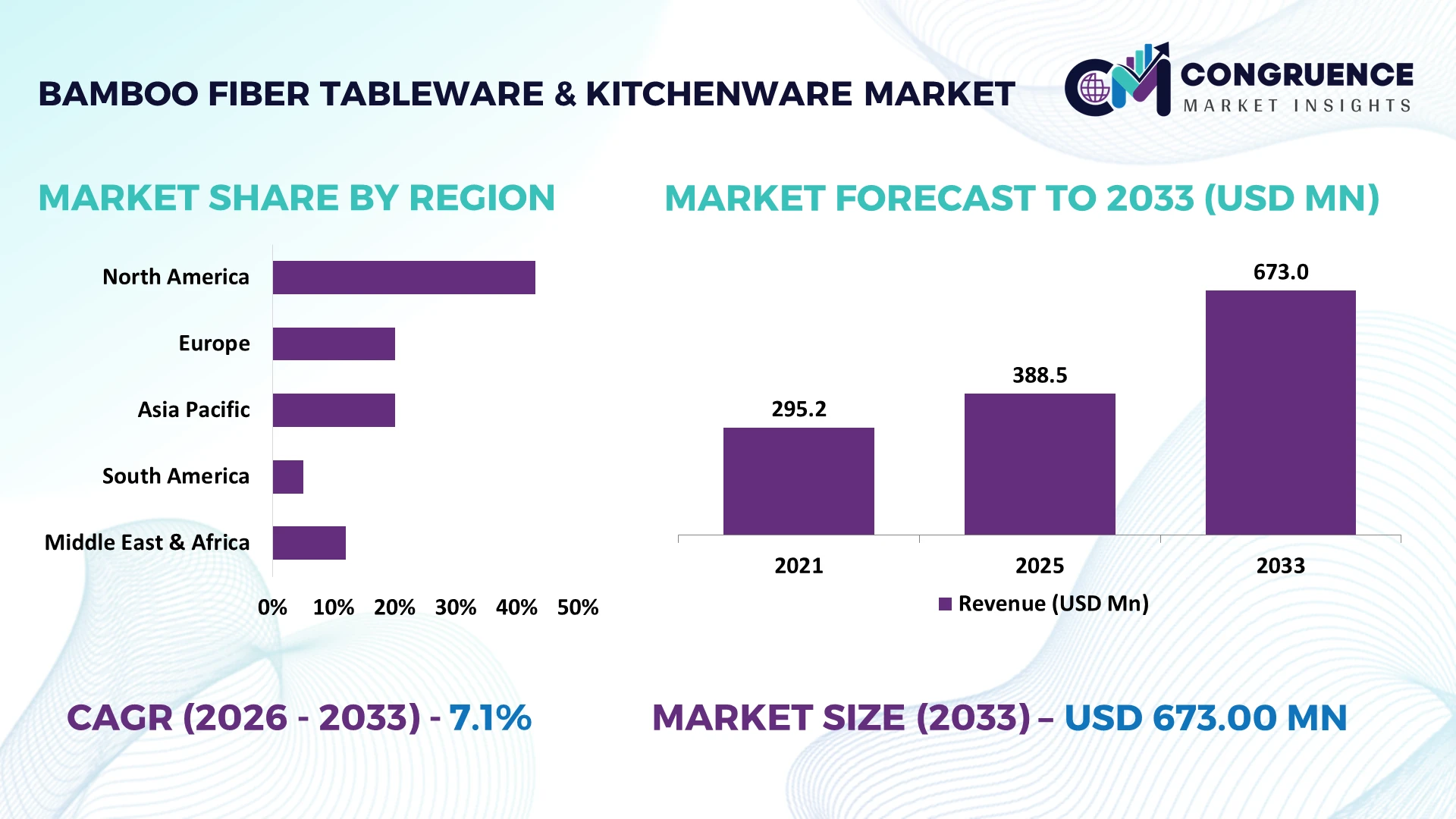
China dominates the supply ecosystem, with Asia-Pacific holding about 46.35% market share and China leading country growth at 7.8%; Anji alone generated over USD 2.7 billion in bamboo-industry output in 2025. Around 70% of Anji bamboo products are exported, while automated processing has improved material utilization by 20%. India follows China with 7.3% country growth, strengthening regional competition.
The strategic priority is to secure compliant Chinese supply while expanding premium, foodservice-focused capacity across India and other high-growth Asian markets.
Market Size & Growth: USD 388.48 million to USD 673 million, supported by automation and plastic substitution.
Top Growth Drivers: Plastic replacement 31%; sustainable-material adoption 24%; foodservice conversion 18%.
Short-Term Forecast: By 2028, automation targets 10% lower processing costs and 8% higher material efficiency.
Emerging Technologies: AI quality inspection, automated molding, and advanced bamboo-fiber composites are accelerating production consistency.
Regional Leaders: Asia-Pacific approaches USD 236 million; Europe USD 209 million; North America USD 168 million, led by sustainable procurement.
Consumer Trends: Residential users represent about 58%, with reusable and design-led products gaining traction.
Pilot/Case Example: In 2025, Anji machinery delivered at least 20% higher material utilization through cleaner processing.
Competitive Landscape: Shaoneng Group leads at over 5%; key players include LEKOCH, Bambu Home, Ekobo, and Suncha Technology.
Regulatory & ESG Impact: EU plastic tableware restrictions and food-contact controls are accelerating compliant material substitution across 21 European countries.
Investment & Funding: A USD 84 million Chinese bamboo-fiber facility targets 120,000 tons of annual capacity with 180 automated machines.
Innovation & Future Outlook: Supply chains are shifting toward waste-derived fibers, premium molded designs, traceability, and scalable bamboo-for-plastic manufacturing.
Bamboo fiber tableware and kitchenware is gaining strongest traction in plates, bowls, takeaway formats, reusable dining products, and hospitality procurement. Plates and bowls account for about 41% of product demand in available market estimates, while automation is improving consistency and material utilization. China’s “Bamboo for Plastic” initiative and tighter European food-contact scrutiny are pushing manufacturers toward verified compositions, cleaner processing, and export-ready compliance, creating a stronger strategic case for advanced product development and diversified supply chains.
Bamboo fiber tableware and kitchenware is becoming strategically important as manufacturers respond to plastic restrictions, food-contact requirements, and procurement shifts toward renewable materials. China remains the dominant production base, while India is expanding processing capacity and Europe is tightening compliance expectations. This supply-chain restructuring is pushing companies to secure certified bamboo inputs, modernize molding lines, and develop export-ready product portfolios.
Advanced automated molding and machine-vision inspection can reduce production scrap by 12–18% and improve dimensional consistency by about 10% versus conventional manual inspection and forming. China benefits from established bamboo-processing clusters, while India has greater room for capacity modernization and organized manufacturing adoption. Over the next 2–3 years, automated quality control, traceability, and certified food-contact formulations are positioned to become standard procurement requirements.
A practical deployment pathway involves integrating bamboo-fiber pulping, automated compression molding, and digital inspection within a single production workflow, reducing handling losses and shortening quality cycles. Companies are redirecting investment toward high-volume plates, bowls, foodservice containers, and premium reusable products while forming partnerships with material processors and hospitality distributors. Competitive advantage will increasingly depend on compliant materials, production consistency, and diversified sourcing rather than bamboo availability alone.
Plastic-reduction policies and automated processing are strengthening structural demand for bamboo-fiber alternatives. Foodservice buyers are increasingly shifting procurement toward renewable tableware, while automated molding can improve material utilization by 12–18% and reduce labor-intensive handling by roughly 15%. China’s established bamboo clusters provide manufacturers with integrated raw-material and processing networks, accelerating commercialization. Companies are responding by expanding compression-molding capacity, upgrading inspection systems, and developing food-contact-compliant formulations. The non-obvious advantage is manufacturing repeatability: standardized fiber preparation reduces dimensional variation, enabling larger hospitality contracts and export batches. Producers that combine local bamboo sourcing with automated forming are gaining stronger cost control and faster product customization.
Bamboo-fiber manufacturers face structural constraints from feedstock variability, formulation consistency, and food-contact compliance. Moisture and fiber-quality differences can increase processing losses by 8–12%, while specialized additives and testing requirements can add approximately 5–10% to finished-product costs. Chinese producers benefit from mature processing ecosystems, whereas smaller Indian manufacturers often face greater requirements for formulation standardization and testing infrastructure. Companies are mitigating exposure through multi-supplier contracts, localized preprocessing, and tighter incoming-material inspection. A critical operational issue is that lower-cost bamboo input does not automatically deliver lower unit economics; inconsistent fiber quality can increase reject rates and erode the savings gained from inexpensive raw materials.
Automation, traceability, and advanced composite formulations are creating higher-value opportunities beyond basic household tableware. Digital inspection can reduce defect identification time by 20–30%, while optimized fiber formulations can improve product strength by approximately 10–15%. India’s expanding organized foodservice sector offers an underpenetrated channel for standardized reusable plates, bowls, and takeaway formats. Companies are positioning through R&D partnerships, automated production lines, and premium designs that target hospitality and institutional procurement. A particularly attractive opportunity is traceable bamboo-fiber products linked to verified sourcing and food-contact documentation, allowing manufacturers to command stronger procurement preference while reducing compliance friction across export markets.
Long-term competitiveness depends on achieving consistent mechanical performance across high-volume production while meeting evolving food-contact and sustainability expectations. Variations in fiber length, resin distribution, and moisture can create 6–10% differences in product strength, complicating large institutional orders. Manufacturers also face workforce gaps in composite formulation and automated-process maintenance, particularly outside established Chinese industrial clusters. Companies must invest in process-control systems, operator training, laboratory testing, and supplier integration to stabilize output. The strategic challenge is not simply scaling capacity; it is maintaining identical performance across batches, molds, and production sites. Producers that solve this consistency problem can secure larger multinational foodservice contracts and build stronger export resilience.
Automated Molding Adoption: Automated compression molding is reducing material handling requirements by 12–18% and improving dimensional consistency by approximately 10%. Chinese manufacturers are integrating automated forming with machine-vision inspection to address labor constraints, increase batch uniformity, and shorten production cycles.
Takeaway Format Optimization: Takeaway products are receiving greater manufacturing attention as foodservice operators prioritize stackability, leak resistance, and thermal stability. Optimized molding can improve handling efficiency by 8–12%, prompting manufacturers to redesign containers, strengthen fiber formulations, and expand dedicated production capacity.
Digital Traceability Integration: Digital batch tracking and fiber-source documentation are entering supplier-qualification workflows, with sustainability influencing approximately 83% of packaging-substrate decisions among surveyed foodservice organizations. Manufacturers are responding through standardized formulations, documented bamboo sourcing, and integrated quality-control systems.
Specification-Based Procurement: Foodservice purchasing is shifting toward measurable durability, food-contact compliance, and lifecycle performance. Approximately 84% of foodservice companies prioritize sustainability in packaging selection, encouraging suppliers to strengthen testing, documentation, and product-performance specifications rather than relying on environmental positioning alone.
Plates represent the leading type at approximately 31% share, supported by high-volume deployment across households, restaurants, hotels, and catering operations. Their simple geometry enables efficient molding, nesting, and packaging, giving manufacturers strong scalability. Bowls account for nearly 23%, supported by broad meal-serving applications, while Cups represent about 17% as producers improve moisture resistance and structural stability. Cutlery contributes approximately 12% and remains important for bundled foodservice solutions.
Food Containers are the fastest-growing type, with adoption expanding approximately 11–13% as takeaway operators prioritize stackability, portion control, leak resistance, and food-contact performance. Companies are shifting investment toward container-lid compatibility, reinforced fiber formulations, and automated forming. This creates a strategic shift from mature, high-volume Plates toward engineered Food Containers, where customization, stronger performance, and private-label contracts offer higher commercial value.
Food Serving leads application demand at approximately 34% share because Plates, Bowls, Cups, and Cutlery are deployed across routine household and commercial dining. Food Storage represents nearly 22%, while Meal Preparation accounts for about 17%, supported by demand for reusable kitchen formats. Companies are standardizing dimensions and strengthening surface finishes to improve durability and reduce replacement frequency.
Takeaway is the fastest-growing application, with adoption increasing approximately 11–13% as quick-service restaurants and delivery operators prioritize packaging performance. Catering represents around 14% and benefits from stackable formats that simplify high-volume event logistics. Companies are expanding Takeaway-specific molds, improving structural strength, and integrating standardized packaging workflows. The shift makes Takeaway increasingly operationally critical because packaging performance directly affects transport efficiency, food presentation, and customer experience.
Restaurants represent the leading end-user group at approximately 35% share because of high transaction volumes, frequent replacement cycles, and standardized procurement requirements. Households follow at nearly 32%, supported by reusable kitchenware purchases, while Hotels account for about 12%. Catering Companies contribute approximately 9%, with purchasing concentrated around events and high-volume serving requirements. Companies serving Restaurants are increasingly emphasizing durability, stackability, and consistent specifications.
Foodservice Operators are the fastest-growing end-user group, with adoption rising approximately 12–14% as organized chains incorporate sustainability, food-contact, and performance requirements into procurement. Restaurants prioritize operational durability, while Hotels emphasize design consistency and guest experience. Companies are responding through customized specifications, private-label manufacturing, bundled portfolios, and longer-term procurement agreements. This shift is moving competitive focus from household replacement demand toward institutional contracts where standardized products can generate larger recurring orders and stronger capacity utilization.
Asia-Pacific accounted for the largest market share at 46.35% in 2025 however, Asia-Pacific is expected to register the fastest growth, expanding at a CAGR of 7.8% between 2026 and 2033.
Foodservice Conversion Strengthens Commercial Demand
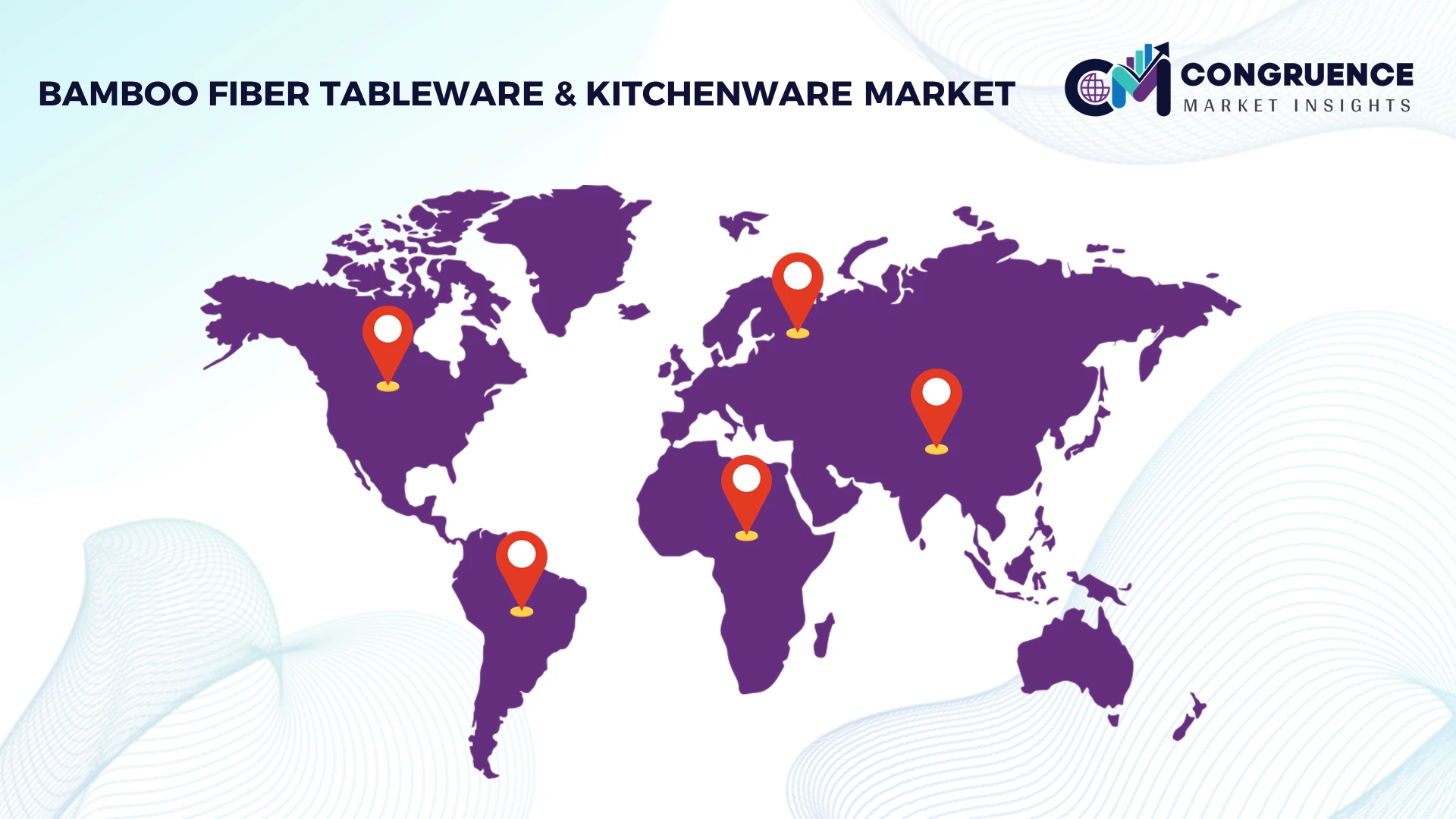
North America represents approximately 24% of global demand, with the United States contributing more than 70% of regional consumption. Restaurants, hotels, catering companies, and institutional foodservice operators are increasing procurement of bamboo-fiber plates, bowls, cups, and food containers as plastic-reduction requirements reshape packaging specifications. Off-premises dining remains an important deployment channel, while retailers are expanding reusable and premium sustainable tableware ranges. Manufacturers are responding through private-label partnerships, regional warehousing, and customized product development. Automated inspection and standardized molding are improving batch consistency by roughly 10%, helping suppliers meet larger institutional contracts. Supply diversification is also becoming more important as North American buyers seek shorter replenishment cycles and reduced dependence on single-country sourcing. Competitive positioning increasingly depends on compliance documentation, delivery reliability, and product durability rather than sustainability claims alone.
United States Market Outlook: The United States is the dominant North American demand center, accounting for more than 70% of regional consumption. Its large restaurant and foodservice infrastructure supports recurring procurement of durable tableware and takeaway formats. Approximately 90% of off-premises diners prioritize packaging performance when ordering food, strengthening demand for engineered products that preserve quality during transport.
Food-Contact Compliance Reshapes Product Specifications
Europe contributes approximately 19% of global demand, with Germany, France, and the United Kingdom forming the principal commercial markets. Regulatory scrutiny of bamboo-containing food-contact materials is forcing manufacturers to distinguish genuine bamboo-fiber products from unauthorized plastic composites. This is increasing demand for documented formulations, laboratory testing, traceable raw materials, and compliant labeling. Manufacturers are reallocating product-development resources toward reusable plates, bowls, cups, and food containers with verified food-contact characteristics. Premium suppliers are also strengthening distributor relationships to address retailer qualification requirements. Germany, France, and the United Kingdom together represent more than 60% of European consumption, creating concentrated opportunities for suppliers with established compliance infrastructure. The strategic shift is moving competition from low-cost material substitution toward technically verified products capable of meeting stringent European procurement specifications.
Germany Market Outlook: Germany is a leading European market because of its sophisticated retail network, extensive hospitality infrastructure, and stringent product-compliance environment. Germany, France, and the United Kingdom collectively represent more than 60% of European consumption. Manufacturers targeting Germany are prioritizing documented material composition, durable reusable designs, and standardized product specifications for retail and foodservice procurement.
Manufacturing Scale Drives Supply-Chain Leadership
Asia-Pacific commands approximately 46.35% of global demand and remains the principal manufacturing and export base. China holds the strongest production position through integrated bamboo cultivation, fiber processing, molding, tooling, and export networks. Anji, Zhejiang, recorded approximately RMB 19.2 billion in bamboo-industry output in 2024, demonstrating the depth of its industrial ecosystem. India is emerging as an alternative manufacturing center, supported by expanding bamboo cultivation and organized foodservice demand. Companies are investing in automated compression molding, digital inspection, product diversification, and export-oriented capacity. China retains a significant scale advantage, while India offers opportunities for supply-chain diversification and localized production. Manufacturers are increasingly combining automated processing with direct sourcing to improve material utilization, reduce handling losses, and strengthen cost competitiveness across international markets.
China Market Outlook: China remains the strategic manufacturing hub because of its mature bamboo-processing clusters, specialized machinery base, and established export infrastructure. Anji exports approximately 70% of its bamboo products, demonstrating strong international supply-chain integration. Manufacturers are increasingly moving toward engineered tableware and foodservice formats, creating higher-value opportunities beyond conventional bamboo household products.
Brazil Leads Sustainable Foodservice Adoption
South America contributes approximately 6% of global demand, with Brazil representing more than 55% of regional consumption. Restaurants, hotels, catering companies, and premium retailers are the principal demand centers, while limited domestic processing capacity leaves part of the market dependent on imported finished products. Brazil's established agricultural infrastructure provides a foundation for developing localized bamboo preprocessing and fiber manufacturing. Companies are expanding through distributor partnerships, regional inventory, and product portfolios focused on plates, bowls, and takeaway containers. Logistics remain a material cost consideration, particularly for suppliers importing finished tableware from Asia. The non-obvious opportunity is upstream localization: integrating bamboo cultivation, preprocessing, and molding within Brazil could reduce import dependency while improving lead-time control. Manufacturers with localized processing capabilities can gain stronger procurement positions as foodservice operators seek more reliable sustainable-material supply.
Brazil Market Outlook: Brazil is the strongest South American market due to its large foodservice sector, established agricultural base, and expanding sustainability-oriented procurement. More than 55% of regional demand is concentrated in Brazil. Companies are increasingly evaluating domestic bamboo processing and distributor partnerships to reduce finished-product import dependence and improve replenishment reliability.
Hospitality Modernization Drives Premium Procurement
Middle East & Africa accounts for approximately 5% of global demand, with purchasing concentrated in Gulf hospitality, tourism, catering, and premium foodservice operations. The United Arab Emirates and Saudi Arabia are the principal commercial centers, supported by large hotel networks, international tourism, airports, and event infrastructure. Premium plates, cups, bowls, and serving formats are gaining attention where sustainability must align with visual presentation and durability. Companies are responding through regional distributors, localized inventory, hospitality-specific customization, and long-term procurement relationships. Import dependence remains higher than in established Asian manufacturing hubs, making inventory positioning strategically important. Suppliers that maintain regional stock can shorten replenishment cycles by approximately 15–20% compared with purely order-based import models. Competitive advantage is increasingly linked to hospitality specifications, delivery reliability, and product customization.
United Arab Emirates Market Outlook: The United Arab Emirates is the region's leading commercial hub because of its concentrated hospitality infrastructure, international tourism activity, and advanced import-distribution network. Dubai's hotel and catering ecosystem creates recurring demand for premium sustainable tableware. Suppliers are strengthening local distribution and warehouse partnerships to improve availability and meet contract-based hospitality procurement requirements.
The competitive landscape includes Shaoneng Group, LEKOCH, Bambu Home, Ekobo, Suncha Technology, and specialized regional manufacturers competing across cost leadership, premium design, foodservice supply, and household channels. The top five players collectively hold approximately 19% share, leaving significant room for regional suppliers and niche brands. Chinese manufacturers compete primarily through scale, integrated bamboo sourcing, and production efficiency, while premium brands differentiate through design and customization. Automated molding can reduce processing costs by 10–15%, while integrated sourcing can improve material utilization by approximately 15–20%. Companies are expanding through capacity upgrades, private-label partnerships, distributor networks, and vertical integration. Competition is shifting toward traceable materials, food-contact compliance, faster customization, and reliable delivery. Entry pressure remains high around tooling, formulation consistency, certification, and export documentation. Winning requires supply-chain control, competitive unit economics, compliant materials, and the ability to customize products rapidly for institutional buyers.
Shaoneng Group
LEKOCH
Bambu Home
Ekobo
Suncha Technology Co., Ltd.
EcoSouLife
Better Earth
Totally Bamboo
ZUPERZOZIAL
Bamboo India
ChopValue
EcoSoul
Mann Bamboo Fiber Ware Co., Ltd.
Panabam Green Home Co., Ltd.
Automated compression molding, precision fiber preparation, and machine-vision inspection are the current technology backbone. Compared with manual forming and visual inspection, integrated automated lines can improve material utilization by 12–18% and reduce handling-related labor requirements by about 15%. Adoption is strongest among large Chinese manufacturers, where production scale justifies automated tooling, inline quality checks, and standardized moisture control.
Emerging technologies are shifting toward engineered bamboo composites, digital traceability, and waste-derived fiber processing. EKOBO uses bamboo fiber sourced from leftover chopstick-factory sawdust, converting an industrial by-product into reusable tableware. This approach can reduce raw-material waste by approximately 10–15% while improving feedstock utilization. By 2028, connected quality-control systems are positioned to reach roughly 35–40% deployment among export-oriented manufacturers, strengthening consistency and documentation.
Disruptive development is centered on PFAS-free, home-compostable bamboo composites and advanced thermoforming. New formulations targeting 93.8% degradation within 128 days demonstrate a significant performance shift from conventional mixed-material products. During 2026–2028, automated molding, material traceability, and certified compostability will increasingly determine supplier qualification. Technology leaders benefit most because they can combine lower processing losses, faster customization, regulatory readiness, and scalable foodservice production, creating stronger competitive positioning than cost-only manufacturers.
September 2025 EcoSoul Home secured USD 20 million in Series B funding, including USD 17 million equity and USD 3 million debt. The capital supports manufacturing expansion, international entry, and product development across India and overseas markets. Source: economictimes.indiatimes.com
October 2024 Bambu announced Ceres organic certification for its Veneerware bamboo plates, bowls, cutlery, and trays. The certification covered two core product lines, strengthening verified sourcing credentials and supporting retailer and foodservice procurement requirements. Source: bambuhome.com
July 2025 Sichuan Huanlong Ecological Technology received approval for a RMB 1.5 billion bamboo-fiber project, including 46,000 tons of molded-paper tableware capacity. The project targets major pulp substitution and strengthens China's integrated bamboo-material supply chain. Source: joyful-printing.com
February 2026 EKOBO detailed its bamboo-fiber eco-composite approach using leftover sawdust from chopstick factories as feedstock. The material strategy converts manufacturing waste into reusable tableware, strengthening circular sourcing and differentiated product positioning. Source: ekobo.co
The report evaluates the Bamboo Fiber Tableware & Kitchenware Market across Plates, Bowls, Cups, Cutlery, and Food Containers, with application coverage spanning Food Serving, Food Storage, Meal Preparation, Catering, and Takeaway. End-user analysis covers Households, Restaurants, Hotels, Catering Companies, and Foodservice Operators. Regional assessment includes North America, Europe, Asia-Pacific, South America, and Middle East & Africa, with country-level emphasis on China, the United States, Germany, India, Brazil, and the United Arab Emirates.
The scope also examines automated molding, precision fiber processing, machine-vision inspection, traceability, engineered bamboo composites, and compostable formulations. Strategic analysis evaluates supply-chain restructuring, regulatory compliance, product innovation, manufacturing localization, and competitive positioning. Segment-level indicators such as approximately 31% share for Plates and 11–13% adoption growth for Food Containers provide decision-useful benchmarks. The report supports investment planning, capacity expansion, sourcing diversification, partnership strategy, and competitive positioning from 2026 through 2033.
| Report Attribute/Metric | Report Details |
|---|---|
Market Revenue in 2025 | USD 388.48 Million |
Market Revenue in 2033 | USD 673 Million |
CAGR (2026 - 2033) | 7.11% |
Base Year | 2025 |
Forecast Period | 2026 - 2033 |
Historic Period | 2021 - 2025 |
Segments Covered | By Type
By Application
By End-User
|
Key Report Deliverable | Revenue Forecast, Growth Trends, Market Dynamics, Segmental Overview, Regional and Country-wise Analysis, Competition Landscape |
Region Covered | North America, Europe, Asia-Pacific, South America, Middle East, Africa |
Key Players Analyzed | Shaoneng Group, LEKOCH, Bambu Home, Ekobo, Suncha Technology Co., Ltd., EcoSouLife, Better Earth, Totally Bamboo, ZUPERZOZIAL, Bamboo India, ChopValue, EcoSoul, Mann Bamboo Fiber Ware Co., Ltd., Panabam Green Home Co., Ltd. |
Customization & Pricing | Available on Request (10% Customization is Free) |




