
Reports
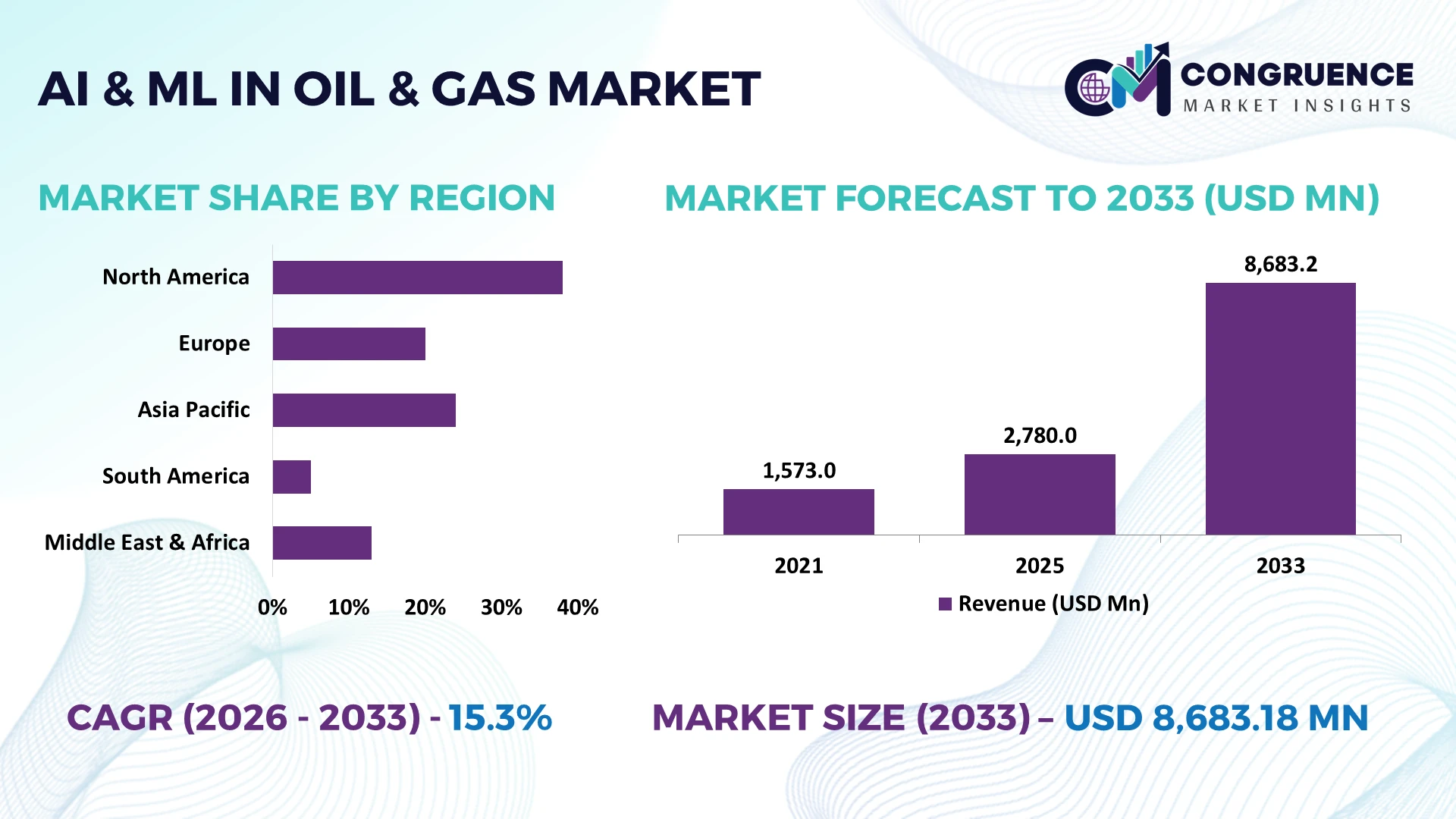
The Global AI & ML in Oil & Gas Market was valued at USD 2780 Million in 2025 and is anticipated to reach a value of USD 8683.18 Million by 2033 expanding at a CAGR of 15.3% between 2026 and 2033. Growth is driven by machine-learning-based reservoir characterization, predictive maintenance for aging infrastructure, autonomous drilling optimization, and real-time process control that reduces equipment failures, energy consumption, and production variability.
The United States and Saudi Arabia represent distinct strategic centers of adoption, supported by large-scale hydrocarbon operations, substantial digital infrastructure, and advanced industrial automation. In Saudi Arabia, Aramco's Khurais oil field uses approximately 40,000 sensors across more than 500 wells, with deployed digital solutions delivering a reported 15% increase in oil production. The United States benefits from shale development, offshore engineering, and sophisticated upstream software ecosystems. Saudi Arabia's integrated national energy infrastructure contrasts with the United States' more distributed operator and service-provider landscape.
Strategic implication: Prioritize investments in proven, scalable AI applications that connect operational data to measurable production, maintenance, and energy-efficiency improvements, while adapting deployment models to each country's asset structure.
Market Size & Growth: The global market stands at USD 2,780 million in 2025 and targets USD 8,683.18 million by 2033, at a 15.3% CAGR, supported by predictive analytics and intelligent process automation.
Top Growth Drivers: Predictive maintenance accounts for 41% of reported AI priorities, smart monitoring 28%, and biodiversity management 25% in an industry survey.
Short-Term Forecast: By 2028, operators should target measurable reductions in unplanned downtime and maintenance expenditure through asset-specific AI performance benchmarks; savings must be validated against individual operating baselines.
Emerging Technologies: Generative AI, digital twins, and autonomous robotics are advancing reservoir modeling, equipment diagnostics, and remote inspection across complex oil and gas assets.
Regional Leaders: North America leads in shale analytics and drilling software; the Middle East emphasizes integrated field optimization; Asia-Pacific prioritizes refinery automation. Comparable regional market-value forecasts require a consistent segmentation dataset.
Consumer/End-User Trends: Integrated producers increasingly connect operational sensors, production systems, and analytics platforms to support faster maintenance and process-control decisions.
Pilot/Case Example: In 2025, Aramco's Fadhili Gas Plant adopted reinforcement-learning AI that reduced amine and steam usage by 10–15% and power consumption by approximately 5%.
Competitive Landscape: Aramco is a leading industrial deployment benchmark; a defensible company-level market-share percentage is not publicly established. Key technology competitors include SLB, Baker Hughes, Halliburton, and Siemens.
Regulatory & ESG Impact: AI-driven fuel optimization at Aramco's Yanbu refinery reduced Scope 1 and Scope 2 emissions by 14%, demonstrating the link between operational intelligence and emissions targets.
Investment & Funding: Aramco reported USD 1.8 billion in AI-driven technology realized value for 2024, with more than 200 solutions deployed by late 2025, highlighting the shift toward industrial-scale implementation.
Innovation & Future Outlook: Industrial large language models, edge AI, and real-time digital twins are strengthening operational decision-making, making data quality, cybersecurity, and integration with legacy control systems critical investment criteria.
Demand for AI and ML in oil and gas is concentrated in predictive maintenance, seismic interpretation, intelligent drilling, production forecasting, and refinery process optimization. Reinforcement-learning systems and AI-enabled digital twins are improving operational control by adjusting process parameters in response to changing field conditions. At Aramco's Fadhili Gas Plant, AI reduced amine and steam consumption by 10–15%, illustrating the potential to improve resource efficiency without relying solely on new physical infrastructure. An emerging trend is the integration of industrial generative AI with legacy operational systems, particularly as geopolitical uncertainty and supply-chain disruptions increase the value of faster, data-backed operating decisions. These developments position measurable implementation outcomes, rather than technology adoption alone, as the basis for strategic investment prioritization.
Artificial intelligence and machine learning are becoming strategic differentiators in oil and gas because they directly influence production reliability, drilling economics, asset utilization, and capital allocation. With Aramco reporting more than 200 deployed AI solutions by late 2025, the competitive benchmark is shifting from isolated digital pilots to enterprise-wide systems that translate operational data into measurable performance improvements. Companies that integrate AI into core workflows gain faster decision cycles and better visibility into asset-level costs.
Supply-chain restructuring, aging infrastructure, and tighter emissions requirements are accelerating investment in predictive maintenance, intelligent drilling, and automated process control. Compared with conventional, schedule-based maintenance, predictive systems identify equipment deterioration from sensor patterns and prioritize interventions before failures disrupt production. Aramco's Fadhili Gas Plant provides a practical benchmark: reinforcement-learning applications reduced amine and steam consumption by 10–15% and power consumption by approximately 5%. These results connect digital investment to operating expenditure and resource efficiency.
Deployment priorities differ by geography. US operators emphasize shale-drilling optimization and cloud-based analytics, while Saudi Arabia prioritizes integrated field intelligence across large, centrally managed assets. Over the next two to three years, the strongest investment cases will center on expanding validated applications across multiple facilities, improving operational data quality, and integrating AI with existing control systems. Technology partnerships, cybersecurity investment, and workforce training will determine how consistently companies convert individual successes into durable competitive advantages.
The shift from reactive maintenance to predictive, data-led operations is strengthening AI adoption across upstream, midstream, and downstream assets. Machine-learning models identify equipment anomalies, optimize drilling parameters, and improve production planning using real-time sensor data. At Saudi Arabia's Fadhili Gas Plant, reinforcement-learning AI reduced amine and steam consumption by 10–15% and power usage by approximately 5%. These results establish a measurable business case for expanding intelligent process control. As operators face pressure to improve asset utilization while managing energy costs, companies are scaling validated applications through automation partnerships and integration with existing control systems. The strategic advantage lies in replicating proven savings across multiple facilities rather than funding disconnected pilot projects.
Legacy control systems, inconsistent sensor quality, and fragmented operational databases constrain the scalability of AI deployments. Integrating machine-learning platforms with supervisory control and data acquisition systems requires specialized engineering, secure connectivity, and extensive historical data validation. In the United States, mature shale and offshore assets frequently combine equipment from multiple technology generations, increasing integration complexity and implementation costs. Industrial cybersecurity findings indicate that 22% of surveyed organizations experienced an operational technology incident in 2025, while 40% of reported incidents caused operational disruption. These figures highlight the financial exposure associated with interconnected infrastructure. Companies are mitigating the constraint through phased deployments, standardized data architectures, vendor diversification, and contractual performance benchmarks before committing to enterprise-wide expansion.
Edge AI, industrial digital twins, and reinforcement-learning applications offer opportunities to optimize production without replacing entire processing infrastructures. Saudi Arabia's Fadhili Gas Plant demonstrated 10–15% lower amine and steam consumption and approximately 5% lower power usage, establishing a practical benchmark for resource-efficient automation. In the United States, operators can apply similar methods to artificial-lift optimization, methane monitoring, and equipment performance across geographically dispersed shale assets. The emerging opportunity extends beyond production forecasting to automated process adjustment and continuous emissions measurement. Companies that combine operational AI with methane detection and energy-management systems can strengthen regulatory reporting while improving resource utilization. Strategic investment should prioritize applications that deliver independently verifiable savings and scale across comparable assets.
Scaling AI across critical energy infrastructure requires reliable model performance, secure operational connectivity, and clear human accountability for automated decisions. In the 2025 industrial cybersecurity survey, only 13% of respondents reported full visibility across the industrial control systems cyberattack chain, while 14% felt fully prepared for emerging threats. These gaps increase exposure as AI platforms connect production networks, cloud analytics, and remote operating systems. In oil and gas, erroneous model outputs can affect pressure control, equipment integrity, and production continuity, making validation essential before autonomous execution. Companies must invest in segmented networks, continuous model monitoring, simulation-based testing, and operator training. Long-term competitiveness will depend on deploying AI that remains explainable, secure, and reliable under changing operating conditions.
Machine learning remains the leading technology segment, accounting for approximately 49.2% of the AI and ML in oil and gas market in 2025. Its dominance reflects established applications in equipment-failure prediction, production forecasting, reservoir characterization, and drilling analytics. Compared with specialized deep-learning architectures, conventional machine-learning models often require less computational capacity and integrate more readily with structured operational datasets. Operators therefore continue prioritizing scalable machine-learning platforms that deliver measurable improvements across existing assets.
Deep learning is gaining traction in seismic interpretation, complex geological modeling, and image-based inspection, where large datasets and unstructured information demand more sophisticated pattern recognition. Natural language processing supports technical-document retrieval, while computer vision improves inspection workflows. Predictive analytics remains central to decision support, and generative AI is emerging as an interface for querying engineering records and operating procedures. Companies are increasingly combining these capabilities in unified platforms rather than purchasing disconnected tools, shifting investment toward interoperable systems that connect analytical outputs with operational workflows.
Predictive maintenance represented approximately 29.2% of the AI and ML in oil and gas market in 2025, making it the leading application. Its position reflects the financial exposure associated with unplanned failures across compressors, pumps, drilling equipment, and processing facilities. Continuous condition monitoring enables operators to identify equipment anomalies earlier, prioritize maintenance schedules, and reduce unnecessary shutdowns. Offshore industry survey respondents also identified predictive maintenance as their leading AI application, at approximately 43%, ahead of seismic data interpretation at 31%.
Reservoir optimization and exploration and drilling applications remain important for improving geological interpretation, well placement, and drilling performance. Production optimization supports throughput management, while pipeline monitoring and safety management are gaining operational importance as companies strengthen asset integrity and emissions oversight. Supply chain optimization addresses equipment availability, inventory planning, and logistics coordination. Companies are increasingly integrating these applications into shared operational platforms, prioritizing measurable reliability improvements before expanding into more complex, interconnected workflows.
Oilfield service providers represent the leading end-user category in the 2025 market segmentation, reflecting their role in embedding AI into drilling, reservoir analysis, well services, and equipment management. A consistent, independently verifiable percentage share for this specific end-user category is not publicly established across comparable market estimates. Their strategic advantage comes from combining proprietary field data, engineering expertise, and established customer relationships to deploy AI across multiple operators. This business model supports repeatable technology commercialization rather than relying on individual producers to develop every capability internally.
Upstream operators remain important buyers because exploration, drilling, and production generate extensive geological and equipment data. Midstream operators and pipeline operators prioritize integrity monitoring, flow optimization, and leak detection, while downstream operators and refining companies emphasize process stability, throughput, and maintenance planning. LNG operators face additional requirements involving complex liquefaction equipment and continuous process control. In 2025, 88% of energy-sector leaders surveyed for ADNOC and Microsoft's Powering Possible report considered AI essential to energy transformation. Technology vendors are responding with sector-specific platforms, integration partnerships, and configurable deployment models that accommodate different asset sizes and operational requirements.
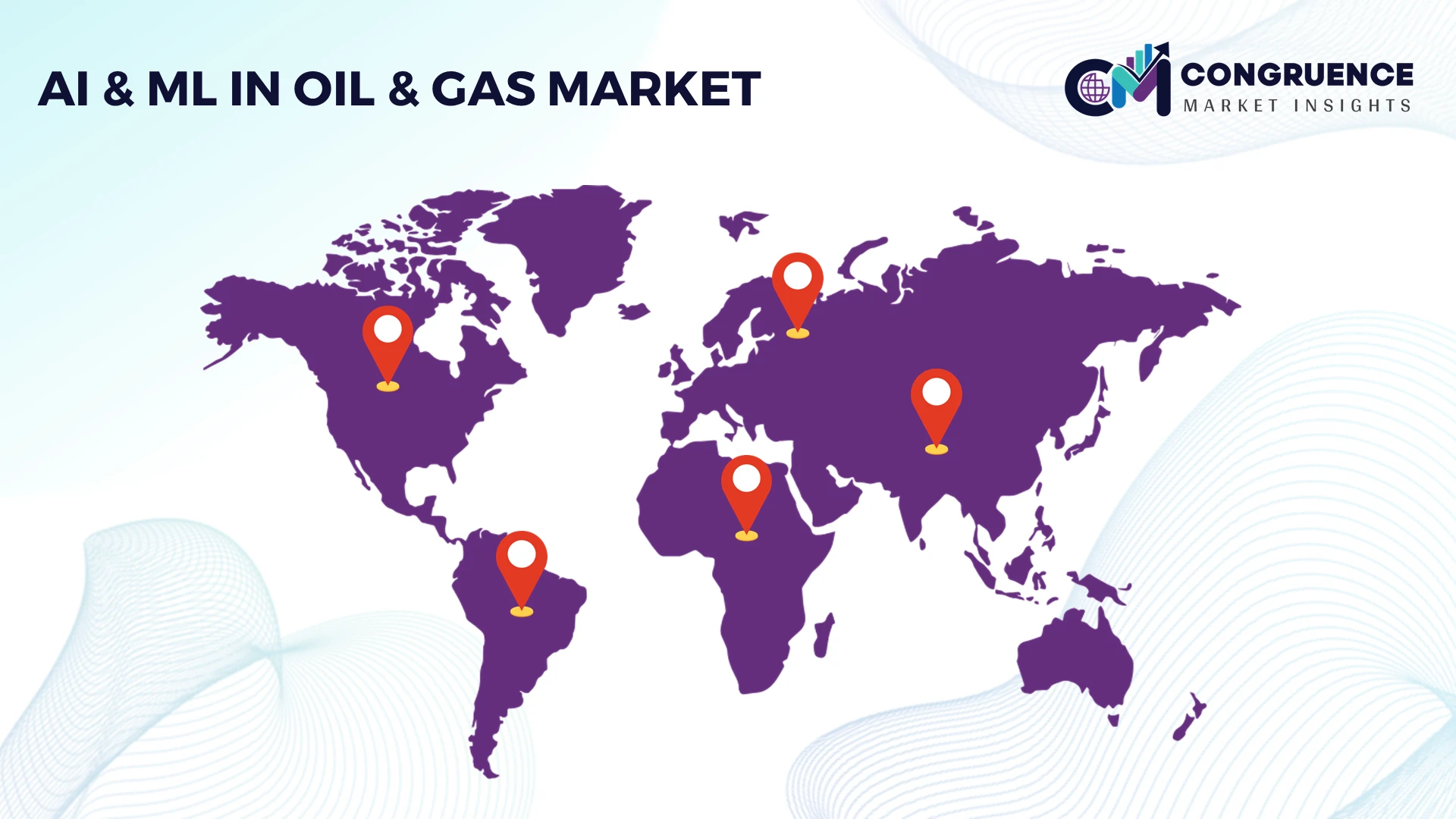
North America accounted for the largest market share at 35.9% in 2025; however, Asia-Pacific is expected to register the fastest growth, expanding at a 14.41% CAGR between 2026 and 2033, driven by refinery modernization and increasing AI adoption across China and India.
Digital integration and intelligent production optimization drive adoption
North America maintains a strong position through its established oilfield services industry, cloud infrastructure, industrial software capabilities, and digitally enabled shale operations. The United States leads regional implementation through drilling analytics, predictive maintenance, and automated production monitoring, while Canada applies AI to oil sands operations and pipeline integrity. Operators are integrating machine learning with supervisory control systems to improve equipment availability, optimize well performance, and reduce nonproductive time. The region's competitive advantage lies in its ability to commercialize software across extensive, repeatable operations. Companies are expanding partnerships between energy producers, software developers, and equipment manufacturers to improve interoperability and accelerate deployment across existing assets.
United States Market Outlook: The United States remains the principal regional market because its shale industry generates extensive drilling and production data. Operators are using AI to improve well placement, optimize artificial-lift systems, and predict equipment failures across geographically dispersed assets. The country's established oilfield services ecosystem supports integration between sensors, cloud analytics, and automated drilling technologies, strengthening demand for scalable enterprise solutions.
Offshore modernization and emissions accountability shape deployment
Europe's market is shaped by mature offshore fields, subsea engineering expertise, energy-security priorities, and stringent environmental requirements. Norway and the United Kingdom are important deployment centers, with operators applying AI to seismic interpretation, equipment diagnostics, and remote asset management. Equinor reported USD 130 million in AI-related value creation and savings during 2025, demonstrating the commercial relevance of industrial AI. Companies are prioritizing digital platforms that improve recovery from mature assets, reduce maintenance interventions, and strengthen operational reporting. European suppliers and operators are also integrating automation with established offshore infrastructure to limit replacement costs while improving reliability. Investment increasingly favors applications that combine production efficiency with measurable environmental performance.
Norway Market Outlook: Norway benefits from advanced offshore engineering, subsea technology, and established digital operating systems. Equinor monitors more than 700 rotating machines using approximately 24,000 sensors, providing a foundation for predictive maintenance and equipment-performance analytics. These capabilities support demand for AI-driven inspection, reliability engineering, and production optimization across complex offshore facilities.
Refinery expansion and industrial digitization accelerate adoption
Asia-Pacific's market is supported by extensive refining infrastructure, growing energy consumption, and modernization across major hydrocarbon-producing economies. China is advancing industrial automation, while India is emphasizing refinery efficiency, pipeline monitoring, and domestic exploration. The region's large refining base creates opportunities for AI applications in process control, production scheduling, equipment monitoring, and energy management. Operators are integrating analytics into existing distributed control systems to improve throughput without replacing entire processing facilities. Supply-chain volatility and changing crude-oil trade flows are strengthening the value of AI-enabled inventory planning and refinery scheduling. Adoption nevertheless varies according to digital infrastructure, cybersecurity maturity, and the availability of specialized engineering talent.
China Market Outlook: China combines large-scale refining and petrochemical operations with a substantial industrial automation ecosystem. Domestic technology suppliers and equipment manufacturers support the integration of AI into process control, predictive diagnostics, and production planning. Refiners are prioritizing solutions that improve energy efficiency and operating consistency while preserving investments in existing infrastructure, creating opportunities for vendors offering compatible industrial software and automation systems.
Deepwater production strengthens demand for operational intelligence
South America's market is anchored by Brazil's offshore pre-salt developments, where technically complex reservoirs and capital-intensive subsea assets increase the value of advanced analytics. Petrobras produced approximately 2.40 million barrels of oil per day in 2025, an increase of 11% from 2024. This production expansion strengthens demand for reservoir modeling, drilling optimization, equipment monitoring, and production forecasting. However, specialized offshore infrastructure, connectivity limitations, and dependence on international equipment suppliers create implementation constraints. Companies are prioritizing AI applications with measurable production benefits and collaborating with engineering and technology providers to improve deployment efficiency. The strongest commercial opportunities lie in optimizing existing offshore assets rather than deploying expensive digital infrastructure without clear operational justification.
Brazil Market Outlook: Brazil leads regional adoption through its deepwater production capabilities and expanding pre-salt operations. Petrobras and its technology partners can apply AI to geological interpretation, well-intervention planning, and floating production facility monitoring. The country's substantial offshore production base supports demand for solutions that improve equipment availability and reservoir recovery. Vendors with subsea engineering expertise and established offshore integration capabilities hold a competitive advantage.
Integrated national digital programs reshape field operations
The Middle East and Africa market reflects contrasting adoption patterns, with national digitalization programs supporting advanced deployments in Saudi Arabia and the United Arab Emirates, while several African producers face infrastructure and investment constraints. Aramco reported more than 200 deployed AI solutions by late 2025, demonstrating the scale of industrial implementation in Saudi Arabia. Applications span drilling optimization, process control, maintenance, and production management. National energy companies are combining operational technology with analytics platforms to improve asset performance across large facilities. In Africa, deployment priorities center on equipment reliability, remote monitoring, and production efficiency. Companies are using phased investments and technology partnerships to align implementation costs with infrastructure readiness and operational requirements.
Saudi Arabia Market Outlook: Saudi Arabia benefits from large integrated hydrocarbon assets, coordinated technology investment, and established industrial digital infrastructure. At the Khurais oil field, approximately 40,000 sensors monitor more than 500 wells, supporting data-driven production management and equipment diagnostics. This installed infrastructure enables expansion of AI across connected assets. Technology providers that combine industrial software, secure connectivity, and engineering services are positioned to support the country's digital transformation priorities.
SLB, Baker Hughes, and Halliburton lead oilfield AI deployment, collectively commanding approximately 40–45% of upstream digital and AI services spend through embedded platforms including Lumi, Cordant, and DecisionSpace 365. They compete directly against hyperscalers—Microsoft Azure, AWS, and Google Cloud—that supply compute infrastructure and LLM capabilities beneath operator workflows. A third cohort of specialized AI innovators, including AIQ, Cognite, and SparkCognition, competes on model customization and deployment speed, pressuring incumbents on domain-specific depth. Competition has shifted from data aggregation toward model orchestration: SLB's Lumi compresses deployment cycles from months to weeks, while Baker Hughes' Cordant targets 20%+ production uplift. Consolidation accelerates as service majors acquire AI startups to internalize capabilities rather than rely on partnerships. Entry barriers remain formidable—petabyte-scale subsurface data access, OT/IT integration expertise, and multi-year operator relationships.
Schlumberger (SLB)
Baker Hughes
Halliburton
Microsoft
IBM
Google Cloud
Amazon Web Services
Cognite
SparkCognition
AIQ
Aspen Technology
Emerson Electric
Honeywell International
Machine learning, predictive analytics, and digital twins are transforming oil and gas operations by connecting equipment sensors with production planning and maintenance workflows. Predictive maintenance replaces fixed-interval servicing with condition-based intervention, helping operators identify equipment deterioration before breakdowns interrupt production. At Saudi Aramco’s Fadhili Gas Plant, reinforcement-learning applications reduced amine and steam consumption by 10–15% and power usage by approximately 5%. These measurable gains strengthen the business case for integrating AI with existing industrial control systems rather than replacing established infrastructure.
Emerging technologies include generative AI, computer vision, and edge analytics. Generative AI accelerates access to engineering documentation, while computer vision supports automated inspection of pipelines, processing equipment, and hazardous operating environments. Edge AI processes sensor data closer to equipment, reducing dependence on centralized systems for time-sensitive decisions. Compared with reactive maintenance, predictive systems enable earlier fault detection and more targeted interventions. Integrated platforms benefit oilfield service providers and operators that combine proprietary operational data with established automation capabilities.
Between 2026 and 2028, industrial AI adoption will increasingly favor interoperable platforms, secure data pipelines, and domain-specific AI models. Operators should prioritize applications delivering verified reductions in downtime, energy consumption, and maintenance costs. Companies that establish reliable data architectures and validate model performance now will accelerate deployment across multiple assets, strengthen operational consistency, and gain an advantage over competitors relying on fragmented analytics and manual decision-making.
November 2024: ADNOC announced its ENERGYai platform, developed with AIQ, Microsoft, and G42, targeting autonomous reservoir management and real-time drilling optimization across its upstream portfolio, with a stated target of unlocking USD 500 million in value during 2024 through AI-driven operational improvements. This establishes sovereign-backed agentic AI as an operational standard in Middle East upstream. Source: adnoc.ae
January 2025: TotalEnergies signed a three-year partnership with Mistral AI committing €100 million annually to co-develop agentic AI systems for subsurface interpretation, predictive maintenance, and carbon-footprint monitoring across its global exploration and production assets. The deal signals European majors moving from pilot projects to enterprise-scale AI infrastructure commitments. Source: totalenergies.com
September 2024: SLB launched its Lumi data and AI platform, embedding large language models and physics-informed workflows to unify subsurface, drilling, and production data across operator environments, with the platform designed to reduce model-deployment cycles from months to weeks for asset teams. This consolidates fragmented point solutions into enterprise-scale orchestration. Source: slb.com
March 2025: Repsol reported that its Leucipa AI-driven production surveillance platform now spans approximately 75,000 wells across 20 countries, recovering millions of barrels through autonomous choke optimization and gas-lift tuning, demonstrating measurable reserve recovery rather than efficiency-only gains. This validates AI's direct contribution to production volumes at multinational scale. Source: repsol.com
The report evaluates the global AI & ML in Oil & Gas Market from 2026 to 2033, covering six technology types: Machine Learning, Deep Learning, Natural Language Processing, Computer Vision, Predictive Analytics, and Generative AI. Application analysis spans seven areas, including Predictive Maintenance, Reservoir Optimization, Exploration & Drilling, Production Optimization, Pipeline Monitoring, Safety Management, and Supply Chain Optimization. End-user coverage includes upstream, midstream, and downstream operators, refining companies, oilfield service providers, pipeline operators, and LNG operators.
Regional assessment covers North America, Europe, Asia-Pacific, South America, and the Middle East & Africa, with country-level analysis of deployment activity, industrial infrastructure, technology adoption, and competitive positioning. The report examines established applications alongside emerging opportunities in generative AI, autonomous operations, and intelligent asset monitoring. By comparing segment performance, operational priorities, and regional adoption patterns, it supports investment allocation, market-entry decisions, partnership development, competitive differentiation, and expansion planning.
| Report Attribute/Metric | Report Details |
|---|---|
Market Revenue in 2025 | USD 2780 Million |
Market Revenue in 2033 | USD 8683.18 Million |
CAGR (2026 - 2033) | 15.3% |
Base Year | 2025 |
Forecast Period | 2026 - 2033 |
Historic Period | 2021 - 2025 |
Segments Covered | By Type
By Application
By End-User
|
Key Report Deliverable | Revenue Forecast, Growth Trends, Market Dynamics, Segmental Overview, Regional and Country-wise Analysis, Competition Landscape |
Region Covered | North America, Europe, Asia-Pacific, South America, Middle East, Africa |
Key Players Analyzed | Schlumberger (SLB), Baker Hughes, Halliburton, Microsoft, IBM, Google Cloud, Amazon Web Services, Cognite, SparkCognition, AIQ, C3.ai, Aspen Technology, Emerson Electric, Honeywell International |
Customization & Pricing | Available on Request (10% Customization is Free) |




